
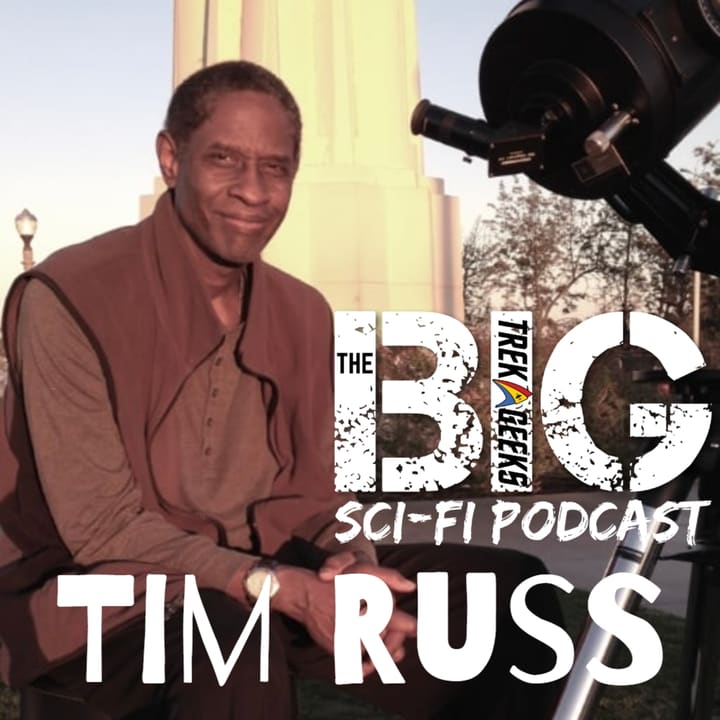
Actor, Musician, Astronomer
The versatile Tim Russ joins us for a fascinating discussion about his love for acting, music, astronomy and more! Tim's role as Tuvok on Star Trek: Voyager made him a Trek icon and a fan favorite, but his career is wide and deep. In fact, even if you're not a Star Trek fan, you have probably seen him in film and television more than once. We think you'll love listening to our conversation with Mr. Russ and even feel like you're on the couch with us enjoying the dialogue. This episode is coming your way at warp speed, so light a few Vulcan meditation candles, sit back, and relax as we talk with the multi-talented, Tim Russ.
To learn more about Mr. Russ:
https://screenrant.com/star-trek-5-characters-tuvok-tim-russ-actor/
Timโs comedy reel: https://www.youtube.com/watch?v=iF0G642xqnE
Watch some of his music videos:
https://www.youtube.com/watch?v=o2rEFW6YKRM
https://www.youtube.com/watch?v=3NnCA0WaZsw
This podcast is a proud part of the Trek Geeks Podcast Network and works hard to bring you great content from all over the science fiction universe. We would love to hear your feedback, suggestions, and ideas. Take a moment to send us an email at thebigscifipodcast@gmail.com.
Check our podcast out and learn more about the other great podcasts on the network by visiting trekgeeks.com.
We've got the merch! If you want BIG Sci-Fi swag, check out this link and support us by wearing us everywhere you go! www.teepublic.com/thebigscifipodcast
Check out all of our social links in one place:
https://linktr.ee/thebigscifipodcast
Check out Cris' amazing YouTube channel for Trek content galore:
https://www.youtube.com/@yellingaboutstartrek1532
Check out Brian's new book available at Amazon for Kindle and in paperback:
https://www.amazon.com/stores/Brian-Donahue/author/B0C3BQ93VD?ref=ap_rdr&store_ref=ap_rdr&isDramIntegrated=true&shoppingPortalEnabled=true
Follow Brian on Substack: https://bdonahue.substack.com/
Subscribe for free to Brian's Substack page where he writes original science fiction and fantasy: https://bdonahue.substack.com/
Find Adeena's books here: https://crazyrobot.myshopify.com/
Follow her on Substack here: https://beyondthedroid.substack.com/?utm_source=homepage_recommendations&utm_campaign=1493637

[00:00:01] Do not change the station. What you're hearing is coming from the BIG Sci-Fi Podcast and the Trek Geeks Podcast Network.
[00:00:08] Stay tuned for the next exciting episode of...
[00:00:11] Wait a minute. Receiving a new transmission. What is that? What am I seeing? It's big! It's really big! Oh my god, it's so...
[00:00:19] Welcome to Season 6 of the BIG Sci-Fi Podcast, the biggest sci-fi podcast in the galaxy.
[00:00:25] Join our crew, Adina, Brian, Chris, and Steve, as we travel the Milky Way looking for the best that science fiction has to offer.
[00:00:33] Make sure you're strapped in tight, because we're going to have a lot of fun talking all things sci-fi.
[00:00:39] Stay tuned to this channel for the next audio transmission.
[00:00:45] Welcome back, listeners of the BIG Sci-Fi Podcast.
[00:00:48] Today, we are joined by the multi-talented Tim Russ.
[00:00:52] Now, of course, here at the BIG Sci-Fi, we know Tim for his iconic role as Lieutenant Commander Tuvok on Star Trek Voyager.
[00:01:00] But his talents and interests span far beyond the bridge of a starship.
[00:01:04] Now, I couldn't even begin to list all of his acting credits.
[00:01:08] It actually might be easier to list the top shows of the last couple decades he hasn't been in.
[00:01:14] But more recently, Tim continues to expand his creative horizons as a director and actor.
[00:01:19] He's currently directing the second season of the intriguing web series, 12 Sided Die, and is gearing up to direct the feature film Myth.
[00:01:29] Additionally, you can catch him showing off his acting chops in the recently released Star City Murders.
[00:01:35] Tim is not just a presence on screen, but in the music world as well, with four, which is impressive,
[00:01:41] that's four music CDs available on Amazon and iTunes, and some very engaging music videos on YouTube.
[00:01:48] And we'll include those links in the show notes.
[00:01:51] Now, and this might be my favorite part about Tim, at least so far,
[00:01:55] is that when he's not in front of the camera or behind the mic,
[00:01:58] Tim is pursuing his passion for the stars as an amateur astronomer,
[00:02:02] a pursuit that has seen him collaborate with NASA on the Lucy mission.
[00:02:06] And we're absolutely going to discuss that at some point during the show today.
[00:02:10] So, Tim, welcome to The Big Sci-Fi.
[00:02:13] Did I catch all the highlights?
[00:02:15] Yeah, I guess you did.
[00:02:16] Yes, thank you.
[00:02:17] And it's a pleasure to be here.
[00:02:18] Thank you for having me.
[00:02:19] Thank you.
[00:02:19] Well, so we do primarily know you, you know, from Trek and also from Spaceballs.
[00:02:25] I remember when I was young and I had put those two together.
[00:02:28] That was just like, ah, that was wonderful.
[00:02:30] But the credits that are listed on your IMD page, I really, I was astounded as I'm like scrolling through this amazingly long list.
[00:02:39] What's been some of your like highlights or favorites?
[00:02:43] There, you know, there was, there were a couple of smaller projects that I worked on over the years.
[00:02:50] It was just, I was just on as one of the supporting actors or one of the regular actors on this, just a small project.
[00:02:58] There was a series project I worked on, Freddy's Nightmares, which was just a blast to work on with the people that were on it.
[00:03:06] And particular episodes or two, we did a couple of episodes on it.
[00:03:09] They were just, I just had so much fun working on them, you know, in terms of just going on and doing a gig and coming off.
[00:03:16] And some of the stuff that's become, was it a cult classic with Spaceballs?
[00:03:21] And that's, those were just one day's worth of work at the time.
[00:03:24] And I didn't even think about it, you know, it was just show up, get paid and do your job and then go home.
[00:03:29] And then later on, it became much bigger than anybody would have anticipated as far as the very small bit that I had on there.
[00:03:40] I did enjoy Voyager because I had, working with the cast and crew on that show is just wonderful.
[00:03:47] And I made some very good friends and I really enjoyed working with those people on that, on that show for that seven years.
[00:03:54] It was for myself, for in terms of a career, it was a very beneficial gig, you know, to do it.
[00:04:00] It was a very beneficial opportunity in terms of the business, in terms of the career and work.
[00:04:05] That was a very big step because I was able to branch off into other areas of the entertainment business as a result.
[00:04:13] There's directing and voiceover and everything else.
[00:04:15] So, but yeah, that, you know, and, and I did some voiceover work on a cartoon a while back and that was actually a lot of fun.
[00:04:23] So, um, that's the sweetest gig.
[00:04:26] If I can, I can get another series, regular role on one of those shows, uh, just doing VO.
[00:04:31] That's the one, that's the one I'd like to do.
[00:04:34] So, um, for anybody out there who's producing and listening, um, but that, but yeah, that, you know, the, so it, all those jobs in between that, that I've been doing probably since 85, 86, you know, they're there.
[00:04:48] It's all basically the same formula, the same routine, the same.
[00:04:53] Do you run into the same people over and over again?
[00:04:56] Sometimes I run into some of the same people, uh, different directors I worked with more than once.
[00:05:01] And also sometimes a hair and makeup and things like that on the crew that I have worked with and run into on different projects throughout the years.
[00:05:08] Um, you know, from one to the other, I might catch them two years later, three years later.
[00:05:12] And we're standing there going, where do we, where did we work?
[00:05:15] What was that?
[00:05:16] You can figure out what show it is, what, what TV show, what movie, what, whatever.
[00:05:20] So the thing about working on all those projects is it's, it's, it's, they're basically, uh, very much the same in terms of, um, single camera stuff.
[00:05:30] The comedies that I've worked on have been very different.
[00:05:33] Those are much more exciting.
[00:05:35] And, um, I've done a few of those and they've been great, but there's, the routines are all the same.
[00:05:40] Um, so there's nothing that to me that sticks out as extraordinary, um, on, on each one of the individual projects that I worked on.
[00:05:50] They're all basically the same, um, in terms of getting in and getting out and doing the job and showing up in your marks, saying your lines and, and, you know, and hopefully the check will clear.
[00:06:00] And, and that's it.
[00:06:01] Most important.
[00:06:02] Most important, exactly.
[00:06:04] But as far as a career changer, Voyager was probably the, the most consequential in terms of the jobs that I've had.
[00:06:12] I'm going to say, how did you end up getting that gig?
[00:06:14] I did.
[00:06:15] Were, did you specifically, uh, audition for that particular role or where is it?
[00:06:21] Like, did they say, you know, something you're perfect for this character.
[00:06:25] No, it was a little bit of both.
[00:06:26] Actually, it was actually for Voyager.
[00:06:29] Rick Berman had already had me in mind, uh, for that part.
[00:06:33] So when the time came, um, I just went in and I, and I still did a read.
[00:06:37] I just did one read for him, him and the other producers.
[00:06:40] And that was it.
[00:06:41] I just happened to be, uh, right for the role.
[00:06:45] I happened to be available for the role.
[00:06:46] Um, I had the right physical, uh, type for it, the right voice for it.
[00:06:50] You know, the attitude and stuff was, was easy enough to cop.
[00:06:54] And so it just worked out that way, but that, you know, was a long process in coming because
[00:07:00] I had worked for the, uh, the Star Trek franchise three times before that.
[00:07:06] So I worked on, you know, next generation.
[00:07:09] I worked on space nine.
[00:07:10] I worked on the feature film generations.
[00:07:12] So they kept bringing me back to work on, on their projects in different roles.
[00:07:17] So by the time Voyager came, they were already familiar with my work.
[00:07:22] So it was just a matter of, Hey, why don't we bring you in for this thing?
[00:07:26] Let's see how it works out.
[00:07:28] And that's, so that's over a, I want to say seven year.
[00:07:31] It was a seven year process before Voyager interview for Voyager.
[00:07:37] Seven year interview for Voyager.
[00:07:38] Yes.
[00:07:39] Being obviously aware of the franchise.
[00:07:42] Yeah.
[00:07:42] Were you at every time, would you at any point in that consider yourself a fan of
[00:07:47] Trek as well?
[00:07:48] When I grew up, I watched, um, the original series, um, along with Gilligan's Island and
[00:07:53] I Love Lucy.
[00:07:54] I mean, you know, we only had three channels.
[00:07:57] So, uh, that's all they played over and over again.
[00:08:02] So there's no way you're going to miss it.
[00:08:03] And let's not forget the twilight zone as well.
[00:08:05] So you're not going to limit.
[00:08:07] Yeah.
[00:08:07] Every word, every minute, every episode, you're familiar with all that stuff.
[00:08:11] And they, you know, the series became iconic in and of itself, which is why they brought
[00:08:15] them all back.
[00:08:17] But, uh, some of the, I, I didn't watch, um, a lot of the new shows that were on.
[00:08:23] I only caught a couple of episodes here and there.
[00:08:25] And the ones I did catch were quite good.
[00:08:27] But so, um, the thing about the original, the original series and the concept of Trek is,
[00:08:34] is, is the fact that the, they're more about the stories than there are anything else.
[00:08:38] It's the stories and the characters and, um, and, and the twists and the, uh, the perspective
[00:08:46] changes and the, uh, the, the, the challenging of the human condition, um, and our sort of human
[00:08:52] sort of mores that we already have set and, and, and stone and things like that and shaking
[00:08:57] everything up.
[00:08:57] That's what, that's what Star Trek does, you know, uh, as comparison to the, um, the space
[00:09:03] action adventure stuff where you can get a good guy and a bad guy and just shoot and
[00:09:06] at each other all the time.
[00:09:07] This is the Trek is about the story.
[00:09:10] So, you know, I think what was appealing in the original series to a lot of people, um,
[00:09:17] was the, the fact that their stories were so interesting and they, and, and they, they,
[00:09:23] basically reflected what was going on in, uh, in real life, uh, at the time.
[00:09:28] And they, when they, we did it on our show, did the same thing we discussed and delved into
[00:09:33] subject matters that are real subject matters today, you know, contemporary subject matters
[00:09:39] and challenges for those things.
[00:09:41] And that's, you know, you can't really beat that.
[00:09:44] You know, I, I, what I'm a fan of, if I had to say, I was a fan of anything, I'm a fan
[00:09:50] of the genre of science fiction, because it allows you to do all of those things.
[00:09:55] Yeah.
[00:09:55] I've got a Voyager question just about the character.
[00:09:58] Did you ever have difficulty getting into the character of Tuvok and then getting out of it
[00:10:04] when you were done filming for the, for an episode?
[00:10:08] No, no.
[00:10:09] You know, you can ask my friends, you know, they were like, yeah, what, what, how much
[00:10:13] work does that take for you to play that character?
[00:10:16] Because they know me.
[00:10:18] So, uh, you're, you're stoic to begin with.
[00:10:22] Well, I'm, I do, I do appreciate practicality and I appreciate, uh, logic whenever we can
[00:10:29] get it.
[00:10:30] And these days there's not much of it.
[00:10:31] Um, right.
[00:10:33] Yes.
[00:10:34] Point of fact.
[00:10:35] Yeah.
[00:10:35] I could fall out of bed and do that role as an actor, you learn and you train and you
[00:10:42] study and do all that to learn how to show emotions, showing emotions, the nuances of
[00:10:50] emotion, the dialogue you might have.
[00:10:53] And there's three sentences and each sentence is a, is a gear shift in the, in the, in an
[00:10:57] emotional twist.
[00:10:59] You got to show that you got to convince people that that's real.
[00:11:03] That is hard.
[00:11:04] That is work on any scale in any project.
[00:11:07] I don't care what it is.
[00:11:08] What I'm doing as, uh, Picardo would say, as I'm playing King Lear with an eyebrow, I
[00:11:16] don't have to do, I don't have to do anything.
[00:11:19] Uh, my idea is just to play it straight and dry and boy, that's cake and ice cream.
[00:11:24] And that's, you know, it's ironic that I did study as many years as I did for as long as
[00:11:28] I did to end up playing this character for seven years.
[00:11:30] It doesn't show the emotion, but at the end of the day, uh, you know, the, the, the, the
[00:11:38] personality that I do have personality traits that are similar to that character.
[00:11:43] And my friends will all, and my family will tell you, you know, that you are Vulcan.
[00:11:48] That's what I always tell me, you know, and, and, and to some degree, I, you know, fanatical
[00:11:53] about things making sense, things that make sense, things that are thought out things that
[00:12:02] are, you know, rather than, you know, getting the update on your phone that adds four steps
[00:12:09] to what you were doing that only took one step.
[00:12:11] That's where, that's what drives me absolutely bananas.
[00:12:15] That's where Tuvok and I are in full agreement.
[00:12:19] So, you know, it's that kind of crap that, uh, you know, put it together, you know, make
[00:12:24] it work in as few steps as possible, you know, to the point, to the point, yes.
[00:12:29] If you have a website about horses, you might want to put something on there about horses.
[00:12:35] When did you get the acting bug?
[00:12:37] When did you decide that, you know, uh, this is the direction I want to travel in my life?
[00:12:42] Oh, it was high school.
[00:12:44] I, you know, I last year in high school, junior year in high school, junior year in
[00:12:48] high school, I, uh, was taking classes and acting and I was doing a couple of musical
[00:12:54] plays on stage and it was really a thrill.
[00:12:57] It was very exciting.
[00:12:58] And I caught the bug then.
[00:13:01] And so I decided when I left high school to go ahead and study it in theater in Austin,
[00:13:05] Texas, a small college there.
[00:13:06] It was really good college.
[00:13:08] St.
[00:13:08] Everett University.
[00:13:09] Um, it's a small school, but they had a, and they had a small theater.
[00:13:13] Uh, it was a, uh, matter of fact, it was an arena theater.
[00:13:16] So I cut my teeth on arena stage rather than a proscenium, which I love.
[00:13:20] It was great.
[00:13:21] And, um, consequently before, just before I arrived, one of the actors that was there
[00:13:28] in a play called does a tiger wear a necktie was William Shatner.
[00:13:31] Uh, while I was there, I worked on a play called Caligula with Leonard Nimoy.
[00:13:38] Wow.
[00:13:39] Again, that's right.
[00:13:41] Yeah.
[00:13:42] Because the director of the theater would bring out celebrities from Hollywood to be in the
[00:13:47] shows with the students.
[00:13:48] That's why I went to that school.
[00:13:51] Wow.
[00:13:51] That's amazing.
[00:13:52] Yeah.
[00:13:53] I don't think I've, I've heard, I we've, we've talked to many people about their theater experiences
[00:13:56] and this one, that's a unique story.
[00:13:58] I have not heard that one before.
[00:14:00] It actually happened.
[00:14:02] Uh, I, I, I enjoyed working with Leonard.
[00:14:04] He was great to work with.
[00:14:07] Um, and I would, there was a number of actors that I worked with was I got for Cambridge and
[00:14:11] Mercedes McCambridge.
[00:14:12] There was, uh, Donnie most.
[00:14:14] Um, a lot of people, uh, Sal Mineo.
[00:14:18] Oh my.
[00:14:19] Yeah.
[00:14:20] So a lot of people went through your school, the college that you went through.
[00:14:24] Right.
[00:14:24] And they were all brought in as, as celebrity actors to work with the students so they could
[00:14:30] really see a pro.
[00:14:31] Wow.
[00:14:32] That's it.
[00:14:32] And you were on stage in the plays with them, you know, in supporting roles.
[00:14:37] And, um, he did that in order to go on with the ticket sales.
[00:14:40] That's how you got the ticket sales for the theater.
[00:14:43] Smart.
[00:14:44] Thinking like a business person too.
[00:14:46] Yeah.
[00:14:47] Yeah.
[00:14:47] Yes.
[00:14:48] Yes.
[00:14:49] Excellent.
[00:14:49] Austin's always been a very creative town, very liberal arts in a, in a, in an interesting
[00:14:55] state.
[00:14:56] But that is the one thing about, uh, Austin is that you can, you have music, you've got
[00:15:02] art, you've got barbecue, you've got a lot that goes in that, that it, so you set, you
[00:15:09] seeked out that school for that specific reason.
[00:15:12] Yeah.
[00:15:13] They sent me the information and I was sold immediately.
[00:15:16] Um, I definitely had to go in the hole.
[00:15:18] I'd take out a loan to get there because it was pretty expensive.
[00:15:20] It was not a state school and I was out of state anyway.
[00:15:24] So, um, uh, so I wasn't a resident of the state.
[00:15:27] So it was going to cost me some money to go there and, uh, but it was worth it at the time.
[00:15:31] Um, I was able to get out.
[00:15:32] I got out and I did two summer stock sessions there because they would have, uh, plays in
[00:15:38] the summer.
[00:15:38] They'd have three summer stock shows, uh, back to back.
[00:15:41] So we, the, the, the, the, the whole concept of the theater was of the program was that you,
[00:15:47] after four years, you could open up your own theater and run your own theater.
[00:15:51] That was the concept.
[00:15:52] So, cause you could study in any area.
[00:15:55] You could study playwriting, directing, lighting, sound, costume design, box office, acting,
[00:16:02] all of it.
[00:16:04] And that you could work on all of these different plays in any capacity you wanted to.
[00:16:09] And that's, that's what they did.
[00:16:11] And they did four plays during the regular school year and three during the summer.
[00:16:15] Yeah.
[00:16:17] That's what your family supportive of, of your desire to go to acting school.
[00:16:23] Well, pretty much.
[00:16:24] My dad was a military 20 years, so he wanted me to go in the military.
[00:16:27] Um, he would prefer me to go in the military, but I didn't want to go in the military.
[00:16:31] So, you know, there was, you told him you joined start fleet.
[00:16:34] Come on, you know, he should be proud of you for that.
[00:16:39] Oh yeah.
[00:16:39] Sure.
[00:16:40] Afterwards.
[00:16:41] Sure.
[00:16:41] But you telling him upfront that you're going to go pursue acting as a career, boy, you know,
[00:16:45] you're not going to get all the support in the world from that.
[00:16:47] And that's for sure.
[00:16:48] You know, it's a, it's a very risky proposition going off on that road.
[00:16:52] So.
[00:16:53] Yeah.
[00:16:54] It seems like it's worked out very well for you.
[00:16:57] Yeah.
[00:16:57] I was lucky.
[00:16:59] That's what happened.
[00:17:00] I was very lucky.
[00:17:02] I was able to, you know, uh, to pull it off and I got it into a couple of doors, um, early
[00:17:08] on, um, you know, eventually after four or five years of really hustling, uh, here in
[00:17:13] town, I, I, you know, I got into a door and I was able to sell it and get going.
[00:17:16] I got the ball rolling from that gig.
[00:17:18] Um, very lucky.
[00:17:48] Uh, there's no way that I'm going to take full credit for all that.
[00:17:51] There is definitely a matter of, of looking back with 2020 hindsight, not being able to
[00:17:58] see what's in front of you.
[00:18:00] But what was in front of me was a couple of opportunities, serendipity, timing, everything
[00:18:06] else working out.
[00:18:07] Yeah.
[00:18:07] That's it.
[00:18:08] That's all.
[00:18:09] There, there's no other way around that.
[00:18:11] No.
[00:18:13] So when did music come into the picture?
[00:18:15] That's good.
[00:18:16] Yeah.
[00:18:16] Thank you.
[00:18:17] It has been 50 years.
[00:18:19] I've been playing music since I was 16.
[00:18:21] Um, I started out playing R and B bands.
[00:18:24] I'm sorry.
[00:18:24] Rock bands at the time, uh, 1960s, seventies rock, hard rock.
[00:18:28] And I started playing R and B big R and B bands with a horn section, seven, eight piece
[00:18:33] bands playing guitar and that's when I'm singing.
[00:18:36] Then I went to college.
[00:18:37] I was doing acoustic folk stuff because that's what was popular at times approach.
[00:18:42] Cat Stevens, all these other people doing the singer songwriter, acoustic stuff, coffee
[00:18:47] shop stuff.
[00:18:49] Um, worked at that during college, made money during college, made money after college, doing
[00:18:54] the same thing.
[00:18:55] And then moved to Los Angeles, started playing top 40.
[00:18:58] I was making a living playing top 40 locally in town for about two or three years.
[00:19:03] Um, then it took a break.
[00:19:05] The acting took off.
[00:19:06] Then I came back and started working, uh, with a record company called crescendo.
[00:19:10] We put together the first CD that I had with the owner of that company, uh, the owner's
[00:19:15] son who had a band as well.
[00:19:17] And I worked with his band and toured a little bit in Europe, came back and then, um, put together
[00:19:26] my own band from that point forward.
[00:19:28] And that's what I have now.
[00:19:29] So it's 50 years of playing music.
[00:19:32] So the acting and the music are basically on a parallel track.
[00:19:36] Uh, and, uh, the music would have dropouts every once in a while during that track because the,
[00:19:42] uh, the acting would take over and do whatever.
[00:19:44] And then that I would bring it back and forth.
[00:19:46] So it was in and out all the time, but it's always been a part of my life.
[00:19:49] Music has been, it has always has been, and I hope it will be for some time.
[00:19:53] So it's, uh, and it's still running today.
[00:19:55] I mean, it's still playing today.
[00:19:57] So, you know, do you enjoy writing music and do you enjoy composing your own?
[00:20:04] I am not as prolific as a songwriter as a lot of people are.
[00:20:09] I do not consider myself a prolific songwriter by any stretch.
[00:20:14] I've written a couple of songs for projects, specific projects, um, here and there.
[00:20:19] I wrote a children's CD, music for a children's CD that my sister produced, that my sister
[00:20:24] sells on her music, a children's music company.
[00:20:27] Um, I put that together, recorded it, wrote all them, sang all of them, but all that.
[00:20:33] And I've got a few of my own.
[00:20:35] I typically prefer playing live.
[00:20:39] Um, I prefer, uh, mining for B side covers, obscure songs that people have never heard
[00:20:46] and then rearranging that's, and then performing them.
[00:20:50] I like performing live.
[00:20:52] I can go in the studio.
[00:20:53] I'm just not a big fan of going in the studio necessarily.
[00:20:56] I could do it today.
[00:20:58] There's some stuff I could lay down.
[00:20:59] I'm just not, you know, if I get around to it, I get around to it.
[00:21:01] Um, I prefer to perform live.
[00:21:05] That's what I like doing, playing and singing live.
[00:21:10] Chris, you're going to ask something.
[00:21:12] Yeah, I was going to say, so when you're, when you're finding, or when you find, say,
[00:21:15] a B side song that you want to rearrange, what's your, what's your process for that?
[00:21:20] The process is whether or not, first of all, if I like the song, got to like the track.
[00:21:24] It's got to speak to me.
[00:21:26] Um, you know, I got to feel something for that song.
[00:21:29] The lyrics have to be interesting.
[00:21:30] The point of the song has to be interesting.
[00:21:33] The production of the song has to be, uh, suitable for my band because I've only got, uh, three pieces.
[00:21:39] So a lot of stuff I'm not going to be able to duplicate or replicate or fill out as much.
[00:21:44] So if it's a fairly straightforward song, not too complicated in terms of the arrangement, in terms of the pieces and instrumentation, that's also a factor.
[00:21:52] So those things wrapped together will determine whether or not I'm going to do this and make it happen.
[00:21:58] Sometimes they work and sometimes they don't.
[00:22:00] I mean, sometimes I'll play them once and I'm done.
[00:22:01] I trash them.
[00:22:02] It's like, nah, that didn't work.
[00:22:03] And other times they're bulletproof.
[00:22:05] They work every time.
[00:22:07] So, uh, it just depends, but I do have to like the song.
[00:22:10] People send me stuff all the time.
[00:22:12] You, you should sing this song or you should sing that song or what I get there all the time.
[00:22:16] And I, if I just listened to it, if I, in the first 30 seconds, I know whether I'm going to sing that song or not.
[00:22:20] Cause if it doesn't, if I don't like it, I'm not going to sing it.
[00:22:23] So what are some of your favorite?
[00:22:26] My songs?
[00:22:27] Yeah.
[00:22:27] Um, I do, uh, some stuff by Bruce Hornsby.
[00:22:30] I really like several of his tracks.
[00:22:32] Uh, I do sing several of his tracks.
[00:22:35] Um, Robbie Robinson from the band.
[00:22:38] Um, I do some Kev Moe.
[00:22:39] I do, uh, some Willie Dixon, a couple of his tracks.
[00:22:42] I like his stuff as well.
[00:22:44] Um, and, and then a variety of other artists who I can't even remember who they are, but because again, I just cop these tracks every once in a while.
[00:22:52] I'll be in a store and I'll just Shazam the damn thing.
[00:22:56] We'll catch it at home.
[00:22:57] Listen to it.
[00:22:57] I said, oh yeah, that's cool.
[00:22:58] I like that.
[00:22:59] And it literally could be in a store, just listen to the music.
[00:23:01] And if something comes on, I said, that's, that's really cool.
[00:23:04] I like that.
[00:23:04] I'd never heard it.
[00:23:05] Watch the end of a TV show, end of a movie.
[00:23:07] And the credit roll has got a couple of songs in it.
[00:23:10] Um, I just picked up a couple off of credit roll not long ago that I really liked.
[00:23:13] And I put them in the set because I'd never heard them before.
[00:23:16] I was like, man, this is an amazing jam.
[00:23:18] I don't know who this is, but I love the song.
[00:23:20] And, you know, it's not a huge, big hit.
[00:23:23] You know, um, I typically don't play anything.
[00:23:26] That's a really big, big popular song, especially contemporary, new concurrent.
[00:23:31] I play a couple of songs that, uh, people might recognize, but in the set, but a lot
[00:23:36] of stuff, you know, you won't recognize it necessarily.
[00:23:39] And, uh, I do play a lot of blues, although I don't listen to it that much at all.
[00:23:44] If on my own, I don't listen to it, but I play it, um, because it works well with my
[00:23:48] instrumentation.
[00:23:49] It works well with my voice and such.
[00:23:51] So it, you know, I can, I get along with some of that stuff as well.
[00:23:54] So this, this leads me to, I, now, now I'm dying to know.
[00:23:58] Um, so in late February, 2025, there's a little Star Trek cruise happening.
[00:24:05] Yeah.
[00:24:05] I think you're going to be part of, uh, as a guest, as someone who's, um, I will be a
[00:24:12] passenger on that cruise.
[00:24:14] Do you play live music on the cruise?
[00:24:16] Um, I did on the last one that I went on with the band.
[00:24:19] Um, I don't know if they're bringing the whole band on this cruise or not.
[00:24:24] Okay.
[00:24:24] Um, that has not been determined.
[00:24:27] It's still early.
[00:24:28] It's still early.
[00:24:30] It all depends on, uh, the promoters, man.
[00:24:33] I have nothing to say about any of that.
[00:24:35] I'm going to be in Vegas in August for the big, uh, creation convention.
[00:24:40] I'll be, I'll be sitting in with two bands.
[00:24:43] They are the action figures, which are the band made up of actors and, um, the
[00:24:49] Roddenberrys.
[00:24:50] I'll sit in with them as well.
[00:24:51] So, uh, that'll be a kick in the pants.
[00:24:54] I did it last August and it was absolutely amazing.
[00:24:58] So, uh, yeah.
[00:24:59] Did you ever, uh, sit in with the enterprise band?
[00:25:03] No, no, I didn't.
[00:25:05] Um, and I know they were there for a number of years, um, but I never did.
[00:25:09] Um, once the Roddenberrys sort of came in and kind of took over, you know, that gig,
[00:25:14] then I can sit in with them, you know, cause they'll do like a whole show at night
[00:25:18] on Saturday.
[00:25:19] So I'll go and sit in with them and the action figures are doing a show, I think on Friday
[00:25:22] night.
[00:25:23] So I'll sit in with them as well.
[00:25:25] My band has played there a couple of times over the years.
[00:25:27] It just depends on what those guys want to do.
[00:25:30] Um, each year they do change it up typically.
[00:25:33] So, um, and, and, and I'll have to talk to the crews, uh, the Booker, um, uh, I'd have
[00:25:39] to talk to her and see if they're going to do that with the band.
[00:25:42] It's still a little ways out.
[00:25:43] So I don't know if they're going to make that decision or not, but we did the last
[00:25:48] cruise we did play.
[00:25:49] Played two shows.
[00:25:50] Yeah.
[00:25:51] Yeah.
[00:25:52] Great.
[00:25:52] Something to potentially look forward to.
[00:25:54] I went on my first cruise this past year and was so excited.
[00:25:58] We booked, uh, we booked next year.
[00:26:01] Of course.
[00:26:01] That's, that's basically how it works.
[00:26:03] Yeah.
[00:26:04] They sucker you.
[00:26:04] They, they get you and then you're in for life.
[00:26:07] That's right.
[00:26:11] Um, speaking about conventions, when was the first one you went to?
[00:26:16] Were you surprised by the response you got from the fans that were there?
[00:26:22] Um, and how did you feel about all that?
[00:26:25] Yeah.
[00:26:25] Um, I think I still remember the very first one I went to was Greenville, Greenville, North
[00:26:32] Carolina, I think is the very first convention I went to.
[00:26:35] Um, and it was, uh, it was an eye opener to say the least.
[00:26:40] Um, because cognitively I was aware of, uh, the conventions and, and, and the, the, the
[00:26:47] enthusiasm of the fans and things like that.
[00:26:49] But it, it does make a difference when you are announced and you step out on stage and
[00:26:53] you've got a really large room full of people and are all, you know, screaming and hollering.
[00:26:57] Um, so that was unexpected and, uh, took me by surprise when it happened.
[00:27:03] Um, so yeah, that was an eye opener.
[00:27:06] The very first one was an eye opener.
[00:27:07] Uh, no question about it.
[00:27:09] And that was after Voyager had ended or did you do them?
[00:27:14] No, this was right.
[00:27:15] This was right at the beginning.
[00:27:16] This was in the first year that I was on the show.
[00:27:18] Oh, wow.
[00:27:19] Wow.
[00:27:19] Yeah.
[00:27:20] Yeah.
[00:27:20] They started right then.
[00:27:21] So I've been doing them for this entire time.
[00:27:24] Yeah.
[00:27:26] So what might be the, the, your, I don't know, favorite con moment or even the weirdest one?
[00:27:32] Cause we, we know everybody has all kinds of fun stories from conventions.
[00:27:35] Weird con moments.
[00:27:36] Oh yeah.
[00:27:36] Yeah.
[00:27:37] There was a, I, I did one in, uh, Canada.
[00:27:41] Oh, cool.
[00:27:42] I was invited from Canada.
[00:27:45] Yeah.
[00:27:46] I was invited to the city of Vulcan.
[00:27:51] It's Vulcan.
[00:27:52] Oh, okay.
[00:27:53] Yeah.
[00:27:53] Right.
[00:27:53] In Alberta.
[00:27:54] Yeah.
[00:27:55] It's in Alberta, middle of nowhere.
[00:27:57] And the little tiny town is in the middle of nowhere.
[00:28:00] And they invited me to go.
[00:28:02] And initially I thought, you know, I don't want to make that.
[00:28:05] I've said it doesn't sound like a lot of fun.
[00:28:07] It's, and I just threw out some price of fee for them that I thought there's no way
[00:28:11] they're going to get back to.
[00:28:12] And then they got back to me.
[00:28:14] Um, they said, yeah, sure.
[00:28:15] We'll pay.
[00:28:15] And I said, you have got to be kidding me.
[00:28:17] And, uh, okay.
[00:28:18] So I stuck on a plane.
[00:28:19] I'm out there and I'm driving, you know, into the middle of the cornfields.
[00:28:22] This place is in the middle of the cornfields and it's a little tiny town.
[00:28:26] And they gave me a parade in this little tiny town, a very strange parade.
[00:28:35] I haven't heard about a parade before.
[00:28:37] It's a parade.
[00:28:38] And it just goes around the block or a couple of blocks or something around the center town.
[00:28:45] And, you know, it's, um, it was just very strange.
[00:28:48] Um, the whole thing was very, cause it's, it's such a small place and it's such a small
[00:28:53] parade.
[00:28:54] Um, and it's part of their gearly festival thing.
[00:28:59] And that's what it was.
[00:29:00] It wasn't just, you know, come to, because we can sell a lot of tickets to a con.
[00:29:06] No, that's not what they were doing.
[00:29:07] It was something that the town, you know, uh, collects the money for and they spend the
[00:29:12] money on this day, week, weekend, whatever it is they have going on.
[00:29:17] And it's a special thing every year.
[00:29:19] So I'm just part of the special thing that they're going to do regardless.
[00:29:23] And that's why they were able to make my fee because it wasn't based on ticket sales.
[00:29:30] You know, it's the city paying for it.
[00:29:33] So, so that's, I did not know any of that until, so I showed up and I said, oh, that's
[00:29:37] how this works.
[00:29:38] Okay.
[00:29:39] Because it's a very tiny town and, um, yes, they gave me a parade and that was the strangest
[00:29:46] thing that I've done.
[00:29:47] Um, you know, I mean, I'm great.
[00:29:50] Vulcan.
[00:29:50] Yeah.
[00:29:51] Yeah.
[00:29:53] Vulcan Canada.
[00:29:54] Yeah.
[00:29:54] That was it.
[00:29:56] That was the strangest.
[00:29:57] No question about it.
[00:29:59] Did you feel very special when it was happening or did you feel like being honored and I don't
[00:30:06] understand why?
[00:30:07] Yeah.
[00:30:07] Yeah.
[00:30:08] No, I, it was, I thought it was fine.
[00:30:10] I felt fine.
[00:30:11] It was, they were wonderful people.
[00:30:12] It was a very nice, very pleasant, um, uh, as all the conventions have been.
[00:30:18] Um, it's just that it was just the, the, the parade in such a, such a small venue or
[00:30:25] town was just a little strange, you know, it was, uh, and it was, uh, the parade itself
[00:30:30] is, you know, um, had some odds and ends in there that, uh, made it.
[00:30:35] And it just, just weird.
[00:30:37] Uh, but what the heck, you know, it is what it is.
[00:30:41] And, uh, it was a gig and you, you accepted it and that's exactly it.
[00:30:47] Yeah.
[00:30:47] Uh huh.
[00:30:48] Yeah.
[00:30:48] And the check cleared.
[00:30:49] So that's the important thing.
[00:30:51] That's important.
[00:30:52] Yeah.
[00:30:54] Um, and as of newer ones go, are anything that's happened, you know, do you still, do you still,
[00:31:02] when you go to a convention that people are so happy to see you?
[00:31:08] Yeah.
[00:31:08] For your role?
[00:31:09] Yeah.
[00:31:10] There, you know, uh, there is still a great deal of enthusiasm from the fans.
[00:31:15] Um, even though the show has been off the air for as long as it has, and a lot of the fans,
[00:31:20] some of them are just watching it for the first time, which is crazy.
[00:31:24] But, um, um, I think, um, I've done them, uh, eight or nine of them in Australia.
[00:31:32] I've done about 12 of them in Germany, 13 or 14 in England, and then all parts of the U S
[00:31:39] and I did two in Italy actually, uh, as well.
[00:31:44] They, they, uh, and every one of them is more or less the same thing.
[00:31:49] They all have the same motif.
[00:31:51] They all function basically the same way.
[00:31:54] And the fans are all the same, whether they're speaking Italian or English or whatever it
[00:31:58] comes out to, they're all basically still the same, very enthusiastic.
[00:32:02] And the shows that I've done in recent years, you know, uh, some of them are really big and
[00:32:08] some of them are a little smaller, but they're all basically run the same.
[00:32:12] The routines are the same.
[00:32:14] Uh, and, and, and the way that they operate in a way that you, you know, things that you
[00:32:19] end up doing there are all the same.
[00:32:21] I'm not sure if you remember, but in 2019, the summer of 2019, you were at a very small
[00:32:25] convention in Frederick, Maryland.
[00:32:28] That's where I met you the first time.
[00:32:30] Uh, cause it was, and I, I remember very clearly because it was my birthday and I had found out
[00:32:36] I would never have thought that Frederick, Maryland had a convention and I found out maybe the
[00:32:40] day before.
[00:32:42] Right.
[00:32:42] And I was, I, and I was, uh, my second child, I was less than a year postpartum with my second
[00:32:47] child.
[00:32:48] And I looked at my husband, I'm like, it's my birthday.
[00:32:51] Can I just go to this convention by myself?
[00:32:53] You know, here you take baby, you take kids.
[00:32:55] I want to just go have my day with, you know, Star Trek stuff.
[00:32:59] And he's like, sure, of course go.
[00:33:01] So you and Garrett were there.
[00:33:03] We did talk a little astronomy space stuff for a few minutes, but I have, I have up there,
[00:33:08] uh, both, uh, your autograph and Garrett's saying happy, actually saying happy birthday
[00:33:13] to me.
[00:33:14] Outstanding.
[00:33:15] But it was a small, it was a very small convention.
[00:33:17] It's the smallest one I've ever been to.
[00:33:19] Yeah.
[00:33:19] There's, there's a few that I've done that are pretty small.
[00:33:23] You know, uh, I think the promoters would have preferred them to be a little bigger, but
[00:33:27] that's what they were.
[00:33:27] And they would bring me out for those shows.
[00:33:30] If they, if they happen, that's the way it is.
[00:33:33] Uh, the one in Canada was tiny.
[00:33:35] It was a tiny show.
[00:33:36] There's maybe a hundred people there over the weekend and most.
[00:33:40] So I've done them.
[00:33:42] I've done them with, uh, 25,000.
[00:33:46] I've done them at a hundred thousand and I've done them, you know, at, uh, you know, 300,
[00:33:51] you know, so it just depends on the show.
[00:33:54] And whether I can have time in the schedule to do it or, you know, a conflict of schedule
[00:33:59] and stuff like that, and I'm available to do it.
[00:34:02] So, yeah.
[00:34:03] So any of the conventions in the last year?
[00:34:05] Okay.
[00:34:06] So since you recently reprised a version of Tuvok, the changeling version of Tuvok, what's
[00:34:15] that done for fan response?
[00:34:18] And, and actually I want to even step back when you were presented with, Hey, we want to bring
[00:34:22] you back as a changeling version of Tuvok.
[00:34:27] Were you surprised?
[00:34:28] What was, what did you think about that, that part in that role?
[00:34:31] Um, well, I didn't give, they, they asked me about doing the, the, the role, but I didn't
[00:34:38] know what the role was until, you know, very close to actual issue date.
[00:34:44] And it was only a couple of three days that they sent me the script because they did not
[00:34:48] want that information to get out.
[00:34:51] So, uh, that was a fun surprise.
[00:34:53] Yeah.
[00:34:54] Yeah.
[00:34:54] Oh, I was so excited.
[00:34:56] Yeah.
[00:34:57] It was, uh, the best, it was a surprise.
[00:34:59] And, um, I thought, okay, this is cool.
[00:35:02] Um, the part looks cool and it was a changeling role so that there was a twist at the end of
[00:35:07] that scene.
[00:35:07] And I thought, well, that's even cooler.
[00:35:09] Let's see what happens.
[00:35:10] And so they did.
[00:35:11] And then they, you know, once we shot it, they, after that, they said, we're going to
[00:35:15] bring him back again, um, in a few weeks.
[00:35:19] And sure enough, they didn't send me the second script until a few days before shooting and,
[00:35:26] uh, the scene with Jerry.
[00:35:28] So that was even better to be able to come back and work with her and part of it.
[00:35:32] And, uh, to resolve the, uh, the question is whether or not Tuvok was still alive or not.
[00:35:38] And clearly he is, uh, and they brought him back as the captain.
[00:35:43] And, uh, and, and I thought it was just great.
[00:35:45] So it was cool.
[00:35:47] It was fine.
[00:35:48] You know, it was getting back on the bike and riding it, you know?
[00:35:52] Yeah.
[00:35:52] We were actually discussing, uh, before we talked to you this evening, we were actually
[00:35:56] discussing possible ways that Tuvok could continue to show up in future, future Star
[00:36:04] Treks.
[00:36:04] We were, you know, and we were looking actually, it took us, uh, on a fun
[00:36:08] journey of exploring Tuvok's page on memory alpha to look at, you know, birth dates and
[00:36:14] could Tuvok be in strange new worlds or the section 31.
[00:36:18] So we, we had some fun brainstorming ways to bring Tuvok back.
[00:36:23] Yeah.
[00:36:23] Yeah.
[00:36:24] It's a, it has to be in the timeline, um, somewhere in the timeline.
[00:36:30] My character lives a long time, so you've got a good stretch that you can go.
[00:36:35] It's either, you're either going to prequel it or you're going to do it afterwards and
[00:36:38] afterwards makes more sense.
[00:36:40] So, uh, that's what they left off is further down the line.
[00:36:44] And, uh, it all depends on the studio.
[00:36:49] Number one, do they want to finance a new series?
[00:36:52] Do they want to do this and the other thing, the writers and producers, what they come up
[00:36:56] with, you know, what they're going to run with, what are they going to come up with?
[00:36:59] Whether the studio says yes or no, and all that good stuff way above my pay grade.
[00:37:05] So, uh, I'm only available when they say, you know, to my agent or manager, can he come
[00:37:11] and work on, you know, this show?
[00:37:14] Is he interested in coming on as a recurring character or whatever it might be?
[00:37:17] There's certainly no reason why he couldn't.
[00:37:20] Right.
[00:37:20] Along with any number of other characters from, um, our show.
[00:37:25] There's no reason why you can't bring back any other ones as well.
[00:37:28] So sure.
[00:37:29] Absolutely.
[00:37:30] Yeah.
[00:37:31] The way Picard ended, a lot of us are hoping for the concept of Star Trek legacy, uh,
[00:37:37] to continue, you know, continue on.
[00:37:39] And yes, it's ripe for bringing back so many of the characters that we love.
[00:37:43] So we're rooting for this.
[00:37:45] That would be the case in concept.
[00:37:47] And, you know, it's entirely up to Paramount in this case, you know, uh, whether they want
[00:37:53] to spend the money on it or not, you know, they're trying to make some money right now
[00:37:58] and not doing so well.
[00:37:59] So, um, so it depends on whether they want to slap down the bread.
[00:38:04] Those are expensive shows to shoot.
[00:38:05] They're very expensive.
[00:38:06] Yeah.
[00:38:07] That's what we hear.
[00:38:08] Yeah.
[00:38:08] They're pricey.
[00:38:09] Definitely pricey.
[00:38:10] That's why you have so many cops and robbers shows on because they're not.
[00:38:14] Yes, I know.
[00:38:15] Yeah.
[00:38:15] I like to say CVS crime broadcasting system.
[00:38:19] They seem to have lots of crime shows all the time.
[00:38:24] And they're not, they're not the only ones.
[00:38:26] I know.
[00:38:27] And let's not forget doctor shows.
[00:38:29] So it's crimes.
[00:38:30] Oh yeah.
[00:38:31] Doctors, crime, doctors, shooting, cops.
[00:38:34] That's it, man.
[00:38:35] And it doesn't cost as much as our show does.
[00:38:38] That's the thing.
[00:38:38] And a lot of people, unfortunately, the audiences are bigger.
[00:38:44] The audiences are bigger for those types of shows.
[00:38:48] The Star Trek and science fiction does not garner as big an audience.
[00:38:54] Science fiction takes a little more work to enjoy from the average viewer.
[00:39:02] Most people who are watching regular television are going to be 50 and up.
[00:39:07] And they're not watching science fiction, most of them.
[00:39:10] The younger people might watch it, but they're not going to watch it on network television.
[00:39:15] They're going to watch it on a stream.
[00:39:18] And they're going to watch, they may watch stuff, you know, the comedies, the dramas, the
[00:39:26] contemporary shows.
[00:39:27] They're going to watch those more than anything else.
[00:39:29] And that's always been the case.
[00:39:31] Which is too bad.
[00:39:32] Yeah.
[00:39:33] Sci-fi is its own beast, man.
[00:39:35] It's its own thing.
[00:39:37] And you have to, you know, some of the stuff I've caught recently, it's been science fiction.
[00:39:45] A couple of them, they tried to make them more of a soap, man.
[00:39:48] People like soaps.
[00:39:49] They like that soap thing.
[00:39:50] And it just bores me to tears.
[00:39:52] So, you know, rather than the conceptual, you know, really interesting conceptual science
[00:40:00] fiction.
[00:40:01] And that's, that takes more than just watching a cop show or a fireman show or a lawyer show
[00:40:08] or a doctor show.
[00:40:10] Those shows, those shows get more ratings.
[00:40:12] I've just worked on NCIS.
[00:40:14] Which one?
[00:40:16] Can you tell us what?
[00:40:17] 14 on TV, you know.
[00:40:18] It was the original, the first one.
[00:40:20] Okay.
[00:40:21] It's been on for 20 years.
[00:40:23] It's been on for 20 years.
[00:40:25] I mean, that's insane.
[00:40:27] And it's not stopping.
[00:40:29] No, they got a new one coming out, Legacy.
[00:40:31] They're going back to the beginning.
[00:40:34] It's the top 5, 10 shows.
[00:40:37] Those are the types of shows that everybody watches.
[00:40:41] Wow.
[00:40:42] Voyager was always, Star Trek, all the shows were in the 80s.
[00:40:46] Out of 150 shows, they were like in the 80s.
[00:40:49] Never came above that.
[00:40:51] Because it's not as popular a genre as the straight up dramas and things like that.
[00:40:58] Yeah.
[00:40:58] People don't know what they're missing.
[00:41:01] You have to have other elements of thinking and imagination and fascination.
[00:41:09] You have all those kinds of things.
[00:41:11] It goes way beyond just watching some cops and robbers and doctors talking about procedures.
[00:41:17] I mean, that's like watching paint dry for me.
[00:41:21] But for other people, they come home from working all day long and they're playing with the kids or whatever.
[00:41:29] And they sit down.
[00:41:30] They just want to watch all that stuff, man.
[00:41:33] They want to see the crime solved in the last five minutes of the show.
[00:41:38] There's comfort.
[00:41:39] Yeah.
[00:41:40] With the same dialogue on all of them.
[00:41:42] They all have the same dialogue.
[00:41:43] Same dialogue.
[00:41:44] The same stuff.
[00:41:45] It's the same routine.
[00:41:47] It's just rehab.
[00:41:47] Oh, my God.
[00:41:50] It's mind-numbing to me.
[00:41:53] I can't watch a single minute of it, to be honest with you.
[00:41:56] They asked me to work on it.
[00:41:58] Sure, I'll go work on it.
[00:41:59] But it's mind-numbing to watch.
[00:42:02] Sit me down in front of a three-body problem or something like that.
[00:42:06] Give me something.
[00:42:08] That was amazing.
[00:42:09] That was wild.
[00:42:09] So good.
[00:42:10] Give me something.
[00:42:11] Yeah.
[00:42:11] Give me something, man.
[00:42:13] Have you watched For All Mankind on Apple TV?
[00:42:17] No, I have it on โ I think I have it on my playlist.
[00:42:21] I think I pegged it on the playlist.
[00:42:22] I watched it yet.
[00:42:23] I did watch โ what the hell did I watch recently?
[00:42:26] There was something I watched recently.
[00:42:29] I'm trying to get into the other one.
[00:42:32] What is it?
[00:42:33] It begins with a C.
[00:42:35] With the lady that's a lead actress in it.
[00:42:37] There's a lead character as a woman.
[00:42:40] She comes back from the space station back to Earth, and everything's different.
[00:42:44] Oh.
[00:42:45] That sounds interesting.
[00:42:46] It just recently came out.
[00:42:49] I don't know that one.
[00:42:50] Yeah.
[00:42:52] I think it's in its โ it might be in its second season.
[00:42:56] But at least the first season โ I haven't watched all of it in the first season.
[00:42:59] It begins with a C.
[00:43:02] That's the word.
[00:43:04] I don't know.
[00:43:05] I'll think of it in a minute.
[00:43:06] But it's โ she returns from the space station, and things are going sideways.
[00:43:10] There's some crazy stuff happening.
[00:43:12] And you have to get through it to figure out what's happening.
[00:43:14] It's kind of slow, in my opinion.
[00:43:16] But Man Who Fell to Earth, very good.
[00:43:19] That one was outstanding.
[00:43:22] Outstanding.
[00:43:23] Just brilliant.
[00:43:25] And not only because, you know, Kate Mulgrew is in it.
[00:43:28] But it's absolutely fascinating.
[00:43:32] Great pace.
[00:43:33] Great stuff.
[00:43:34] Great story.
[00:43:35] So, again, you know, it has to be โ to me, it has to be interesting.
[00:43:41] I prefer anthologies in general.
[00:43:44] So, you're looking at Outer Limits, Twilight Zone, things like that.
[00:43:46] Anthologies.
[00:43:47] I like anthology.
[00:43:48] A Black Mirror, that kind of thing, where it's an anthology.
[00:43:51] It's something โ first of all, it's not a bunch of filler and stuff.
[00:43:55] I've got to fill out, you know, eight episodes, you know, with a bunch of stuff that I'm not interested in.
[00:44:01] It's a beginning, middle, and end, and we're done.
[00:44:03] It's like a miniature movie.
[00:44:05] And that's what I dig the most.
[00:44:07] Very good.
[00:44:08] Oh, I was going to say, before we run out of time, because we're getting close, I do want to ask about the Lucy mission.
[00:44:14] I'm dying.
[00:44:15] I'm sitting here, like, really so antsy.
[00:44:17] I'm dying to know.
[00:44:18] So, for our listeners who might not know this mission, Lucy is an active spacecraft that is on its way to visit the Trojan asteroids, which is not a term that most people know.
[00:44:30] Most people are familiar with the asteroid belt.
[00:44:32] But the Trojan asteroids, these are asteroids that occupy the same orbit as Jupiter.
[00:44:38] And we can go into that, like, on a whole other podcast episode and put some links.
[00:44:43] But how did you get involved in that mission?
[00:44:47] That's what I'm dying to know is where โ I mean, there's so many missions that NASA is working on.
[00:44:53] Why that one?
[00:44:55] Well, at the time, since I've been doing this, I've been doing astronomy for about 35 years.
[00:45:00] And I'm mostly a visual astronomer.
[00:45:01] I don't do astrophotography.
[00:45:03] Never have.
[00:45:03] It's not something I'm interested in.
[00:45:05] I've always been visual.
[00:45:06] But once I got a hold of this telescope, it's a Unistellar EV scope.
[00:45:12] And the company, when they demoed it to the astronomy club, I was just floored by what this thing can do.
[00:45:19] These are brand-new optics.
[00:45:21] It's an imaging telescope.
[00:45:22] So it's got a mirror.
[00:45:23] It's got a โ it's a fairly small, compact telescope.
[00:45:26] It'll fit in a backpack.
[00:45:29] And it's only a telescope and a tripod.
[00:45:32] There's no accessories.
[00:45:33] There's no attachments.
[00:45:34] There's no finders.
[00:45:35] There's no nothing.
[00:45:36] So this telescope works with your cell phone.
[00:45:39] It works off the GPS so it knows where it is.
[00:45:42] It can align itself in 10 seconds.
[00:45:45] It has a catalog of about 3,000, 3,000, 5,000 objects.
[00:45:49] I can know what the count is.
[00:45:51] It'll go slew to and track whatever those objects are.
[00:45:54] It will image those objects by stacking the light from those objects.
[00:45:58] So you're able to look at deep sky objects.
[00:46:00] And it'll also filter out all the city lights in Los Angeles.
[00:46:03] So I can go in my backyard and I can look at galaxies and nebulas.
[00:46:11] And I can get the color from those nebulas, their color in the images.
[00:46:16] Download them to my phone and put them on my laptop.
[00:46:18] I can do all of that with this telescope.
[00:46:20] Can you do planetary and, you know, the Jovian moons and the moons of Saturn?
[00:46:27] You can do the planets with it, but it's not designed for the planets.
[00:46:32] That is the only reason that about a year or so ago I really wanted to buy that telescope.
[00:46:38] Yes.
[00:46:38] And that is the thing, especially because of the light pollution issue,
[00:46:41] because I have light pollution issues here where I live.
[00:46:43] And that is what stopped me because that's really what I want a telescope for.
[00:46:47] You don't need, you don't need, you need a, for the planets,
[00:46:51] if you just get an optical telescope, Maxudov, whatever size you want.
[00:46:56] Maxudov, Kassegrain.
[00:46:58] I still have my optical telescopes.
[00:47:00] I got an eight-inch Schmidt and a five-inch Maxudov.
[00:47:03] All you need is a Maxudov Kassegrain to look at planets.
[00:47:05] You can see those naked eye.
[00:47:07] Anything naked eye you can see in anybody's city.
[00:47:09] That doesn't matter.
[00:47:11] The visual is the Maxudov Kassegrain.
[00:47:15] It's going to be the sharpest.
[00:47:16] It's sharper than the Schmidt, and it's more powerful.
[00:47:19] Plus, you have a secondary mirror that you don't have to align, which is also very good.
[00:47:23] It's a fixed mirror.
[00:47:24] So those are the best telescopes.
[00:47:26] I'd get a five- or six-inch Mac and call it a day.
[00:47:29] You can put it on a manual tripod with some worm controls, or you can put it on an automated tripod so you can slew it back and forth, or at least track with it.
[00:47:38] So you can do one or the other.
[00:47:39] That's what I would do for the planets.
[00:47:41] The unistellar is for looking at deep sky objects.
[00:47:45] Now, you may want to reconsider.
[00:47:47] It is very expensive.
[00:47:48] However, I sent you the images.
[00:47:50] Did I not?
[00:47:51] I sent you the images.
[00:47:52] You did.
[00:47:52] You did send me some images.
[00:47:54] Right.
[00:47:54] That's what that telescope, and I didn't send you all of them.
[00:47:57] I have a birthday coming up, so I might need to continue to buy myself presents.
[00:48:02] I've been buying myself presents all year.
[00:48:03] That is an amazing scope.
[00:48:05] They have a fairly good forum.
[00:48:07] They have a fairly good support system.
[00:48:10] It will track asteroids.
[00:48:13] You could actually hunt asteroids.
[00:48:15] You could hunt comets with that telescope if you wanted to.
[00:48:18] It will also track exoplanets around other stars.
[00:48:21] Oh, my gosh.
[00:48:23] Oh, this might be selling me.
[00:48:24] You might be selling me this right now.
[00:48:26] How much is it?
[00:48:28] This sounds interesting.
[00:48:29] It's $4,500 for the one that I have, which has an eyepiece, because I insist upon having an eyepiece.
[00:48:36] If you do outreach with public, they want to look into the eyepiece.
[00:48:39] Sure.
[00:48:40] And I enjoy looking into the eyepiece as well.
[00:48:43] So they have a model without the eyepiece, and they have a model with the eyepiece.
[00:48:47] They also have a brand new model called the Odyssey.
[00:48:49] It just came out this year.
[00:48:50] It's even less.
[00:48:51] I think it's $3,500.
[00:48:52] It might be.
[00:48:53] It's under $4,000.
[00:48:54] It's less.
[00:48:54] It does the same thing.
[00:48:58] They have, along with the telescope, again, being able to look in your backyard in the middle of Los Angeles.
[00:49:05] That's crazy.
[00:49:05] You can go out and you can image galaxies.
[00:49:08] I just imaged a supernova in the pinwheel galaxy in my backyard.
[00:49:15] Okay?
[00:49:16] Supernova.
[00:49:17] That's impressive.
[00:49:17] It only lasts for about two months in light.
[00:49:20] But you can see it clear as day in my backyard.
[00:49:24] The asteroid track that I have a video of, I did in my backyard.
[00:49:28] Track the asteroid in my backyard.
[00:49:31] You can't see it in the telescope.
[00:49:33] You set it up, and it does a time lapse.
[00:49:35] Four, three time lapse exposures for about 40 minutes each.
[00:49:39] You send the data.
[00:49:41] You download the data.
[00:49:42] Send it to Unistellar.
[00:49:43] They'll crunch the numbers and send you back the video of the asteroid crossing through the sky.
[00:49:48] Oh, my gosh.
[00:49:48] All right?
[00:49:49] So what they did was they have a citizen science program.
[00:49:53] The citizen science program lists all the missions that you can participate in.
[00:49:59] Comets, asteroids, exoplanet transits, all that stuff.
[00:50:04] In this particular case, the Lucy mission, they reached out to the Unistellar company.
[00:50:09] They said, look, and Unistellar reached out to me because the shadow that was cast by the asteroid going in front of the star, it's called an occultation.
[00:50:19] That's what I was taking part in is an occultation.
[00:50:21] That shadow was crossing right over Los Angeles, right over my house.
[00:50:26] So they said, can you, along with some other people who are also in the cast of the shadows path with some other telescopes, can you image that for us for NASA?
[00:50:37] And I said, sure.
[00:50:40] You know, and I grabbed this thing.
[00:50:42] I got it.
[00:50:42] You know, they sent me the parameters.
[00:50:44] They sent me the setup.
[00:50:45] It's in the app.
[00:50:46] It works off an app.
[00:50:47] They sent me the stuff in the app.
[00:50:49] All I had to do was get the telescope out, program it to go to the coordinates where they were, which was automatically built into the telescope.
[00:50:56] The coordinates went there, slows there.
[00:50:59] I exposed the asteroid for four minutes.
[00:51:03] It was a four-minute exposure, and it was done.
[00:51:06] Download the data.
[00:51:07] Send it to them.
[00:51:08] I have that on video as well.
[00:51:10] It has the asteroid disappearing.
[00:51:12] I mean, the star disappearing.
[00:51:14] The light disappears from the stars.
[00:51:15] The asteroid crosses in front of it.
[00:51:17] And there's a light curve at the bottom.
[00:51:18] It shows the light curve as you move along the light curve as it dips down.
[00:51:22] So I get that.
[00:51:23] They sent it back to me.
[00:51:24] They actually made a model of that asteroid out of this black sort of plastic that they made.
[00:51:31] And they showed me what it looked like at one of the conventions I was at.
[00:51:34] They brought it out, and I said, oh, my God, that's what it looked like.
[00:51:37] What they wanted was an approximation of what that asteroid's shape was by using the shadow cast on the Earth by the asteroid crossing in front of the star.
[00:51:48] It casts a shadow.
[00:51:49] So they take that shadow, and they take the other telescopes that are looking at it from a different angle,
[00:51:55] and they put that all together to try to get an approximation of what the shape of the asteroid was before the Lucy mission, before the probe got there.
[00:52:03] That's what they were doing.
[00:52:05] Excellent.
[00:52:06] And so they had reached out to me directly because I was in the path, and I had the telescope.
[00:52:13] You must feel very proud to be part of something extraordinary as that is.
[00:52:19] It was wonderful.
[00:52:20] It was absolutely amazing.
[00:52:21] I was very surprised, and I thought it would be a lot more complicated, but it wasn't.
[00:52:27] It's not that complicated.
[00:52:29] It actually isn't.
[00:52:30] And my learning curve, I prefer a rock with a light switch.
[00:52:34] That's my learning curve.
[00:52:36] Rock, light switch.
[00:52:37] That's where I go.
[00:52:38] That's where I live.
[00:52:39] I've got time for manuals and an engineering degree and all this other shit.
[00:52:44] I don't have time for that.
[00:52:45] Rock, light switch.
[00:52:47] And this thing comes in, you know, basically in those parameters.
[00:52:52] So, again, you know, it's designed for deep space.
[00:52:57] And alongside it, you get a max.
[00:52:59] It's a lot less.
[00:53:00] Those things, you know, max suit off, gas a grain, and a bloody tripod.
[00:53:04] Hell, I just use a manual tripod half the time because I'm too lazy to go through the setup with the other one.
[00:53:09] So, just for the visual, that's so much better to look at, you know, double stars, planets, and things like that.
[00:53:17] The sun with a short tube refractor with an H-alpha filter, all that stuff, naked eye.
[00:53:22] I'm not going to take a picture of that stuff.
[00:53:23] I don't want to see it naked eye.
[00:53:25] And you can put a camera on there and take a snapshot if you want.
[00:53:28] That's great.
[00:53:29] But it's better through a visual optical telescope.
[00:53:32] This telescope is for looking at deep sky.
[00:53:33] I've imaged Saturn with it.
[00:53:36] You know, I have that image.
[00:53:37] I can send it to you if you want to see it.
[00:53:40] It's not going to be as visual.
[00:53:43] It's not going to be visually as interesting as the deep sky objects that that telescope will make.
[00:53:52] And I can tell you at public star parties, the line up my telescope is pretty long because people are looking at things that they have never, ever, ever seen with their naked eye.
[00:54:02] Mm-hmm.
[00:54:03] You get the Dumbbell Nebula in all its glory with all the colors, the Ring Nebula with all its colors, the Omega Nebula.
[00:54:11] Mm-hmm.
[00:54:12] Incredible.
[00:54:13] Incredible.
[00:54:14] Excellent.
[00:54:15] Okay.
[00:54:15] Well, no, that's great.
[00:54:16] And that answers my question is how, you know, where, how you got involved in Lucy.
[00:54:21] I'm very excited about that.
[00:54:23] And we could definitely talk about this for like another hour or so.
[00:54:28] Yes.
[00:54:28] Yes.
[00:54:29] But I think we're getting close to the end of our time.
[00:54:31] So I want to say, Chris, Steve, do you have any other last minute questions?
[00:54:35] So this is because I know we sort of shifted gears, but I realized, oh, I need to ask you about Star Trek Elite Force 1 and 2.
[00:54:44] What was it like playing Tuvok, but in a video game where you're not actually physically acting as the character?
[00:54:53] Well, it's voiceover work.
[00:54:54] You know, I've been doing voiceover since, I don't know, since before Voyager was done shooting.
[00:54:59] I started doing it, audio books while I was working on Voyager.
[00:55:03] So I've been doing VO for a long time.
[00:55:05] And I don't know how many video games by now.
[00:55:07] But when they called me about doing it, I said, yeah, sure.
[00:55:11] It was easy because I could go back and do my own character, you know, for that role.
[00:55:15] And it was great.
[00:55:16] It was simple.
[00:55:17] It was a piece of cake.
[00:55:19] I was very impressed with how it looked afterwards because I wasn't sure what it was going to look like.
[00:55:25] I didn't see anything until after it was done.
[00:55:27] So I was very impressed with what they did with it and how it worked.
[00:55:30] And people who played it were very happy with it, thought it was a very good game.
[00:55:34] Yeah.
[00:55:34] It was amazing.
[00:55:36] I was blown away.
[00:55:37] I remember seeing you appear on screen.
[00:55:39] I was like, that's actually Tuvok.
[00:55:40] It sounds like Tuvok.
[00:55:41] It's Tim Russ.
[00:55:41] Oh, yeah.
[00:55:43] It was both games.
[00:55:45] And they brought me back in to do it again.
[00:55:47] And it was wonderful.
[00:55:50] Simple.
[00:55:50] Easy.
[00:55:51] You know, the other stuff I've done is a lot harder.
[00:55:54] You know, playing different characters and, my God, most of it's wizards and warlocks and, you know, fantasy stuff and craziness with names that they just make up.
[00:56:04] And, you know, oh, my God, it's just crazy.
[00:56:06] So that stuff is very different than Elite Force where I could just actually do, you know, the character I'm always familiar with and just get it was cake and ice cream.
[00:56:15] I just was impressed with how it looked.
[00:56:17] They did a good job.
[00:56:19] I thought they did a very good job with the game, you know, because I can't say.
[00:56:22] I can't say anything about it because I can't see it.
[00:56:26] My job goes on and then they do everything based on the VO.
[00:56:31] So, you know, I can't see it until it's done, you know.
[00:56:35] So my last question to you, Tim, is you're very passionate about astronomy.
[00:56:42] Just talking to you right now, it seems to mean so much to you.
[00:56:48] Did your passion for astronomy come out of being from science fiction or did astronomy, was it the other way around?
[00:57:00] Oh, science fiction would have been first.
[00:57:02] I mean, ever since I was a kid, I was fascinated with science fiction.
[00:57:06] Later on, as it were, it was when I was in the 1980s when I decided that I, out of the blue, that I would just buy a telescope and I would take it out to the dark skies north of Los Angeles and start learning, you know, the sky.
[00:57:24] You know, because at that time there were no computerized consumer telescopes.
[00:57:28] Everything was manual.
[00:57:29] So I had to go out there and learn the constellations and memorize where all the objects were and use a star chart and all that kind of stuff to find things.
[00:57:39] And I do remember the first time I got a chance to see Saturn, a piece on a telescope, and it just blew me away.
[00:57:46] It absolutely blew me away.
[00:57:47] Yeah.
[00:57:48] And that was it after that.
[00:57:51] So I just out of it was just one day I was sitting around and deciding, you know, I'm going to take up astronomy.
[00:57:59] I had taken up scuba diving just before that.
[00:58:02] I was scuba diving for about 30 years or so.
[00:58:05] So this was just one other hobby I wanted to partake in.
[00:58:08] I was fascinated by the sciences.
[00:58:10] I've always been fascinated by all of the sciences.
[00:58:13] And I mean everything from paleontology to astronomy and everything in archaeology, anthropology, all that shit fascinates the hell out of me.
[00:58:22] I can't get enough of it.
[00:58:23] I just put an IV in my arm and I'm off to the races.
[00:58:28] But ultimately, the space science has always fascinated me and still does today.
[00:58:34] And I just wanted to get my hands dirty and actually start, you know, enjoying and participating in it and looking at the skies.
[00:58:44] Yeah.
[00:58:44] My daughter bought my son-in-law a very nice little optical telescope.
[00:58:49] And they live in Poway.
[00:58:51] And one day we pulled it out and we looked at Saturn.
[00:58:54] And just seeing it through an eyepiece was just amazing.
[00:58:59] Just amazing.
[00:58:59] People don't even look through there and they said, oh, that's a picture.
[00:59:03] And I don't even believe they're looking at something floating in the blackness of space.
[00:59:07] And it's just sitting there like a it's just it's just gorgeous, you know.
[00:59:11] And on a clear, still night where there's no atmospheric going on and there's no, you know, there's no heat around coming up and you're, you know, magnifying the heat.
[00:59:23] It's just a beautiful still night.
[00:59:25] And those are rare.
[00:59:27] Or you can get the focus as sharp as a tack and increase the magnification and see even more detail.
[00:59:33] Nothing like it in the world.
[00:59:34] Nothing like it in the world.
[00:59:36] No.
[00:59:37] Any quick tips?
[00:59:38] Any quick tips for someone that wants to get into astronomy but, like, doesn't know where to begin with it?
[00:59:44] Yeah.
[00:59:45] You start very, very simply and small.
[00:59:48] Simple and small.
[00:59:50] You want to start with looking at the moon and the planets, right?
[00:59:54] The moon and the planets.
[00:59:56] That's all you need to worry about.
[00:59:58] I would suggest a 90 millimeter Maxudov Casagrain and a manual tripod.
[01:00:05] And I say manual, a sturdy, sturdy manual tripod.
[01:00:11] You can't get anything rickety and ricketing.
[01:00:12] You can't get it over at Costco and you can't get it at Walmart.
[01:00:15] Don't be doing that.
[01:00:16] You got to get a decent brand name telescope.
[01:00:20] They're not that expensive.
[01:00:21] 90 millimeter Maxudov Casagrain is a good starter.
[01:00:26] And I would get a manual tripod that has worm controls.
[01:00:32] There's these long cables that come off.
[01:00:34] They're cable controls.
[01:00:35] Slow motion cable controls so you can keep the object centered in the eyepiece.
[01:00:39] Yeah.
[01:00:40] And that's how I would start like that.
[01:00:43] And a good finder.
[01:00:44] You need a good finder, which is what you use to find the object that you're looking for.
[01:00:48] And there's a couple of good ones out there, Telrad or Rigel.
[01:00:52] The ones they send you are not that great.
[01:00:55] You can work with them.
[01:00:56] Not the best.
[01:00:57] Yeah.
[01:00:57] You can find the moon pretty easily with it.
[01:00:59] But when you start looking at Jupiter or Saturn, they're a little trickier.
[01:01:04] You can work with them.
[01:01:06] But there are better finders out there.
[01:01:09] And just that basic stuff right there is not going to cost you that much money at all.
[01:01:15] You're off to the races under 300 bucks.
[01:01:18] Yeah.
[01:01:18] That's good.
[01:01:19] Yeah.
[01:01:20] And they're going to give you an eyepiece.
[01:01:21] They'll give you two eyepieces when you buy those telescopes.
[01:01:24] You can always upgrade your eyepieces.
[01:01:26] You can upgrade your tripod.
[01:01:28] You can get a computerized tripod at some point in time if you want.
[01:01:32] They're out there.
[01:01:33] And you can keep going.
[01:01:35] But just start off with something small and simple to move around and to use.
[01:01:43] And because you don't, because people get frustrated when they are trying to work with stuff that's too complicated.
[01:01:49] Your first targets are going to be the moon.
[01:01:51] That's your first target.
[01:01:52] And once you have your sights, the scope sight, the finder sight set up for the moon, you got it centered.
[01:01:58] Then you can switch off, try to find a couple of bright stars.
[01:02:02] Stars you can see with the naked eye.
[01:02:03] And then you can look for the planets.
[01:02:05] The planets don't twinkle.
[01:02:06] They're static.
[01:02:08] So you can find those.
[01:02:09] When they're up, Jupiter, Saturn.
[01:02:10] You can get an app for your phone which shows you where everything is in the sky.
[01:02:15] Right?
[01:02:16] It goes off your phone's GPS.
[01:02:18] You put it up to the sky and you can see the constellation.
[01:02:20] You can see the planets.
[01:02:21] You can see where everything is.
[01:02:23] And you can use that to help you just to orient yourself where the sky is, where the things are.
[01:02:29] And that's it.
[01:02:30] Another thing that I tell people, not only in this business or astronomy, but even entertainment and other things.
[01:02:40] Everything, in case you weren't aware, is online.
[01:02:45] Yes.
[01:02:47] Everything is on the Google.
[01:02:51] You got a question.
[01:02:54] Beginning telescope.
[01:02:55] What do I do for a beginning astronomer?
[01:02:56] There will be 4,000 pages.
[01:02:57] You go on there and you sift through that, do the research.
[01:03:01] You will find all kinds of opinions and whatever it might be.
[01:03:05] And helpful tips about this and that.
[01:03:07] So everything I'm saying is there for people who are listening.
[01:03:11] This is the way I started.
[01:03:12] There may be other ways people don't start.
[01:03:14] But I'm saying for the gear and equipment and this kind of telescope and that kind of telescope, all that stuff is online.
[01:03:20] Just don't buy it at Costco and Walmart.
[01:03:23] It's not that stuff.
[01:03:24] You got to get it.
[01:03:25] Amazon does sell the name brand stuff.
[01:03:28] Just make sure it's name brand and that it's high end.
[01:03:32] Explore Scientific is a place you can get it from Celestron.
[01:03:35] It's a company you can go through.
[01:03:37] There's Explore.
[01:03:38] My stuff is Explore Scientific.
[01:03:40] They have a setup that's ready to go.
[01:03:42] It's really, really cool.
[01:03:44] And I'll send you the pictures of stuff that I've shot and images.
[01:03:50] I'll send you.
[01:03:51] Yeah, that'd be cool.
[01:03:52] I'll send you.
[01:03:52] I'll send you the starter stuff that you can go with.
[01:03:56] I'll send it to you on an email when we're off here.
[01:03:59] I got it on my computer.
[01:04:00] I'll just send you the images.
[01:04:01] I'll send you the names.
[01:04:03] Just go down the list.
[01:04:04] Bing, bing, bing.
[01:04:05] You'll be off to the races.
[01:04:07] Yeah.
[01:04:07] The one other thing I might add for our listeners, especially if anyone is nervous about spending money on something new,
[01:04:13] is to, you mentioned before the concept of an astronomy club.
[01:04:17] There are local astronomy clubs, you know, everywhere, all over the country.
[01:04:22] Look for your local astronomy club.
[01:04:24] That will help if you can't afford to buy equipment.
[01:04:27] Or even if you can and you're not feeling confident with it, your local astronomy club is a great place to go, as is your local university.
[01:04:34] A lot of the large universities have an astronomy program.
[01:04:37] A lot of those astronomy programs have outreach events to the public.
[01:04:42] And I know this because my university, we hosted once or twice a month an open house with our telescopes for the public.
[01:04:49] I used to work.
[01:04:50] I used to work that, you know, as a student.
[01:04:52] And shortly for the first couple of years after I graduated, I was one of the students that helped people when they came to visit.
[01:04:59] So there are other resources for people who, again, are nervous about spending money or can't spend the money.
[01:05:06] Yeah.
[01:05:07] There's that too.
[01:05:08] That's a very good idea to hook up with the astronomy clubs in your town or city for people that might have them there.
[01:05:15] And you can also, because everybody in there is going to have a different type of telescope so you can get familiar with the gear, the equipment, what works, what you might like, what you don't like.
[01:05:25] But just as a general rule, you start out very simple and very basic.
[01:05:31] I agree.
[01:05:31] And work your way up from there.
[01:05:34] And if you are, if you become an enthusiast, I guarantee you, you're going to be working your way up from there.
[01:05:40] That's exactly what I did.
[01:05:42] I think I still have about six or seven back there.
[01:05:44] So it's definitely, definitely would start very basic and very simple.
[01:05:52] And I still have the smallest.
[01:05:54] I still have a 90 millimeter ETX over here.
[01:05:57] I still use it.
[01:05:58] You know, I just want to slap something on the ground and real quick and look at something.
[01:06:01] I'm done.
[01:06:01] You know, and the whole key about this thing is what I enjoy the most are the special events.
[01:06:11] So whether it's a comet that's really bright and you can catch it in the eyepiece, let me tell you there's nothing better than that in the world.
[01:06:18] And I was able to catch the collision on Jupiter of Shoemaker-Levy 9.
[01:06:25] I was able to see it through the telescope that I had at the time.
[01:06:28] And there is no greater thrill.
[01:06:31] The close approach of Mars every 17 years, the detail that you can see with even a 90 millimeter ETX, you can see the detail on the surface when it's close.
[01:06:44] That's why I have the telescope.
[01:06:46] That's the main reason.
[01:06:48] I would like, when the special events occur, I want to be there for it.
[01:06:52] Yeah.
[01:06:53] I remember Shoemaker-Levy, I was in college and we had like, we were open every night for a week and I was one of the students there helping people every night for a week.
[01:07:02] And we took pictures of it with our, like, you know, is a new for at the time for that, our setup there.
[01:07:09] But it was a CCD camera that, you know, was new.
[01:07:12] This is almost 30 years ago.
[01:07:15] Yeah, exactly.
[01:07:16] Yeah.
[01:07:17] I was able to see it naked eye.
[01:07:18] You could see the two impact points on the surface of Jupiter.
[01:07:21] I mean, that's once in a lifetime.
[01:07:23] Yes.
[01:07:23] That's a once in a lifetime event.
[01:07:26] And to be able to see that with just a, you know, a medium to small telescope was just remarkable.
[01:07:34] Those are the things.
[01:07:36] Comet Hyakotake.
[01:07:37] I couldn't believe how bright that thing was.
[01:07:39] I had a Dobsonian at the time.
[01:07:40] So that was like, it was like looking at a floodlight, you know, it was amazing.
[01:07:45] So yeah, I, I, you know, that, those are the other reasons I enjoy, you know, having the gear.
[01:07:52] When it's ready to go, I can slap it down and I can watch these events happen.
[01:07:56] So there you go.
[01:07:58] All right.
[01:07:59] I will, I'll send you, I'll send you the videotapes of the asteroids, the occultation, also the asteroid, which is near us.
[01:08:07] It was a near earth asteroid.
[01:08:08] The unistellar program has a near earth asteroid citizen science program.
[01:08:14] So you can track near earth asteroids as they come by with that telescope.
[01:08:19] Very easy to do.
[01:08:21] So I'll send you the images of those.
[01:08:23] I'll send you some of the, I think I sent you some of the color images already.
[01:08:26] Is that right?
[01:08:27] Oh gosh, I have to look at the email, which ones you sent me.
[01:08:30] Yeah.
[01:08:31] I sent some of those.
[01:08:31] You can forward those to them.
[01:08:33] Thank you.
[01:08:34] And then I'll send you the, I'll send you the beginner telescope images, pictures of some of the gear that you could start with.
[01:08:43] That's very simple and very basic.
[01:08:46] That's great.
[01:08:48] Even a dump.
[01:08:48] I think Chris is going to be spending some money pretty soon.
[01:08:53] I have to be careful.
[01:08:53] And hopefully we're going to turn some of our listeners into amateur astronomers as well, which would make me so happy.
[01:09:02] That's some film equipment I want to get, but ooh, this is, it's tempting.
[01:09:05] Yeah.
[01:09:06] Yeah.
[01:09:06] You get to incorporate it.
[01:09:07] You get to incorporate it, Chris, your camera equipment and that you can use together.
[01:09:11] So yeah.
[01:09:12] It really is.
[01:09:13] Wow.
[01:09:13] You could, you could do, yeah, you could put, you can do both.
[01:09:17] You can put, um, you can get CCD, uh, imagers that you can slap onto the eyepiece of the, of the telescopes.
[01:09:24] And, you know, the more money you spend on those imagers, the better they look, the better the quality of the images.
[01:09:30] They'll run right into your laptop and you snapshot those things and you got them in your laptop.
[01:09:34] So you can do that as well as putting your camera on there.
[01:09:38] You can put a DSLR on there.
[01:09:39] Um, I think the images are better, uh, to use, uh, they slot where the eyepiece would go and whatever's inside the barrel of that telescope.
[01:09:48] It'll image it.
[01:09:49] It'll take a picture.
[01:09:50] So, yeah.
[01:09:51] And the more you spend on those, give me ideas or you spend the better your quality.
[01:09:56] If you're going to use a DSLR on a manual tripod, it's only going to be something that's going to be just one shutter, just a snapshot.
[01:10:03] You know?
[01:10:04] So if you've got the planet in there and it can see it, it's clear and all that, just one snap because a manual, it can't.
[01:10:09] It's not track.
[01:10:10] It's not tracking.
[01:10:11] So if you want to take a long exposure, then you got to have a good solid tracking tripod, um, to allow you for, so you don't get any smears and whatever.
[01:10:21] So, you know, but a CCD camera, it's image, the planets like Saturn or Jupiter.
[01:10:27] I mean, those are not that difficult to do.
[01:10:29] Um, to me, I, you know, I, I like looking in the eyepiece, man.
[01:10:34] That's right.
[01:10:34] I just want to look in the eyepiece.
[01:10:36] If I get a picture, it's like, okay, I got a picture.
[01:10:38] What am I going to do now?
[01:10:39] You know?
[01:10:40] You know?
[01:10:41] So it's, it's, it's about hanging on the wall.
[01:10:44] That's what I do.
[01:10:45] I'd frame it.
[01:10:46] People look at it and force them to compliment me on it.
[01:10:50] When they come over the house, I took that, you know, that, that kind of thing.
[01:10:54] Yeah.
[01:10:54] That's mine.
[01:10:55] Yeah.
[01:10:56] Yeah.
[01:10:56] Yeah.
[01:10:57] Yeah.
[01:10:57] Yeah.
[01:10:57] Okay, cool.
[01:11:06] Thank you so much for sharing your diverse passions and projects with us.
[01:11:09] This has been great.
[01:11:10] Thank you.
[01:11:11] To our listeners, as always, our sincere thanks for once again, tuning into the big sci-fi podcast.
[01:11:18] Don't forget to check out Tim's music on Amazon on iTunes and his music videos on YouTube.
[01:11:23] And I think in our show notes, we're even going to have some awesome fun links to get
[01:11:28] into astronomy, which, like I said, makes me very, very, very happy.
[01:11:33] As a small reminder, keep in mind that you can interact and chat with us on our Facebook
[01:11:37] group or find us on Instagram and Twitter, or you can drop us a note at the big sci-fi
[01:11:43] podcast at gmail.com.
[01:11:45] Until next time, keep your phasers set on fun and may your adventures be as vast as the universe
[01:11:51] itself.
[01:11:52] Farewell, live long and prosper and join us here next time at the big sci-fi podcast.
[01:11:58] Bye.


