
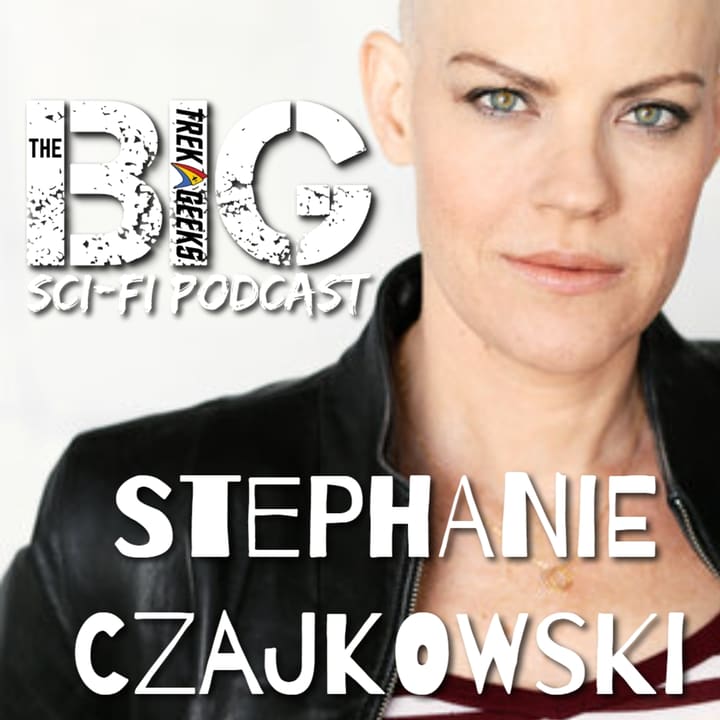
Actor, Podcaster, Cancer Survivor
Steph has appeared on television shows such as Criminal Minds, Bones, Colony, Grey’s Anatomy, Southland, How To Get Away With Murder, and is perhaps best known for her recurring role as Hammerhead in the show Doom Patrol. But that’s not all folks, Star Trek fans know and love her for her role as T’Veen in Star Trek: Picard.
We talk about her acting career, her life, her podcast, and her fight against cancer.
Learn more about Stephanie here:
https://www.chemoskinny.com/
This podcast is a proud part of the Trek Geeks Podcast Network and works hard to bring you great content from all over the science fiction universe. We would love to hear your feedback, suggestions, and ideas. Take a moment to send us an email at thebigscifipodcast@gmail.com.
Check our podcast out and learn more about the other great podcasts on the network by visiting trekgeeks.com.
We've got the merch! If you want BIG Sci-Fi swag, check out this link and support us by wearing us everywhere you go! www.teepublic.com/thebigscifipodcast
Check out all of our social links in one place:
https://linktr.ee/thebigscifipodcast
Check out Cris' amazing YouTube channel for Trek content galore:
https://www.youtube.com/@yellingaboutstartrek1532
Check out Brian's new book available at Amazon for Kindle and in paperback:
https://www.amazon.com/stores/Brian-Donahue/author/B0C3BQ93VD?ref=ap_rdr&store_ref=ap_rdr&isDramIntegrated=true&shoppingPortalEnabled=true
Follow Brian on Substack: https://bdonahue.substack.com/
Subscribe for free to Brian's Substack page where he writes original science fiction and fantasy: https://bdonahue.substack.com/
Find Adeena's books here: https://crazyrobot.myshopify.com/
Follow her on Substack here: https://beyondthedroid.substack.com/?utm_source=homepage_recommendations&utm_campaign=1493637

[00:00:01] Do not change the station. What you're hearing is coming from the BIG Sci-Fi Podcast and the Trek Geeks Podcast Network.
[00:00:08] Stay tuned for the next exciting episode of... Wait a minute. Receiving a new transmission. What is that? What am I seeing? It's big! It's really big! Oh my god, it's so...
[00:00:19] Welcome to Season 6 of the BIG Sci-Fi Podcast, the biggest sci-fi podcast in the galaxy.
[00:00:25] Join our crew, Adina, Brian, Chris, and Steve, as we travel the Milky Way looking for the best that science fiction has to offer.
[00:00:33] Make sure you're strapped in tight, because we're going to have a lot of fun talking all things sci-fi.
[00:00:39] Stay tuned to this channel for the next audio transmission.
[00:00:44] Welcome to the BIG Sci-Fi Podcast. My name is Brian Donahue, along with my co-hosts Adina, Chris, and Steve.
[00:00:51] Well, Chris isn't here right now, but he will come in quietly later on. We'll see how that works.
[00:00:57] This is the biggest sci-fi podcast in the galaxy. At least we think so.
[00:01:02] We're sure glad that you have chosen to spend some of your time listening to us go on and on about how much we love Star Trek, Star Wars, and sci-fi in general.
[00:01:11] We love you guys, and we are so very honored that you keep clicking play on your favorite podcast platform.
[00:01:16] Please do us a favor and take a moment to write a review and rate our podcast on those platforms so more people can have the chance to enjoy the four of us go on and on about how much we love sci-fi.
[00:01:32] Do you know what else we love? We love having special guests on our show.
[00:01:36] And today we get the extreme pleasure of having a very talented actress and fantastic human being on today's episode.
[00:01:43] This woman has appeared on television in shows such as Criminal Minds, Bones, Colony, Grey's Anatomy.
[00:01:50] You may have heard of that one.
[00:01:52] Southland, How to Get Away with Murder, and is perhaps best known for her reoccurring role as Hammerhead in the show Doom Patrol.
[00:01:59] But that's not all, folks.
[00:02:00] Yes, Star Trek fans know and love her for her role as Tavine in Star Trek Picard.
[00:02:08] Beyond her acting career, she is most impressive and inspirational for her battle against cancer,
[00:02:13] and she has a podcast called Chemo Skinny, the podcast we hope you never have to listen to.
[00:02:19] I've been listening to it ever since I knew she was coming on the show, and guys, it is so good and so very helpful.
[00:02:27] Please welcome to the show, for the first time, the one and only Stephanie Zekowski.
[00:02:33] How are you doing, Stephanie?
[00:02:35] I'm good. Thanks for having me.
[00:02:36] Did I get your last name right?
[00:02:38] You got it really close.
[00:02:39] There's a lot of consonants.
[00:02:42] It's Cschaikowski.
[00:02:43] It's like Cschaikowski.
[00:02:44] Okay.
[00:02:45] Cschaikowski.
[00:02:46] I meant to ask you that before we hit record, but I didn't.
[00:02:49] That's totally fine.
[00:02:50] I was stuck in the moment.
[00:02:52] So, Stephanie, pleasure to have you on the show.
[00:02:54] How are you doing?
[00:02:56] I'm good. I'm glad to be on the show.
[00:02:57] Thanks for having me.
[00:02:59] We're so excited, and I just want to get this out of the way.
[00:03:04] I've got to get the fanboy thing out of the way.
[00:03:08] You had some great scenes in Picard, and you were a part of some very powerful scenes, too,
[00:03:15] and action-packed scenes.
[00:03:20] What was that like?
[00:03:22] I am so lucky to have the job I have.
[00:03:23] It was at times anxiety-filling.
[00:03:31] Most of the time, it was thrilling.
[00:03:33] Daily, it was a reminder that I am lucky enough, A, to do this job, but B, to be in this company and on this bridge and in this universe.
[00:03:48] It was a great job.
[00:03:49] And it, the wonder toward the job, as much as fun as it was and as welcoming as it was, the further I get away from it, the more I realize how amazing it was.
[00:04:02] Oh, wow.
[00:04:03] Oh, wow.
[00:04:32] And then, the more I get away from it.
[00:04:42] It was a great job.
[00:04:56] Nice.
[00:05:00] And then, suddenly, I was like, oh.
[00:05:02] And I played China.
[00:05:04] Really?
[00:05:05] Yeah.
[00:05:05] Oh, my goodness.
[00:05:07] And it was, it was the first taste of that because the makeup and the hair was like, the makeup and the wig obbs was fantastic.
[00:05:16] And they were doing, my first scene was the ladder match from 1997.
[00:05:20] And I walked out and they had so many fans.
[00:05:23] And they were like, oh, my God, China.
[00:05:24] And they were just like, China.
[00:05:26] And I was like, and I had to stop for a minute because I was like, but I'm not.
[00:05:30] And then I was like, oh, I guess, I guess.
[00:05:32] And then, slowly but surely, it was the premiere.
[00:05:35] And then, just starting to connect with fans on social media has really broadened, I guess, the expectation and also just the responsibility of what it is to be part of something so beloved.
[00:05:51] And you are on your way to Star Trek Las Vegas, correct?
[00:05:55] Yes, I am for the very first time.
[00:05:56] As we record this?
[00:05:57] Okay.
[00:05:57] Yes, I am.
[00:05:58] So, is this your first convention or just first time at Las Vegas?
[00:06:02] No, it is not my first convention.
[00:06:04] It is my first time at this big of a Trek convention.
[00:06:09] I've gone to, I was at, I'm at Adina at the Diversity and Inclusion Conference in Philadelphia, which was a really intimate and lovely, lovely event.
[00:06:21] So, this is the first time I've been to, you know, I guess, to the show.
[00:06:28] You know what I mean?
[00:06:29] Right.
[00:06:30] To the show.
[00:06:30] Yeah.
[00:06:31] Chris was there a couple years ago?
[00:06:34] Was it last year or the year before, Chris?
[00:06:36] Year before.
[00:06:37] To Las Vegas.
[00:06:38] Yeah, that was, yeah, 2022.
[00:06:41] Okay.
[00:06:41] My first Vegas.
[00:06:43] Wow.
[00:06:43] It was something else.
[00:06:45] It was like a dream come true.
[00:06:47] Yeah.
[00:06:47] I've been to Vegas.
[00:06:48] I've been to the Star Trek experience way back when that was a thing.
[00:06:52] But I've never been to the convention.
[00:06:54] And I'm dying to go.
[00:06:56] So, yeah.
[00:06:58] I was, I went to the convention in Las Vegas a number of times.
[00:07:01] The last time was 2019.
[00:07:04] And then 2020 got canceled.
[00:07:07] Oh, yeah.
[00:07:07] And then just haven't been back since.
[00:07:10] But it was, it's always a lot of fun to go.
[00:07:12] And I would just go for one day.
[00:07:14] I just go to the Saturday.
[00:07:15] And it's so fulfilling.
[00:07:16] Yeah.
[00:07:17] Just to see people.
[00:07:17] And we, and I was there the day that Patrick Stewart came on stage and said,
[00:07:23] Jean-Luc Picard is back.
[00:07:26] Oh, wow.
[00:07:26] And everyone's phones exploded when it came out.
[00:07:29] Oh, my God.
[00:07:30] I remember that day.
[00:07:31] It was like a weird day where I was on a date.
[00:07:33] I just bought my new car, my Subaru.
[00:07:35] I got the news that Picard was coming back.
[00:07:37] And I'm like, what is it?
[00:07:39] Like, there can't be a better day.
[00:07:41] Yeah.
[00:07:41] Or something else.
[00:07:42] Just ride around.
[00:07:44] Yeah.
[00:07:44] Except for your wedding day, of course.
[00:07:46] That was a better day than that.
[00:07:47] But I digress.
[00:07:49] He didn't say anything.
[00:07:50] Stephanie.
[00:07:54] I, we like to go backwards.
[00:07:56] Like, I started with Picard.
[00:07:58] I kind of went out of order for what my questions were, actually.
[00:08:00] Yeah.
[00:08:01] We love to ask people kind of origin stories.
[00:08:04] Like, when did you start down the path of acting?
[00:08:07] Like, when did you know this is, this is what I got to do.
[00:08:10] This is in me.
[00:08:11] I'm good at this.
[00:08:12] It was really young.
[00:08:13] It was, it was really, really young.
[00:08:15] Um, it was very, I think, decisively, or at least just not even decisively, but very much
[00:08:25] a pretty broad inkling when I was, it's, I think it was five and I was in kindergarten.
[00:08:31] And I would come home from school where I lived in Wisconsin.
[00:08:34] I lived in Racine, Wisconsin.
[00:08:36] And after school in syndication, they had the Brady Bunch.
[00:08:39] And I watched the Brady Bunch every time I came home from school.
[00:08:45] And whatever inspired me, I think it was the entree of cousin Oliver, because suddenly there was another child.
[00:08:52] I decided that if this kid could be on the Brady Bunch, then I totally could be on the Brady Bunch.
[00:08:58] So I asked my mother to write a letter to the ABC affiliate station.
[00:09:03] And she did, asking if I could be on the Brady Bunch.
[00:09:07] And they were very kind to write a letter back to be, to tell me that it was no longer shooting and had not been shooting for easily a decade.
[00:09:17] But they suggested that if I wanted to be an actor to start, you know, go into children's modeling and acting.
[00:09:23] And so it started there.
[00:09:25] And then it was, I went to Catholic school.
[00:09:29] My parents, my dad was an engineer.
[00:09:30] My mom was a homemaker and then a seamstress.
[00:09:33] So they had no, we had no entree into this world.
[00:09:39] When I got to, when I was in fourth grade, instead of writing a, instead of writing a science book report about Louis Pasteur, I wrote a play.
[00:09:49] And they, the nuns at the Catholic school I went to let me do the play instead of doing the report.
[00:09:55] Oh, wow.
[00:09:55] And then they kind of encouraged it for a little while.
[00:09:57] And then when I was in sixth grade, I moved to a suburb of Chicago where they had summer theater that I could audition for.
[00:10:03] And so it started and then there started to be an opportunity for it.
[00:10:07] And then I just, I didn't know how to do it.
[00:10:11] So I just went to college for it because I figured like, you know, you go to college for things.
[00:10:15] And so I auditioned for NYU.
[00:10:19] I auditioned for Tisch School of the Arts and I got in and I went and have been kind of figuring it out from there.
[00:10:26] Because, you know, hindsight's always like, oh, did I have to go?
[00:10:30] Don't really know.
[00:10:33] Like, my mom was never a stage mom.
[00:10:36] She was always somebody who said, well, if you want to do this when you get older.
[00:10:41] And everything just pointed to, yes, I want to do this.
[00:10:44] But she was like, when you get older.
[00:10:45] And then finally it was like, oh, great.
[00:10:47] You're 17.
[00:10:48] Go to New York.
[00:10:49] Go to college and figure it out.
[00:10:51] Yeah.
[00:10:52] Right.
[00:10:52] Well, I love, I love that those nuns let you try that.
[00:10:58] That, what a gift.
[00:10:59] I know, right.
[00:11:01] Instead of being so strict by the rules and knowing you got to do it this way.
[00:11:04] They allowed you to be yourself and allowed you to explore that.
[00:11:09] What an awesome, that's a phenomenal part of your story.
[00:11:11] I'm a gluey passenger.
[00:11:12] I'm at a Christmas play.
[00:11:13] Like, I was like, I was like Little Miss Playwright.
[00:11:17] That's fantastic.
[00:11:18] For a couple of years.
[00:11:18] I was like, okay, here we go.
[00:11:20] No, that's the best when there are teachers.
[00:11:22] None are otherwise.
[00:11:22] There are teachers that are willing to kind of look at, understand what you're trying to do.
[00:11:26] And understanding the kids involved and trying to make things work.
[00:11:30] I had a couple of experiences like that too, where I wasn't trying to circumvent the rules,
[00:11:36] but the project as written was not, it was not going to work.
[00:11:40] But the teacher let me do something slightly different that was up my alley, met the intent.
[00:11:44] You know, so I have similar stories to that.
[00:11:46] And I love that.
[00:11:47] That, yes, that's a great, that's a great way to, I guess, you know, find your passion.
[00:11:52] Like, the fact that you're allowed to find your passion in that environment.
[00:11:56] Yeah.
[00:11:57] So, Stephanie, did you start off doing stage work and then moved into TV?
[00:12:04] Or how did that go?
[00:12:05] Yeah.
[00:12:06] I wanted to do musical theater.
[00:12:10] And musical theater and straight theater, like, kind of straight theater.
[00:12:13] Like, I really want to do musicals.
[00:12:14] I do sing.
[00:12:15] I don't sing as much as I used to.
[00:12:17] Um, but I was not a dancer, which turns out to be very important when you want to do,
[00:12:23] at least at the time that I was trying to get into musicals.
[00:12:25] Because there were, of course, like years later when I moved to LA, suddenly there's
[00:12:29] all these things that you can do that you can be a, you know, a singer who moves well.
[00:12:34] And also, I recognized while I was in college, um, one of my very, one of my favorite acting
[00:12:41] teachers at one point, my senior year of college was like, you have a woman's voice in a girl's
[00:12:47] body and you will work eventually.
[00:12:50] Not to mention the fact that I was, you know, five foot 10 and I'm of Eastern European descent.
[00:12:55] So I'm very, I'm physically not imposing, but I'm physically, it's why I got to play China.
[00:13:01] Like I used to be a little bit more, I'm a lot more muscular, but I was, there weren't
[00:13:06] in theater and musical theater in particular, it would, you have like old lady and ingenue.
[00:13:12] And I just did not fit.
[00:13:13] I was either too young because my voice was lower.
[00:13:16] So it didn't fit into either of those things.
[00:13:19] And I just wanted to work.
[00:13:21] Um, and so when I was doing theater, I was, you know, I was playing, I was playing, you
[00:13:27] know, kind of, I, there was a point where, you know, I did, was it Karen Lee's role in come
[00:13:33] back to the five and dime Jimmy Dean playing a post-op transsexual, um, you know, when,
[00:13:38] which you would never be able to do now, which is totally fine.
[00:13:41] Um, and then just playing like, you know, I'm playing aliens, playing, you know, playing,
[00:13:48] playing, you know, uh, witches and ghosts and kind of other worldly beings as opposed
[00:13:55] to human women, at least in the theater space that existed at the time.
[00:14:01] And so when I moved it and Elvis, my big, my like big claim to fame was both
[00:14:08] Grainne O'Malley, the Irish Pirate Queen, which I did like a musical on the Jersey shore.
[00:14:12] And then, um, a Elvis zealot and who became an Elvis impersonator.
[00:14:19] Those were like my big musical theater roles.
[00:14:21] I love it.
[00:14:21] It was a great, great show to do.
[00:14:23] But then I, you know, I wanted, I was doing off of Broadway theater.
[00:14:28] I, I was also working 17, you know, 17 jobs doing other things.
[00:14:32] And I wanted to be able to do stuff that paid enough that I could pay my rent, you know?
[00:14:38] And the beauty about doing theater was it's such a fulfilling experience.
[00:14:42] But on the other flip side is if you're doing off of Broadway theater or you're not getting
[00:14:46] paid that much, you basically suck up all your time to create this product that you get to
[00:14:54] experience and is a wonderful experience.
[00:14:56] But then when it's over, then I would have to go back to work double time.
[00:14:59] So then I'd be just focusing on work and that in order to get back to the craft of it kind
[00:15:04] of.
[00:15:04] And I wanted, and I, and I just, I wanted something a little, not more sustainable, but
[00:15:11] maybe somewhere where I came in, you know, could find an inkling in.
[00:15:14] Cause I was like, I will make a name and then go back to theater because that was also what
[00:15:18] was happening because people weren't going to see it.
[00:15:20] So I moved to LA and I used to, I mean, I was here for God.
[00:15:27] I was here for a good long while trying to figure out, you know, where you meet everybody
[00:15:32] before I booked my very first role on television.
[00:15:35] I did not know I was pregnant playing.
[00:15:40] Surprise.
[00:15:40] Which I keep on my resume because it was the first time I was on TV.
[00:15:44] It was the first time at the time it was like an infamous show on TLC and then slowly, but
[00:15:52] surely.
[00:15:52] And I played like, I think a paramedic and that's where I kind of made my bones as I
[00:15:56] became paramedics and firefighters and cops.
[00:16:00] And because you, you know, I carried a gun and then once the head, and then I started
[00:16:06] when I, I chiseled up to get to a, like slightly bigger role playing a, you know, lesbian lumberjack,
[00:16:12] but you know, everything kind of went in that thing where things kind of led from one to
[00:16:18] another as it were.
[00:16:20] Okay.
[00:16:21] Yeah.
[00:16:21] Go ahead, Chris.
[00:16:23] Sounds like you're ready.
[00:16:24] Yeah.
[00:16:24] I'm very curious because I always see like when I turn on TV and I'm watching shows, you'll
[00:16:28] sometimes see the same people as you're saying like, okay, this person obviously plays a lot
[00:16:32] of cops or this or that.
[00:16:34] Do you get, did you get to a point where it was like, you'd have to audition to each one
[00:16:38] or would, would studios reach out and go, oh, you know what, we need, we need someone who can
[00:16:42] play a cop.
[00:16:43] You know, you were on this show previously.
[00:16:45] How does that work?
[00:16:47] I auditioned for most of them.
[00:16:49] The NC, like, but there were times, the, the one job I got, which I was like, oh my God,
[00:16:55] is I had auditioned for NCIS like 10 times.
[00:17:00] Like I just, they just kept calling me in and kept calling me in and kept calling.
[00:17:03] And the same thing happened with, you know, Grey's Anatomy before I booked Grey's Anatomy.
[00:17:07] Like I just would go in and, and you just point out, right.
[00:17:11] And they just, they know they're going to fit you in somewhere, but they don't know where.
[00:17:15] And one day I got a call, Jason Kennedy, I think called my manager at the time.
[00:17:19] And they were like, we have like a two line detective co-star on NCIS Los Angeles.
[00:17:25] We just want to offer it to her.
[00:17:26] So it was like the first time I'd ever, and it was very, very small and it was, you know,
[00:17:30] but it was just, you know, nice to be like, oh yeah, we know.
[00:17:34] Okay.
[00:17:34] We just need to get somebody in here and we know they can do it.
[00:17:36] You know?
[00:17:37] Yeah.
[00:17:37] Yeah.
[00:17:37] You know, I mean, cause that's ideally what you want is the thing that, you know,
[00:17:43] they'll make fun of people who are, um, nepo babies or nepotism or whatever.
[00:17:48] But like the idea is you build relationships and you get to, cause it's, I mean, it's hard
[00:17:53] to get things made.
[00:17:54] It's hard to get things done and you want to be on set with people who are not assholes and
[00:17:59] can get the job done, you know?
[00:18:00] And I think that's true for kind of any profession.
[00:18:02] Oh yeah.
[00:18:03] Yeah.
[00:18:04] Yeah.
[00:18:04] 100%.
[00:18:06] So what has been some of your favorite roles that you have played?
[00:18:12] Unequivocally, um, Hammerhead was probably my favorite role on television.
[00:18:20] Um, mostly because I got to swear a lot.
[00:18:23] Um, no, I just, that role I think is, that is one of my favorites.
[00:18:30] Like it's top, kind of top tier.
[00:18:33] And I think Tavine falls in right behind it.
[00:18:36] Not because for different reasons, just, I love that both of them, Tavine, even though
[00:18:45] I didn't have as much screen time, the ability to dig in and bring, I think out things that
[00:18:52] people don't expect to come out a little bit.
[00:18:54] You know what I mean?
[00:18:55] That, and that's, that's what always interests me about playing anything is, is being able
[00:19:01] to explore something or a facet, taking a facet of my personality that maybe already exists
[00:19:07] and then expanding on it.
[00:19:09] Right.
[00:19:09] Just finding and finding different dimensions to it.
[00:19:15] Well, I'm going to ask you the big question.
[00:19:18] Don't be so polite.
[00:19:20] Jump right in.
[00:19:20] Let's go.
[00:19:21] Got killed by one of my favorite evil characters of Star Trek of all time.
[00:19:29] Captain Vedic.
[00:19:31] What was it like working alongside Amanda Plummer?
[00:19:34] Because she looked like she was having so much fun.
[00:19:37] And she also got, I think still the greatest exit line of all time as she's exposed, as
[00:19:44] she shot out of the space of the, what was it?
[00:19:48] The Titan.
[00:19:49] Yeah.
[00:19:49] And which those two words she got to say were just fantastic, but she looked like she was
[00:19:55] having so much fun.
[00:19:56] What was it like working alongside someone like herself?
[00:20:00] She was.
[00:20:01] And she was.
[00:20:02] And the thing that I noticed that I was simply in awe of is incredibly approachable and utterly
[00:20:12] creative.
[00:20:13] Wow.
[00:20:14] Like just fully in, like, I feel like a lot of times we'll get in and actors will get
[00:20:20] in and all different stages, get a little into our head of like, this is what I have to do.
[00:20:24] And she was, and in film, I see it a little, like, I think sometimes we feel a little more
[00:20:29] comfortable to do, to just kind of feel it because somehow you feel like you have a little
[00:20:33] bit more time.
[00:20:34] And in theater, that's part of the, you know, the rehearsal process.
[00:20:40] But TV feels a lot like, okay, you've, you're, we have these things and we're going to go and
[00:20:44] we have to, you know, get stuff done.
[00:20:46] So you want to kind of hit it the first time so you can keep going.
[00:20:49] And she always hit, it's not that she never hit it, but she was always, there was always
[00:20:53] something unexpected there.
[00:20:54] And there was always a sense of play in deep creativity that you could see, but wasn't
[00:21:02] standoffish.
[00:21:03] Wasn't because I feel like actors can sometimes be like, this is my thing.
[00:21:07] And you, but it was so just, you could just feel that energy move.
[00:21:14] And that was one of the most striking things about it because also her stature is so small
[00:21:21] and she looms so large, her energy and her presence is so big.
[00:21:26] And then at the, and then at the, at the premiere party, I went up and I was like, I don't know
[00:21:32] if you remember me, you killed me.
[00:21:33] And she was like, I did.
[00:21:34] And she gives me a big hug.
[00:21:35] Like, you know, just, just really, you always treasure, I always treasure artists like that
[00:21:43] because they truly feel like artists and there's no apology for it.
[00:21:49] It's not a standoffish thing.
[00:21:51] It's just like, oh, this is how I go.
[00:21:53] Oh yeah, it's here.
[00:21:54] And it's, they're just in this zone.
[00:21:56] And you're like, oh my God, to be able to always, to be a creative like that, to trust
[00:22:05] yourself enough to do that.
[00:22:07] Because I think a lot of us don't, you know?
[00:22:08] Yeah.
[00:22:09] Yeah.
[00:22:09] Because you had to keep a straight face in that scene.
[00:22:12] Whereas the other actress, she's trembling.
[00:22:15] She's going to pieces.
[00:22:16] She thinks she's going to be killed.
[00:22:18] Yeah.
[00:22:19] And then quickly the gun turns and it goes on to you.
[00:22:22] And I went, no, no.
[00:22:23] I know.
[00:22:24] I liked your character.
[00:22:25] Why?
[00:22:26] So dirty.
[00:22:27] It's so dirty.
[00:22:28] I know.
[00:22:29] So, but it was, but so how did you prepare for that moment?
[00:22:33] Like you knew it was coming.
[00:22:36] How did you get ready to react to it as if it was a complete surprise to the actual person?
[00:22:44] Acting.
[00:22:45] Yeah.
[00:22:46] No, I think, I mean, in it, you, I focused, I focused on everything.
[00:22:50] Like you, you, in the moment with everybody else, you know, they're focusing on Jen and
[00:22:57] Joseph.
[00:22:58] And so you, yeah, as Tavine and even as, you know, Stephanie being on, even though I knew
[00:23:05] that, you know, what was going to happen, it's you focus on the, I have to keep my calm
[00:23:10] because they're going to hurt.
[00:23:11] How do I stop them from hurting you?
[00:23:13] Focus, put the focus outward.
[00:23:15] I think.
[00:23:16] Yeah.
[00:23:16] You know, that's what I did is on the affection and, you know, camaraderie you have with these
[00:23:24] actors you now know, but also as, you know, the character.
[00:23:29] Did you find it more challenging to play a Vulcan versus a human or any kind of other
[00:23:34] humanoid?
[00:23:34] Because I've noticed you're like me, you talk with your hands a lot.
[00:23:38] So our listeners can't see that you're talking with your hands a lot.
[00:23:41] And obviously being a Vulcan, it's more Vulcans do not talk with their hands a lot.
[00:23:46] So is that a real challenge?
[00:23:48] Because I guess as human characters, you could probably do some of that.
[00:23:51] You can gesticulate a lot.
[00:23:52] I think it was very, as somebody who is relatively talks fast is high energy, like kind of can
[00:23:58] be frenetic energy.
[00:24:00] It was great.
[00:24:02] It was a great, it was a great challenge only from the standpoint that it was very much
[00:24:08] about, I have never meditated as much as I meditated while working on that show, just
[00:24:14] focusing in like, and really a to two, you know, through research through memory.
[00:24:22] Alpha through like, because, you know, my entree into that, into Vulcanism.
[00:24:30] And the thing that is most exciting to me is the fact that at one point in time, they were
[00:24:34] so volatile that they had to keep everything under control.
[00:24:38] And so, and I felt like in a lot of portrayals, it was, they just have no emotion, which I
[00:24:44] think is, and, you know, Spock gets an out because he's, you know, human.
[00:24:49] But the idea that it's, it's not just something that comes along.
[00:24:54] It's something that is this practice.
[00:24:57] And I mean, Jean, you know, very much so was throwing an allegory, like comparing human kind,
[00:25:04] like we're watching in Star Trek, basically, you know, a metaphor, not even a metaphor of,
[00:25:10] or an allegory about humankind, right?
[00:25:13] So for me, so for me, at the point in time, it happens.
[00:25:20] I wouldn't say it was easy, but it was so exhilarating to do it.
[00:25:25] Just because of what it brought me in terms of both portraying, you know, to be an, and
[00:25:34] also just my own life at that point in time.
[00:25:39] So working off of that, like, and you talked about meditation.
[00:25:44] Did you have a, like, actually, this is a two-part question.
[00:25:48] One, did you have a process that you, that you, I guess, went through when you were trying
[00:25:53] to get into character?
[00:25:54] And then two, did you ever have a tough time when you're like, okay, I'm not actually Vulcan
[00:25:58] anymore.
[00:25:58] Now I can kind of go back to being myself.
[00:26:02] Was that ever difficult?
[00:26:04] I never had, I don't, I'm going to go second part first.
[00:26:06] I don't think I ever had a problem transferring out of that.
[00:26:10] I do think that during that period of my life, I was a lot more, not stoic, but not, a lot
[00:26:20] more aware of every, like, of observing things around me as opposed to actively participating.
[00:26:26] So, but that is also a part of my personality that I've noticed that I had in high school,
[00:26:34] but in such a different manner, like, as more of a, like, more out of anxiety as opposed
[00:26:39] to curiosity.
[00:26:44] The methodology was, there's a fabulous acting teacher who I did a little bit of work with
[00:26:49] once, because I booked very, very quickly.
[00:26:52] It was, I got the science on Wednesday and by Friday, I was like, what are you doing?
[00:26:57] So the process was, the science did not dictate that to Veen, and it was a different name
[00:27:05] originally.
[00:27:05] I can't remember which name it was.
[00:27:07] It dictated that it was a science officer, but not what species.
[00:27:14] It, I knew from, you know, intuition and from knowing Cassie and doing your little research
[00:27:22] to try to figure out what you're auditioning for, that it was a science officer.
[00:27:26] And it felt to me very, it felt very Vulcan-y.
[00:27:33] It felt very Spock-like.
[00:27:35] So I was like, well, I think this is what it is.
[00:27:37] Let's go, let's go here.
[00:27:40] And then once we decided, once they called me in for a costume fitting and I met, I met
[00:27:46] Terry, which was fantastic.
[00:27:48] They were like, well, of course you're a Vulcan.
[00:27:49] Like, duh.
[00:27:51] And I was like, okay.
[00:27:54] Then he was kind enough to have the production secretary, who is a big Trek fan, go through
[00:28:01] and send me a list of episodes from the original series.
[00:28:07] Like, Vulcan-heavy episodes from the original series.
[00:28:11] I think he did that for Ed, too.
[00:28:12] Like, he made sure Ed saw certain things that he was pulling from to make sure you had that
[00:28:18] knowledge base.
[00:28:19] So I had my own knowledge base and then watched everything that I was recommended and then
[00:28:26] did a deep dive into, you know, Memory Alpha and as much stuff as I could find.
[00:28:32] And then there's an acting teacher named Gregory Berg, who I did some work with that likes to
[00:28:36] work theater, like likes to work really physically so that I could embody like what it feels like,
[00:28:42] like how it may change, how, how this character embodies a space, even if I'm not really moving
[00:28:49] that much.
[00:28:51] So, Star Trek homework, which sounds like awesome to just have Star Trek homework.
[00:28:55] Yeah, that's what I do.
[00:28:55] You're going to have Star Trek homework.
[00:28:57] I know.
[00:28:57] Did you become a fan?
[00:28:59] Did you enjoy watching and experiencing some of the old episodes?
[00:29:03] Well, I had already been, I had already been, I wouldn't say like a devout fit, like I'd already
[00:29:10] been watching.
[00:29:11] I had seen lots of the original series.
[00:29:14] The Star Trek movie, I'm pretty certain, is the first movie I saw in theaters.
[00:29:20] Wow.
[00:29:20] Because my father was a giant Star Trek fan.
[00:29:25] And later on in life, my mom during, when Voyage Home came out, my mother was a seamstress
[00:29:32] and worked for a party shop and actually made the, those like the maroon with the, the admiral
[00:29:38] costumes.
[00:29:39] Like she was making them for, for cosplayers at which she was making them for, you know,
[00:29:44] people who are going to conventions.
[00:29:45] Do you have, do you have any left?
[00:29:47] I need that.
[00:29:47] I don't, I don't.
[00:29:49] I'm desperate.
[00:29:49] But she was, she was making them like hand making them at a point in time when cosplaying
[00:29:54] was not nearly as cool as it, like not nearly as accepted as it is now.
[00:29:59] And so it was, and then in the next generation came out, my dad loved, my dad loved Worf.
[00:30:05] Like it was, so it's been, it's been intertwined in my life for as long as I've basically been
[00:30:12] alive.
[00:30:12] Um, and then became like that much more clear of, you know, I, it became so much more clear
[00:30:20] when I stepped onto that bridge.
[00:30:21] Cause I was like, Oh my God, like just the feeling of recognizing where I was and the
[00:30:26] opportunity, you know, cause my also, cause my father had passed away in 2017.
[00:30:33] So it was a couple of years before working on it, but it was, it was a weird, like coming
[00:30:37] together of just, you know, of, of that a little bit, like kind of a, not a full circle,
[00:30:45] but my father, as I mentioned, he was an engineer and not that he didn't want me to be an actor.
[00:30:51] Um, but up until the time he died, he was asking, I work at a gym.
[00:30:55] If I was going to apply to be the manager just so that I was, he was very logical, very
[00:31:00] logical about how one makes money and relate.
[00:31:04] Yeah.
[00:31:05] So, um, whereas my mom, like part of my choice and I was really thrilled when Terry agreed
[00:31:12] to it of, of my inspiration of having this character be slightly because the bald had
[00:31:18] be a quarter Delton and three quarters Vulcan was inspired by my parents and how their,
[00:31:26] how their, um, traits existed in my life.
[00:31:30] That was so is very, very, is very, very similar to Vulcan and Delton traits.
[00:31:35] Good.
[00:31:36] Wow.
[00:31:37] So you said, you mentioned something there, uh, briefly, uh, you talk about it in your
[00:31:42] podcast, I think a little bit, how did, how'd you get involved in the fitness?
[00:31:47] Um, I think it's because, um, I am from Wisconsin.
[00:31:53] I am Polish, Hungarian, German, and a little bit Irish.
[00:31:56] Like I am built from like farm stock and I, I've just always been someone, my mom was an
[00:32:04] athlete more so than my father, but I've always really liked moving.
[00:32:07] And so fitness was a very natural segue, uh, for me.
[00:32:13] I was, I was in athletics as a kid and then kind of in high school to make a switch.
[00:32:18] I used to make a choice at the high school I went to.
[00:32:21] And so switched to, um, drama cause that's what I wanted to do, but then rediscovered just
[00:32:28] that, that is something that I really, really enjoy.
[00:32:31] Um, but also feeds itself into building character and stuff.
[00:32:35] So, um, yeah, I mean, they, it was weird.
[00:32:38] Cause like at 15, you know, my freshman year of high school, I auditioned, I auditioned.
[00:32:44] I both auditioned for the freshman play and had gotten a job at something called woman's
[00:32:49] workout world, which was like a Lucille Roberts, but you had to become a certified fitness instructor
[00:32:53] to be there.
[00:32:53] And so I had, was supposed to go every day after school until I had enough hours to get
[00:32:57] certified, but I got cast in the school play.
[00:32:59] So I was like, and then years later I went to college and was like, I'm going to be going
[00:33:04] to double major in like fit.
[00:33:06] Like it seems this makes sense, but then I didn't cause it was the paperwork was too
[00:33:10] hard.
[00:33:11] And then finally I ended up graduating and becoming a fitness instructor and then slowly
[00:33:15] but surely like, you know, it all kind of fell into place, you know, 15 years later
[00:33:20] as it were.
[00:33:20] Yeah.
[00:33:21] So, so let me, let me ask this about, I want to pull on the fitness thread a little bit
[00:33:24] because you and I are pretty much the same age.
[00:33:26] We're within a year, we're within a year of each other.
[00:33:29] And this has been on my mind a lot lately for various reasons.
[00:33:33] And just thinking back to probably when we were teenagers and the kinds of messages that
[00:33:38] we get as women about fitness.
[00:33:41] Yes.
[00:33:41] So we're the kind of fitness.
[00:33:43] Yes.
[00:33:44] But also, you know, I've just been strength, strength training this last year.
[00:33:49] I've been told for several years, I need to do it.
[00:33:51] And I'm finally doing it.
[00:33:52] And, but I, you know, thinking back to teenage years and, and I think it was like, okay to
[00:33:57] do aerobics and stuff, but I feel like I had somehow gotten the message from the universe
[00:34:02] that I'm not supposed to be strong.
[00:34:04] So I never tried to be strong.
[00:34:06] I never tried to do it.
[00:34:07] And so to the point where right now I hate, I'm miserable doing, I'm doing it because
[00:34:10] I know I have to, but I'm miserable doing it.
[00:34:12] So when you say you were a fitness instructor, were you also like going towards the aerobics?
[00:34:16] Did you ever like also ingest that whole strength training?
[00:34:20] Like I'm curious as to the messages you received, but also you definitely were, again, different
[00:34:26] body types.
[00:34:26] And so I was never doing anything fitness in high school, never even interested, but
[00:34:32] I'm curious about like your journey and what you kind of perceived there to the kind of
[00:34:37] fitness that you've been into.
[00:34:39] I have always, yeah, no, I have always been someone who really liked lifting weights.
[00:34:44] Um, more so I liked being strong.
[00:34:48] Um, my mother was an athlete, which I think helped a lot.
[00:34:53] She was, I mean, she was comparatively, she was, I'm five, 10.
[00:34:58] Um, she was five, six, but she and her sister who was like five, nine, they were both really
[00:35:03] good athletes.
[00:35:04] Um, and so being strong was not something that at least in my household was something
[00:35:14] that was looked upon as being less than, or that I shouldn't be like I have, I have other
[00:35:21] girlfriends for my size or for my height, whose mothers would body shame them for not
[00:35:28] being thin enough or being too big.
[00:35:31] But I, and it's funny because I grew up with the idea I was playing sports and I knew it
[00:35:38] felt good.
[00:35:39] And once I got to high school specifically in Illinois and into high school, like I was five,
[00:35:45] three, eight.
[00:35:46] So like that kind of body image stuff I saw happening with other friends of mine in terms
[00:35:52] of needing to be smaller.
[00:35:56] And I don't know why it didn't penetrate as much for me because I spent a lot of time
[00:36:04] being like, uh, being like, this is just my size.
[00:36:09] And I like my, like, I, I, I don't know what, I don't know what she did.
[00:36:13] Like in certain respects, like sometimes I'm like, how did I just ignore a mess?
[00:36:18] Like these messages that I was supposed to be super, super skinny, especially once I got
[00:36:22] into high school and college in like the nineties when everyone is supposed to be stick thin and
[00:36:26] then choosing to go into, um, film and television, which I did recognize like, oh,
[00:36:34] if I'm going to fit in, I need to be so much skinnier.
[00:36:40] And then I was like, well, if my arms are already big, big by standard, I might as well get them
[00:36:47] yoked.
[00:36:47] Like they might as well be big for a reason because I was watching so many friends of mine
[00:36:55] destroy themselves, you know, and there's fitness.
[00:36:59] I have colleagues of mine who same thing with, you know, eating disorders to, in order to make
[00:37:04] themselves smaller.
[00:37:06] And I didn't see how that was not going to absorb all of my attention in my life.
[00:37:14] Mm-hmm.
[00:37:15] And so somewhere along the line, I don't know.
[00:37:18] I don't know if it was just like ignoring it and being like, fuck it.
[00:37:21] I'm still here.
[00:37:22] Mm-hmm.
[00:37:23] That I basically was just like, no, this is what I'm going to do.
[00:37:26] I like being strong.
[00:37:28] It makes me feel good.
[00:37:29] That was the thing that I knew is that by lifting weights and like specifically lifting,
[00:37:35] there was a serotonin rush that I felt my body relax.
[00:37:40] And it was that that kept me doing that.
[00:37:43] And then as I got more into it, you know, I just, you know, I'm not like right now, part
[00:37:48] of me is like, I'm not as lean as I used to be.
[00:37:51] Because also, you know, I had cancers and I used to joke because I watched my mom suddenly
[00:37:56] became cum TV skinny because she had cancer.
[00:37:59] And I was like, oh, if I get cancer, I literally said and joked about, if I get cancer, I will
[00:38:06] start working in this industry because I will suddenly get smaller.
[00:38:09] And I did start working more in this industry, but I did not get smaller.
[00:38:12] I just lost my hair.
[00:38:14] And, but I never, you know, I never got to that, you know, to that skinniness part.
[00:38:23] And what I kind of viewed, not viewed as frail, but I also just, but I also spent a lot of
[00:38:32] my life not fitting into what femininity was supposed to be.
[00:38:38] Like, you know, especially once I shaved my head, I was like, oh, there you are.
[00:38:43] Because I didn't feel like I had to fit into the confines of what being feminine was or
[00:38:48] what being a woman, what woman, what like, because I never quite fit in.
[00:38:54] But it took me to, you know, to get cancer so many years later to just finally really almost
[00:39:02] be fully okay with it, as opposed to just ignoring it and being like, fuck it on the other side
[00:39:08] of whatever this is, is so much head drama that I just don't have time for.
[00:39:15] And that was the choice.
[00:39:16] The choice was like, I could make myself crazy about this, or I could just keep going ahead
[00:39:22] and just be like, this is me.
[00:39:25] But also still, you know, on the other side of it, still a little bit like, oh, I should
[00:39:29] look, I should have a ballet body.
[00:39:31] I should, I mean, even, even through cancer, even not like there's still every so often
[00:39:35] that thing creeps in.
[00:39:37] I don't even know if that answered that question.
[00:39:38] I just tangent it all over.
[00:39:39] You did.
[00:39:39] But, and so much of what you said, you know, resonates because as someone who, again, I
[00:39:44] was a girl who went, all my friends were guys, all my interests and hobbies were more of the
[00:39:48] quote unquote guy stuff because I was into computers and all these things.
[00:39:53] And so somehow I managed to get those messages that it's okay, you know, as a, as a woman in
[00:39:58] STEM at a time when I knew I was going into like a field and industry that weren't going to
[00:40:03] be a lot of women, like all of that.
[00:40:05] But I, I didn't digest any of society's messages about staying away from that.
[00:40:09] But for some reason, for some of the bot and I never wore makeup, I never got into makeup.
[00:40:14] That was never my thing.
[00:40:15] But for some reason, when it came to like physical strength and all, like some of the body image
[00:40:20] and the physical strength stuff, I somehow, and again, absorbed.
[00:40:25] Absorbed.
[00:40:25] And I'm now really trying to, well, like I said, at this point I'm doing the strength
[00:40:30] training because as I'm getting older, I know if I want to be active and not be like confined
[00:40:37] to a chair in 40 years, I have to be like, and so, so the only reason I'm doing it now
[00:40:42] is not because I like it, because I'm hate it.
[00:40:44] I'm miserable.
[00:40:45] I tell my trainer the three times a week I show up, I tell him how miserable I am, but he's
[00:40:50] like, well, Adina, at least you're showing up.
[00:40:51] And it's an intellect.
[00:40:53] I'm showing up because intellectually I've told myself I have to, but like, and I,
[00:40:57] because you have that logic from your dad.
[00:40:59] Yes, I did.
[00:41:00] And, and the thing is, and I will say for my, you know, for my, my parents, especially because
[00:41:04] my mom does, you know, sometimes listen to the show, these messages that somehow I, I
[00:41:07] digested about, you know, physical body.
[00:41:10] I did not get at home because my parents, like my, I played, you know, softball.
[00:41:16] My dad was always at my games encouraging me.
[00:41:18] My mom never, she had her own issues with her mom because my mom was always a little overweight.
[00:41:23] So my mom never put that on me.
[00:41:26] So I didn't, I did not get this at home.
[00:41:27] I really didn't.
[00:41:28] It's just all around.
[00:41:31] Yeah.
[00:41:31] No, it's yeah.
[00:41:33] Yeah.
[00:41:34] Well, and it's, and it's also, it is also the thing of, you know, being, I think it's
[00:41:42] the thing of taking up space of in certain respects, daring to take up space, daring
[00:41:47] to take up volume, very daring to at certain points in time, having voice, even still, it
[00:41:52] depends on who you talk to now, you know, but it is that stature.
[00:41:58] Like I, I still recognize not as much anymore because I've learned how to soften myself or
[00:42:06] cancer made me a little bit, changed something that made me re-recognize instead of that.
[00:42:15] But I, you know, to, sorry, I think especially as a fitness instructor, because I was strong
[00:42:21] and I was there and it was, there's only, there's so much runway you're allowed as somebody
[00:42:27] who looks like me, which sounds weird.
[00:42:29] And, but like, I've, one of my best friends is gay and he could be sassy and be like,
[00:42:33] and everyone loves him.
[00:42:35] And I need to be smart.
[00:42:37] Like, cause even in fitness, you've got to be smiley.
[00:42:39] You gotta be about five, four.
[00:42:41] You gotta be bubbly.
[00:42:42] And so like, there's like a thing of what people think for the most part, or at least has become
[00:42:48] the standard of what it is.
[00:42:49] It's changed certainly.
[00:42:51] And what I've realized even in teaching fitness is I'm not for everybody and that's okay.
[00:42:55] Okay.
[00:42:56] And, you know, I, it, because, and one of my bosses thankfully told me, you know, but
[00:43:01] my, how I do things, not necessarily for everybody.
[00:43:06] I have had people, I have a jobs, I've had, you know, theatrical jobs where I've done a
[00:43:11] great job, like that, that, that Elvis job where people, I had to go and live and live
[00:43:17] cause it was, uh, it was dinner theater.
[00:43:19] So we were living in a house together and the director called somebody.
[00:43:25] Called my, one of my friends who was a director to see how I got along with other people
[00:43:29] because he was potentially intimidated that I wouldn't get along with other people.
[00:43:33] So it's, you know, that it's that kind of is, is when that happens is already having
[00:43:39] to recognize how you might be perceived in order to short circuit.
[00:43:44] Like, and it's a lot of gymnastics that after a while I was like, not, not always, but was
[00:43:50] like just chose other side jobs, jobs where I didn't have to, to apologize for just being
[00:43:58] somebody who had a voice and someone who had an opinion, because that was one of those things
[00:44:01] that like, even as children, my parents like, were like, oh yeah, you have opinions.
[00:44:05] Let's hear it.
[00:44:06] Like, cause I also came from a generation that, you know, kids were my parents, you know,
[00:44:11] other parents were like, you just sit at the kid's table and you don't say anything.
[00:44:13] And my mom in particular was not like that.
[00:44:16] So, you know, yeah.
[00:44:18] Good.
[00:44:18] Well, you said a couple of things, you said something, Stephanie, you did, uh, cause I
[00:44:23] want to kind of shift our conversation a little bit here.
[00:44:26] Cause Stephanie, you've got an incredible podcast that I think people need to hear and
[00:44:32] they need to know about at least have the opportunity to listen to, cause it is in, in
[00:44:37] my opinion, as I've listened to, it is much bigger than the cancer thing.
[00:44:41] Um, you are helping people like Adina said, you learn how to push through things.
[00:44:47] You learn how to endure and keep going.
[00:44:50] And certainly having endured cancer, you have learned through ups and downs and failures
[00:44:56] and successes.
[00:44:57] I'm sure how to keep going and keep pushing through.
[00:45:00] Um, but also the lesson that I love to share with people is that avoid that comparison trap
[00:45:10] at all costs because it really hinders and keeps you down.
[00:45:14] I had this, I'll share this real quick.
[00:45:16] I had this experience.
[00:45:18] Uh, I'm a musician and a songwriter.
[00:45:21] And when I was much younger, I did this concert in the round with other local songwriters and
[00:45:27] I was in awe of their talent and their musical ability.
[00:45:33] And before I would do my song, cause we'd go back and forth through the half circle on
[00:45:38] stage.
[00:45:39] And I would say, Oh man, this isn't as good as that.
[00:45:42] Or man, they're way better than me.
[00:45:43] And another musician that I really looked up to and respected on the other side of the stage
[00:45:49] came up to me and I had done some work with him in the past.
[00:45:53] He came up to me and said, dude, I wanted to punch you.
[00:45:57] He's like, why are you comparing yourself to all of us?
[00:46:00] You, you are unique and different.
[00:46:03] And the way you write is different than us.
[00:46:06] And you have a place at the table, man, accept it.
[00:46:11] And you have to embrace that place.
[00:46:13] If you expect anybody else you ever sing to or share a song with, we'll expect it or we'll
[00:46:19] accept it.
[00:46:20] You have to accept yourself in that.
[00:46:22] And man, that was some of the most life-giving advice I've ever been given.
[00:46:28] You know, it started out with, I wanted to punch you in the face, man.
[00:46:32] You know?
[00:46:33] So Stephanie, as we, you've shared about kind of your own experience in this too, but man,
[00:46:42] one day you just get, something's different.
[00:46:45] You go to the doctor and it's cancer.
[00:46:48] Yeah.
[00:46:49] Share, share, share with us about that as, as much as you want to.
[00:46:53] And, um, cause I think there's a lot to learn, but also celebrate.
[00:46:58] Yeah.
[00:46:58] With that.
[00:46:59] So, um, it was, uh, I feel like, you know, my discovery of cancer and then another cancer
[00:47:07] and then another cancer.
[00:47:09] Um, cause I always like to be as, as I've often said, I'm like, I like to be an overachiever.
[00:47:16] Um, okay.
[00:47:20] I like to be an overachiever.
[00:47:21] Yeah.
[00:47:22] Um, it was somewhat a very surreal experience because I had mentioned my dad had died in
[00:47:28] 2017.
[00:47:29] Um, he had died, but within the span of about four months, I lost my uncle, my dad, and one
[00:47:36] of my good friends from college.
[00:47:37] It was kind of, I feel like we as humans go through periods where it's just like, it
[00:47:43] just feels like an onslaught of death or birth or like, it's, it's like weddings and kids being
[00:47:49] bored.
[00:47:50] Oh.
[00:47:50] And then, and then you hit a certain age and it's death.
[00:47:52] And I was always like, yeah, I feel like I'm a little young for this, but.
[00:47:55] Um, so I had, you know, gone in and I, he had died of a heart attack.
[00:48:01] So my brothers and I got checked and I was also having some neuropathy in my hands and
[00:48:07] I had switched to, uh, union health insurance again, cause we'd gone off and gone on.
[00:48:13] And so when you have good health insurance, you get all the things done, right?
[00:48:16] And I had done, um, a CAT scan of my, of my, of my neck and my head and they found this tiny
[00:48:23] little tumor on my thyroid.
[00:48:26] And so I went in and they biopsied it.
[00:48:28] And it was really strange because it was biopsied.
[00:48:33] I went to see it, I think early 2018, February.
[00:48:38] And my, uh, endocrinologist was like, okay, so yeah, it's cancer.
[00:48:43] And I didn't take my husband with me.
[00:48:44] Always take someone else with you.
[00:48:46] FYI, always.
[00:48:48] And they were like, but it's, you know, it's a baby cancer.
[00:48:50] This is an easy, this is an easy cancer.
[00:48:53] So I didn't hear the word cancer.
[00:48:54] I just heard like, oh, we just like cut something out.
[00:48:56] It's not a big deal.
[00:48:58] I went and I shot a movie in Winnipeg.
[00:49:01] I came back.
[00:49:01] I went to see, I had, I had a, um, referral to a surgeon that I hadn't done and it was going
[00:49:07] to run out.
[00:49:07] So I went and I go into this surgeon's office in, in May or April, April.
[00:49:16] And she looks at it and she's like, oh, okay.
[00:49:18] So yeah.
[00:49:19] So you have papillary thyroid cancer and you have Hashimoto's and it's spread to a lymph
[00:49:23] node.
[00:49:23] So we're going to take your thyroid out.
[00:49:24] And I was like, I know what?
[00:49:27] Because it was the first time I heard it.
[00:49:30] And I was like, well, do we really need to?
[00:49:34] She was like, it's pretty big.
[00:49:35] And she's like, I would think what I was like, but I thought you could just take part of it.
[00:49:41] And she says, well, it's, you know, you have also have Hashimoto's.
[00:49:44] It seems that you also have Hashimoto's.
[00:49:46] And I was like, well, that explains a lot because I, I don't think I know what that is.
[00:49:50] It's an autoimmune disorder, um, where your thyroid starts attacking itself and it's like
[00:49:55] your energy levels crashed.
[00:49:56] And for a couple of years I was like, something's not right, but I don't know what.
[00:50:01] And so she was like, well, I think it's, you know, spread to the other, a lymph node because
[00:50:09] literally my MO in that room, when my husband was looking at me like, what the fuck are you
[00:50:14] talking about?
[00:50:15] Was, can we just wait and watch?
[00:50:17] And he was like, uh, what?
[00:50:21] Because the idea of cutting my throat open specifically, like there was something about
[00:50:27] it, about being silenced, about not having my, my voice come back.
[00:50:32] Not ever.
[00:50:33] I hadn't sung in a very long time because since my mom, like it, I get really emotional when
[00:50:39] I sing.
[00:50:39] I, but the idea of never potentially being able to do that again, um, was terrifying to
[00:50:46] me.
[00:50:47] And they did the biops in the office and it came back cancerous.
[00:50:51] So we had to do it.
[00:50:52] And so even though it was a very, very curable, very minor cancer, I was like, I could die.
[00:51:02] So what happens if I die?
[00:51:03] Like, I just, I went deep into the, like, if I die, what happens?
[00:51:10] And then a week before I was supposed to go in for this surgery, I was putting myself
[00:51:15] on tape for something and found the lump in my breast.
[00:51:19] And then I had to go in, I had to go in and I got a biopsy.
[00:51:24] Like I got, I got it.
[00:51:26] Ultrasounded the, I got surgery that Thursday.
[00:51:29] I got a biopsy or, uh, um, what's the trigger?
[00:51:34] I got a ultrasound that Monday or Tuesday mammogram ultrasound.
[00:51:40] I had the lady come in and be like, well, I think you're going to need to get a biopsy,
[00:51:47] which is never, the low talking is never good.
[00:51:50] It just never.
[00:51:51] Right.
[00:51:52] Yeah.
[00:51:52] So the next week I had the biopsy on a Tuesday and that Friday, the results came back in the
[00:52:00] little app.
[00:52:01] I was on my way.
[00:52:02] I was teaching a class, was on my way to go to see the thyroid doctor for my two week
[00:52:08] follow-up.
[00:52:10] And I couldn't get on my phone.
[00:52:12] I couldn't get it.
[00:52:13] The information.
[00:52:13] So I called my husband and I was like, Hey, I need you to read me the results of this.
[00:52:19] So driving home and he's like, um, so it's cancer.
[00:52:24] So I'm just like, uh, I keep thinking about how to like how I, I made my poor partner basically
[00:52:32] give me the news that I had breast cancer while driving home.
[00:52:35] And then we reshuffled everything.
[00:52:37] Um, and then it was just that day was, it was, I feel very lucky.
[00:52:46] It sounds so strange, but I feel very lucky because I had been through a very rare cancer
[00:52:50] with my mother and she had, it was very rare cancer.
[00:52:54] She was in a clinical trial.
[00:52:56] I kept her alive for seven years.
[00:52:58] It represented.
[00:52:59] So I was very interactive with her care, um, in terms of being someone who communicated
[00:53:06] with the doctor because my parents, as we had talked about before the podcast started,
[00:53:12] my mother was of a generation where it's like, well, they'll tell me I don't need to, you
[00:53:17] know, I don't want to bother them.
[00:53:19] I don't.
[00:53:19] And I was like, what the fuck's going on?
[00:53:22] Like that was, I was, if not, if not proactive, semi-aggressive about needing to know what was
[00:53:30] happening.
[00:53:33] And because the only control in situations like that, because you have no control is to
[00:53:41] know as much about what you're trying to fight, like as opposed to ignore it.
[00:53:44] And I, and that was having been through it.
[00:53:47] Luckily my, my husband is the same way.
[00:53:49] We're just, I want to know as much as I can because it gives me more information to have
[00:53:56] what little control I have.
[00:53:58] And so that was, once I got the information, the second cancer was more like a, all right,
[00:54:05] what the fuck's going on?
[00:54:06] I literally have to just let go and kind of trust the universe that everything's going to
[00:54:13] be okay because what is happening in my life?
[00:54:17] Um, but the, like the deep, like kind of, I want to say fucked up stuff, but like the
[00:54:23] real contending with life and death I did on the, on the first cancer for some reason,
[00:54:28] for some reason, the idea of my throat being slit felt so graphic and so just so much more
[00:54:41] violating, I guess, than having my breast cut off for whatever reason.
[00:54:47] Yeah.
[00:54:47] I feel that in the sense that my worst fear is, would be wrapped around.
[00:54:53] Could I ever sing again?
[00:54:55] Yeah.
[00:54:56] Or speak again.
[00:54:57] Yeah.
[00:54:57] Because it's a big part of who I am and has been since I can remember.
[00:55:02] And so I, I would almost rather, I know I would rather lose my eyesight than my voice.
[00:55:09] Right.
[00:55:09] Oh gosh.
[00:55:10] Take a limb or two.
[00:55:11] I would rather honestly.
[00:55:13] Knock.
[00:55:13] I'm the opposite.
[00:55:15] I'm 100% the opposite.
[00:55:17] Yeah.
[00:55:18] Yeah.
[00:55:18] Because you take away eyesight for me, that takes away independence.
[00:55:22] Right.
[00:55:23] Yeah.
[00:55:24] But no, I mean, I'm, I'm just paranoid.
[00:55:26] Like if something were to happen, you know, while my kids are, I think, I think that's.
[00:55:29] I'm not.
[00:55:30] No.
[00:55:30] See, I am, I am fear.
[00:55:31] No.
[00:55:31] If I couldn't drive, if I, you know, something happened where I couldn't drive, that would,
[00:55:35] that would, that would kill me.
[00:55:36] It would be difficult.
[00:55:37] Don't get me wrong.
[00:55:38] But that's, that's, I have more of a fear of that.
[00:55:41] Hopefully, Brian, there's no trading ever.
[00:55:44] Right.
[00:55:45] Like, you know, it's all just hypothetical and so on.
[00:55:48] But thanks for grounding me again.
[00:55:50] You're welcome.
[00:55:51] I do, I do want to say about, you know, Stephanie, your podcast and especially for our listeners,
[00:55:56] you know, the, the title of the podcast or the, the subtitle is the podcast we hope you
[00:56:00] never have to listen to.
[00:56:02] Yes.
[00:56:02] But I think even if you don't have to listen to this podcast, it is worthwhile listening
[00:56:06] to for, for so many reasons.
[00:56:09] Oh yes.
[00:56:09] To include the fact that even if you or your partner are not going through any kind of cancer
[00:56:14] experience, probably have friends who are, you're know someone who is, there's someone
[00:56:19] in your sphere who is, and it still gives you that kind of insight.
[00:56:21] Right.
[00:56:22] It gives you, I think some good motivation to take care of yourself or not put off like,
[00:56:27] Oh, should I check my boobies?
[00:56:29] Um, I should, you know, like it gives you that kind of motivation.
[00:56:32] There are all, and then the fact of just talking about deep medical stuff that's personal.
[00:56:37] I feel like we don't do that enough.
[00:56:39] We, a lot of people just tend to hide, uh, and, and isolate with their medical issues.
[00:56:47] Um, I have a good friend of mine.
[00:56:48] She recently had a preventative mastectomy on one side.
[00:56:51] She's going to probably have the other side too.
[00:56:53] And I'm really happy that she's out there.
[00:56:56] She's telling people about what is going through, you know, she's going through to some degree,
[00:57:01] or at least that she's doing it because people need to, I think, hear about it because maybe
[00:57:05] that will help them in their own journey.
[00:57:08] Yes.
[00:57:08] So I'm really glad for your podcast.
[00:57:11] I think it's excellent.
[00:57:11] I think, I think the big thing for me, like at the time we wrote a blog first and then 2020
[00:57:17] came in because everyone else had a podcast.
[00:57:20] We were like, what, why not?
[00:57:21] Let's do it.
[00:57:22] But it also 2020, you know, and when we were, when I started, part of the reason I blogged
[00:57:26] about it, I had, I blogged, my husband blogged.
[00:57:28] We did like these simultaneous blogs.
[00:57:31] I have a few more entries than he does.
[00:57:34] But one of the things that I did it for is just to give information to people so I wouldn't
[00:57:40] have to repeat it and have a place that they could go if they needed to know.
[00:57:45] So I wasn't telling so many people because I also, there are some people and it is their
[00:57:50] choice to, to hide it.
[00:57:52] And I just, the bandwidth I had, I just didn't have the bandwidth to hide it.
[00:57:56] And at the same time, I recognized that my perception of cancer was only through my experience
[00:58:06] with my grandfather dying and my experience of my mom dying.
[00:58:09] And while I had, you know, benchmarks, it was for me semi easier in certain respects,
[00:58:18] partially because I was so healthy, because I was so strong, because I was, I was a very
[00:58:23] good specimen to, you know, to cut up poison and radiate.
[00:58:29] Like I just, my body was like, I mean, it's aged since then, but like, it was a good specimen
[00:58:34] to have to take that kind of trauma.
[00:58:37] But I realized by being open about it, and it's still happening, there are people who are
[00:58:44] coming up to me at the gym, who've been first diagnosed, who are scared to talk to people
[00:58:50] about it because it comes with its own set of headaches.
[00:58:54] A little bit just of this idea that to have an illness, to have a chronic illness, much
[00:59:00] like mental health, there is a stigma attached.
[00:59:03] There was, you know, there was a stigma attached to, oh, if you, you know, I say of chronic
[00:59:08] cancer, because technically we have cancer on the, you know, I'm taking drugs that I will
[00:59:12] take for the rest of my life.
[00:59:13] I got some today.
[00:59:14] Um, and my doctor was like, yeah, we're going to look out for cancer for the rest of your
[00:59:18] life and it may pop up again and then we'll have to change it, which is fucking amazing.
[00:59:24] But also that C word still freaks everybody the fuck out.
[00:59:28] Sure.
[00:59:29] And as it should, but at the same time, like we're getting to a place that even the cancer
[00:59:34] that my mom had, that was very rare, people are living with it, you know, for decades as
[00:59:40] a chronic condition because we haven't found a cure yet, but we're getting real close.
[00:59:44] No, we're getting a hell of a lot closer.
[00:59:46] And so I feel like by opening conversation about it, A, it makes people feel less alone.
[00:59:53] It also hopefully takes some of the stank off of the absolute terror, abject terror of
[00:59:59] it, because I feel like we've been so conditioned to hear that word and then be like, oh fuck
[01:00:07] that.
[01:00:08] I mean, not that we shouldn't be, but there's gotta be some balance in there somewhere.
[01:00:13] And the balance comes with being able to see examples of people still living and, you
[01:00:21] know, people contending with it because there are what they're over, they're almost a quarter
[01:00:27] of a million people living with chronic cancer right now, if not more.
[01:00:31] And I love, I love how raw and real you guys are about it.
[01:00:37] Like you laugh, you get serious.
[01:00:40] That's like you say, that's what people need to hear and see is that we, you know, there's
[01:00:47] still joy to be had in life, even through hard circumstances like this, where you don't
[01:00:52] know what the heck is going to happen or what tomorrow brings.
[01:00:56] So I appreciate just the wrongness of it.
[01:00:59] Our very dark humor?
[01:01:00] I just, I mean.
[01:01:01] Our humor is so dark.
[01:01:03] We're afraid to do that though, I think.
[01:01:05] Like you said, you know, and I think there is something healing in laughter.
[01:01:10] There's, I think there's gotta be.
[01:01:12] Yeah.
[01:01:13] You know?
[01:01:13] Yeah.
[01:01:14] Yeah.
[01:01:14] Yeah.
[01:01:15] I mean, the thing I, I was, I was going to say, like the thing, the reason, you know,
[01:01:18] I was, we wrote the, you know, the, no one can see this.
[01:01:22] Because we wrote the, I mean, we wrote the podcast and there was someone who was like,
[01:01:25] you should, or we wrote the blog and someone was like, you should be podcasting this right
[01:01:29] now.
[01:01:29] And I was like, yeah, no, like I need time to, and that was 2020 allowed us when, when
[01:01:36] 2020 hit, I was, and everybody thing got shut down and everyone was having to like freaking
[01:01:39] out.
[01:01:40] I was like, oh, wait a minute.
[01:01:41] I know what this is like.
[01:01:43] This is like dealing with like cancer.
[01:01:45] Like this is kind of what like cancer does.
[01:01:47] It takes over your life.
[01:01:49] And it felt like an opportune time to just really take a minute to really take a beat
[01:01:55] and look at what we had gone through because with any big thing, whether it be birth, life,
[01:02:00] death, you know, you, you pummel through, you try to get through and no one thinks about
[01:02:05] the fact that the dealing with it doesn't come during, it comes after.
[01:02:10] It's, you know, it's, it's, it's like death, you know, death, the funerals, the not the
[01:02:14] easy part, but memorial services and all that stuff is the really easy.
[01:02:17] The comparatively easy part, the day, the next day when you wake up and you feel that loss,
[01:02:24] that's when you're like, oh, fuck dude.
[01:02:28] Well, you know, the great thing about your podcast is everyone has been touched by someone
[01:02:35] who's had cancer.
[01:02:36] Yeah.
[01:02:36] My sister, Karen, she had three cancers.
[01:02:40] She passed away.
[01:02:41] I'm sorry.
[01:02:42] I have been in the group here knows, but I've been a platelet donor children's hospital for
[01:02:46] the last 33 years.
[01:02:48] Thank you.
[01:02:48] And I've given about, I've given about 370 donations.
[01:02:54] I was direct donating for a young boy, a teenager.
[01:02:58] And for two years, I direct donated for him.
[01:03:01] Wow.
[01:03:01] And then one day while I was donating, they came over and told me he had passed away.
[01:03:06] And it was like, I had lost my own son.
[01:03:09] Yeah.
[01:03:10] Because we thought I, we'd all helped out to try to keep this kid alive.
[01:03:16] Yeah.
[01:03:16] And they told me that those two years that he was long, that was given a chance to live.
[01:03:23] We kept him.
[01:03:24] That was the best thing we could do for his parents.
[01:03:26] So it, to hear you tell your story and for people to understand what you went through and
[01:03:34] to understand that it is, I mean, you see like at the, at the all-star game, you know, they
[01:03:38] have the moment for stand up to cancer and everybody's holding up a sign because everybody has been
[01:03:44] touched by it.
[01:03:45] So maybe by listening to your podcast, they can relate to what you went through and how
[01:03:51] you've dealt with it.
[01:03:52] And they can maybe from have some solace in that, that if it did affect them in one way
[01:03:57] or another, you know, either themselves personally or a loved one, they can understand through
[01:04:03] your story.
[01:04:04] And I think that's great.
[01:04:06] Well, thank you.
[01:04:07] I mean, I think that's, I'm just like, thank you.
[01:04:10] Anytime someone listens, like anytime someone listens or was given someone.
[01:04:14] And it, I mean, cause we're like, maybe this a lot, I don't know.
[01:04:18] And it, and every time I hear somebody that it's helped in some way, it just, it makes doing it that,
[01:04:26] I mean, that's why we hopefully, we hoped.
[01:04:30] Yeah.
[01:04:31] You know, we're just like, man, what can you do?
[01:04:33] And I think the only thing you can do is try and pay for it as much as you can.
[01:04:38] Yeah, exactly.
[01:04:39] Exactly.
[01:04:40] And that's, that's, yeah.
[01:04:41] And, and I think that's what you're trying to do.
[01:04:43] And I think that's absolutely wonderful.
[01:04:45] Um, cause it, again, I said, it's my, my sister-in-law, she had, uh, colon cancer, but she got to
[01:04:53] ring the bell, you know, cause she was, she got the treatment, but she didn't know that
[01:04:58] she had it for 10 years.
[01:05:00] Yeah.
[01:05:00] And it was just, they are growing until she, she found out.
[01:05:04] So it's, it's a surprise, but it's also, you know, and this goes with any type of condition.
[01:05:10] Don't, don't try to live with your head in the sand, find out what it is.
[01:05:16] Get it treated or at least, you know, get checked out.
[01:05:19] And I think one thing you touched on the idea of talking about it, like my mom, you know, she passed
[01:05:24] away from cancer a few years ago.
[01:05:27] And I think that was one of the hardest things is that she kept it very, um, very private.
[01:05:32] And I felt like, you know, I'm seeing people that are dealing with it and it's like, it's
[01:05:36] so important to be able to talk about it.
[01:05:38] And for whatever reason, as you point out, there is a really, there is a stigma around
[01:05:43] it.
[01:05:43] And it's something that I think people just don't want to talk about, but I think that's
[01:05:47] so amazing that you had this platform and you're having these honest conversations
[01:05:51] around it.
[01:05:52] That's, that's amazing.
[01:05:54] Oh my God.
[01:05:55] Thanks.
[01:05:58] Hey, guess what?
[01:05:59] You're the hero.
[01:06:00] Even though you say you're not in this podcast, I'm just like, I'm just kind of like, Oh,
[01:06:05] I just can't keep my mouth.
[01:06:06] I can't keep my trap shut.
[01:06:10] No, keep talking.
[01:06:11] We love it.
[01:06:11] Yeah.
[01:06:12] Yes.
[01:06:12] Yes.
[01:06:13] Stephanie, it has been just an absolute pleasure to have you on the show.
[01:06:18] I think I can speak for the rest of the gang here.
[01:06:21] We, we hope it's not the last time we get to share some time with you and awesome.
[01:06:28] And we look forward to everything new in your career.
[01:06:31] Is there anything new you'd like to share or any, how can people, um, get ahold of you?
[01:06:38] The best place is, I think the best place is, I'm like the best places.
[01:06:43] Oh yeah.
[01:06:44] I'm like, I get closer to the microphone.
[01:06:46] Um, is, uh, I think Instagram at ski says S K I S A Y S S A Y S is the best place to
[01:06:54] find out what's going on with me, especially with career.
[01:06:58] Um, there's been auditions.
[01:06:59] Um, the thing that I'm most excited about, I co-produced, um, I am not one, I am not one
[01:07:05] of the, um, hosts, but my aforementioned husband with the very, very good voice is, uh, we have
[01:07:13] a podcast dropping on August 1st.
[01:07:16] Um, and it's about the movie Caligula, the infamous movie Caligula that was produced.
[01:07:23] It's, it's a behind the scenes look at the making and remaking of the movie Caligula.
[01:07:29] Um, it has been ongoing since 2020.
[01:07:32] The story behind it is just as insane as the movie was.
[01:07:37] Um, and so it drops on August, uh, it's called, uh, package of excellence Caligula, the podcast
[01:07:43] package of excellence and it drops on August 1st.
[01:07:47] Wonderful.
[01:07:48] Yeah.
[01:07:48] I will be posting all about it.
[01:07:50] Okay, cool.
[01:07:51] Cool.
[01:07:51] We'll stay tuned for that then.
[01:07:53] Absolutely.
[01:07:54] Uh, very, it's definitely a left turn from cancer.
[01:07:57] Um, or not hard to say.
[01:08:01] Right.
[01:08:01] Right.
[01:08:02] Well, thank you again, Stephanie, for being with us today, sharing your amazing story.
[01:08:06] You've inspired us.
[01:08:08] And if you have enjoyed listening to Stephanie's story and check out her podcast,
[01:08:11] chemo skinny, the podcast, we hope you never have to listen to it's fantastic.
[01:08:17] And so very helpful for Dina, Chris and Steve.
[01:08:21] I'm Brian Donahue reminding you to live life to the fullest, treat others with respect and
[01:08:25] dignity, and don't wait until tomorrow to say, I love you do it today.
[01:08:29] As soon as possible.
[01:08:31] Another hard phrase to say might be something like, I'm sorry, or even harder than that.
[01:08:37] I forgive you.
[01:08:38] Don't wait until tomorrow to say these things.
[01:08:41] Do it as soon as possible.
[01:08:42] You will not regret it.
[01:08:44] And the world will be a more beautiful and peaceful place because of it.
[01:08:49] Again, thanks for listening for the rest of my co-hosts.
[01:08:51] Stay tuned for the next exciting episode of the big sci-fi podcast.


