
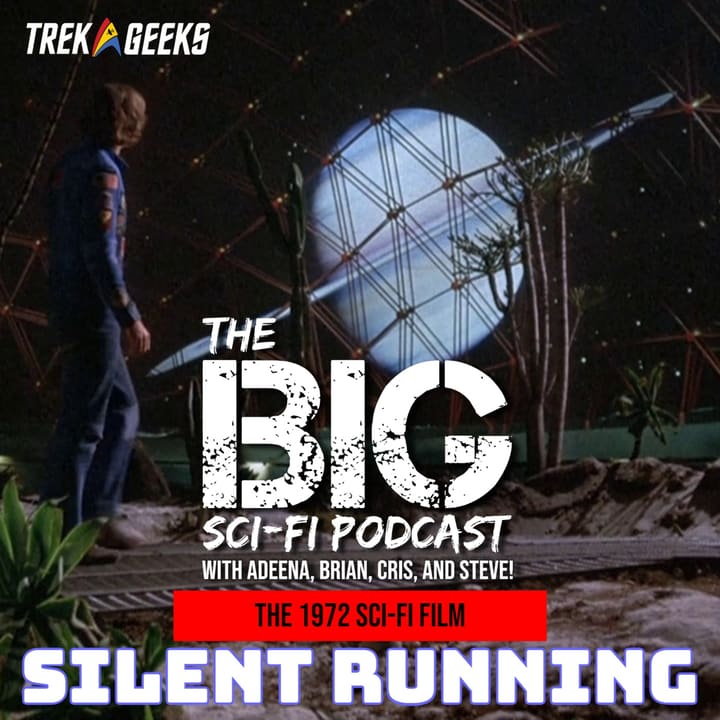
The 1972 Sci-Fi Film
Come with us as we explore this one-of-a-kind conservation sci-film from the mind and heart of the legendary Douglas Trumbull. His direction of this 1972 film was unexpected, but executed with great love and care for the message of taking better care of our planet. Ahead of it's time in some ways, and troubling in others, we talk about this film from all the angles. We hope you'll have fun listening and, if you've never seen this film, that you might give it a chance!
This podcast is a proud part of the Trek Geeks Podcast Network and works hard to bring you great content from all over the science fiction universe. We would love to hear your feedback, suggestions, and ideas. Take a moment to send us an email at thebigscifipodcast@gmail.com.
Check our podcast out and learn more about the other great podcasts on the network by visiting trekgeeks.com.
We've got the merch! If you want BIG Sci-Fi swag, check out this link and support us by wearing us everywhere you go! https://teepublic.com/thebigscifipodcast
Check out all of our social links in one place:
https://linktr.ee/thebigscifipodcast
Check out Cris' amazing YouTube channel for Trek content galore:
https://www.youtube.com/@yellingaboutstartrek1532
Check out Brian's new book available at Amazon for Kindle and in paperback:
Subscribe for free to Brian's Substack page where he writes original science fiction and fantasy: https://bdonahue.substack.com/
Find Adeena's books here: https://crazyrobot.myshopify.com/
Follow her on Substack here: https://beyondthedroid.substack.com/?utm_source=homepage_recommendations&utm_campaign=1493637

[00:00:00] Welcome to season 5 of the Big Sci-Fi Podcast with Adina, Brian, Chris and Steve, the biggest
[00:00:14] sci-fi podcast in the galaxy.
[00:00:17] The adventure is just beginning here at the Big Sci-Fi Podcast and we invite you to come
[00:00:21] aboard the Starship Tangent.
[00:00:23] We know you'll enjoy the conversation, the members of the big sci-fi podcast. They are Adina. Hi everybody. Brian. Yo, yo, yo, yo, yo. It's Brian from Ohio. His favorite song. And Chris.
[00:01:40] Hey everybody.
[00:01:41] Wow.
[00:01:42] That's all I got.
[00:01:43] What? Okay.
[00:01:44] Do you want me to sing a song? film. And I didn't understand what he meant, but after watching the Andromeda strain first and then Silent Running, I understood what he meant. Too often, sci-fi films deal with apocalyptic storylines, like Plan of the Apes, nuclear weapons cause us to go back to the Stone Age, and Jonathan Frakes all signed the bottom of the base of my model of the Phoenix that day at the convention. I don't often ask for signatures, but to have those great steward means a lot to me. Okay, okay, I'll get off myself, Bax. That's it. Let's discuss this film with my fellow podcasters.
[00:04:23] Can I ask you a question?
[00:04:25] Yes.
[00:04:26] I'm sorry.
[00:04:26] Go ahead. Heston is in it, right? He sure is. So I love Charlton Heston movies for the most part. And so I can't believe I've never seen that. Yeah, I think I heard about this because I went into it or down the rabbit hole looking for facts on my other favorite movie of all time, Brazil.
[00:05:43] And then eventually that led to, oh, yeah, there's a movie where people
[00:06:42] Yeah. Watching Charlton Heston movies.
[00:06:45] Yeah. And so it's just one I've never saw it before. It's interesting because Charlton Heston starred in three very unique films at
[00:06:50] the during that period of time. He starred in Planet of the Apes.
[00:06:54] Yep. He starred in Soil and Green.
[00:06:58] He also starred in a film called The Omega Man.
[00:07:01] The Omega Man. Freaky movie.
[00:07:03] You've seen that one?
[00:07:05] Yes, go ahead. And it dovetailed into what I was saying a moment ago with the things kinda coming into pop culture or not. And I think that's why this has been on my mind is, because I feel like I'm fairly well versed in quote unquote classic-ish science fiction movies,
[00:08:21] especially movies from the 60s and 70s.
[00:08:25] But not only had I thought that this was a similar-ish movie to that. Then, so I had zero idea and I'm like how did I get, I'm surprised, like how did I get this far and knowing that Silent are robots in it, too. Yeah, I knew nothing about these robot. These I've never when we, you know, when I see images of pop culture robots, I feel like I see everything. I don't see these. Yeah, I haven't seen those either. But I know I'm in the same.
[00:11:01] I feel like I also know, but I just feel like every once in a while That's true. So now that the fact that you've the other three have you three have seen it, what did you think of the film? How did it make you feel?
[00:12:20] Any order? It was a it was a roller coaster for me.
[00:12:23] For one thing, I'll say this.
[00:12:24] I so I think so what I usually do,
[00:13:26] One of the things I found interesting about it, Steve, is the main character is at odds with the other three guys up on the ship immediately. But he's got one guy that's trying to figure
[00:13:32] him out and trying to soften the other guys. That was all like, Adina has pointed this
[00:13:37] out about some 80s films, like just very cringe-worthy, stereotypical joking back and forth. There's
[00:13:42] the one odd man out, you know crazy so well, whatever it is.
[00:15:01] From being in the Twilight Zone episode of the Zanti Um, and so it was, it was in essence a short know if there was, say, a group of people on Earth who cared too, and he was the only one who was able in a position to act on behalf. Because as diverse as the people of Earth are, there's not gonna be just one human who cares about theirs. There's gonna be a lot of humans.
[00:17:41] And so that kind of made it hard,
[00:17:44] but that also as a short story I used titles like that, but at the end of the day, you have an organization, a group of people, and someone does have to be the leader, so I was. So my love of science fiction combined with my love of the environmental stuff, again, also makes it surprising that I didn't see it back then, but I wish I had. Well, do you think of that this film came out in 1972?
[00:19:03] Earth Day, I think, started in 1970.
[00:20:02] war or this is going to be that or we're going to kill the environment. You know, that so is very it was a very deliberate use.
[00:20:05] And that's and that's fine.
[00:20:07] That's nothing wrong with that. But.
[00:20:11] Did I go with that statement?
[00:20:13] Good, Chris. Yeah, I feel like I'm in the same boat.
[00:20:16] So one thing I do want to say, going back to the acting,
[00:20:19] I actually liked the performance of the camera.
[00:20:22] What's the character's name?
[00:20:25] The free treatment, the free know, they're right. It just seemed like it was just more the parts of the time
[00:21:45] where I feel like even if you look at 2001 like
[00:22:43] to a, maybe to a film interesting stuff, but I would have liked more.
[00:22:48] I think just because I always like more and more answers to things.
[00:22:49] You're right, Chris. And I think, I think if this film was remade today, they might show more of
[00:22:54] the actual situation on earth.
[00:22:57] And cause there's gotta be other people going like he did.
[00:23:00] This is insane.
[00:23:02] When he gets the order that they're supposed to blow up everything and return 2001, he did Blade Runner. So he was, you know, this was something different, but he still wanted that detail on the spacecraft themselves. You can really see the budget come through in the explosions. Yes. Where it's basically lens flare, you know.
[00:24:21] But seeing the pull apart, you know,
[00:24:23] when the models, when the dome came off,
[00:24:26] yeah, they're doing that separation.
[00:24:28] Yeah, that was kind of neat. to appreciate that. We're going to talk about the song too. Go right ahead. The song was interesting. It was 1972. It was peace loving. I like Joan Baez. I like her music.
[00:25:41] I was caught off guard when that all of a Adina. Come on, Steve. I've been listening to Final Frontier all week. Like, just put on my headphones. And I love it. I love that song, though. I actually really like the song. I'm just like, why do this joke? When a horror sings? Yeah. Yeah, this is. I've always wanted to play to a captive audience.
[00:27:01] Boys.
[00:27:04] Well, I'm glad you chose that part of Brian
[00:27:07] and not the soundtrack. Now, it wasn't easy.
[00:28:21] And I actually went to this place near where I lived
[00:28:24] where they made bootleg movie soundtrack tapes.
[00:28:27] And I like a really good choice. But I mean, overall I didn't, I didn't really like notice it. Normally when I don't like a soundtrack, I, I, I'm all over it. I'm like, Hey, this terrible. I didn't, except for this theme song,
[00:29:43] I, I didn't notice it so much. So that's, I think it was in the background. It's just there.
[00:30:43] And he was the very first CD I ever purchased of music. Oh really?
[00:30:44] Interesting.
[00:30:45] Which I still have it.
[00:30:46] And another interesting fact, listeners of the big Sci-Fi podcast, I think every single
[00:30:51] episode we've ever had, Steve has at least one person we talk about that he's seen or
[00:30:56] met in real life.
[00:30:58] It's like you, it must just be the LA connection.
[00:31:01] He lives in Hollywood, yeah, because they were they were people there. These are people who are amputated below the waist. Well, I think and I think for it is yes, I was very surprised. I was not expecting. I was not expecting that. I thought they were going to be puppets.
[00:32:20] Yeah. And that they were they were standing on their hands
[00:32:23] as they were doing their their their bits.
[00:33:21] learn poker on their own.
[00:33:25] No, no. But once they learned it, once they were told, you know, he, he puts in there how to play the game of poker.
[00:33:29] So they played.
[00:33:30] And then the scene where he's,
[00:33:31] he's falling over laughing because he just got beat by his computers.
[00:33:36] Yeah.
[00:33:38] Which was kind of like, okay.
[00:33:40] So they were developing their own personality,
[00:33:42] so their own intellect so that he could end up leaving the one behind to tend to
[00:34:44] cassettes were, you know, the, uh, the stuff that cassettes are on,
[00:34:50] the magnetic tape that existed. And so that kind of being like some extension of you're still, you are keeping the program external and then you're giving it
[00:34:54] to them and then you can replace it with something that you can take it out.
[00:34:57] And that's actually extension of what he was, you know, of, of the seventies,
[00:35:02] they was doing something, they were printed circuit boards.
[00:35:05] So he was doing something. We using the,
[00:36:04] of the moral aspect of the film of his actions. Yeah, so this is where I had the hardest time
[00:36:07] because I understand what he's doing
[00:36:09] and I get like the greater good of like,
[00:36:11] he has to do this to save the forest, to save the dome.
[00:36:16] But I was like trying to figure out,
[00:36:17] it just seemed like killing these people
[00:36:19] was like the most extreme thing you could do.
[00:36:23] Like, I had a theory,
[00:36:26] but I was thinking say that was the most deplorable, right? A little less deplorable his life's work, yeah. But in some ways it's more than his life's work.
[00:39:02] It's like he thinks that that't allow them to take him. So of course he does the last thing he does. I'm going to push back a little. Okay, go ahead. And correct me if I'm wrong, I'm not sure for my actions. I, I just, I killed three people and I still can't let the last forest go. This thing I fought for, which is he, then he's also, I guess. Yeah. Yeah. I mean, I've, I think they kind of led us to say he would jettison that for, he
[00:41:42] would not let them get the forest and destroy it.
[00:41:45] Right.
[00:41:46] Um, but yeah, I, those were very callous and even though he's a little under the gun pressure, there was still a little tacticalness to it because he let the dome go and detonate it,
[00:43:01] kind of very knowingly, there was a little bit of planning.
[00:43:04] And so that's where, yeah,
[00:43:05] he doesn't have the kind of moral center, be cheering on his character as much as the overall message they wanted to get across of just the insane situation they were all in with Earth, having destroyed a ton of its natural resources. But I also like, I found myself wanting to like Lowell. Yeah.
[00:44:20] But I just, it was like, oh man, these robots are really what I like.
[00:44:25] You know, in the little cars then it, uh, we'll, I don't know what that's called by my not thinking of the right term, but I'll try and reset the game for you. I thought that was interesting. And that was, you know, again, very early rudimentary, robotic, robotic systems for manufacturing that it would pick up something and drop into
[00:45:40] another location and so on.
[00:45:41] So it's really hilarious.
[00:46:49] made Lowell seem like just strange and crazy for a reason or if it's just choices of the actor and director. Is it, you know, cause I just at the very, it is obvious he was the main character,
[00:46:57] obvious that we were supposed to sympathize with one actor playing all the, I mean, you've got a film like Gravity where it's just Sandra. She's the, you know, and, and it's, they've got to be good actors to keep you and You don't know the name of the movie You don't know what year it came out there Joseph this is a movie that came out and you were to just purely read the script and you had a guess the decade or possibly the part of the decade it was I feel like
[00:49:43] You'd be able to guess the time period of this whatever. And the rest of them are just support people that are just there because it's a job. And the big difference of what you do is you have communication back home so that botanist guy can be talking back to people on earth. So he can be talking back to his homies
[00:51:00] who are also outraged environmentalists.
[00:51:03] Now you have these that's got a big mission, but like the Martian in some ways has a similar vibe where you have someone out by themselves, they can eventually communicate back to Earth to solve whatever problems they're solving. And I think there's similar vibes there and why you could say it work. And even again, gravity was a good example too,
[00:52:20] where you have someone out in space dealing with a problem.
[00:52:24] And again, well, her connectivity again,
[00:52:26] back to Earth was We need to make a list of all the movies are remaking. So so far we have explorers and now we have silent running. I
[00:54:45] want to figure out a better way to do this than the one guy who just cares about blowing stuff up and coming home. Or you could have that moment like on Hunt for Red October where Alec Baldwin,
[00:54:53] you're the blank chef, you're the chef! And then he shoots the living daylights out of him,
[00:54:59] you know, like that's the guy who's been sabot You're right. It was. And not only a book. Who wrote the book? Michael Crichton? Was that? No. Who was it? Who wrote the book? Come on, Dina. Yes, Michael Crichton. Sorry. It was. Okay. It was Michael Crichton. Who also wrote Jurassic
[00:56:22] Park. Is that right? Yeah. So again, he's written. But again, it. So that's fair. Interesting. Interesting. Can I ask a question about the end game? What was like, where does he expect the dome is going to go? Say in 10, 20 years, he makes that statement. Remember, he makes a statement about having I once put a note in the bottle and threw it in the ocean.
[00:57:40] I don't know if anyone ever found it.
[00:57:43] So his idea was I'm just launching us into space.
[00:58:42] That's the thing is he didn't have an end game. He didn't.
[00:58:43] Which I agree with Steve.
[00:58:47] With that message in the bottle was kind of
[00:58:50] his explanation for that that's the only insight into that.
[00:58:54] Right, and that his problem was solved by putting up some
[00:58:59] high intensity lights and that would generate the
[00:59:04] equation which was sunlight how they fueled it. They kept playing that blasted song over and over again and that that created energy for everything. Good vibes. That's how the shoot was. Good vibes.
[01:00:22] Joan Baez is right now crying because of what you said. I said it off camera before you came on, but I'm not sure I want to anymore. I, I think this is one of those films I'm probably never going to watch again. That's in, you know, I mean, that's obviously, you know, we all have those films, but you know what? I'm not going to be, no, I don't, should I guys,
[01:02:47] They use the words high end Domino's carryout pizza. So that hurt. I love me some Domino's too. Are you getting cheese in the crust? I hope you're getting cheese in the crust.
[01:02:52] But I will say this, Adina, the best pizza I've ever had was when we went to that pizza
[01:02:57] shop in Long Island. Oh yeah. That was, that was, if to moonfall. By the way, the other awesome classic films, science fiction films, films of the early 1970s, the ones I can think of are all also based on books.
[01:04:20] Clockwork Orange, Logan's Run, Sloane House Five,
[01:04:25] all based on books, take Instagram, or whatever platform you use to listen to our podcast. And please if you want to send us your thoughts via email at the big sci-fi
[01:05:40] podcast at gmail.com. If you send us an email, I know we'll respond.


