
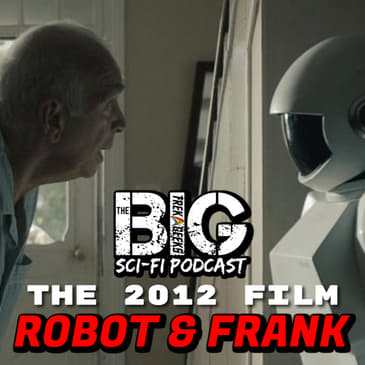




The 2012 Film
The BIG Sci-Fi Podcast embarks on an intriguing journey into the world of Robot and Frank, a heartwarming and thought-provoking film that explores the unlikely friendship between an aging ex-cat burglar and his robot caretaker. Join us as we delve into the film's captivating storyline, examine its poignant themes of aging, memory, and the ethical implications of caregiving robots, and discuss its unique take on human-robot relationships. We'll also share our reflections on the movie, dissect its cinematic elements, and consider its impact on the sci-fi genre. Whether you're a sci-fi aficionado or just curious about the future of technology and companionship, this episode is sure to spark some fascinating conversations!
This podcast is a proud part of the Trek Geeks Podcast Network and works hard to bring you great content from all over the science fiction universe. We would love to hear your feedback, suggestions, and ideas. Take a moment to send us an email at thebigscifipodcast@gmail.com
Music heard on this podcast opening is from Mikhail Smusev of SignmaMusicArt and provided by Pixabay. Listen to more of his music at: https://pixabay.com/users/sigmamusicart-36860929/
Music heard at the end of this podcast is from Ivan Ohanezov of PumpUpTheMind and provided by Pixabay. Listen to more of his music at: https://pixabay.com/users/pumpupthemind-19969411/
Check our podcast out and learn more about the other great podcasts on the network by visiting trekgeeks.com.
We've got the merch! If you want BIG Sci-Fi swag, check out this link and support us by wearing us everywhere you go! www.teepublic.com/thebigscifipodcast
Check out all of our social links in one place:
https://linktr.ee/thebigscifipodcast
Check out Cris' amazing YouTube channel for Trek content galore:
https://www.youtube.com/@yellingaboutstartrek1532
Check out Brian's new book available at Amazon for Kindle and in paperback:
https://www.amazon.com/stores/Brian-Donahue/author/B0C3BQ93VD
Subscribe for free to Brian's Substack page where he writes original science fiction and fantasy: https://bdonahue.substack.com/
Find Adeena's books here: https://crazyrobot.myshopify.com/
Follow her on Substack here: https://beyondthedroid.substack.com
[00:00:00] This is the Big Sci-Fi Podcast, the biggest sci-fi podcast in the galaxy, a proud part of the Trek Geeks Podcast Network.
[00:00:08] Season 6 was a blast, but Season 7 is going to be even more fun as we continue to go where no podcast has gone before, deep into the sci-fi universe.
[00:00:19] Join Idina, Brian, Chris, and Steve as they explore television, film, and literature for the best sci-fi has to offer.
[00:00:26] Even if you're not a sci-fi fan, you'll love the banter and the epic tangents as these four friends talk about what they love.
[00:00:34] We invite you to sit back and relax, because the journey is just beginning on this season of The BIG Sci-Fi Podcast.
[00:00:44] Today, The BIG Sci-Fi Podcast is going to discuss a film that deals with a condition that affects nearly 7 million Americans, Alzheimer's, and dementia.
[00:00:55] This is a particular concern to those of us over 65 years of age, where 1 in 5 women and 1 in 10 men will suffer from this debilitating condition.
[00:01:07] I'm 68, so this is a particular concern for myself.
[00:01:13] And this brings us to the film we are going to discuss today, 2012's Robot and Frank.
[00:01:21] Since the co-star in this movie is a robot, it clearly fits the criteria of films we like to review on this podcast.
[00:01:28] However, what makes this film so special is the quality of it.
[00:01:33] The cast of renowned actors that are in it, such as Robert Langella as Frank, the star, Susan Sarandon as Jennifer,
[00:01:44] Peter Sarsgar as the voice of the robot, James Marson as Frank's son Hunter, and even Liv Tyler as Madison, the daughter of Frank.
[00:01:54] Frank, these actors must have given up a lot of salary because it was made on a modest budget of 2.5 million and earned a less modest amount of 4.9 million at the box office.
[00:02:10] Now, I was one of those who helped to get it to the lofty 4.9 million when it came out, if we are to believe these stats from Wikipedia.
[00:02:20] Now, Alzheimer's is a disease that might have encountered with any of our family members or friends.
[00:02:29] It's not nice.
[00:02:30] On a personal note, it affected my father's mom and dad to the point that near the end of their lives, they had no idea where they were, living in a home for the aged, or who many of us were.
[00:02:43] My dad asked me repeatedly why I would not visit them at the home, and my reply always was, I don't want to remember them this way.
[00:02:52] I'm going to introduce the members of the Big Sci-Fi podcast, and I will ask them, if they like, to tell us of anyone they have encountered that suffers from Alzheimer's disease.
[00:03:04] And that's their choice if they wish to do it or not.
[00:03:07] So, I'll start with Adina.
[00:03:08] Hi, everybody.
[00:03:10] And yes, there has been some Alzheimer's and dementia in my family.
[00:03:15] My great aunt, Rose, she suffered from Alzheimer's, and she never had any kids of her own.
[00:03:21] And she was my grandfather's sister and one of 10 kids.
[00:03:25] And so, my dad and a couple of the cousins wound up becoming responsible for her.
[00:03:30] And I hadn't seen her in her later years.
[00:03:33] She was in a facility.
[00:03:35] But my dad would tell me that, yeah, near the end, she had no idea who anybody was.
[00:03:41] And again, it was very, very, like, end-stage stuff.
[00:03:46] And my grandmother, my maternal grandmother, she also suffered from dementia.
[00:03:50] I don't think she was ever really diagnosed.
[00:03:55] It was slight in her last decade or so.
[00:04:00] It was more evident in the last few months and especially the last few weeks of her life when she was in a facility recovering from a fall.
[00:04:09] And I called her every day for more than a week before she wound up in hospice care.
[00:04:16] And we literally had the same conversation every day.
[00:04:21] She would say the same exact things to me as if I hadn't talked to her in months.
[00:04:26] So, yeah, at least she knew who I was.
[00:04:32] That's good.
[00:04:33] So, I think that's the extent of my direct experience with it.
[00:04:36] Chris, any thoughts on this as well?
[00:04:39] Yeah, I really haven't.
[00:04:41] Both my grandparents passed before this started, like, before it happened to them.
[00:04:45] My grandpa, when, like, maybe a week before he passed, I can't remember what the issue was.
[00:04:50] But he, I guess, was suffering from that to a degree because he, like, for quite a while wasn't remembering who we were.
[00:04:57] But then, but just also wasn't, like, processing anything.
[00:05:00] So, I don't even think it was that.
[00:05:01] I think it was something else.
[00:05:02] But, like, I was really, really fortunate that the last time I saw him, he was, like, cognizant.
[00:05:09] And he told me a bunch of stories.
[00:05:10] And it was just, like, old times.
[00:05:12] But, yeah, but, yeah, none of them, like, my grandparents didn't really have it except for that, which could have been.
[00:05:20] And then my mother passed well before that, too.
[00:05:24] So, I really haven't had any direct experience of it.
[00:05:26] Yeah.
[00:05:27] My mom and dad into their 80s were as sharp as tacks.
[00:05:30] Never had a problem.
[00:05:31] But my grandparents, my dad's mom, the worst part was she wasn't a particularly nice person to begin with.
[00:05:40] And when she, when the Alzheimer's started to kick in and she started, she was very, she wasn't pleasant to be around.
[00:05:48] And my grandfather, who was the sweetest character, my dad's dad, who was the sweetest man you ever knew,
[00:05:54] a machinist who worked for the Singer Sewing Company and designed components for sewing machines,
[00:06:02] you know, at the end, he went for a walk one day.
[00:06:06] And he was gone well into the evening.
[00:06:10] And the police had to find him.
[00:06:11] And that's when their parents knew it was time that he had to, they had to be, they couldn't live on their own anymore.
[00:06:17] Yeah.
[00:06:18] My Aunt Rose, that, the one I was speaking about, she, same thing.
[00:06:21] She, I have still somewhere the newspaper clipping of, of how, yes, Rose Mignona had gone off and had to be found.
[00:06:29] And I don't know if that was the time, but there were definitely times she left, you know, burners on, on the stove.
[00:06:34] And she was living with her sister, her sister who did have kids.
[00:06:38] And it is kind of funny how, so the one sister wound up with Alzheimer's.
[00:06:42] The other sister, Zitzi, she passed at 92, 93.
[00:06:47] And yes, sharp as anything till the very last day.
[00:06:50] Yeah, yeah.
[00:06:51] It, it is, it's, it's inconsistent the way it affects different people of the same age level.
[00:06:59] And it's just, it's just not, that's why this movie is, is really, it, when I saw it 12 years ago, it really touched me because it was personal.
[00:07:10] My parents, my grandparents had long since been gone, but it was very personal.
[00:07:13] So let's get, let's get into the discussion of the film itself.
[00:07:17] Okay.
[00:07:18] And I'm going to first ask the, our favorite old question.
[00:07:21] What was your overall impression of the film?
[00:07:24] You can start off with Dina if you'd like.
[00:07:27] Sure.
[00:07:27] Sure.
[00:07:27] I enjoyed it.
[00:07:29] And now I watched it this last week to prepare for today, but I did see it not in the theater, but maybe 10 or so years ago on a streaming service.
[00:07:39] Because of course, any film that clearly has the title robot and robots in it catches my interest.
[00:07:46] And then add in, it's robot and Frank and Frank being my grandfather slash son's name.
[00:07:53] Yeah.
[00:07:53] I couldn't not watch it.
[00:07:55] But it is interesting because when I watched it the first time, this was before my grandmother had passed and before we had significant issues with her.
[00:08:03] Um, because in the years, so she passed in 2014, which is about 10 years ago.
[00:08:09] But I know I definitely saw this before that because I would have, I'm looking at it differently.
[00:08:16] But also after 10 years, I'm just looking at, I guess, things, things differently.
[00:08:20] I always enjoyed it.
[00:08:22] I always was like, who could not want a robot cooking and cleaning for you?
[00:08:29] You know, Alzheimer's dementia or not.
[00:08:31] I mean, I still, I want that robot who can cook and clean.
[00:08:36] And, you know, the night, the thing I liked about it was that it could figure out what to cook for you.
[00:08:45] That's honestly the worst thing about adult life is having to decide that every single day and have to think about it.
[00:08:53] I don't mind the actual act of cooking, but having to make the decisions.
[00:08:57] So having a robot to make some of those decisions would be so lovely.
[00:09:01] Yeah.
[00:09:02] Yeah.
[00:09:03] Chris, what was your thought of the film?
[00:09:05] What did you think of it when you said it?
[00:09:06] I really enjoyed it.
[00:09:07] Like, I started it as I thought, okay, it's going to be interesting.
[00:09:09] I knew it would be good, but I was worried that it would be a little bit slow to get into.
[00:09:13] But then I was just surprised at how easily and how quickly I got into the movie.
[00:09:17] And there were just so many layers for me.
[00:09:19] There was a layer of, I love robots.
[00:09:21] Anything set in the future or near future is always cool.
[00:09:24] From a filmmaking perspective, I just thought it was really well shot.
[00:09:27] And I just loved how, I don't know if low key is the right word, but it's just a refreshing breath of, like, it's just refreshing to see a movie that's like not these crazy stakes.
[00:09:38] It's just a very personal story about a man who's trying to deal with, like, you know, deal with not being who he used to be.
[00:09:45] And his dealing with his children who are well-meaning but frustrated.
[00:09:51] So I like that aspect of it.
[00:09:53] But then also just reminded me of my grandpa, like, especially when my grandma passed, where he would just be alone by himself.
[00:09:59] And there is very much of a, like, hey, do you need our help?
[00:10:05] And yes, he would be very good about calling us to say, I need your help.
[00:10:08] But there is also very much, like, I want to do things on my own.
[00:10:11] So it just reminded me of seeing that.
[00:10:13] And I find anytime there's, like, an older person in a movie, especially if it's a male, I just always think of my grandpa.
[00:10:20] And it always just brings me back to that.
[00:10:21] So it just, like, it touched me on it a lot of different ways.
[00:10:24] And then, yeah, the robot was cool.
[00:10:27] And it was, and I just loved how sweet it was.
[00:10:31] It was a very sweet story that involved a jewel thief.
[00:10:36] And I just love that idea that it's like they were bonding over, hey, I'm going to teach you how to break a lock or how to pick a lock and do all that stuff.
[00:10:43] So, yeah, just very well done and really enjoyed it.
[00:10:46] And it was neat how the robot would, was like, humor him or attempting to humor him, trying not to go full on, hey, I'm going to be a robot thief.
[00:10:55] But was like, okay, no, we can plan.
[00:10:58] Planning isn't doing.
[00:10:59] Thinking about isn't doing.
[00:11:00] Learning how to pick the lock isn't actually picking a lock, you know.
[00:11:04] I really liked that the robot was kind of aware of that boundary.
[00:11:09] And even though Frank really pushed it and kind of took advantage, the fact that the robot did, was aware of the boundary was really interesting.
[00:11:18] And it had me thinking throughout the film, like, was it staged to give him something to do?
[00:11:27] You mean, was that the intention of like, I'm going to call him Cyclops.
[00:11:31] What's his name?
[00:11:32] Hunter.
[00:11:33] Right.
[00:11:34] I don't think Hunter was thinking.
[00:11:36] I have to say.
[00:11:38] I know, because that's what he plays.
[00:11:40] Yes.
[00:11:40] It was really nice.
[00:11:41] And I just love anytime I see him in a movie where he actually.
[00:11:45] I don't want to be mean because I really like the X-Men movies, but he didn't get much to do.
[00:11:48] But like having him be a presence and like having him play that son who, again, is well-meaning but frustrated.
[00:11:55] So, yeah, to your point, I don't know if it was like even intentional on his, but I was like, well, I just need someone to look after him.
[00:12:00] Right.
[00:12:01] Well, but with the connection with the wife and the library, and so he still steals the book.
[00:12:08] It's almost like I had this thought, I don't think it's right, but I had this thought that like they staged it for him knowing that he would latch onto that as an intellectual activity.
[00:12:19] Right.
[00:12:19] Because like she showed him the book.
[00:12:22] Yeah.
[00:12:22] Right.
[00:12:23] Like we get at the time that she shows him, we think she's just showing him a book because he's interested in books.
[00:12:28] But the fact that she's his ex-wife.
[00:12:32] Oh, really?
[00:12:34] I didn't know that until the end of the, that's the beauty.
[00:12:37] We're going to get to that.
[00:12:38] Yeah.
[00:12:39] But the thing is.
[00:12:39] I didn't know.
[00:12:40] I was like, was I supposed to have known?
[00:12:41] But I love that little twist.
[00:12:42] Yes.
[00:12:43] That reveal was a great reveal.
[00:12:45] Yeah.
[00:12:45] But the thing is, is so she's showing him the book knowing full well he's a former thief.
[00:12:53] Mm-hmm.
[00:12:53] And he's got these issues.
[00:12:55] She obviously knows that he's going to have this, you know, because it sounds like she and the kids talk just fine.
[00:13:03] Right.
[00:13:03] So she's going to be aware of all the care plans.
[00:13:06] So I'm almost like, did they, now they might, they probably did not intend for him to go and steal the dude's like jewelry.
[00:13:14] Right.
[00:13:14] But I feel like the book was a deliberate setup to kind of entice him to an activity that he would be drawn to.
[00:13:24] Right.
[00:13:25] I kind of like that.
[00:13:25] I actually like that.
[00:13:27] It's interesting.
[00:13:28] I'm sorry.
[00:13:29] Go ahead, Chris.
[00:13:30] Yeah.
[00:13:30] I was going to say, it's an interesting idea.
[00:13:31] I didn't get that vibe.
[00:13:33] But like looking at it now, because now you're right.
[00:13:35] Because it's like she's his wife, ex-wife.
[00:13:39] She already knows what he's.
[00:13:40] That was a little confusing because being the ex-wife but having pictures of him in her office, that was where I'm like, maybe is she his ex-wife or is not?
[00:13:52] Like I was a little confused about that part.
[00:13:54] Well, again, when the picture that they showed of the two of them together was very early in their marriage.
[00:14:01] So at some point when he went to prison, that's maybe when the marriage ended.
[00:14:07] But she never stopped loving him.
[00:14:10] She just couldn't be around someone with that criminal activity or in that situation where she had to protect her children from that type of life that they wanted him.
[00:14:23] I think he even said at one point, like he says, I tried to show Hunter this stuff and he just never latched onto it because the son knew that this is a criminal activity.
[00:14:33] And the end result was dad went to prison twice for his activity.
[00:14:39] So, yeah.
[00:14:40] But you're right about that, Adina, is that it's almost like she said, here's the book.
[00:14:44] And then later on in the movie, she goes, I knew you stole it.
[00:14:48] Right.
[00:14:48] Because she knew that that's something that he would take this one thing that really meant something to her because she knew that the library was closing, all the books were going, everything was going to be digitized.
[00:14:59] And as a book person, I also want your thoughts on how you feel about that type of activity happening in the world because it could be happening in the world.
[00:15:09] I like your response.
[00:15:11] But it was almost like she want him to get the book.
[00:15:14] And then when he went to return it to her as a gift, because he didn't even his cognitive skills were like separate from one from the other that he stole it from her and then was returning, giving it to her as a gift, realizing or not realizing.
[00:15:30] I just I stole this from her, you know, and now he's giving it back to her.
[00:15:35] I took it as like, it's not really because she's having to sell everything.
[00:15:41] So that wouldn't be hers.
[00:15:43] So it's like, I'm going to steal it from the place that she works so she can have it before it gets sold to this other person and this other agency.
[00:15:52] That's how I took it.
[00:15:53] So he thought he was doing like a favor, like, I'm going to get this for her because it means something to her.
[00:15:57] Yeah.
[00:15:58] She can at least have it and they'll just think it was a thief and they're not going to like.
[00:16:03] Yeah.
[00:16:04] Back her down, even though that probably would happen.
[00:16:06] Well, you worked here.
[00:16:08] We're going to talk to you first.
[00:16:11] But I took it as that, like, I want to do this for my wife.
[00:16:13] Or again, it's hard because.
[00:16:16] No, I don't think at any point in time up until that reveal, I don't think he recognized her as.
[00:16:21] Yeah, no.
[00:16:21] But he recognized her as a woman that he was interested in, which makes sense given that she at some point was his wife.
[00:16:29] So, you know, but he, you know, his dementia has progressed to the point where he's not remembering very significant details of his life.
[00:16:40] Yeah.
[00:16:42] That does happen.
[00:16:43] And I mean, people who have advanced case, they have their short term memories is terrible and their long term memory is non accessible.
[00:16:55] I mean, corrupted files, whatever you want to say in the world of computers.
[00:17:00] A dean is what's happening in the human brain, which is an amazing device.
[00:17:04] Yeah, but it's interesting what he still does remember, although he does get details with his kids confused.
[00:17:11] Like, like he knows who his kids are, but he thinks, you know, Hunter is still in school and all that.
[00:17:16] Right.
[00:17:16] Mm hmm.
[00:17:17] Yeah.
[00:17:18] And so anyway, I was going to propose, what did you think about the idea what this quote unquote yuppie guy was going to do to the library and get rid of books and digitize it or turn it into a coffee shop?
[00:17:32] Yep.
[00:17:33] So I think very clearly what's happening in the real world, I don't see that stopping is, you know, there's clearly a large number of people that love actual books, you know, but there's clearly a large amount of digital content.
[00:17:50] I think the people who love books in all forms, you know, there's room for both, you know, actual books aren't going away.
[00:17:58] It's quite possible that, you know, libraries will slowly favor digital content because it's easier to manage and maintain.
[00:18:28] Mm hmm.
[00:18:31] I don't, you know, while you're seeing just this one, I think they're, you know, kind of implying that this is kind of becoming the new, the new world in their universe.
[00:18:43] But like I said, I don't think it, I don't think it will happen like that or if it does, it will be so, so gradual and it will be in the form of less books are printed.
[00:18:53] But I don't, you know, look how many people and how much love for actual physical books there are.
[00:18:59] Yeah.
[00:19:00] Yeah.
[00:19:01] Yeah.
[00:19:01] I feel like that's just one of those things that's just totally not going to go away.
[00:19:04] Like I generally prefer like digital, but I still like sometimes just having a physical book and I'm like, I wouldn't want there to be a time where we can't go to a library and like, you know, check out a book or even just hold one.
[00:19:17] Yeah.
[00:19:18] Yeah.
[00:19:19] No, there's something, something very tactile about putting that, putting that bookmark in the page so you don't lose track of where you were when you left it.
[00:19:29] And then picking up again where you left off and going from that point.
[00:19:33] So, yeah, there's, I, it wasn't, I think again, like the movie opened, you know, in the near future.
[00:19:38] So it doesn't really say when this is, we just know it's sometime in the future and this is maybe a possibility of what could happen.
[00:19:46] Mm-hmm.
[00:19:47] So with your love of robots, Adina, what did you think of the way that the robot was portrayed?
[00:19:53] And, and actually the design of the robot was based on the Honda robot.
[00:19:59] Yeah.
[00:19:59] It looked very much like it.
[00:20:01] So the activities, well, go ahead.
[00:20:05] Oh, no, no.
[00:20:06] I was going to say I loved everything about it.
[00:20:08] I want it.
[00:20:10] Yeah.
[00:20:10] But seriously, I will, I will absolutely be an early, if it's financially feasible, I would definitely be an early adopter of a household robot that can cook and clean.
[00:20:20] But the key part of that is the decision making aspect of it.
[00:20:24] I don't want to have to tell it to clean.
[00:20:26] I want it to know.
[00:20:27] I want it to look at my, look, just look at the room and know things need to be put away.
[00:20:32] And that's, that's really like the key.
[00:20:35] That's the key with teenagers and that's the key with husbands too, is all we want is for them to kind of self-actuate and know what to do without us having to say anything or be the manager of it.
[00:20:50] So no, so I really, so those aspects of the robot where it was clearly designed to take initiative.
[00:20:58] Ah, I, I, I can't wait for that.
[00:21:00] That's what I want.
[00:21:01] It's what I've always wanted.
[00:21:01] Funny because the daughter Madison was adamantly against them having the robot.
[00:21:08] She whispered the password into its speaker, whatever, and shut it down.
[00:21:15] And then she in turn realized, I really need to have this thing.
[00:21:21] And she turns it back on so it can clean the house.
[00:21:23] So she could, she feels overwhelmed by it.
[00:21:26] I, I think once we get used to a technology, we can't, we almost can't live without it.
[00:21:33] Yeah.
[00:21:33] Well, and the thing is, is with, in the case of this particular technology, the thing I didn't like about her character is they didn't really give any reason for why she didn't like it or thought it was unethical or whatever.
[00:21:46] There was no actual reason.
[00:21:48] And in the case of this kind of home health care, it makes so much sense.
[00:21:53] So many people want to be able to stay home.
[00:21:55] And so it was really interesting.
[00:21:58] So recently I just happened to come across another short season of a show on Netflix, not science fiction, but with Ted Danson.
[00:22:09] It's called The Man in the Room.
[00:22:10] Oh, I wanted to see that.
[00:22:11] I, I really liked it.
[00:22:13] And so it written, uh, done, I think it was written by the same guy who did The Good Place, which, which I loved.
[00:22:19] And, um, so Ted Danson is playing, uh, an older retired gentleman who goes undercover at one of these independent living facilities.
[00:22:30] They think there's a thief or something there, but the kind of side plot or subtle thing going on is what you learn about his character.
[00:22:38] And I'm sorry, there's going to be some spoiler alerts on this, but nothing, nothing crazy.
[00:22:42] Um, cause you learn this pretty much in the first episode.
[00:22:45] So his wife had passed maybe a year or so ago of Alzheimer's.
[00:22:50] And at some point in one of the episodes, when you're getting deep into Ted's character, uh, he, one of the, the, cause he sees another character in the home struggling with the early stages of that.
[00:23:05] And so he's affected because he sees, you know, repeat of what was happening to his wife.
[00:23:09] And so at some point it comes out, he's saying how, you know, one of the things he had promised his wife is that she'd stay at home and she wouldn't have to go to a facility.
[00:23:20] But he's upset because like the day before she passed, he had made the decision to, uh, you know, to admit her to one of these facilities cause he couldn't care for her anymore.
[00:23:34] And that's, that's such a big thing is anyone who's dealt with people in end of life care, not just from, from this, but from cancer, from other things.
[00:23:41] I mean, that is such a caring for, you know, sick relic.
[00:23:48] It's not to be taken lightly.
[00:23:50] And I feel like any help that we, it's not just helping the, the person who's ill, it's helping the caregivers and the other people around them too.
[00:23:58] And to turn your nose up at that technology for no good reason.
[00:24:03] And that's what I saw in, in live Tyler's characters, like no good reason.
[00:24:07] I'm glad she came around to it and realized, oh yeah, we do need this help.
[00:24:10] Yes.
[00:24:12] That's what I struggled with with her character because there was no good reason for it at the beginning.
[00:24:16] Yeah.
[00:24:16] If that, if this robot had existed while my mom was alive and while I was taking care of her, I would have said, yeah, sure.
[00:24:22] Like, let's do it.
[00:24:23] Like just another pair of hands because it does take a toll.
[00:24:26] Yeah.
[00:24:27] Because then you could spend the time just interacting with your mom and someone else or something else is cleaning the house, making sure there's food, making sure it's the right food, all these things.
[00:24:37] And then you can just focus on just say, just being with your mom.
[00:24:40] And it's not like this extra stress on you.
[00:24:43] It may have been that they just had to had a opposing view.
[00:24:48] Someone had to represent that.
[00:24:49] And the two brother and sister squabbling, not getting along on this sense, you know,
[00:24:55] and one is, what, out in the archaeology work or whatever she was doing.
[00:25:02] Something philanthropic in Turkmenistan.
[00:25:03] They didn't really explain it too much.
[00:25:06] But she's like, she's, you know, she's above this.
[00:25:09] She's someone who feels like, okay, things should be more natural, whatever.
[00:25:13] And the son is going, no, let's embrace this technology.
[00:25:17] It's going to help dad out.
[00:25:19] Let's do it.
[00:25:20] So you just had them competing with each other until the point where she realizes, yeah, this thing is really quite useful and helpful.
[00:25:29] And why did we do, why did I, she has to admit her mistake in having done that and admitting that it was the right thing to do.
[00:25:37] And then what did you think about, what about the whole idea of the jewel heist?
[00:25:42] Did you, did you like that?
[00:25:44] It was, it just, it was, it just, I don't know.
[00:25:46] How did you feel about that part of the story?
[00:25:48] I liked it a lot.
[00:25:50] I love heist movies.
[00:25:51] And so I always just love seeing people plan like, you know, when they get the architectural drawings and they get the layout and they talk about, okay, we're going to do this thing.
[00:25:59] Here's like all the exits, entrances and here are all the scenarios.
[00:26:02] I always loved that stuff.
[00:26:04] And I just thought it just hit on so many levels.
[00:26:07] It's like, one, it's fun to watch a jewel, like a jewel heist.
[00:26:09] Two, I thought it was really sweet to see him getting back into the groove of what he used to do, even though it's not the most honorable.
[00:26:16] But it was so fun to see him doing that and to see him incorporating the robot into it.
[00:26:21] And then just that guy, I was just like, you know what, dude?
[00:26:24] Like you deserve it.
[00:26:26] It's fine.
[00:26:26] You deserve it.
[00:26:27] I wasn't a fan of him, even though he technically wasn't doing anything wrong.
[00:26:30] He's just a business owner.
[00:26:31] He's, you know, but it's just, he came off that way.
[00:26:34] So I was like, yeah, let him, let him, let him have it.
[00:26:39] Oh, yeah.
[00:26:39] For the sake of the movie, I mean, it was, it was great.
[00:26:42] It was, so he's not just some older guy who just had just some normal career that any of us can identify with.
[00:26:48] He's got like this twist, this interesting, a little morally ambiguous because right.
[00:26:53] It's, it's not, he's not, he's not a murderer.
[00:26:56] He's not hurting people, but he's stealing stuff, which is wrong.
[00:26:59] He has been in jail.
[00:27:00] And again, and it's, it's cost him a lot.
[00:27:03] It's cost him his family, you know, a lot of issues with his family.
[00:27:06] But then, right, they make the guy who he steals from completely unlikable.
[00:27:10] So then you're not, you're not, you're not put off by the fact that he's doing it in the movie.
[00:27:16] He deserves it.
[00:27:17] He deserves it.
[00:27:18] Kind of an answer with that.
[00:27:20] But that, and that's, that's the, that's the neat thing about it because it was almost like the robot knew that part of its problem was to give Frank purpose.
[00:27:31] Give him something to do, to stimulate his mind, to stimulate his activity.
[00:27:36] Even if it is to bring back these old skills about how to pick a lock or, you know, how to case a joint.
[00:27:43] I mean, when he's sitting out in the field with the binoculars and making notes and stuff.
[00:27:47] But then when Frank, when the robot gets turned off and he's left by himself, he's missing his best friend.
[00:27:54] Because he hates the machine to begin with.
[00:27:56] As remember, he does not want the thing around him.
[00:27:58] He is considered an intrusion into his life.
[00:28:02] But in the end, they become the best of friends, which is really kind of a, the wonderful development of the story of the, he's trusting the robot.
[00:28:14] To work with him on this, even though, as you said, it's probably, probably the robot already knew that what they were doing was illegal and, and not proper.
[00:28:24] But he knew that it was giving him purpose and he could see the change.
[00:28:28] Whereas he's like, I want to eat this food.
[00:28:30] I wanted you to give me the nourishing food that I should be having as opposed to when his daughter shows up and just, I got your Captain Crunch.
[00:28:37] And she goes, I don't want to eat that crap because he's already been, he has evolved and gotten better.
[00:28:44] And that's where I think where this film develops and goes into that direction.
[00:28:48] Right.
[00:28:49] That people with activity fare better than those that are inactive.
[00:28:56] Right.
[00:28:56] And, and also just that whole caregiver aspect.
[00:28:59] I mean, most people, I feel like, don't know how to care for other people in the situation.
[00:29:06] You know, just because you're a parent, you want to care for them.
[00:29:09] You want to take care of them.
[00:29:10] But if you're not trained in any of that stuff, you have, you have no, you have no idea.
[00:29:16] Right.
[00:29:16] Like, I wouldn't know what to do.
[00:29:18] I have absolutely no idea what to do if I had to be in that situation.
[00:29:21] So having something or someone, and again, in today, it's expensive to have someone.
[00:29:28] So having something might be more, like I said, I am, you can't tell all for this kind of technology.
[00:29:35] And when I'm old, which won't be for a very, very, very, very, very long time, very long time, I will welcome this into my home.
[00:29:44] Let's get going.
[00:29:45] Let's, let's.
[00:29:46] Yeah.
[00:29:47] Let's do it.
[00:29:47] Let's do this.
[00:29:49] When are we going to get the transparent phones with like the transparent screens?
[00:29:53] Yeah.
[00:29:53] That's pretty neat too.
[00:29:55] Yeah.
[00:29:55] I love that.
[00:29:56] That was almost, you know, liquid crystal, liquid crystal design, something of that nature might be able to create that type of technology that can do something.
[00:30:08] But that was a little things that they wanted to show that we were in the near future that, you know, okay.
[00:30:14] So, yes, it's, it's an out, it's an Audi that he drives from 2012.
[00:30:18] Okay, fine.
[00:30:19] And she's driving a Prius from 2012.
[00:30:22] We, that's fine.
[00:30:23] Put that aside.
[00:30:24] Even though at the beginning of the movie, that little electric concept vehicle goes by Frank as he's walking down the highway.
[00:30:31] Oh, yeah.
[00:30:31] Oh, this is the future.
[00:30:33] That's what people are driving.
[00:30:34] No, they're still driving Audis and they're still driving Toyotas, but they got cool phones and they got robots.
[00:30:41] And that's where we're kind of, you know, are we 10 years in the future?
[00:30:46] Are we 30 years in the future?
[00:30:47] It's not known, but that's okay.
[00:30:50] That's okay.
[00:30:51] We, we just accept that because it's really, that's just, that's just part of what, how they wanted to advance the time to give the, that yes, we could have robots that assist the elderly, which at the end of the film, we see that there's more than one of those robots assisting other elderly people in the retirement home.
[00:31:13] Yeah.
[00:31:14] Yeah.
[00:31:15] I love this future.
[00:31:15] I also thought it was just funny when Hunter was like, man, there's like, what did he say?
[00:31:20] Like this house is like so dirty.
[00:31:22] And, and Frank is like, oh, it's just a little dusty.
[00:31:25] I'll take dust any day.
[00:31:26] It's like, well, no, you wouldn't.
[00:31:27] Cause we just came off of watching interstellar where dust was like a main threat.
[00:31:32] Like it was part of the, the harsh reality.
[00:31:34] So I thought that was amusing.
[00:31:36] And it's just like a nice to see a nice bright future where, yeah, some things were a little different, but it wasn't dark dystopian future as we saw.
[00:31:43] It was only semi dystopian with, you know, the print media going away.
[00:31:49] Yeah.
[00:31:49] And that part was like the one thing where man, oh, that's a little dystopian.
[00:31:52] Yeah.
[00:31:54] And, and did you think that Frank Langella as Frank, easy play.
[00:32:03] Did, did you really, did you believe his character having Alzheimer's?
[00:32:07] Did you believe, did he portray it in a way that you said, yeah, I, I, I see that in, in reality that he was acting the part.
[00:32:16] Yeah.
[00:32:17] I think he did a really good job.
[00:32:18] I felt it was very believable and it was definitely like sad to see like he, his really sharp moments and then to see him like slipping again.
[00:32:26] So that, that was tough, but yeah, he really did a good job in that role.
[00:32:30] I think he did too.
[00:32:32] Cause there's, um, you know, some of the things I remember from my grandmother.
[00:32:35] Um, so as she was developing dementia, I remember there was this one day in particular where I was up in New York, uh, visiting with family.
[00:32:44] And I swear during the day she asked me five times, where are you staying?
[00:32:52] As if she had not asked it was like, and we had the same conversation over and over again.
[00:32:57] And there's this, this processing moment that you can see in their face when you try to say something like, yeah, we, we, you know, you asked me this before grandma.
[00:33:08] And there, there's like this pause where they're trying to recollect and recall.
[00:33:13] And I think he, I feel like I saw that too.
[00:33:15] There was these pauses.
[00:33:16] He did, he did a great job of that pause and processing.
[00:33:21] And so I thought he was, I thought he was amazing.
[00:33:24] And of course, then with the reveal with the wife, when he sees the pictures and he like is putting two and two together, uh, the look on his face, I thought was great.
[00:33:33] He, he's fantastic.
[00:33:34] And that's the reason why she had forbidden him from coming into her office because she, she wanted to keep that away.
[00:33:42] She didn't want to shock him by realizing who she was that, you know, that they were a couple, so to speak, even without being a couple and realizing what's going on.
[00:33:55] And you have to wonder how many times had that happened before?
[00:33:59] That's true.
[00:34:00] Yeah.
[00:34:00] We, we don't know.
[00:34:01] Maybe.
[00:34:02] Maybe.
[00:34:02] I mean, she, she, yeah, like she, she knew, you know, she was very clear.
[00:34:07] Don't come in here.
[00:34:08] Don't go in there.
[00:34:09] And so, yeah, you have to believe that it had happened before and it was a bad reaction.
[00:34:15] And yeah.
[00:34:17] And so then she decided I better keep him away because his, his, he may have at the other time, you know, lashed out at her for lying to him or something like that.
[00:34:26] So rather than to allow that from happening once more.
[00:34:29] And that's the, that's what I said about my grandmother being the, the angry Alzheimer patient.
[00:34:36] Um, quite a few years ago, my daughter, Jenny was writing a, or helping prepare a book on the history of the genealogy of this husband and wife that she was working with.
[00:34:48] And, um, the gentleman, the husband, one of the reasons why they commissioned this also was that my daughter, Jenny was spending time with him during the day because he had Alzheimer's.
[00:34:59] But he was the nicest gentleman you ever met.
[00:35:03] And whenever there was a conversation going and he lost track of what was going on or what was being discussed, he would just say, Hmm, well, that's very interesting.
[00:35:15] And that was his way of trying to be part of the conversation, even though he had no idea what was going on.
[00:35:22] He was really, you know, so there's different people.
[00:35:25] And so you can just see that in this Frank has two sides.
[00:35:29] There's an angry side to him, but a compassionate side to him as well.
[00:35:34] And I think they, he came off just so beautifully doing that.
[00:35:37] I mean, really.
[00:35:39] And at the end, when the robot's saying to him, I'm the evidence of the crime, just wipe my memory, just go ahead and do it.
[00:35:50] But I can't do that to you.
[00:35:52] Frank says, I can't do that to you.
[00:35:53] He says, you don't understand.
[00:35:55] I'm not human.
[00:35:57] I don't have memories.
[00:35:59] I just have backup.
[00:36:01] And then the very end, when he does turn off the robot and wipe the memory.
[00:36:09] That was a.
[00:36:10] And they hug each other.
[00:36:12] It's like, oh, my God.
[00:36:15] This is very emotional.
[00:36:17] You know, it's like.
[00:36:19] He sacrificed himself for to keep Frank from going to prison.
[00:36:23] It's it's just a very well done.
[00:36:27] Yeah.
[00:36:28] Yeah.
[00:36:28] Very well done.
[00:36:30] Yeah.
[00:36:30] It's definitely one of those.
[00:36:31] OK, let me decompress a little bit.
[00:36:32] But I liked how it was still a sad ending, but it was still.
[00:36:36] But it was also a happy ending that he was surrounded by his family.
[00:36:39] But it was hard to see him kind of like fall as I was kind of hoping it would be, you know,
[00:36:43] maybe we'll just have it end with him much more alert.
[00:36:47] And then we're like, we'll assume it will go down.
[00:36:49] But like, we won't actually see it happen.
[00:36:51] But I see they wanted to make it more.
[00:36:53] I'm assuming they want to make it more realistic.
[00:36:55] Yeah.
[00:36:56] It's inevitable.
[00:36:57] Well, I would actually say the most depressing thing or dystopian slash depressing thing about that film is the not too distant future.
[00:37:06] It appears that we've made no progress in treating Alzheimer's.
[00:37:10] Right.
[00:37:11] Yeah.
[00:37:11] Yes.
[00:37:12] That's actually the sad thing, because there is no, you know, from my understanding, there's no some point there's no reversal of this.
[00:37:18] And so what that's what they're showing.
[00:37:20] Yeah.
[00:37:20] So he's not going to unless they were showing a future where there was some miraculous treatment or something.
[00:37:26] There is no coming back.
[00:37:27] There is no getting better.
[00:37:29] Yeah.
[00:37:29] You know, from where he is, there's only getting worse.
[00:37:32] And so it was believable and realistic, but it was a satisfying conclusion for a movie, too, that you see everything, you know, everything wound up.
[00:37:41] And the interesting thing that the gentleman that Jenny was spending time with, he was actually on a program with UCLA for a treatment for Alzheimer's.
[00:37:53] But we don't know if he was a placebo receiver or a medicine receiver.
[00:37:59] So, again, that was part of the testing that he was being given this, but they never let him know or let anyone know if he was a positive or, you know, he was a placebo patient.
[00:38:13] And it was really, I never knew what ever happened to him after Jenny finished the book.
[00:38:18] And believe it or not, his relatives went all the way back to being the first Surgeon General of the United States for George Washington.
[00:38:30] That's how far Jenny could go back in looking at their family history.
[00:38:34] Wow.
[00:38:35] Which was kind of interesting, you know.
[00:38:36] That's impressive.
[00:38:37] Yeah, very impressive.
[00:38:38] Just very nice people.
[00:38:40] They were very, very nice people.
[00:38:41] But it's, you just saw it and you knew when you saw him right away, you knew that he was suffering from it.
[00:38:48] And, but he, he hid it.
[00:38:51] He, he tried to hide it as best he could.
[00:38:53] And that's, I think what Frank was character was doing as well, trying to hide it in his actions.
[00:39:00] And that's where the portrayal comes off so well by Frank Langella.
[00:39:04] Yeah.
[00:39:05] Yeah.
[00:39:05] I frequently wonder what I would do if I, if that started happening, if I would try to hide it or not.
[00:39:13] I feel like I would go full bore on anything I can do to one, prevent it and slow it.
[00:39:19] But, so I don't know if I would try to hide it from, from people around or not.
[00:39:24] Yeah.
[00:39:25] And maybe the parts, you know, they're, cause Alzheimer's, my understanding is it, it is essentially some form of brain damage.
[00:39:32] And so maybe the stuff that would, that I would rationally do right now, I wouldn't do because that part of my brain might be damaged.
[00:39:40] That's true.
[00:39:41] Yeah.
[00:39:41] That's true.
[00:39:42] Yeah.
[00:39:44] It's a scary thought.
[00:39:46] It is.
[00:39:47] It is.
[00:39:47] And it, that's, that's why this movie, um, it, it works so well.
[00:39:53] I mean, it is a science fiction film because it's set in the near future.
[00:39:58] We have robots and glass phones and things like that, but it's also something that's quite relatable.
[00:40:05] And you're right.
[00:40:06] It is, you know, as we try to move forward in technology, we also, are we still not catching up with physical.
[00:40:19] Mm.
[00:40:20] All right.
[00:40:21] That, that dealing with Alzheimer's, dementia, Parkinson, MS, Lou Gehrig disease.
[00:40:28] I mean, there's all these things that, that hit people without their knowing and they didn't do anything wrong to make it happen.
[00:40:36] They didn't, you know, it wasn't, I, I, I, I injured, I fell and I injured myself.
[00:40:41] It's just something that develops on its own and it's terrible why it happens to certain people and others not.
[00:40:49] Well, okay.
[00:40:50] So there are, you know, some known genetic components and there are some known lifestyle factors.
[00:40:55] You know, so there's, there's some things that, you know, we can either learn or do.
[00:40:59] Um, I actually did the genetic testing and I do not have the genetic factors.
[00:41:05] Um, so the, that doesn't mean I, I won't wind up with Parkinson's or dementia or Alzheimer's.
[00:41:11] It just means I'm not at that elevated risk.
[00:41:14] Right.
[00:41:14] So, you know, like I said, there's, so some things we can learn and do.
[00:41:18] Um, and I, I'm definitely a, I, I fall into the camp of people who think, you know, keep your brain active,
[00:41:24] you know, stay active, keep your brain active, active, active, active, everything's active.
[00:41:29] Yeah.
[00:41:29] And then that's a good thing.
[00:41:31] Mm-hmm.
[00:41:31] I, I agree.
[00:41:33] I agree.
[00:41:33] As, as those have become, those have become sponges by doing nothing, I guess, end up becoming sponges and are nothing.
[00:41:44] And, and I think that's what happened with, with like my own grandparents is that they're,
[00:41:50] they couldn't take care of themselves or they didn't have purpose in their lives.
[00:41:55] And that's, you know, what, what has happened to men, too many people.
[00:41:58] Yeah.
[00:41:59] I mean, my grandmother, her dementia, I think clearly started after she retired and yeah, if she hadn't retired, she might have delayed the onset.
[00:42:10] I, you know, I don't know.
[00:42:11] But my aunt Rose, uh, what's interesting is I, I thought I had read somewhere, some connection between having kids and that, that if you don't have kids, that there's an increased risk.
[00:42:20] And I don't know if I latched onto that because aunt Rose was like the only one of that generation in my family to not have kids or not.
[00:42:27] But it's, it's, it's interesting because I, I don't have any of the genetic risk factors and we are genetically related.
[00:42:33] I mean, she's my great aunt.
[00:42:35] Um, and so I obviously her genetic makeup is going to be still different enough, you know, uh, quite a bit different from mine.
[00:42:42] But.
[00:42:43] You know, because she had it, I was expecting.
[00:42:46] I was expecting to see something in my DNA reports.
[00:42:50] And I was, I was a little shocked that there's nothing.
[00:42:52] So I'm wondering if there is something to the kid thing.
[00:42:54] I don't know, but I've, I've got two.
[00:42:56] So check that box.
[00:42:59] I, I, I, I, you know, that there's a lot to that.
[00:43:02] You're on the fence of having kids, you know, maybe live longer.
[00:43:05] Although all the stress and anxiety they cause might offset that, you know, so.
[00:43:11] So you get some of each.
[00:43:13] No, no, it's, it's, it's really true.
[00:43:15] You're, you're right about that.
[00:43:16] And it's, it's something that, uh, you know, makes me wonder, cause I'm 68 now that when could it happen?
[00:43:27] I, I be honest, I went to a company I worked for many years ago, Leach and Garner.
[00:43:32] There was a vice president who worked for the, for the company, Chick Leach.
[00:43:36] And Chick was sharp as a deal.
[00:43:38] And he was as smart as they go.
[00:43:40] But by his mid fifties, he had such bad Alzheimer's.
[00:43:43] He couldn't remember anybody.
[00:43:45] And that's in his fifties.
[00:43:47] Yeah.
[00:43:47] And he was active.
[00:43:48] So, you know, yes, that can be a relatable fact.
[00:43:51] And I guess maybe in some cases it just, it is what it is.
[00:43:56] You, you have that propensity for having the deterioration of, of your brain functions.
[00:44:04] We don't want to be like how the computer and at some point singing Daisy, you know, because you're removing the higher levels of brain function and then getting rid of the lower functions of brain power.
[00:44:16] But yeah.
[00:44:17] I want to be on the enterprise because I don't think we ever saw evidence of, with the exception
[00:44:24] of Sarek.
[00:44:26] And so none of us are Vulcan.
[00:44:27] So we don't have any Vulcan diseases.
[00:44:29] Mm-hmm.
[00:44:30] I don't think they ever showed any human dementia Alzheimer's.
[00:44:35] So that obviously by the time we get to Star Trek, they've cured it.
[00:44:38] Yeah.
[00:44:38] I don't think so.
[00:44:40] I think like it's so funny because it's not funny, but like they have tried to retcon the whole Scotty thing where it's like, where's Kirk?
[00:44:47] Like they tried to say in some of the books, I think it was that, oh, he was suffering from some sort of neurological disease because he was in the transporter for so long.
[00:44:56] Right.
[00:44:58] But I just, I don't think, I don't buy that at all.
[00:45:00] No.
[00:45:01] So I'm going to go with, the only reason Sarek had it was because he was like, what, 200, 300 years old?
[00:45:06] It's like 250 or so.
[00:45:08] But that was a, that was a very specific and they said it was a rare condition too.
[00:45:12] Mm-hmm.
[00:45:13] Okay.
[00:45:13] Sure.
[00:45:14] But he's also not human.
[00:45:15] Yeah.
[00:45:16] Right.
[00:45:16] But he's not human.
[00:45:17] That they kind of talk about.
[00:45:20] Also not the same.
[00:45:21] So, but so, so that's exactly it.
[00:45:23] I think for Star Trek, they've cured this.
[00:45:25] So we have some hope.
[00:45:27] Yeah, we'll go with that.
[00:45:28] Yeah.
[00:45:28] I think you're right.
[00:45:29] Well, well, if, if Dr. McCoy can cure the, with, in the Star Trek IV.
[00:45:38] Yeah.
[00:45:40] I'm actually wearing my Star Trek IV whale shirt.
[00:45:42] Save the whale shirt right now.
[00:45:44] Oh, nice.
[00:45:44] Yeah.
[00:45:45] I've been listening to that like nonstop while I work.
[00:45:47] Like, it's just like helping me finish up this film and getting it edited.
[00:45:50] It's like, that's the perfect thing.
[00:45:51] I know the dialogue.
[00:45:52] Yeah.
[00:45:53] It won't throw me off, but it's comforting.
[00:45:55] Yeah.
[00:45:55] Yeah.
[00:45:55] So yeah.
[00:45:56] So maybe, maybe, maybe there is a, going to be a bag of tricks that they're going to
[00:46:00] develop that we'll be able to a pill or a shot or.
[00:46:03] Or, you know, something of that nature that will, we'll, we will get past these type of
[00:46:10] debilitating diseases that have the Star Trek IV.
[00:46:13] Well, and just hopefully it'll come in a time where some of us who are, you know, alive
[00:46:16] today can benefit.
[00:46:18] Yeah, exactly.
[00:46:19] Yeah.
[00:46:19] Um, but, um, not, nothing that we know of on the horizon at this moment, sadly.
[00:46:26] So all we can do is, uh, just drink lots of water, stay active.
[00:46:30] Yes, exactly right.
[00:46:31] Water, stay active.
[00:46:33] Uh-huh.
[00:46:34] Start a podcast, write a book.
[00:46:36] Yeah.
[00:46:36] Uh-huh.
[00:46:37] Anything of these natures, you're exactly right.
[00:46:39] So, um, any other thoughts about the film that you want to share?
[00:46:43] Just, I just liked how, um, again, like it was a, like, it was an emotional and important
[00:46:50] story, but it was very, like, it's not the stakes of the universe.
[00:46:54] I liked the fact that it was like just a simple robot that wasn't going to like attack anyone.
[00:46:59] I know there's, or like, wasn't up to anything.
[00:47:01] I think there's, like, a new Megan, uh, Fox movie that just came out where she plays,
[00:47:08] like, some sort of android who's a housekeeper.
[00:47:11] Mm-hmm.
[00:47:11] Stuff goes awry.
[00:47:12] So it was just nice just to see a very, like, friendly robot who really did have Frank's
[00:47:17] best interest at heart.
[00:47:20] Mm-hmm.
[00:47:20] Um, yeah.
[00:47:20] So just overall, a really good film that, yeah, that was a, that was a fun watch.
[00:47:25] Mm-hmm.
[00:47:27] Adeanna, any final thoughts?
[00:47:28] I agree.
[00:47:29] And that, that's, yeah, that's something also that I really appreciated is here you
[00:47:32] have a robot that is not doing anything bad, not trying to take over the planet, not trying
[00:47:37] to, you know, not going awry.
[00:47:39] The robot is just a really, it's a nice, helpful, doing what it's supposed to do robot.
[00:47:43] You know, the fact that Frank gets it to commit crimes with it, uh, is not, you know,
[00:47:48] I don't want to say it's not the robot's fault, but it's, it's nice to see robots portrayed
[00:47:52] in a nice, helpful, non-evil way.
[00:47:57] And so it was a good story, great use of robots.
[00:48:00] Mm-hmm.
[00:48:00] I enjoyed it.
[00:48:01] I think people should watch it.
[00:48:02] Yeah.
[00:48:03] I, I absolutely.
[00:48:04] And again, if, if Wikipedia's right, this was made on a $2.9 million, $2.5 million budget,
[00:48:11] you know, that these actors who get paid a lot of money to do films, sometimes they want
[00:48:18] to do something because it's the right thing or the way that the story is portrayed that
[00:48:22] they want to get this, they want to be a part of it.
[00:48:25] And I'm really happy who, how they all came off so well as actors portraying these characters
[00:48:32] and that the film was made on a, I think a modest budget.
[00:48:37] And it was, it was successful, even though it wasn't financially successful.
[00:48:43] Let's put it that way.
[00:48:44] Yeah.
[00:48:46] So using, so now we're on to the final thing, using the Brian Donahue five-star rating system,
[00:48:54] copyright Brian Donahue.
[00:48:56] Yep.
[00:48:57] Where would you give this as stars of one to five?
[00:48:59] Who couldn't make it today?
[00:49:00] We don't know what he thinks about this film.
[00:49:02] Yeah.
[00:49:02] Yeah.
[00:49:02] We haven't mentioned that Brian wasn't here.
[00:49:05] His happy voice.
[00:49:06] I wish he was here because I know he would have had some really good feelings about this
[00:49:11] film.
[00:49:12] And I'm sure he probably has some stories he could share about his own family that may
[00:49:16] or may not have been affected by this condition.
[00:49:19] So, but I know he will be listening and editing this and hopefully enjoying it as much as everyone
[00:49:25] else who will be listening to this podcast and enjoying it as well.
[00:49:29] So back to the five-star rating system, one of five stars.
[00:49:33] Adina, where would you give this film?
[00:49:35] Oh, okay.
[00:49:36] So remember, I treat five as I want to rewatch, rewatch, rewatch.
[00:49:41] So I think we're somewhere close to about 4.5.
[00:49:44] This isn't necessarily something, this isn't the background comfort movie that I'm going
[00:49:49] to rewatch like I will always do with Star Trek 4.
[00:49:52] But it's a great movie.
[00:49:55] If I had a reason to watch it again, I'd happily do it.
[00:49:58] I think other people should watch this movie.
[00:50:00] It's a great movie.
[00:50:01] So 4.5.
[00:50:03] Chris?
[00:50:04] Yeah, that's where I am.
[00:50:05] I think I'm a 4.5.
[00:50:07] I think like it's one that I enjoyed and I'll definitely watch it again if, you know,
[00:50:12] still wants to watch it if there's some reason to watch it.
[00:50:14] But I don't think this is one I'm just going to keep watching over and over.
[00:50:18] So I'd say 4.5.
[00:50:19] But yeah, really well done.
[00:50:21] I love the filmmaking, the directing, the acting, cinematography.
[00:50:24] Everything was all top notch.
[00:50:26] Yeah.
[00:50:27] Yeah.
[00:50:28] Well, let's call the word unanimous.
[00:50:31] I'm with 4.5 as well.
[00:50:32] I really do.
[00:50:34] When I told Lane, my wife, that we were going to do this particular podcast and we had to
[00:50:40] watch it, she was like, I could watch that movie again.
[00:50:43] So yes, it's one of those where I could watch that movie again, but I don't know when it'll
[00:50:48] happen again.
[00:50:49] But, you know, the movie is so good and I think it's left an impression upon us that
[00:50:55] we're not going to forget about it.
[00:50:56] It's always going to be there.
[00:50:58] It's always so, maybe this movie is going to help to alleviate ours of any possibility
[00:51:04] of memory loss because we're not going to forget this film, even though we may not watch
[00:51:08] it again, ever again.
[00:51:09] But that's fine.
[00:51:11] So I'm going to say by, I've always felt that the lack, and we discussed this, the lack
[00:51:17] of activity is one of the reasons for Alzheimer's dementia to affect an individual.
[00:51:22] And once we feel we have no purpose or reason to get up in the morning,
[00:51:26] especially after you retire like I did from the working world, I think that's when your
[00:51:31] brain begins to deteriorate.
[00:51:33] And I've seen this happen too many times where a person becomes sedimentary and their
[00:51:38] functions begin to deteriorate.
[00:51:40] Now, Frank, as depicted in this film, is in a position where the robot gives him purpose
[00:51:48] and shows off his abilities, even teaching him, as we've discussed, to be a cat burglar.
[00:51:53] And that stimulates his mind.
[00:51:55] But once the robot is turned off, as we see at the end of the film, he reverts and ends
[00:52:00] up in a home for the aged.
[00:52:03] And I mentioned at the beginning of this podcast, this is one of the fears that I have gotten
[00:52:07] as I grow older.
[00:52:09] And many years ago, my daughter Jenny asked me, she said, what do you fear the most, dad?
[00:52:15] And I said, Alzheimer's, getting that.
[00:52:18] I don't want to ever forget who people are or what I've done in the past and so on.
[00:52:24] And that's why I try to do something every single day.
[00:52:28] And that is why, and thank you, folks, this podcast is so important to me.
[00:52:34] For here I am, remembering the details of films and TV series and books that I may have not
[00:52:41] seen or read for years, yet when we discuss them, and I'm stimulating my brain and hopefully
[00:52:47] will remain sharp.
[00:52:49] And yes, we all have our senior moments when we forget things.
[00:52:54] And it only shows that the brain is a complex and amazing part of us.
[00:52:59] So thank you, my fellow podcasters and fellow members of the Bank of Sci-Fi podcast for keeping
[00:53:06] me sharp and having interesting and lively discussions on the subject we love, which is
[00:53:13] sci-fi.
[00:53:14] Thank you for this little bit of youth serum that I get from you.
[00:53:18] We're going to keep you alive for like decades and decades and decades.
[00:53:21] Right.
[00:53:22] Definitely.
[00:53:23] I, I, that's why.
[00:53:25] But you know what?
[00:53:26] It's always a pleasure because you guys remember, you know, there's that old joke, that old line
[00:53:30] that goes, I've forgotten more than you'll ever remember.
[00:53:34] But you know what?
[00:53:36] I'm glad you guys remember so much because it helps me to relive these, when we do an episode
[00:53:43] or a movie or whatever, it's, it's so good.
[00:53:46] So thank you.
[00:53:49] And to our listeners, thank you for listening to our podcasts.
[00:53:52] I hope they have stimulated your mind and that you share your thoughts and opinions on our
[00:53:58] Facebook and Instagram pages or posting wherever you listen to your podcast.
[00:54:03] Send us a message to our email, email of the big sci-fi podcast at gmail.com.
[00:54:09] We do these podcasts for our mutual and enjoyment and entertainment.
[00:54:14] And as always, I leave you leave.
[00:54:17] I can't talk today.
[00:54:18] What's going on?
[00:54:19] And as always, I leave you with these parting words.
[00:54:22] Look to the skies, live long and prosper.
[00:54:30] Thanks for listening to this week's episode of the big sci-fi podcast.
[00:54:34] If you're having fun and enjoying the podcast, we ask that you would share the love by liking,
[00:54:39] following, subscribing, rating, and writing a review for us.
[00:54:43] That helps get our podcast in front of more potential listeners.
[00:54:46] Follow us on Facebook, Instagram, YouTube, and Twitter.
[00:54:50] Once again, we're a part of the Trek Geeks podcast network,
[00:54:54] and you can find our podcast along with other fantastic podcasts by visiting trekgeeks.com.
[00:55:00] Thank you.
Become a Patron

Our Presenting Sponsor

The Best Star Trek Band Ever
All the News on All the Star Treks