
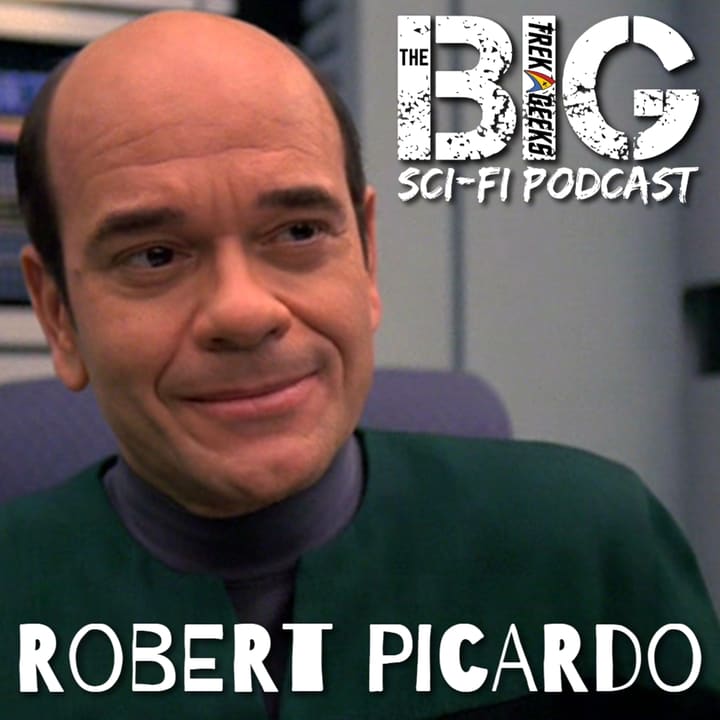
Robert Picardo
The BIG Sci-Fi PodcastAugust 30, 2024x
16
00:59:02

Robert Picardo

The One and Only

We have the privilege of talking with the original holographic doctor himself, Mr. Robert Picardo! Beloved for playing "the doctor" on Star Trek: Voyager, his skill as an actor has been evident with his involvement in a myriad of television shows and films. His work with the Planetary Society is of note as well as his love for the opera. We talk all this and more with the wonderful and kind, Robert Picardo!

This podcast is a proud part of the Trek Geeks Podcast Network and works hard to bring you great content from all over the science fiction universe. We would love to hear your feedback, suggestions, and ideas. Take a moment to send us an email at thebigscifipodcast@gmail.com.

Check our podcast out and learn more about the other great podcasts on the network by visiting trekgeeks.com.

We've got the merch! If you want BIG Sci-Fi swag, check out this link and support us by wearing us everywhere you go! www.teepublic.com/thebigscifipodcast

Check out all of our social links in one place:
https://linktr.ee/thebigscifipodcast

Check out Cris' amazing YouTube channel for Trek content galore:
https://www.youtube.com/@yellingaboutstartrek1532

Check out Brian's new book available at Amazon for Kindle and in paperback:
https://www.amazon.com/stores/Brian-Donahue/author/B0C3BQ93VD?ref=ap_rdr&store_ref=ap_rdr&isDramIntegrated=true&shoppingPortalEnabled=true
Follow Brian on Substack: https://bdonahue.substack.com/

Subscribe for free to Brian's Substack page where he writes original science fiction and fantasy: https://bdonahue.substack.com/

Find Adeena's books here: https://crazyrobot.myshopify.com/

Follow her on Substack here: https://beyondthedroid.substack.com/?utm_source=homepage_recommendations&utm_campaign=1493637
[00:00:01] Do not change the station. What you're hearing is coming from the BIG Sci-Fi Podcast and the Trek Geeks Podcast Network.

[00:00:08] Stay tuned for the next exciting episode of... Wait a minute. Receiving a new transmission. What is that? What am I seeing? It's big! It's really big! Oh my god, it's so...

[00:00:19] Welcome to Season 6 of the BIG Sci-Fi Podcast, the biggest sci-fi podcast in the galaxy.

[00:00:25] Join our crew, Adina, Brian, Chris, and Steve, as we travel the Milky Way looking for the best that science fiction has to offer.

[00:00:33] Make sure you're strapped in tight, because we're going to have a lot of fun talking all things sci-fi.

[00:00:39] Stay tuned to this channel for the next audio transmission.

[00:00:45] Welcome both listeners of the BIG Sci-Fi Podcast. I'm here today with my co-hosts, Brian.

[00:00:51] Hey, it's Brian from Ohio.

[00:00:53] And Steve.

[00:00:54] Hello, it's Steve from Los Angeles.

[00:00:57] And Chris is fighting all the really heavy traffic in Toronto, and we'll sneak in in about 10-15 minutes.

[00:01:04] And then I'm Adina, normally from Maryland, but today I'm recording from Huntsville, Alabama, right across the highway from Space Camp.

[00:01:14] I'm not here for Space Camp, I'm here for work, but I see Space Camp out the window.

[00:01:20] And we also have an amazing guest today.

[00:01:23] Now, we all know him primarily as Voyager's emergency medical hologram, a.k.a. the doctor.

[00:01:30] But for our guest, Robert Ricardo, he already had an amazing career in TV and film long before Voyager came along.

[00:01:37] Now, I know when Voyager started, I had recognized him because he was in recurring series.

[00:01:43] He was a series regular on both The Wonder Years and China Beach, which were two shows I watched pretty religiously when I was in high school.

[00:01:50] Robert's versatile acting skills have brought to life a wide array of characters across the genres.

[00:01:56] Beyond his roles in those shows I just mentioned, The Wonder Years and China Beach, he's made memorable appearances in iconic films like Inner Space and Gremlins 2.

[00:02:06] And has appeared in shows ranging from ER to Stargate to the Orville, all while showcasing his knack for both drama and comedy.

[00:02:14] His extensive theater background, including a stint on Broadway, is probably partly responsible for how he's able to give his performances a depth and presence that captivate audiences.

[00:02:24] But Robert isn't just about acting. He's also a passionate advocate for science education and has been working with the Planetary Society.

[00:02:32] That's a space advocacy group that I'm also a member of.

[00:02:35] Since Voyager was in its third or fourth season, I believe.

[00:02:40] Not to mention he sings, and I'm sure we're going to learn, I'll learn a few more things that we didn't know today as we delve into this remarkable actor.

[00:02:49] Robert, please welcome.

[00:02:52] Thank you. Thank you very much. That was such a nice introduction.

[00:02:55] I certainly didn't want to interrupt it because it reminded me of things that I'd long forgotten.

[00:03:00] So thank you for telling me.

[00:03:03] It was actually two stints on Broadway.

[00:03:07] And what else did you get slightly wrong?

[00:03:09] I was a regular on China Beach, but a recurring guest star on The Wonder Years.

[00:03:14] But yes, they were both on the same network.

[00:03:16] So magically, the China Beach producer would make me available to The Wonder Years producer because The Wonder Years was the number one show on ABC back at that time.

[00:03:27] Oh, yeah.

[00:03:28] So anyway, so yes, I've been a lucky man for a guy who set out in life to study medicine and to become a doctor who took a last minute, you know, off ramp from pre-med at Yale and decided to be an actor.

[00:03:46] I have been remarkably, remarkably fortunate with what was basically a very impulsive decision at the time.

[00:03:57] Yeah. And you're still very active.

[00:04:00] And, you know, spoiler alert for our listeners.

[00:04:03] If you have I'm just going to say if you haven't watched season two of Prodigy, you need to because, you know, you're still you're still very active in Star Trek.

[00:04:13] The one thing I really wanted to ask about is because you were recently at Star Trek Las Vegas.

[00:04:19] How was that?

[00:04:21] Well, it's a it's a big convention.

[00:04:25] It's the biggest dedicated Star Trek convention in the world every year.

[00:04:30] And and I've gone I can't tell you how many times in the 30 years that I've been part of the Star Trek franchise.

[00:04:38] I have to think I've been to the Las Vegas convention at least 20 of those 30 years.

[00:04:44] And it's a lot of fun. First of all, I see so many of my colleagues from my show and the other shows.

[00:04:51] So it's always great to to see Jerry Ryan and this year Tim Russ, Garrett Wong and Kate Mulgrew from my show.

[00:04:59] But really, I've developed so many friendships with the actors and in many different iterations, including some of the newer shows.

[00:05:07] And that it's just wonderful, wonderful to see them.

[00:05:12] And of course, the fans are so jazzed to be there, so excited to see us.

[00:05:17] And as you know, I'm as you may know, I'm not only on Star Trek Prodigy, but it had just been announced that I was that I was going to be a regular cast member of Starfleet Academy.

[00:05:32] Yes. So that that makes me, I guess, along with Patrick Stewart, the first legacy performer from my era anyway of Star Trek from the Rick Berman to to be asked back to be a regular member in a new series.

[00:05:47] So that that announcement had been made at Comic-Con only five days before the beginning of the Vegas convention.

[00:05:57] So there I got a lot of a lot of kudos from the fans and a lot of questions about the new show.

[00:06:03] And I even surprised the audience during my panel when Ian Spelling, a wonderful Star Trek journalist friend of mine for years, moderated the panel with Jerry Ryan, Tim Ryan.

[00:06:15] I'm sorry, Tim Russ and myself.

[00:06:17] And and and when he turned to me and said, Bob, what can you tell us about Starfleet Academy?

[00:06:21] I went, I don't know. Let me find out.

[00:06:24] And then I called I called Alex Kurtzman and Noga Landau, my two the showrunners and my two new bosses on the phone and and and put my put the microphone in a giant convention room.

[00:06:39] I put the microphone right up to my iPhone speaker and the sound was glorious.

[00:06:45] And they talked right to the audience and told whatever they were willing to tell them and told them the reason they cast me, which I think was that, well, you know, because the doctor was teaching cadets in Star Trek Prodigy.

[00:06:59] It seemed kind of natural for him to still be teaching cadets a few hundred years later.

[00:07:04] So anyway, it was it was a wonderful surprise for the audience.

[00:07:08] We got a lot of big cheers and gasps from my getting both producers on the phone in a matter of seconds.

[00:07:15] They all thought it was impromptu, but that's what acting is. Right.

[00:07:18] We fooled them. Yeah.

[00:07:20] And and it was it was really a special day for me.

[00:07:24] And in the intervening days, I must say that I'm really getting excited about the new project.

[00:07:32] Every day emails, updated versions of the scripts they've sent me, you know, with little tweaks to the writing.

[00:07:41] You have to meet with these people and all of the excitement of of, you know, just really getting ready.

[00:07:49] The show starts shooting the last week of August.

[00:07:53] And I'm not in the first week shooting, but I will start very shortly after that.

[00:07:59] So and I'll be flying in a matter of eight days, I guess.

[00:08:06] I'll be headed up for some preliminary meetings and whatnot, meet the other cast members.

[00:08:11] So it's all you know, it's all really getting into gear.

[00:08:15] So I'm every day there's my my excitement level is building.

[00:08:21] That's fantastic.

[00:08:22] Robert, is it being filmed up in Toronto as was Strange New Worlds?

[00:08:28] Yes, it is.

[00:08:31] Basically, we in the same way that Star Trek was always shot at Paramount.

[00:08:37] And when and when Voyager came along because Deep Space Nine and the next generation overlapped, Voyager came along just when next generation had wrapped their seven year television run and were transitioning to the big screen.

[00:08:57] So we that is the cast of Voyager.

[00:09:00] We got the the next generation sets of Paramount.

[00:09:04] Similarly, in this in this passing of the torch, we will get my understanding is we'll get the stages that were occupied in Toronto and Pinewood by by Discovery.

[00:09:18] OK.

[00:09:19] And and I believe that our sister show that is already in progress and wonderful, by the way, Strange New Worlds.

[00:09:26] Yeah.

[00:09:26] We'll be across town at another facility.

[00:09:29] So, you know, it'll be it'll be great to be in town, although the shows don't quite shoot at the same time.

[00:09:35] So I won't see as many of my colleagues from Strange New Worlds as I as I did just last weekend in Vegas.

[00:09:45] So in your in your wildest dreams, did you think you'd have the opportunity to come back in a live action situation and play the doctor again?

[00:09:56] I know.

[00:09:57] Um, I don't think I really did.

[00:09:59] I, you know, a lot a lot of time has gone by and they had set they they've set I it's no it's to no one's surprise, I think, to say that the new show is set in the same future that Discovery is in.

[00:10:18] And you'll recall the Discovery jumped hundreds of years into the future.

[00:10:23] Um, so and I know the fans, this is it's also no secret that the fans of Discovery had had been calling out for years that the time frame Discovery had jumped into was mentioned.

[00:10:37] That particular time in the future was mentioned in a Voyager episode called Living Witness, where a a backup program of the doctor, which had been basically had been buried on a planet because of some piece of history that was explained in the episode.

[00:10:59] A copy of the doctor's program with all of the information that he had at the time they made the copy, right, had been sort of a time capsule left on a planet.

[00:11:11] And when he was discovered and reactivated, he became a witness to the past in this time period in the future where where it was a story about revisionist history.

[00:11:26] Some there was a museum in the future in which the Voyager crew were vilified as terrible, you know, terrible, terrible Hitler like villains.

[00:11:42] Oh, and, uh, and, uh, and, and, and, uh, in this particular episode, the, the, the doctor's backup program who had been a living witness to the true history straightens out the revisionist history in this, in this future, um, in this future timeline.

[00:11:59] So, uh, it was a very exciting kind of interesting and strange episode, really a nice one for my character, beautifully directed by my colleague, Tim Russ.

[00:12:09] But in, in any case, the, the, uh, the fans of discovery went, well, wait a minute, there's another doctor floating around some in this timeframe.

[00:12:16] So they're the ones that first brought about two or three years ago.

[00:12:20] And I honestly have no idea whether that was an influence in any way, um, to the producers deciding to use me.

[00:12:28] I can say that when I first met, um, Noga, our co-show runner on zoom, the first thing she said to me was thanking, thank you for helping to raise me.

[00:12:43] Hmm.

[00:12:44] And I know, isn't that sweet?

[00:12:46] And I know I can't do that because she said the same thing to the entire, uh, Star Trek fan audience at Las Vegas just a few days ago.

[00:12:54] So, um, we're very careful about what we do and don't say about a new project, but, uh, but that was a, that was a compliment she paid me that she made public.

[00:13:04] So I am sharing that with all of you.

[00:13:06] That's wonderful.

[00:13:07] Lovely.

[00:13:07] That is great.

[00:13:08] So you mentioned, you know, there's some script tweaks and such going back and forth.

[00:13:12] How much do you get to contribute to the current, I guess, writing of the doctor character?

[00:13:21] I would say not at all.

[00:13:23] Um, they, they have, you know, these, these rewrites are, are, uh, completely standard in the business.

[00:13:29] They write various drafts of the script and they change it and they tweak things and sometimes even move little moments from this script to that script.

[00:13:38] This is standard procedure.

[00:13:39] They have been very gracious and having a lengthy meeting where I met on zoom, the entire writers room and they wanted my thoughts and feelings.

[00:13:49] So we had a discussion, but, um, but, and that may who, I don't know if any of that will ever impact future script stories, but right now this is, they're just, they have a wonderful writers room.

[00:14:02] They know what they're doing.

[00:14:04] Uh, I'm delighted with the scripts I have read, not just for my, my, from my character's perspective, but from the whole arc of the story.

[00:14:13] And I'm very excited to work with the, uh, the actors that had been announced.

[00:14:21] Holly Hunter, a, um, absolutely wonderful Academy award winning actress whose career I've followed a very long time.

[00:14:30] Paul Giamatti, another actor that I hugely admire who's playing our first season villain, apparently because he said in social media that he's always wanted to be on Star Trek.

[00:14:39] He said he wanted to be a Klingon and then, um, he looked good as a Klingon.

[00:14:44] Yes.

[00:14:46] There's a, uh, a group of young actors playing the cadets, many of whom, um, the Star Trek fan audience has met on social media.

[00:14:55] They shared a wonderful video of the reactions of those actors on zoom when they were told by the producers, they'd gotten the role.

[00:15:06] It's just lovely.

[00:15:08] Their, um, their emotional response, uh, their humor, their, their, uh, what's the word?

[00:15:15] They're almost brought to being brought to tears, all different responses.

[00:15:18] Um, so I feel like I have a little window into the young colleagues that I'll be meeting very shortly from that, uh, from that video.

[00:15:28] And, uh, and also, um, I know, uh, I've, I've met Mary Wiseman and I'm happy that she will, she's been announced as a recurring character on the show.

[00:15:36] And I'm a big fan of Tig Notaro, not only from her work on Discovery, but I've seen her live, uh, in her, you know, in her, you can't even call it stand up.

[00:15:48] She is a storyteller, I think.

[00:15:51] Comedian, but she's just a very uniquely talented person that I look forward to.

[00:15:58] And I, I'll share this secret with you.

[00:16:00] Both of my daughters who are big fans of her are delighted that I'm going to meet and work with her.

[00:16:06] Yeah.

[00:16:07] I can just see you and her, um, cause they can write the script, but you are the doctor.

[00:16:15] You have the inflection, you know, how he acts and how he, and I know that's exactly what everyone's hoping for when we see you on stage or see me on, on screen, but opposite Tig to me.

[00:16:27] Oh, it's going to be, it's going to be hilarious.

[00:16:29] It's going to be hilarious because she is so funny.

[00:16:32] We are both characters that don't suffer fools, right?

[00:16:35] Which is going to be, which will be, which will be a lot of fun.

[00:16:39] Um, no, I, I am.

[00:16:40] And I, I, my expectation always, especially with a, with a celebrity actor is that they know nothing about me and have never seen me on Star Trek.

[00:16:50] So, uh, I have no idea whether, uh, Ollie Hunter will know, you know, anything about my character in the past.

[00:16:58] Paul Giamatti is indeed a Star Trek fan.

[00:17:00] Right.

[00:17:01] It's likely that he's seen me at least a couple of times.

[00:17:03] We're both, um, we're, we're both, uh, Yale alumni.

[00:17:08] So I might, you know, I might, uh, greet him with, with the Yale fight song, but I doubt I'll do that.

[00:17:14] And I have no idea.

[00:17:19] That's exactly what I was thinking.

[00:17:21] Tig Notaro is, um, is apparently a really long time friend of, uh, of Alex Kurtzman.

[00:17:29] In addition to being, you know, um, uh, uh, the, the celebrity, um, storyteller comedian that I've known her to be.

[00:17:38] And also I watched her last, she did a television series, which she created.

[00:17:42] I watched all of that too.

[00:17:44] Uh, this is about three or four years ago.

[00:17:46] So, um, but I, and I don't know how much she knows about, uh, about, uh, Star Trek shows before, but it'll be fun.

[00:17:54] You know, to, to meet and work with these people and to get to know, obviously the young, the younger folks who really are the characters that carry the show and really carry what the show is about.

[00:18:05] I mean, if it's Starfleet Academy, you know, it's really about the young cadets and their journeys and their, you know, their unique stories and how they grow and learn, um, through the, through the experiences.

[00:18:20] Uh, so I'm, I, uh, and, and as I said, I, I was, uh, I'm very pleased with, um, uh, with the writing and can't wait to get started.

[00:18:30] Yeah. Well, speaking of young people, I am talking to more and more people who are discovering the Berman era track like next gen, like DS nine, like Voyager and enterprise too.

[00:18:44] And who have maybe caught on to the newer stuff like discovery or strange new worlds, or even, uh, the animated series, both of them.

[00:18:52] Um, to me, it's pretty exciting as a Star Trek fan who watched next gen and its original run D space nine, Voyager and enterprise to see a whole nother generation.

[00:19:03] Maybe a couple coming up saying, wait a minute, this is really cool stuff.

[00:19:07] And so for them, they're, they're getting more and more excited about even, even, I hate to say it, but the older track, you know, and that just is revitalizing the franchise.

[00:19:18] In my opinion.

[00:19:20] I totally agree.

[00:19:21] And I think it was particularly wise of, uh, of, uh, you know, uh, CBS television to launch prodigy because the best way, the best way to re reinvigorate an aging name brand and aging franchise is to really capture a young audience.

[00:19:42] And prodigy is just a wonderful show.

[00:19:46] I think it is.

[00:19:47] I love the animation.

[00:19:48] I love the heart of it.

[00:19:50] It was great fun for me to have, you know, my character reintroduced.

[00:19:55] If only vocally on that show, I had to pitch my voice back up in the doctor's range.

[00:20:01] And now some 30 years on, you know, I think my voice has probably dropped an octave from my regular speaking voices that, as that character.

[00:20:09] Uh, that's what my wife pointed out anyway.

[00:20:11] So I had to, uh, really try to recreate the, the, uh, you know, the doctor as he sounded, um, in that era.

[00:20:20] But, um, you know, there, I can tell just from the star track you mentioned, there are passionate fans for prodigy.

[00:20:28] And I really, really hope that somebody smart at Netflix or elsewhere, uh, decides to make a third season because there's a real hunger for it.

[00:20:38] But, but, but also it, you know, if you, if you get a six or seven year old loving prodigy, perhaps even a four or five year old loving prodigy, then there are the chances are they're going to want to sample other star Trek.

[00:20:51] Cause that's exactly the story that one of the, one or two of the fans came up and said, I have a five year old or a four year old.

[00:20:59] And now they want to watch everything a five or four, you know, wow.

[00:21:03] So that was a, it's, first of all, it's, it's clever marketing, but also it's good art.

[00:21:09] It's like, you know, if, if the storytelling stands up from the Berman era, certainly.

[00:21:15] And if you love strange new worlds, which is kind of reminiscent of the original series.

[00:21:22] And of course, Voyager was reminiscent of the original series and having more self-contained episodes, less large super story arcs.

[00:21:32] You know, the, the only real overarching arc and Voyager was getting home seven years.

[00:21:37] We didn't have, you know, we didn't have big arcs about, you know, wars between different, you know, that were going on.

[00:21:45] We were, we were traveling home and on the journey, we met a new adventure every week, which is really more in keeping with the original series wagon train to the stars kind of concept.

[00:21:57] So I'm not surprised to hear that someone who loves strange new worlds and that's their entrance into Star Trek would go, what else is like this?

[00:22:07] And then watch both Voyager and the original series.

[00:22:10] Well, Chris has, Chris has jumped in here now.

[00:22:13] He made it home safe from the Toronto traffic.

[00:22:16] I'm not going to talk about that, but, uh, glad to have you here.

[00:22:19] I'll tell him I'll be joining him in Toronto relatively soon.

[00:22:22] Nice.

[00:22:23] I guess that's true.

[00:22:25] Yeah.

[00:22:25] It's pretty crazy.

[00:22:27] That's amazing.

[00:22:28] Yeah.

[00:22:29] Nice to meet you.

[00:22:30] Um, nice to meet you.

[00:22:32] So I'm always curious about people when they first start off and, you know, in a big TV show, what was the, like, maybe not necessarily the first day, like, but what was the night before?

[00:22:44] Like when you're prepping and you're like, all right, I got to go to set tomorrow and I got to be the doctor and I got to, you know, do my thing.

[00:22:52] That's a great question.

[00:22:53] I haven't had that.

[00:22:59] I haven't had that exact question.

[00:23:22] But since then, I have seen the light.

[00:23:26] I have cast, I've cast myself at the feet of the faithful and I've, I've been forgiven.

[00:23:33] Thank you, Gene.

[00:23:35] You know, so I used to do this, this, uh, mock evangelical, I've come to Gene moment if I may, you know, where I said I didn't get it before, but now I get it.

[00:23:51] Um, in any case, at the time I was cast, at the time I auditioned, I didn't know anything about Star Trek at all.

[00:23:58] Really?

[00:23:59] Um, I didn't even know if I knew that Tafaris Kelly used to say, damn it, Jim, I'm a doctor, not a, you know, not a, uh, uh, what do you call it?

[00:24:07] Brick layer.

[00:24:08] Not a toaster oven, a brick layer, a toaster, not a whatever.

[00:24:11] Um, but at my audition, I, my, my children told me years later, when my kids, when Voyager premiered, my kids were like four and a half and seven.

[00:24:22] But years later, they told me, dad, the secret to your success on Star Trek is your resting bitch face.

[00:24:28] So I think that's really what, what helped me because my children were used to me smiling all the time at home, but then they saw me on Star Trek and my four and a half year old daughter said, daddy's so mad.

[00:24:39] Why are you so mad?

[00:24:40] I said, well, dear, they, they're paying me to be mad.

[00:24:44] Um, I think that when my face is at rest, I look, I have, uh, what looks, what, which was, uh, what Italians would call a faccia di limone, which means sourpuss face of lemon.

[00:24:58] Um, I think that that helped me because the doctor, if you remember, never had a glimmer of a smile really for the first two years.

[00:25:06] And when I, and so when I said medical tricorder, it was funny.

[00:25:11] I didn't know the line was funny to a Star Trek fan.

[00:25:15] It, to me, how could I know that?

[00:25:18] I didn't even know what the difference was between a medical tricorder and a tricorder, but someone explained to me, oh, they're different things.

[00:25:24] So of course, but just a combination, as I said, of my, um, arch delivery, um, and resting bitch face.

[00:25:35] Uh, apparently won the day.

[00:25:37] And then I learned quickly.

[00:25:39] I think I, so the night we've been, to get back to your original question, the night before, I don't think I was really nervous.

[00:25:46] I didn't quite know what it was going to be like.

[00:25:49] What I was concerned about is that at the same time I was shooting the very next day, I was performing at a major theater venue in Los Angeles, the Mark Taper Forum, playing the lead in a play.

[00:26:02] And the producers were not legally obligated to let me go, but they said they'd make the best effort to get me out of time because I had no understudy.

[00:26:10] They would have had to cancel a performance in a theater that seats 600, 700 people.

[00:26:16] And the producers, to their great credit and to my eternal appreciation, uh, dropped out of that scene.

[00:26:24] We were not done shooting that very first scene of the doctor's first activation.

[00:26:29] We shot most of it and they let me go at 630 or 645.

[00:26:34] So I could make my 730 half hour and my eight o'clock show.

[00:26:38] Also, as fate would have it, what character was I playing in that play?

[00:26:42] A doctor with a terrible bedside manner.

[00:26:46] So maybe my, um, my theater experience that was going on right at the time I auditioned sort of helped me get the part.

[00:26:54] So I, I didn't, I gave you a very long winded non-answer, which is, I was, I don't know how I was feeling the night before other than nervous that I wouldn't get to the theater to do my regular day job that I had at that point.

[00:27:08] That was just about to end.

[00:27:10] Um, so, um, you know, it was, it was really when we shot the second episode, when Kes comes to sick bay because she wants to start a hydroponics bay and she needs soil samples.

[00:27:24] And I complained bitterly that I am, I am the absolute, absolute apotheosis of everything humanity and every other alien race knows about medicine in the 24th century.

[00:27:37] But yes, let me get your dirt.

[00:27:40] In other words, he clearly was disgruntled because he was being asked to do things beyond the scope of what he was designed for.

[00:27:51] And he found that, he found that annoying and insulting.

[00:27:56] And he, and even, I think it generated a certain paranoia in him that along with the fact that any idiot could turn him on or off like a light switch.

[00:28:06] I mean, I, I explained when people said, what's the source of the doctor's attitude?

[00:28:11] I said, well, if you were the most brilliant compendium of, of knowledge, if you had the power of all of that information program in you.

[00:28:20] So you have that incredible power paired with the vulnerability of any idiot turning you on or off, like flipping a switch.

[00:28:31] I said, you would be, you'd be paranoid too.

[00:28:33] And crank.

[00:28:34] Yeah.

[00:28:35] Indeed.

[00:28:36] So I want to take Chris's question and broaden it a little bit.

[00:28:39] Do you generally, do you ever get nervous before a performance?

[00:28:43] Especially when you're younger.

[00:28:48] A live performance?

[00:28:57] And I had not reviewed it.

[00:28:59] So there were twice in this three and a half minute scene where I forgot my line and she bailed me out to her great credit.

[00:29:06] But I can't say I get nervous anymore.

[00:29:08] First of all, the Star Trek audience is so forgiving.

[00:29:10] And if you're doing something humorous anyway, they just love it.

[00:29:13] If you go, is that my line?

[00:29:15] Is that me?

[00:29:16] Do I talk here?

[00:29:17] You know, so, but if you're prepared, at least with the body of experience I've had in theater, I just did a major role in a original musical theater thing with this theater group that I work with in the Bay Area.

[00:29:37] And, you know, if you're prepared, if you really know, if you made your choices, you really know your lines, you really know your music, if it happens to be a musical, I think you get excited and energized.

[00:29:50] But I wouldn't call it nervous.

[00:29:52] I would call it sort of just good adrenaline.

[00:29:54] So I guess the answer to your question is no, I don't really get nervous.

[00:29:57] Now, of course, you know, if I were performing, you know, for the president or for the queen or something like that, you know, where you're in a situation where you have this amazing opportunity to perform in front of very special people with everybody's eyes on you for that moment.

[00:30:20] Would that make me nervous?

[00:30:21] Probably.

[00:30:22] Probably.

[00:30:22] But, you know, and when I get, you know, it's going to be fun to revisit the character.

[00:30:30] I don't anticipate being nervous the first day I step on the set to shoot something.

[00:30:36] I just think I'll be excited and really pleased to meet all of these wonderful young actors that I've only had little glimpses of and to work with them.

[00:30:47] I mean, think of that opportunity, right, to be a guy who's in it, who just turned 70 less than a year ago.

[00:30:54] And suddenly I'll be working with actors that range in age.

[00:30:57] I don't know exactly, but I'm going to guess most of them are, you know, 18 to 20 years old, let's remind us, a year or two.

[00:31:06] So that's going to be, you know, I said, working with that incredible energy of young people that are at the beginning of their career journey will, I think, has to be both exciting and hopefully it will make me feel young rather than incredibly old and decrepit.

[00:31:25] Speaking about working with young actors, if you don't mind me engaging the way back machine, we've reviewed and talked about a certain film called Explorers.

[00:31:35] And you worked with a couple of very young actors on that particular movie who were just starting and they're building their careers.

[00:31:43] Was that the first foray into science fiction for you?

[00:31:47] Had you done stuff before?

[00:31:48] And then did you enjoy doing your Flash Gordon type of character in that as well, besides the other aliens?

[00:31:58] That's a great question.

[00:32:01] I had obviously been in a horror movie.

[00:32:03] I'd been in a fantasy movie shortly around that time.

[00:32:07] Legend.

[00:32:09] Legend may have been right after that.

[00:32:10] I don't recall.

[00:32:12] No, it was before it, I think.

[00:32:14] But I think it was my first science fiction.

[00:32:16] Good for you.

[00:32:16] I've never really thought.

[00:32:18] I thought of Explorers as being more of a comedy.

[00:32:21] Of course, it is science fiction, you know, but I always considered it a comedy versus, you know, sci-fi.

[00:32:28] But that scene, you've just answered what I consider to be the greatest Star Trek trivia question of all time because I made it up.

[00:32:38] And here's the question.

[00:32:40] What Star Trek actor acted on a Star Trek set years before he was ever cast in Star Trek?

[00:32:48] And the answer is me.

[00:32:48] The Captain Starkiller set was a modified Klingon torpedo bay.

[00:32:53] Oh, my.

[00:32:54] Oh, my.

[00:32:55] You know, a modified Klingon, you know, little was the I guess the torpedo bay of a little Klingon bird of prey from the Wrath of Khan, I believe.

[00:33:08] Oh, my.

[00:33:08] Oh, my.

[00:33:10] I don't think we knew that.

[00:33:11] We didn't.

[00:33:11] That didn't come up when we talked about that movie.

[00:33:13] No.

[00:33:13] Now we have to go review it.

[00:33:15] And I even took a picture of Starkiller and I'd never seen this where I'm in my Lamech and I'm standing on the steps of Star Trek, the search for Spock, which was had just.

[00:33:30] Which and the torpedo bay may have been from the search for Spock, not the Wrath of Khan.

[00:33:36] I don't know.

[00:33:37] All I know is there was a series of steps that looked very kind of Egyptian that were used somewhere in the search for Spock.

[00:33:44] And I took a picture on them.

[00:33:46] They said, Bob, this is, you know, Star Trek said because I wasn't interested in Star Trek, as I confessed only a few moments ago to you folks.

[00:33:53] That's right.

[00:33:54] I didn't really care.

[00:33:55] But there is a picture of me somewhere in my Captain Starkiller outfit standing on us on these big stairs that were part of the search for Spock.

[00:34:04] So, I mean, they just the weird confluence of events.

[00:34:11] You can't make it up.

[00:34:12] Right.

[00:34:13] That's amazing.

[00:34:13] That's amazing.

[00:34:14] That's amazing.

[00:34:15] Thank you so much.

[00:34:16] That's neat.

[00:34:18] So is filming Starfleet Academy, is this going to cut into your time that you spend doing things for the Planetary Society and other things you do?

[00:34:29] Another great question.

[00:34:30] You guys are to be complimented for your good questions.

[00:34:33] Something that's been on my mind.

[00:34:35] First of all, I'm looking for my ultimate successor.

[00:34:51] I believe that my work with the Planetary Society has always been inspired by Michelle Nichols.

[00:35:02] And what she did on the original series while she was on it and after, because she got the idea that she was an inspirational role model for young women and young people of color to go into space to apply to be astronauts.

[00:35:25] And she had an enormous influence.

[00:35:28] And I guess I took her lesson that even though we are just actors and playing make-believe in a show about the future, you can't deny that Star Trek has an inspirational relationship with NASA and other space-faring agencies around the world.

[00:35:47] But with the people that do the real work, the scientists, the engineers, and the astronauts, and all the people that pour their efforts into real space exploration, robotic or human.

[00:36:03] Those people have watched, grew up watching Star Trek, a lot of them, and are, and they drew some sort of inspiration.

[00:36:12] And they wanted to make that vision closer to reality.

[00:36:15] They wanted to see things on Star Trek and make them come real.

[00:36:20] So once I understood that, then I no longer felt silly.

[00:36:25] I no longer felt silly being an actor sitting on stage in Huntsville, Alabama, where you are right now, Adina, at space camp for the, I think it was the 30th anniversary of Star Trek in 1998.

[00:36:41] I sat on stage with five men who had walked on the moon.

[00:36:46] Wow.

[00:36:48] And I said to myself then, this is so weird.

[00:36:53] Why am I here?

[00:36:54] Along with my colleague, Robert Duncan Neal, with, oh my God.

[00:36:59] Of course, it was Buzz Aldrin.

[00:37:02] It was, it was Dave, astronaut Dave Scott.

[00:37:09] It was Alan Shepard, Alan Bean.

[00:37:15] And one other, forgive me, my mind, I lost the fifth one.

[00:37:19] I have their autographs, all five of them.

[00:37:22] But I was, I realized then I could feel silly and out of place here, or I could embrace.

[00:37:27] I could embrace the fact that the audience sees some sort of connection between these real heroes and the imaginary hero that I play.

[00:37:36] Right.

[00:37:37] And I could either feel awkward about that, or I could embrace it and try to use it for good.

[00:37:41] And that's what I've tried to do.

[00:37:44] And as someone who is a recipient of that, yeah, you know, I tell everyone all the time, the reason I got into the aerospace industry was because of Star Trek.

[00:37:52] You know, Next Generation was the one that was on when I was a teenager.

[00:37:55] And that was what got me into, you know, that's why I'm sitting in Huntsville, Alabama today.

[00:38:00] Yeah.

[00:38:01] And just as much as, you know, seeing the shuttle program, and if even more, just because, again, it's that imagination spark.

[00:38:10] It's like cool to see and know what's going on in reality with like, you know, when the shuttle was going on and now with the International Space Station and such.

[00:38:17] But seeing the science fiction, then you get glimpses of what lies beyond state of the art today.

[00:38:24] And I think that's what kind of feeds into the whole cycle and getting people excited about STEM.

[00:38:30] And I'm great, you know, it's wonderful to hear you talk about looking for people, other actors to possibly bring into the planetary society to take over and do what you're doing.

[00:38:39] Because, again, that's one of the challenges is just finding the next generation of people to come into these fields in all the different, you know, ways that are impactful.

[00:38:49] So I'm glad to hear.

[00:38:51] So I hope some of your younger colleagues take you up on that.

[00:38:54] Thank you.

[00:38:55] And if I can reminisce, my early experience with the Planetary Society, when they first asked me to be on the advisory council, and I thought, well, I'm only an actor.

[00:39:04] How can I help you?

[00:39:05] I don't quite get it.

[00:39:06] But then it became clear to me right away.

[00:39:08] One of the earliest things I became associated with at the Planetary Society was called Red Rover Goes to Mars.

[00:39:15] It was a strategic partnership with the Planetary Society and Lego.

[00:39:20] And we had just landed the Sojourner.

[00:39:23] The first Mars rover had landed, I think, in 98, right?

[00:39:28] 98?

[00:39:29] That sounds about right.

[00:39:29] Sounds about right.

[00:39:30] And this Red Rover Goes to Mars was a perfect analog for what we were doing at that moment.

[00:39:40] Kids in high school, and even younger, I guess, if they were interested, probably as young as middle school, but in high school, could buy this rover set.

[00:39:50] They would build their own Mars rover with this Lego kit that had motors and this and that and the right suspension so it could climb over hills and around obstacles.

[00:39:58] And they would build their own rover at their school.

[00:40:01] Then they would create their own Martian surface, some sort of giant sandbox that was, I don't remember what the parameters were, 15 to 20 feet wide with peaks and valleys.

[00:40:10] They would send their rover to another school.

[00:40:13] That school would send their rover to your school, and you would have to map, map each other's Martian surface using the Internet, which was basically relatively new, right?

[00:40:23] That everybody had Internet access in the late 90s.

[00:40:25] So you were doing, the students were doing a perfect analog of what NASA was doing at that moment.

[00:40:32] And I thought, this is pretty cool.

[00:40:34] You know, what a great way to do.

[00:40:36] May I share something with you, Robert?

[00:40:38] My youngest daughter, Jenny, did exactly that in her middle school.

[00:40:42] She had, they had built a Martian landscape.

[00:40:46] They had the little mechanical rovers.

[00:40:49] And I went to school one day and watched her.

[00:40:52] And I walked in the door and I said, hello, I'm from NASA.

[00:40:54] I want to see what you kids are doing.

[00:40:55] They went, what, what, what?

[00:40:57] But it was truly amazing to see these kids doing it in their classroom, recreating what was going on on Mars.

[00:41:06] Was this in the late 90s, early 2000?

[00:41:09] Yes, it was.

[00:41:09] Yes, yes.

[00:41:10] It was probably Red Rover Goes to Mars.

[00:41:13] Yeah, I know.

[00:41:13] They probably had bought the kit.

[00:41:15] It was that program.

[00:41:16] I have to ask my daughter now as a reminder about that.

[00:41:19] But I remember just being so, and myself being so proud, because again, you know, being a child of Star Trek, watching it when it first was on TV,

[00:41:27] and seeing my daughter involved in this and knowing now that it was the Planetary Society that was involved in this, this is, I feel very proud right now.

[00:41:37] Thank you.

[00:41:37] Well, good.

[00:41:38] Well, I feel proud that you're proud.

[00:41:39] I feel, I'm taking some of your pride.

[00:41:43] I'm sitting here sad that I missed out on this.

[00:41:46] I had already graduated from college by then.

[00:41:47] And I was already working.

[00:41:49] You were already being inspired.

[00:41:51] In space.

[00:41:52] Yes.

[00:41:52] You were ahead of the national timeline.

[00:41:55] So look at it that way.

[00:41:56] Yes.

[00:41:56] This is true.

[00:41:57] But, you know, it was very hard for the internet to find opportunity.

[00:42:01] I mean, again, I'm very excited that kids these days have much more opportunity.

[00:42:06] It seems like they have more opportunity than they did.

[00:42:08] This is a great time to mention that the Planetary Society launched about two years ago, Planetary Academy, which is a program for young people.

[00:42:20] If you have a niece or nephew or son or daughter that is quite young, and I think they recommend it all the way down to kids as young as five and six.

[00:42:30] You get quarterly mailings.

[00:42:33] If you join them up with different projects and, you know, with educational information and different projects they can do if they're interested in learning about space exploration.

[00:42:43] It's called Planetary Academy.

[00:42:46] We got an endorsement from LaVar Burton.

[00:42:48] And I think we, as a last count, I think we had over 2,000 signups.

[00:42:57] So I encourage your listeners, if you have a family with, you know, with a child as young as five or six, and you can check me on that.

[00:43:06] Maybe they're recommending it for kids as, you know, seven and older.

[00:43:09] I don't specifically remember, but go to www.planetary.org and look for Planetary Academy and see if it's right for that young person in your family.

[00:43:21] So I would say as a parent of an almost six-year-old who is a subscriber to that, it's been for the last year.

[00:43:29] Yeah, that five or six is on the bottom end of the range.

[00:43:33] I would say depending on how interested your child is already motivated in that, I think right now when the package comes, I might be more excited.

[00:43:42] The great thing is you did it.

[00:43:44] Yeah.

[00:43:45] You did it.

[00:43:46] And you could probably speak more authoritatively about the program than I can, but I'm happy to hear that.

[00:43:52] Yeah.

[00:43:52] No, it's very cute, especially if you do have a child who has any interest in space.

[00:43:57] This is a great thing.

[00:43:59] And again, I think kids do like things, you know, coming in the mail for them.

[00:44:03] That's always fun to open up and everything.

[00:44:05] Although I think in this case, just because of my own five-slash-almost-six-year-old, it's more exciting for mommy.

[00:44:16] Well, guys, any last-minute questions for Robert here?

[00:44:21] Yeah, I have a quick question, just because I don't think we've touched on opera yet, but I have to ask about it.

[00:44:30] How did you get interested in opera?

[00:44:33] What inspired you to, I guess, learn how to sing it?

[00:44:38] Well, I don't really know how to sing it.

[00:44:40] I have to say that my opera singing is completely amateur level.

[00:44:45] But I think if you grow up Italian, you inevitably hear Mario Lanza.

[00:44:54] You'll even hear old Caruso recordings.

[00:44:57] Italians love opera.

[00:44:59] You know, Italy is the birthplace of opera.

[00:45:02] I believe people don't argue that.

[00:45:04] And it is, you know, I think of opera as being the most emotionally charged kind of performance.

[00:45:15] It's just the emotions are huge.

[00:45:18] And the power of someone who is trained to use the human voice that way.

[00:45:25] And I'm happy to say that in the last only year, year and a half of my life, I have befriended a truly wonderful opera singer named Arturo Chacon Cruz.

[00:45:38] He's probably one of the thinnest level of greatest tenors alive and working now and performing lead roles all over the world.

[00:45:51] I saw him in the San Francisco opera last September do the lead in Il Trovatore Mandrico, I guess is the character name.

[00:46:00] And then he goes and does, you know, all over the world does the lead in La Boheme.

[00:46:06] Rodolfo in La Boheme, he does the lead in Turandot.

[00:46:11] He is just amazing.

[00:46:13] And when I met him, he saw me do, I did an Arthur Sullivan musical.

[00:46:20] And he came up to me after he said, yes, Star Trek.

[00:46:24] He said, I remember when I was training, I watched you sing La Donne Mobile.

[00:46:27] And I said, I'm so sorry to hear that.

[00:46:31] And he said, and he said with a bemused look, he said, no, no, you were quite good.

[00:46:37] He was lying.

[00:46:38] But now he and I have become great friends.

[00:46:41] And and but to go back to your question, I my first Broadway role, my character was an opera lover.

[00:46:51] And there was much opera played in the play, even though the play was not a musical.

[00:46:56] It was a very silly and fun comedy called Gemini.

[00:47:00] And my character was a poor kid from South Philadelphia who went on scholarship to Harvard.

[00:47:06] And and it's the summer before his freshman year.

[00:47:09] And his rich girlfriend from Harvard drops in to see him in his ghetto home in South Philadelphia.

[00:47:14] And the audience assumes that he's humiliated because of his, you know, the poverty comes from just the difference in social class.

[00:47:23] His father, Danny Aiello, played my father.

[00:47:26] Every other word was an F bomb, you know, and he was a huge, expansive personality.

[00:47:31] The lady next door was was foul mouthed and loud.

[00:47:36] He loud and, you know, everything in the play in the character's background was embarrassing to him because he had, you know, he had gotten into Harvard on scholarship and was living a double life, so to speak.

[00:47:48] And then it turns out that the character can't decide whether he loves his girlfriend or her freshman brother because he's having a sexual identity crisis.

[00:47:57] Well, this this show in the late 70s just captured a moment, I guess, in the in the movement, so to speak, it sort of moved the needle on the understanding and appreciation and acceptance of of everyone's sexuality.

[00:48:16] That in other words, you could just because you either couldn't decide or if you decided he was gay or straight as long as you didn't avoid life, as long as you had people who loved you.

[00:48:28] It didn't matter.

[00:48:29] Now, in 1977, that was fairly that was a you know, it was obviously the needle move much further with plays like, you know, Angels in America, whatnot.

[00:48:39] But Gemini was hugely popular, ran four years.

[00:48:42] It is the fourth longest running non-musical in the history of Broadway.

[00:48:47] Nobody ever remembers it.

[00:48:48] And I opened the play, played the lead character who loved opera.

[00:48:52] So that was sort of my beginning.

[00:48:54] And because the act, the the the Yale Drama School graduate, Albert Inarato, who wrote the play, was himself a huge opera fan.

[00:49:03] So that was my beginning to be, I guess, acquainted with opera.

[00:49:07] My mother loved opera.

[00:49:09] I don't remember her going very much.

[00:49:12] She only she loved she had seen.

[00:49:16] Presumably when she was younger, she listened on record more when I grew up.

[00:49:19] I don't remember a lot of opera being played in the house, but my mother loved Madame Butterfly in particular.

[00:49:27] I remember.

[00:49:27] So it was always sort of in the air if you're an Italian American.

[00:49:32] And when I moved to my neighborhood in New York, which was near Little Italy, on every Sunday, you could hear open the window and hear recordings of Mario Lanza just being blasted out of the neighborhood.

[00:49:45] But I never intended to sing opera on Voyager.

[00:49:49] But I did make the suggestion that opera was part of the doctor's life.

[00:49:55] I said, wouldn't it be funny if a character like the doctor who had zero emotional affect, this was early on in the show, chose to listen to opera in sickbay.

[00:50:10] You have this incredibly passionate music and his placid, expressionless face.

[00:50:15] My idea was that this was going to be like a cutaway joke.

[00:50:19] Right.

[00:50:20] No words spoken.

[00:50:21] Certainly no singing.

[00:50:22] Just him working away in sickbay and hearing this huge, passionate music playing around him.

[00:50:29] I thought that would be intriguing for the audience.

[00:50:32] Well, I remember Jerry Taylor when I pitched her that simple idea.

[00:50:39] She said, well, we're doing a lot of Klingon opera stuff on Deep Space Nine right now, so the timing's not good, but we'll keep it in mind.

[00:50:46] And I forgot about it.

[00:50:47] And then about four months later, five months later, I read an early copy of a script and I'm singing opera in the opening.

[00:50:58] I must have run full speed across the entire lot right to her office, knocked on the door and said, but no, I'm sorry.

[00:51:06] No, no, no, no, no, no.

[00:51:06] You misunderstand me.

[00:51:07] I don't want to sing opera.

[00:51:08] I want to listen to it.

[00:51:09] She said, well, can you sing?

[00:51:10] I said, I can sing, but I can't sing opera.

[00:51:14] And she said, well, try it.

[00:51:15] If you're no good, we'll replace your voice.

[00:51:17] And that is how I came to sing.

[00:51:19] And I did all the singing myself in four of the five shows I think I sang.

[00:51:24] But in Virtuoso, I just, it was just too hard.

[00:51:28] So the opera singer, the professional opera singer who taught me all of my music in the shows that I sang myself, right?

[00:51:36] He taught me Rigoletto, La Donne Mobile, O Suave Fanchula from La Boheme.

[00:51:43] His voice replaced me in some of Virtuoso.

[00:51:47] And it's so obvious to be, you can hear when he's singing and when I'm singing.

[00:51:50] But it was just, I did the best I could.

[00:51:54] You have to have that years of training to know how to open the back of your throat and extend your range.

[00:52:01] But long story short, my new friend, Arturo Chacon Cruz, has been giving me little videos, he sends me, of vocal warm-ups.

[00:52:10] So I'm getting trained by one of the greatest singers in the world.

[00:52:13] Nice.

[00:52:13] So I have no excuse not to get better.

[00:52:16] Awesome.

[00:52:17] Well, I hope we get to see some of that, whether it's in Starfleet Academy or maybe even on the cruise next year, which I'll be on again.

[00:52:26] You never know.

[00:52:28] You never know.

[00:52:29] I have actually spoken to the cruise people about my friend, Mr. Cruz, Mr. Cruz Chacon Cruz.

[00:52:38] So, and I mean, he is a Star Trek fan, as is his wife and his son.

[00:52:43] Oh, great.

[00:52:44] So if we could ever get him on as a guest, he would stand up and sing and people would just, your heart would soar.

[00:52:52] When he sings, it is the most, you feel like you're being lifted off the earth.

[00:52:57] So I really hope you get to see him sing.

[00:53:01] And as I said, he sings all over the world.

[00:53:05] And I had mentioned him to the, apparently, at least it seems to me, one of the, I think, it was one of the two producers said, oh, we're both opera fans, referring to, you know, I don't know if it was.

[00:53:20] So I'm always hoping that they might do an opera gag in the show.

[00:53:26] But believe me, it would probably be safer if they didn't.

[00:53:29] But I have no idea if it'll come to pass.

[00:53:32] Cool.

[00:53:33] Okay.

[00:53:34] Well, I have to say, unfortunately, we are at the end of another enthralling episode of our big sci-fi podcast.

[00:53:42] I have to give a huge thank you to Robert Ricardo for joining us today.

[00:53:46] Thank you so much for sharing such lovely stories.

[00:53:48] Thank you.

[00:53:48] It was fun.

[00:53:49] You guys asked really good questions.

[00:53:51] I'm not used to that.

[00:53:51] I'm used to the same old, same old.

[00:53:53] So it was a pleasure.

[00:53:55] Thank you all.

[00:53:57] And don't forget to help create a little buzz for Starfleet Academy, even though, as you know, it takes about a year and a little more before the first day of shooting, before all the post-production is done.

[00:54:12] So my guess is it'll be late 2025 before you'll see any.

[00:54:16] But there's no reason why we can't start getting really jazzed about it now.

[00:54:20] I'm already excited.

[00:54:23] We're excited.

[00:54:25] We're excited.

[00:54:25] And so I'm just going to say thank you, listeners, for doing what you do best, tuning in and engaging with us.

[00:54:31] We'd love to continue the conversation on Facebook or drop us a line at the big sci-fi podcast at Gmail with any thoughts or questions you might have.

[00:54:39] So, you know, of course, like and subscribe and share with more episodes where we talk all things science fiction.

[00:54:44] As always, be kind to each other, live long and prosper, everyone, and join us next time here at the big sci-fi podcast.

[00:55:37] We'll be right back.

[00:56:04] We'll be right back.

[00:56:07] We'll be right back.

[00:56:09] We'll be right back.

[00:56:18] We'll be right back.

[00:56:18] We'll be right back.

[00:56:22] We'll be right back.

[00:57:58] We'll be right back.

[00:57:58] We'll be right back.

[00:57:59] We'll be right back.

[00:58:00] We'll be right back.

[00:58:01] We'll be right back.

[00:58:01] We'll be right back.

[00:58:02] We'll be right back.

[00:58:03] We'll be right back.

[00:58:03] We'll be right back.

[00:58:03] We'll be right back.


Copyright 2025, Coconut MediaWorx LLC. All rights reserved. Our podcasts are not endorsed, sponsored or affiliated with CBS Studios Inc. or the Star Trek franchise. All STAR TREK trademarks and logos are owned by CBS Studios Inc.