



Author
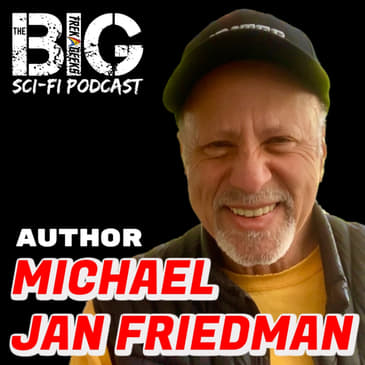
Our guest this week has authored 80 works over the years making him one of Star Trek's and science fiction's most prolific and popular authors. If you're a Star Trek fan and love to read Trek fiction, then you have probably read one or two or three Michael Jan Friedman stories! He's a versatile author and a nice human being as you'll discover in this week's intriguing and insightful episode!
This podcast is a proud part of the Trek Geeks Podcast Network and works hard to bring you great content from all over the science fiction universe. We would love to hear your feedback, suggestions, and ideas. Take a moment to send us an email at thebigscifipodcast@gmail.com
Music heard on this podcast opening is from Mikhail Smusev of SignmaMusicArt and provided by Pixabay. Listen to more of his music at: https://pixabay.com/users/sigmamusicart-36860929/
Music heard at the end of this podcast is from Ivan Ohanezov of PumpUpTheMind and provided by Pixabay. Listen to more of his music at: https://pixabay.com/users/pumpupthemind-19969411/
Check our podcast out and learn more about the other great podcasts on the network by visiting trekgeeks.com.
We've got the merch! If you want BIG Sci-Fi swag, check out this link and support us by wearing us everywhere you go! www.teepublic.com/thebigscifipodcast
Check out all of our social links in one place:
https://linktr.ee/thebigscifipodcast
Check out Cris' amazing YouTube channel for Trek content galore:
https://www.youtube.com/@yellingaboutstartrek1532
Check out Brian's new book available at Amazon for Kindle and in paperback:
https://www.amazon.com/stores/Brian-Donahue/author/B0C3BQ93VD
Subscribe for free to Brian's Substack page where he writes original science fiction and fantasy: https://bdonahue.substack.com/
Find Adeena's books here: https://crazyrobot.myshopify.com/
Follow her on Substack here: https://beyondthedroid.substack.com
[00:00:00] This is the Big Sci-Fi Podcast, the biggest sci-fi podcast in the galaxy, a proud part of the Trek Geeks Podcast Network.
[00:00:08] Season 6 was a blast, but Season 7 is going to be even more fun as we continue to go where no podcast has gone before, deep into the sci-fi universe.
[00:00:19] Join Idina, Brian, Chris, and Steve as they explore television, film, and literature for the best sci-fi has to offer.
[00:00:26] Even if you're not a sci-fi fan, you'll love the banter and the epic tangents as these four friends talk about what they love.
[00:00:34] We invite you to sit back and relax because the journey is just beginning on this season of The BIG Sci-Fi Podcast.
[00:00:43] Welcome back, listeners of The BIG Sci-Fi Podcast.
[00:00:47] Today, we are beyond excited to introduce a legendary guest in the world of science, fiction, literature, and Star Trek fandom.
[00:00:54] Welcome, the incredible Michael Jan Friedman.
[00:00:57] If you're a lover of classic Trek novels like me, you're in for a real treat.
[00:01:03] Michael Jan, and I call him Michael Jan because I'm going to reveal something I have never revealed on the podcast before.
[00:01:10] At least, I think I haven't.
[00:01:11] My middle name is also Jan.
[00:01:15] Michael Jan is an accomplished and prolific author with over 80 books to his name, including countless stories set in the Star Trek universe.
[00:01:25] Now, you might also recognize his work from fan-favorite novels like Reunion, Crossover, which I just read recently, and The Valiant.
[00:01:35] Those have become some of the essential reads for Trekkies everywhere who love to read Trek.
[00:01:39] Now, Michael has a knack for bringing beloved characters to life while expanding the Star Trek lore in ways that feel both thrilling and true to the spirit of this franchise.
[00:01:48] And his writing goes beyond Trek, too.
[00:01:51] He's penned stories in other franchises such as Lois and Clark, Predator, Aliens, X-Men, and more.
[00:01:57] So today, we're going to dive into Michael Jan's impressive career, his insights on storytelling in the Trek universe,
[00:02:04] and hopefully he'll share some details about some recent or upcoming projects.
[00:02:08] Hi, Michael.
[00:02:09] Michael Jan.
[00:02:11] Hi.
[00:02:12] How are you doing?
[00:02:14] We're great.
[00:02:15] We're great.
[00:02:16] I want to start with just what initially drew you to writing.
[00:02:22] I want to just start right there, especially because you're so prolific.
[00:02:26] Reading.
[00:02:27] You know, I was a voracious reader when I was young.
[00:02:35] I actually started with comics when I was very little, and then, you know, I started reading everything.
[00:02:41] I read, I think, one month, I read the whole Hardy Boys over it.
[00:02:47] Oh, my.
[00:02:48] Wow.
[00:02:49] In fact, I used to go back and forth.
[00:02:51] I was a little guy, but I used to go back and forth across a park in the evening to my friend's house to, because he had the whole series of Hardy Boys books.
[00:03:05] So I would exchange what I had just read for a new one.
[00:03:09] And his parents must have thought, this guy's parents let him run across the park at night?
[00:03:16] You know, what's going on here?
[00:03:19] I would, as soon as I finished one, I would run to Stephen's house and go get another one.
[00:03:27] So I read a lot, and, you know, I admired the people who could keep me enthralled the way they did.
[00:03:35] And I wanted to be one of those people.
[00:03:38] So, like, what age would you say you wrote your first story?
[00:03:44] I think probably around seven.
[00:03:47] Wow.
[00:03:47] You know, it was a little story.
[00:03:50] I wouldn't even call it a short story.
[00:03:52] It was almost more like a vignette.
[00:03:54] But I guess I must have gotten good feedback because I did it some more.
[00:04:01] And, you know, through middle school and high school, I continued to write.
[00:04:09] And then I got to college.
[00:04:12] And I thought, you know, I think I could really do this.
[00:04:17] I think I can really write a novel.
[00:04:20] And I had a professor at college, a guy named Jerry Mangione, who was the uncle of Chuck Mangione, the musician.
[00:04:31] I was just going to ask what's in the name of John.
[00:04:33] Okay, okay, okay.
[00:04:35] That's pretty cool.
[00:04:36] And he had won the National Book Award.
[00:04:37] And he encouraged me.
[00:04:44] And he kept saying, you know, why does a Jewish kid from Queens want to write about, you know, mythological characters?
[00:04:54] How does that happen?
[00:04:55] And that's what I'm interested in.
[00:04:58] So he was helpful and encouraging.
[00:05:01] And I did a series of independent studies.
[00:05:06] And by the time I was done, I had a bar.
[00:05:10] And there was a guy I went to college with because I also wrote a humor column for the school paper.
[00:05:18] And there was a guy at school, a guy named Rich, whose family had a literary agency in Manhattan.
[00:05:28] And he liked my columns.
[00:05:31] And he said, listen, Mike, when you write your first novel, you're going to bring it to me.
[00:05:36] And I'm going to get it published.
[00:05:38] So I fine-tuned this thing.
[00:05:41] And I fine-tuned it and fine-tuned it and threw it out.
[00:05:45] And started again.
[00:05:47] Wow.
[00:05:48] You know, because it really was never going to be good enough.
[00:05:52] So then I started again.
[00:05:54] And I worked, you know, on weekends and lunchtime and so on until I had something that I could be proud of.
[00:06:01] And I sent it to this guy, Rich.
[00:06:03] And Rich said, he goes, wow, Mike, you remember it.
[00:06:07] That's great.
[00:06:08] He said, I read it.
[00:06:11] And this could be the next great science fiction classic.
[00:06:15] Or it could be a pile of horse manure.
[00:06:18] I don't know.
[00:06:19] I don't read this stuff.
[00:06:22] So he said, but, you know, I know somebody who does.
[00:06:28] And he referred me to another agency.
[00:06:30] So I called this other agency.
[00:06:32] And I said, you know, so, you know, I have this fantasy novel.
[00:06:38] And, you know, I'd like you to represent me.
[00:06:40] And they said, well, you know, we're not taking on any new authors right now.
[00:06:46] And, you know, you've got to be a little pushy.
[00:06:48] This is Manhattan.
[00:06:48] So I said, don't you want the next Stephen King?
[00:06:52] And they said, actually, we're very happy with the current Stephen King.
[00:06:56] Oh, wow.
[00:06:58] I said, okay.
[00:07:00] But can you tell me who might want to represent me?
[00:07:04] And they directed me to another agency.
[00:07:07] And at this other agency, indeed, I found somebody who was willing to take me on.
[00:07:13] And she was a big help.
[00:07:16] She said, I just want you to add a few chapters.
[00:07:22] Because it was sort of a, there was some counterpoint chapters.
[00:07:25] She said, I want you to add a few of those.
[00:07:27] So the ones that you have now don't look so weird sticking in there.
[00:07:32] And she sold it.
[00:07:36] So what novel was that?
[00:07:38] Thank you.
[00:07:39] This is The Hammer and the Horn.
[00:07:42] The very first novel I published.
[00:07:44] And it was based on Norse mythology.
[00:07:49] It was about the survivors of Ragnarok.
[00:07:52] And it was in the, at the time, the 20th century.
[00:07:55] And these are two sons of Odin, two sons of Thor who survived.
[00:08:01] And something's happened in the nine worlds of Norse mythology.
[00:08:07] And this guy, Vidar, he's the protagonist.
[00:08:12] And he's getting sucked back into the old conflicts.
[00:08:18] So, yeah.
[00:08:19] So that was the premise.
[00:08:23] And why didn't the Marvel Universe buy your book?
[00:08:26] The Marvel Universe.
[00:08:28] Right, right, right.
[00:08:30] Yeah.
[00:08:31] And if you look at the guy, you know, on the covers of these books, he's basically Thor.
[00:08:38] Thor and Blue Jeans.
[00:08:41] But so I, so had lunch.
[00:08:46] I mean, I mean, you know, selling that book was, was such a game changer.
[00:08:51] It, it was like the, the, the validation of everything I had done.
[00:08:58] And, and my agent and I and, and the editor, a woman named Kathy Malley at Warner Books.
[00:09:08] Um, we all had lunch.
[00:09:10] And Kathy said, you know, the, um, you kind of left it open at the end.
[00:09:17] Like, like there could be a sequel.
[00:09:19] And I said, yeah, I kind of did.
[00:09:21] And she said, well, she goes, would you like to write a sequel?
[00:09:25] And I said, absolutely.
[00:09:27] And she said, you know, it was like, um, it was April.
[00:09:31] She said, can you have it by October?
[00:09:32] And I was like, it was like, it took me over two years to write this first one, you know, on lunchtime and weekends.
[00:09:40] And I said, I was starting to say, I don't think so.
[00:09:44] And I, and my agent kicks me under the table and she goes, of course he can.
[00:09:50] So were you, were you still in school or were you also working at the time?
[00:09:53] No, no, I was working.
[00:09:54] I was working at that point.
[00:09:55] I was, uh, I guess it was 20, 20 in my late twenties.
[00:10:01] Okay.
[00:10:01] Um, and I was working at a full-time job as a, as a business journalist.
[00:10:08] And, um, and so she, she kicks me into the table.
[00:10:13] She goes, of course he can.
[00:10:14] I almost choked on my linguine.
[00:10:16] So, so, uh, but there it was, I had, I had another assignment.
[00:10:20] So it was cool.
[00:10:21] But you know, if I said six months, how do I do this in six months?
[00:10:24] So I actually had to cannibalize my job.
[00:10:27] I said, your priorities are your priorities.
[00:10:30] This job is not where you want to go.
[00:10:34] You want to be a, you want to be a science fiction and fantasy writer.
[00:10:37] Here's your chance.
[00:10:38] Don't blow it.
[00:10:39] So I cannibalized my job.
[00:10:41] And, and a few weeks later, months later, maybe, uh, my publisher calls me in and he says,
[00:10:47] you know, Mike, not for nothing, but you really haven't done anything here in weeks.
[00:10:53] And I said, well, you know, I've been busy.
[00:10:57] And, uh, and he said, yeah, he goes, so what do you think?
[00:11:02] And I said, I think I'm going to, but, but maybe I could get another week or two, you know,
[00:11:08] and, and they didn't want to fire me and pay unemployment and stuff.
[00:11:11] So they actually gave me another couple of weeks.
[00:11:13] And, uh, and I worked there or I was employed there, but I didn't actually work.
[00:11:18] I was working on my book.
[00:11:19] And, um, and then I was home completing it.
[00:11:23] And that, and that, um, became the second book in the trilogy.
[00:11:27] That was the, the seekers and the sword.
[00:11:30] You see a pattern, right?
[00:11:34] And then I left that kind of open at the end too.
[00:11:38] And Kathy Malley said, you know, you keep on doing this.
[00:11:41] I guess we're going to have to give you a third book.
[00:11:44] So they, so they did.
[00:11:46] And that was the fortress and the fire.
[00:11:49] And that was, and, and that was the, the end of the trilogy.
[00:11:54] And then I did one more book for them, uh, uh, a singleton, um, also had to do with kind
[00:12:02] of Norse mythology and, um, and then Kathy Malley retired.
[00:12:09] And I came in to, you know, cause I knew her protege cause he worked for her and, uh, he
[00:12:14] was bumped up and, and I came in to talk to him about future projects and he goes, you
[00:12:22] know, Mike, uh, you know, you've done four books now and they were all, we were all very
[00:12:30] pleased with them, but you know, you kind of didn't break out.
[00:12:34] So I think we're going to go in another direction.
[00:12:38] Oh no.
[00:12:40] Oh, my gut punch.
[00:12:42] That's crushing.
[00:12:43] Oh yeah.
[00:12:45] So, and this was my home, you know, I felt like this was my home and I was getting kicked
[00:12:50] out and, and I was like, you know, I'm like, you know, I'm like, you know, I'm
[00:12:52] I had always said if I could write one book, I would die happy.
[00:12:58] Just one.
[00:12:59] And, and I had done four.
[00:13:01] So really I was ahead of the game and I said, you know, maybe that's it.
[00:13:05] If, if that's it, that's it.
[00:13:07] You know, I, I, I'm still going to write, but if that's the only, if those are the only
[00:13:12] four books I can publish, so be it.
[00:13:14] And, and then I got a call from my agent while I was in the depths of despair.
[00:13:25] And she said, Mike, have you ever thought about writing a Star Trek book?
[00:13:32] And I was like.
[00:13:33] Just like that.
[00:13:34] Yeah.
[00:13:35] Wow.
[00:13:35] Wow.
[00:13:36] Because, because, um, uh, they were looking for writers.
[00:13:41] They, they, they thought they, they could improve on the caliber of the writing that they
[00:13:48] had so far.
[00:13:50] And so they were looking for other writers.
[00:13:52] And, um, my agent had sent my, my fantasy books to Dave Stern, who was the editor at the
[00:13:59] time.
[00:13:59] And, um, and he liked them.
[00:14:02] And I said, great, great.
[00:14:06] Uh, you know, I've, I've, I've been reading these Star Trek books by Anne Crispin and by
[00:14:11] Howie Weinstein.
[00:14:12] And, and I liked them.
[00:14:14] I think I, can you imagine putting words in Kirk and Spock?
[00:14:19] So I, um, so I, uh, uh, put together an outline and I sent it to Dave and I called him
[00:14:28] and I said, have you had a chance to read it?
[00:14:30] He goes, yeah, you know, Mike, I'm still struggling with this.
[00:14:32] He goes, you know, it's, it's, it's sort of about Scotty and Scottish mythology.
[00:14:40] And I, you know, it's, we don't do mythology here.
[00:14:45] We do science fiction.
[00:14:47] And I said, but you know, I heard that you liked my books.
[00:14:50] He goes, yeah, yeah.
[00:14:50] I like your writing.
[00:14:52] I would like to see a science fiction book with that kind of writing.
[00:14:56] And I said, oh, okay.
[00:14:59] I get it.
[00:15:00] And, uh, put together another outline and, uh, and I sent it in and I called Dave.
[00:15:06] I said, so what do you think?
[00:15:07] He goes, this one I really love.
[00:15:10] He goes, but there's no ending.
[00:15:11] And I said, well, you know, I didn't want to spoil it for you.
[00:15:15] And no, no, no, because I'm a professional.
[00:15:19] You can spoil the ending for me.
[00:15:22] So I said the ending and it had to do with Romulans and stuff.
[00:15:25] And it was a lot of fun.
[00:15:27] It was, uh, it was called double double.
[00:15:29] And it was based on what are little girls made of the original series episode
[00:15:34] continuation of that.
[00:15:36] So, um, and that was my first, uh, Star Trek novel.
[00:15:42] And I have to say, I don't know exactly what order, uh, I read them, but, but at that time
[00:15:47] period, that was when I was heavily into reading the novels because I, I be, I became a Trekkie
[00:15:55] in the summer of 1988.
[00:15:58] And at the time, yeah.
[00:16:00] And at the time, you know, so there are, you know, three seasons of Trek, a couple of now
[00:16:05] they're into next gen.
[00:16:06] But if you didn't videotape it when it came on, you know, that, that was kind of all,
[00:16:13] all you had.
[00:16:14] And I felt at the time, I just wanted more, especially original series episodes.
[00:16:19] So I felt when I was reading the novels that that was what I was, that was what I was getting.
[00:16:24] That was my way to get more.
[00:16:25] And so like I said, I don't know what order I read them because it was whatever was available
[00:16:30] in my local bookstore, which was only, even though they were like 50 or so out, um,
[00:16:36] there may be like at any given time, five or so available, but like yours was definitely
[00:16:42] that first one in that early first, you know, year or two of my reading them.
[00:16:47] So I'm very happy I got you to sign it when I saw it in person.
[00:16:51] Yeah, yeah, yeah.
[00:16:52] And I, I know exactly how I signed it too.
[00:16:56] Yes, yes.
[00:16:57] Um, that, and I was gonna say when that first book came out, what year was that in relation
[00:17:03] to the TOS movies or so on?
[00:17:06] I think, uh, I think it was, it could have been 88.
[00:17:11] It could have been 88.
[00:17:12] The, the listed date is 89.
[00:17:15] 89.
[00:17:15] Okay.
[00:17:16] Is that what we've been right around Final Frontier, I think?
[00:17:18] Uh, well, I think, uh...
[00:17:20] A little before.
[00:17:20] Yeah, yeah, yeah.
[00:17:21] Yeah, right.
[00:17:22] Jen started maybe in 89, right?
[00:17:26] Something like that.
[00:17:27] 87.
[00:17:28] So next gen was in 87.
[00:17:30] So yeah, it was like shortly after, um, but before, before Final Frontier, uh, yeah.
[00:17:37] So were you nervous?
[00:17:39] You know, and one of the things I always thought about that concept of writing in like someone
[00:17:43] else's universe, were you nervous about getting the voices or the, you know, personalities of
[00:17:50] the characters, right?
[00:17:52] That, that was something that's always made me nervous.
[00:17:55] I, I wasn't nervous.
[00:17:57] I, I paid attention to it.
[00:17:59] I, I, um, uh, I, I tried to come up with the right voices and stuff, but mostly I was just,
[00:18:07] honestly, I was having fun, you know?
[00:18:10] And, and I figured if I'm having fun, probably the reader's having fun too.
[00:18:14] Um, and, and I found that when you're, when you're, um, when you're trying to emulate someone's
[00:18:26] voice, there are usually certain keywords and, and this sounds simplistic, but it actually
[00:18:33] works.
[00:18:33] You know, if you, if, if you have Picard in a scene and he's talking to Riker, it never
[00:18:40] hurts for him to say number one, right?
[00:18:45] All of a sudden, everything else he said sounds like him.
[00:18:49] You leave him at number one and it's like, well, anybody could have said that.
[00:18:54] So, so there are certain keywords that if you use them, it makes, it makes it sound authentic.
[00:19:01] And did you have a favorite character that you liked writing for of, I guess, of the
[00:19:07] original series?
[00:19:07] I know you wrote for, for most of them.
[00:19:10] Yeah.
[00:19:10] In the, in the original series, my favorite character was Kirk.
[00:19:14] Obviously I, I like Spock and, and McCoy is great.
[00:19:18] McCoy is one of the, one of the great gifts of popular culture to every world.
[00:19:23] I, I would say the two most fun people to write dialogue for are, are McCoy and Ben
[00:19:34] Grimm, the thing.
[00:19:36] Hmm.
[00:19:37] Oh, okay.
[00:19:38] Gotcha.
[00:19:38] Yeah.
[00:19:39] Right.
[00:19:40] Cause they're irascible and they're sarcastic and there's so much fun to write dialogue for.
[00:19:47] Um, my, but my favorite character was Kirk and then next generation came along and eventually,
[00:19:52] you know, uh, Picard, uh, uh, kind of, uh, kind of, uh, rivaled Kirk for, for favorite
[00:20:03] character.
[00:20:05] Yeah.
[00:20:06] That's really cool.
[00:20:07] Oh yeah.
[00:20:08] Sorry.
[00:20:08] Go ahead.
[00:20:08] Oh no, I was gonna say.
[00:20:09] So, I mean, as, as you wrote more and more in the, the Trek franchise, how did things evolve?
[00:20:15] Um, you know, as the franchise itself got more popular and we got more shows, we got Deep Space
[00:20:19] Nine, we got Voyager and everything.
[00:20:22] Like, I guess, did things change with how much approval or involvement they had over your
[00:20:28] story concept and what you were going to do, especially if you're going to do anything,
[00:20:31] I'm going to say relatively major, like kill the father of a beloved character or things
[00:20:40] like, um, did things change over time like that?
[00:20:43] Yeah.
[00:20:44] Well, originally there were three layers of approval.
[00:20:47] There was a pocket books, um, as any editor, you know, would have to approve of your writing.
[00:20:54] Um, there was also the licensing department at, at, at the time paramount and there was also
[00:21:00] Gene Roddenberry's office.
[00:21:02] So there were three layers of approval and Gene really wasn't that into the books.
[00:21:09] So he had an employee, uh, a guy who had been a fan and, um, uh, and he was betting the books.
[00:21:17] And so you would get these, these very, very persnickety kinds of, kinds of, uh, uh, criticisms like, for instance.
[00:21:28] Mm-hmm.
[00:21:29] So, so when, when we, we sent in double, double, um, uh, we got a response and the way, and the way they communicated between paramounts between Gene's office and, um, uh, and the pocketbook offices in those days was a, um, it was a fax machine.
[00:21:48] And in those days, fax machines looked like, like warp cores on their side.
[00:21:55] Right.
[00:21:55] Mm-hmm.
[00:21:56] And it took six minutes to send the fax, right?
[00:21:59] It was like, okay.
[00:22:02] So, so, and you could all, you could only send one a day.
[00:22:08] So they would send us one and, and we would respond because they didn't want more than one a day.
[00:22:14] So they sent us a punch list of all the things they, they, they want to change, change in double, double.
[00:22:21] And they said, and you got to change 10 pages of Chekhov's dialogue.
[00:22:26] 10 pages of Chekhov's, Chekhov was, was a, was a, a mainstay of, of, of the original series.
[00:22:34] What are you talking about?
[00:22:36] So, uh, so, so, so we sent that fax essentially.
[00:22:39] What would it mean?
[00:22:40] And they sent back a fax.
[00:22:43] And again, I stood there while the thing was coming through six minutes.
[00:22:49] Uh, look at your star date.
[00:22:52] It was like, look at my star date.
[00:22:54] So we said, what do you mean?
[00:22:57] And they sent back a thing the next day.
[00:23:01] Chekhov wasn't on the ship at that time.
[00:23:04] And there was a, there was a memo posted on the wall, um, at pocketbooks that from Gene Roddenberry
[00:23:13] from a couple of years earlier.
[00:23:15] And Gene said, don't worry about the star dates.
[00:23:18] We made them up as we were going along.
[00:23:22] Just do whatever you do.
[00:23:23] It's fine.
[00:23:23] And so we said, you know, but the star gates, Gene said, the star gates, don't worry about
[00:23:31] them.
[00:23:32] And we got to, you know, got a response, right?
[00:23:35] Six minutes.
[00:23:37] Um, and they said, nope, Chekhov was not on the ship during that star date.
[00:23:44] So we sent back a, a, another, another response.
[00:23:47] And we said, okay, let's see if we got this.
[00:23:50] We can change 10 pages of dialogue and make it, I think DeSoto was the, was the guy.
[00:23:58] Oh yeah.
[00:23:59] DeSoto.
[00:23:59] At that time.
[00:24:00] Right.
[00:24:00] We can change 10 pages of dialogue or we can change the star date.
[00:24:06] And they sent back and they sent back a response.
[00:24:09] Yes.
[00:24:11] So we changed one number in the star date.
[00:24:15] And you didn't have to change the other 10 pages.
[00:24:17] And the 10 pages stayed in.
[00:24:20] So that was, you know, when, in the, in the, in the licensing department, there were people
[00:24:25] like, like, uh, uh, notably Paula Block who's, who's retired now, but was a wonderful,
[00:24:32] perceptive, creative person.
[00:24:33] And in the licensing department, if she, if there was something she said, Mike, you know,
[00:24:39] you really kind of got to take this out, but here's, here's a solution for you.
[00:24:44] Why don't you try that instead?
[00:24:47] Um, but in Jean's office, you didn't get that.
[00:24:50] You only got, you can't do it.
[00:24:52] You can't do it.
[00:24:54] You know, I also wrote the, um, star Trek, the next generation comic for like seven years.
[00:25:00] And, uh, in the first, in the first, sorry, the phone's ringing in the first, um, issue
[00:25:07] that I wrote, um, I had people, you know, I use thought balloons and, um, and we got a
[00:25:16] response, take out the thought balloons.
[00:25:18] And we said, why?
[00:25:19] And they said, our people don't think.
[00:25:22] What?
[00:25:23] What?
[00:25:23] That doesn't make sense.
[00:25:25] Because on the show, there are no thought balloons.
[00:25:29] You never get, you know, unless, unless it's a telepathy episode, you never get into the
[00:25:35] comic.
[00:25:36] Yeah.
[00:25:37] That's the point.
[00:25:37] I mean, that's always in comics where you have thought balloons because you're able to
[00:25:43] exp, you know, expand what the person is thinking.
[00:25:45] So, you know, without having to do about 10 panels worth of cartoons to explain what they're
[00:25:50] thinking.
[00:25:51] That's crazy.
[00:25:52] But this is, this is an example of how kind of narrow minded, persickety Jean's office was.
[00:25:59] So, um, and, and they were, you know, sometimes you would get comments like, uh, you know, he
[00:26:08] took, he took a tricorder out of his pocket.
[00:26:12] You know, our people don't have pockets.
[00:26:15] Uh, my, my, my friend, uh, Peter David once said something like, uh, Riker, Riker says, um,
[00:26:26] I'd, I'd rather, I'd rather walk the neutral zone in my underwear.
[00:26:31] And the comment that came back was it hasn't been established that our people have underwear.
[00:26:37] So, so it's just, you know, they were very narrowly focused.
[00:26:42] I think that's true.
[00:26:43] I don't think the first time underwear appeared on any Star Trek series was enterprise.
[00:26:48] Yeah, I guess so.
[00:26:50] Yeah.
[00:26:50] The blue underwear.
[00:26:51] I think that might be it.
[00:26:52] And I, now, now with Dean is like, Hmm.
[00:26:55] I'm trying to think was ever an episode where someone wore their underwear, but yeah, I think
[00:26:59] the closest we got was Picard's like not pajamas, but is like, I'm relaxing outfit that he'd wear
[00:27:06] when like at night.
[00:27:08] But yeah, that's crazy.
[00:27:09] Did they have any, um, like guidelines that you were sent where it's like, okay, here are
[00:27:14] the things you can't, here are the things you can do and here are the things you can't
[00:27:18] do.
[00:27:19] Well, yes, but it was never, it was never comprehensive because they, they just couldn't
[00:27:27] anticipate all the things that you want.
[00:27:29] Right.
[00:27:30] Okay.
[00:27:31] Um, so, but you know, there were, there were guidelines and, and, you know, we had a tech
[00:27:35] technical manual and, uh, uh, we had, uh, references and things that they would give the writing
[00:27:43] team.
[00:27:44] We would get those as well.
[00:27:46] Mm-hmm.
[00:27:46] Um, so yeah, yeah, but it was, you know, um, but then eventually after Gene passed away,
[00:27:55] that office closed and what we were left with was the, the very, very helpful, um, licensing
[00:28:02] department.
[00:28:02] Okay.
[00:28:03] So at that point, this is sort of a long answer to a short question.
[00:28:07] At, at that point we had more leeway and we were able to, we were able to, uh, to do
[00:28:14] things that we hadn't done before.
[00:28:16] We still had restrictions, but they were much more, um, logical.
[00:28:22] Yeah.
[00:28:25] That's a good word.
[00:28:27] And, and because you mentioned earlier about the fact that star dates don't matter, then
[00:28:33] trying to fit your storylines into the relative canon of the various, you know, Star Trek movies,
[00:28:42] it really didn't matter then.
[00:28:44] It didn't, you know, cause it's, you know, if you look at, I don't know, again, with Marvel,
[00:28:48] they're very fastidious that everything has to be interwoven and the pieces of the puzzle
[00:28:54] all have to fit together.
[00:28:55] But when you were writing your novels, did you really think like, okay, now this is between
[00:29:02] this portion of history and that portion of history and so on?
[00:29:06] Yes.
[00:29:06] Eventually, eventually we had to do that because eventually they did pay attention in the next
[00:29:11] generation.
[00:29:12] They paid attention.
[00:29:14] Um, and in the movies, I think, I'm not even sure how many times star dates were mentioned,
[00:29:20] but in the movies, they eventually did have a continuity.
[00:29:26] So at that point, yes, you did have to pay attention.
[00:29:29] Okay.
[00:29:30] Okay.
[00:29:30] Yeah.
[00:29:31] Very interesting.
[00:29:33] And so after the, you know, doing some Trek novels is, is the fact that you establish yourself
[00:29:38] as a capable tie-in writer, did that lead to others or did you go now seek out other franchises
[00:29:43] to write for?
[00:29:45] Um, I, they pretty much came to me.
[00:29:49] Um, I guess, cause that established a name in science fiction.
[00:29:55] Um, and, and not just, not just the name, but, but I proven that I could do it.
[00:30:01] Mm-hmm.
[00:30:02] Um, and a reputation that, that helped me inside the Trek world and also outside the Trek world
[00:30:08] for, you know, not being a jerk.
[00:30:11] Um, and I, I, I, um, I, I, um, I never did that.
[00:30:24] If I was going to do something that I thought was going to be, you know, on the edge, I told
[00:30:33] them about it.
[00:30:34] I said, all right, this might be on the edge, but I'd like to establish this.
[00:30:40] And they would usually tell me, sure.
[00:30:43] You know, I, I wrote the reunion was the first next generation hardcover and I was allowed
[00:30:49] to do it.
[00:30:49] It was, you know, it was coming up with, uh, the cards original crew from the stargazer.
[00:30:55] And I was allowed to do that because I had established that I wasn't going to take advantage
[00:31:00] of their good graces.
[00:31:04] Do you, um, you know, with the extensive, um, encyclopedias that Mike and Denise Okuda have
[00:31:11] put together, do you often refer back to that to get, you know, to continually, you know,
[00:31:19] confirm what you're writing about that these characters do kind of fit into the Star Trek
[00:31:23] realm?
[00:31:24] All the time.
[00:31:26] Okay, great.
[00:31:27] Uh, Mike and Denise are great, great people.
[00:31:30] They're great, great, uh, uh, at, at, at, at what they work on, on the show and, and
[00:31:36] in the publishing world.
[00:31:38] And, um, uh, I refer to their work and also the other, the other, um, like the Star Trek,
[00:31:46] uh, next generation companion by Larry Nemechek, all of that stuff.
[00:31:51] I refer to it all the time and I, and I really try to always, uh, uh, um, it in with what
[00:32:01] they've established.
[00:32:03] Right.
[00:32:03] Cause like, if you're writing about the Stargazer crew, Picard's first ship, the crew has to
[00:32:10] be acceptable.
[00:32:12] You just can't like, I'm going to throw in this new character and he's, but he'll die
[00:32:17] on the planet.
[00:32:17] So it's okay.
[00:32:18] You know, um, you know, that's where you have to be, I guess that's where you're referring
[00:32:23] back to maintaining that degree of canon.
[00:32:26] If you can.
[00:32:27] As much as, as much as I can.
[00:32:30] Okay.
[00:32:30] I, and I, I never to, as far as I can remember, I never conflicted with, with canon.
[00:32:39] Okay.
[00:32:39] Excellent.
[00:32:40] Yeah.
[00:32:40] Thank you.
[00:32:40] It can be really hard.
[00:32:41] So I, I got to do two short stories this year, um, for the Star Trek Explorer magazine.
[00:32:46] And the first one, uh, there was very, very, actually very minuscule tie-in.
[00:32:51] But the second one is, um, Admiral Necheyev back when she was Lieutenant Necheyev.
[00:32:57] Oh, that's true.
[00:32:57] And so getting, um, the, some of the details right.
[00:33:01] And I did have some back and forth to, you know, cause I, and I mostly refer to memory
[00:33:07] alpha and information to make sure I was getting things, um, getting things straight.
[00:33:11] But, you know, they came back to ask, you know, cause they wanted to make sure that their
[00:33:16] vision of which uniforms was my vision.
[00:33:18] I was like, yeah, it's about the same time as the Enterprise C, but, um, but something
[00:33:22] I said made it seem like it was not exactly the same time.
[00:33:25] So yeah, it was like, and this was just for a 2000 word short story, which is nothing in
[00:33:33] the grand scheme of like a novel that is, you know, 70, 80 or more thousand words.
[00:33:39] So yeah, um, yeah, it, I mean, it was a lot easier when I started out, just wasn't as much
[00:33:48] stuff.
[00:33:49] Right.
[00:33:50] And then as I, as I went along and there was more and more, I was able to absorb it as
[00:33:56] it happened.
[00:33:57] So it wasn't really a chore.
[00:33:58] If, if I had to start writing Star Trek books now with all that's been established, it'd
[00:34:05] make me crazy.
[00:34:06] So do you have any, uh, any writing, writing rituals that you tend to fall into when you
[00:34:15] start a new book?
[00:34:17] Well, yeah.
[00:34:19] Well, first of all, when I'm starting a new book, it's because I've just finished the book,
[00:34:23] right?
[00:34:24] So when I finish a book, I, I take my left hand and I reach over my right shoulder.
[00:34:31] That's good.
[00:34:33] Cause I just freaking finished the book.
[00:34:36] Yeah.
[00:34:38] That was great.
[00:34:39] And then I celebrate for all of the bad 10 seconds, patting myself on the back and then
[00:34:44] I go, okay, let's go into the next one.
[00:34:47] Um, so, uh, I, I, I plow into the next one.
[00:34:52] Um, I think that, so that's, that's a ritual, but, um, in general, one of the things I do
[00:34:58] that, that baffles some of my colleagues is, um, I write, um, in a nonlinear way.
[00:35:08] Um, so I have an outline, um, to some extent, if it's something like Star Trek, it's very detailed,
[00:35:15] long and detailed outline.
[00:35:17] Um, and I, and I, you know, writing is, uh, is, is a, is a tough business and it's, you
[00:35:26] know, it's, um, it's not easy to do it day after day, after day, after day, after day.
[00:35:33] Um, as much fun as it is, it's also work.
[00:35:37] So, so it's easier for me when I work in a nonlinear way, I'll say, what do I feel like
[00:35:45] doing today?
[00:35:45] Oh, today I really want to write some dialogue, but it doesn't take place until chapter three.
[00:35:50] That's okay.
[00:35:51] I'll write that.
[00:35:52] And then the next day I'll, I'll say, you know what?
[00:35:57] Now that I've had that, that dialogue, I kind of have a better idea of how it really needs
[00:36:03] to start off.
[00:36:04] And then I'll write the first couple of pages and I'll jump to chapter four because chapter
[00:36:10] in the first couple of pages mentioned something that's going to happen.
[00:36:14] And while it's fresh in my mind, I want to write.
[00:36:16] Yeah.
[00:36:17] Okay.
[00:36:17] So I'm jumping around all the time and, and, and I like doing that.
[00:36:23] It's, it's, um, it keeps you fresh and, um, and, you know, you're not, you're, you're
[00:36:32] always, or almost always writing something you really want to write, which usually is, it's
[00:36:38] a good thing in terms of the quality.
[00:36:40] How, how detailed would you say your outlines are?
[00:36:44] Uh, it depends.
[00:36:44] I mean, uh, um, if I'm just writing an outline for myself, something that I'm going to publish
[00:36:50] independently, um, um, and it's just me, uh, not that detailed, but I always know the beginning,
[00:36:59] the middle, and the end.
[00:37:00] Okay.
[00:37:01] Um, and it's kind of flexible, you know, sometimes, you know, I was writing a book called Calus,
[00:37:06] um, uh, uh, about the, you know, the Klingon, um, epic hero.
[00:37:13] And, um, I had a detailed outline and then I got to a certain point in the book and I'm
[00:37:20] not going to tell you what it was.
[00:37:22] It was a spoiler for anyone, but, uh, where I said, oh my God, wait a second.
[00:37:28] What if this guy is that guy?
[00:37:31] And, and, and, and I said, this is too good to pass up.
[00:37:35] So I, again, I don't surprise anybody.
[00:37:38] So I, I called the licensing department at Paramount and I spoke to my friend Paula and I said,
[00:37:45] I wanted, can I do this?
[00:37:47] I know, I know it wasn't in the outline.
[00:37:49] Can I do this?
[00:37:49] And she said, yep, go ahead and do it.
[00:37:52] So I surprised myself, you know, um, uh, Douglas Adams who wrote the hitchhiker's guide books
[00:37:59] writers only job is to surprise himself.
[00:38:02] So I did, I surprised myself and it worked out better, but having said that, I still
[00:38:09] always have an outline, even for short fiction.
[00:38:12] I generally have some kind of outline.
[00:38:15] I know how it's going to go and maybe I'll tweak it.
[00:38:19] I'll diverge from it, but I want to know, um, I want to know how it's going to end and
[00:38:25] how it's going to begin and what's going to happen.
[00:38:30] Um, to, oh, I was going to go ahead.
[00:38:33] No, you go.
[00:38:33] I was going to say to expand on Chris's question to you, what is your writing day?
[00:38:40] Like, I mean, do you get up in the morning?
[00:38:41] I have a glass of juice, a bowl of Cheerios, and then I go to the word processor and about
[00:38:48] five 30 at night, I go, well, I'm done.
[00:38:50] And I'm going to go watch the evening news or dinner or whatever.
[00:38:54] I wish I could tell you I was that predictable.
[00:38:59] Okay.
[00:39:00] Really not.
[00:39:00] My, my goal by the end of the day is to write a certain number of words and they have to
[00:39:05] be good.
[00:39:07] So that could take a certain amount of time.
[00:39:09] It could take, it could take three hours.
[00:39:11] It could take six hours.
[00:39:12] Um, I always try to start my day, um, at about eight o'clock in the morning.
[00:39:20] And, but, but, you know, again, uh, you know, a lot of writers, you know, uh, will, will say,
[00:39:29] um, I have to do X number of words today and will drive themselves crazy trying to accomplish
[00:39:37] that.
[00:39:38] And I, I want to do that.
[00:39:41] And that's my goal for sure.
[00:39:43] But I don't approach it that way.
[00:39:46] I sit down in front of my computer and I bring up the manuscript and then I sit there until
[00:39:56] something happens.
[00:39:57] Now, I'm not going to let myself off the hook.
[00:40:00] I'm going to sit there, but I'm, but I'm not necessarily going to make myself write.
[00:40:05] But then as I'm reading and thinking inevitably could be an hour, could be two hours, could
[00:40:13] be 10 minutes.
[00:40:14] At some point I say, Oh, okay.
[00:40:16] How about if I expand this or this wasn't great, but if I do it this way and then have
[00:40:23] another chapter that does that.
[00:40:25] And inevitably I get to some point in the day and I've done the volume of work that I want
[00:40:31] to do.
[00:40:31] But, but, um, uh, by the end of the day, I want to have that number, but at the beginning
[00:40:37] of the day, I'm not thinking about that number.
[00:40:40] I'm just thinking about the story.
[00:40:44] So, so can I ask what, what that number usually is?
[00:40:47] I'm curious.
[00:40:48] Yeah.
[00:40:49] It used to be a thousand words.
[00:40:50] Uh, now it's 600 because, because it can be.
[00:40:56] Right.
[00:40:57] Right.
[00:40:57] So when, and when you say it has to be like a good thousand words or good 600 words, does
[00:41:03] that mean, are you self editing as you go?
[00:41:07] Um, so you're not, you're not just getting words out and then coming back.
[00:41:10] You're how, how does, what does that look like?
[00:41:13] Um, I'm self editing.
[00:41:15] I'm editing as I go, but inevitably I start the next day and I look at it and I continue to
[00:41:21] tweak it.
[00:41:22] It's still a, you know, a living thing.
[00:41:25] Um, I'm still chain, making little changes, making little additions, subtractions.
[00:41:32] Um, but, uh, at the end of the day, I want it to be good enough that if I, if I, if I never
[00:41:41] saw it again, it would still be good.
[00:41:43] Okay.
[00:41:45] Interesting.
[00:41:46] Interesting.
[00:41:46] It's always fun, uh, you know, to talk to other writers and how people do it because
[00:41:50] everyone does it differently.
[00:41:53] Yeah.
[00:41:53] Um, yeah.
[00:41:54] I mean, I try to write when on the days that I'm writing, I try to write a thousand or 1500
[00:41:58] words, but I only have usually an hour to do it in.
[00:42:01] So I just write and I don't worry about the quality.
[00:42:05] I know that I can come back later, edit, fix, edit, edit, edit.
[00:42:09] I just need to get it out and then come back.
[00:42:13] Yeah, yeah, yeah.
[00:42:14] Well, you can, I mean, you know, that's certainly a way to do it.
[00:42:17] Um, yeah.
[00:42:19] I, yeah.
[00:42:20] Oh yeah.
[00:42:21] I'm just going to ask.
[00:42:22] I'm just always curious about this because when I like work, if I'm editing video or doing
[00:42:26] something creative, especially if I'm doing something creative, I like to have music in
[00:42:30] the background.
[00:42:31] Do you tend to listen to music or are you more just let me not hear anything?
[00:42:35] I never listen.
[00:42:39] I might, what I might do is listen to music, uh, before.
[00:42:45] Okay.
[00:42:46] Or in between, you know, I, I might do that, but I can't, I can't listen to music and, and
[00:42:54] write.
[00:42:54] I, I mean, if, uh, I mean, you know, let's say, let's say somebody who's playing music
[00:42:59] next door and I can hear it.
[00:43:01] I can drown that out.
[00:43:03] I can, I can block that out, but to play music for my consumption while I'm writing, I can't
[00:43:10] do it.
[00:43:11] Yeah.
[00:43:11] Interesting.
[00:43:13] So you mentioned, uh, a minute ago doing in, if you're writing for someone else versus
[00:43:19] if you're doing an independent project.
[00:43:21] Uh, so what kind of independent projects have you been doing?
[00:43:25] And maybe tell us a little bit about crazy eight press, which I know you're associated
[00:43:29] with.
[00:43:30] Tell us what that's about.
[00:43:31] And also tell us it's interesting because again, in the writing world, there is this, do
[00:43:36] people publish traditionally or try to publish traditionally?
[00:43:39] Do they go independent and you've done both?
[00:43:43] Right, right.
[00:43:44] Well, I mean, I have the luxury of, of having some credibility, um, because I've published
[00:43:55] traditionally, um, you know, I have a following because of that and I have, and I have street
[00:44:00] cred.
[00:44:01] Um, but, um, I like, uh, you know, and I, and, and I loved working in different franchises.
[00:44:09] I loved working with Star Trek, um, bouncing off walls that other people had established, shining
[00:44:16] a light in little dark corners that other people opened for me.
[00:44:20] Um, I really liked that, but I also like writing my own stuff.
[00:44:26] Um, and, uh, and every day I get up and I write the thing I want to write, you know,
[00:44:33] I mean, beyond, beyond writing a particular part of a story.
[00:44:40] Um, I'm also writing different stories today.
[00:44:43] I'm writing a novel tomorrow.
[00:44:45] I'm writing a short story, you know, neither one is complete both.
[00:44:49] You know, they're both balls in the air.
[00:44:51] Um, I like doing it.
[00:44:53] Yeah.
[00:44:54] I was going to ask that question.
[00:44:55] Do you, do you have multiple, you know, are you, are you working on a novel short story?
[00:45:00] They're not even related to each other at the same time that you can put something.
[00:45:04] So you can, so during your day of thinking, you're also thinking about this project or
[00:45:09] that project for, to fulfill your day.
[00:45:13] Yeah.
[00:45:14] Yeah.
[00:45:15] Within a given day, I'm mostly thinking of one project.
[00:45:18] Okay.
[00:45:19] But, but, um, but within a given week, I might be working on three different projects.
[00:45:24] Ah, okay.
[00:45:25] I mean, right now I'm working on a, uh, uh, a novel, um, uh, called empty space,
[00:45:35] called betrayal in a, in a series I've, I've started.
[00:45:39] Um, I've, I'm working on a Sherlock Holmes collaboration.
[00:45:46] Ooh, that's very cool.
[00:45:48] Uh, Chris Abbott.
[00:45:49] Mm hmm.
[00:45:50] Yes.
[00:45:51] And, um, and, uh, and I'm also working on a series of, uh, short stories for a collection
[00:45:59] that I'll publish after that.
[00:46:01] So, so all those things are going on right now.
[00:46:04] Uh, and, uh, and I'm working on a children's, uh, um, a preschool animated series.
[00:46:14] Oh, very good.
[00:46:15] That's amazing.
[00:46:16] Streaming YouTube kind of thing.
[00:46:18] Um, so I'm working on a lot of different things and, and, uh, I like, I like, that's
[00:46:25] great.
[00:46:26] That way it's a challenge, but anyway, so the, the independent stuff is published under,
[00:46:32] let's see if I can, if I, can we see, I see your name upside down.
[00:46:40] No, there we go.
[00:46:41] Wait, wait, wait.
[00:46:42] Let's see if I can.
[00:46:43] There we go.
[00:46:43] You see that?
[00:46:44] See that?
[00:46:45] Oh yeah.
[00:46:45] We see the crazy eight press logo and, uh, yeah, we'll put the link.
[00:46:49] We'll make sure folks have the link in the show notes here.
[00:46:51] Thank you.
[00:46:52] So, uh, so, so, um, crazy eight is, uh, is an independent, I'm going to call it a tandem
[00:46:59] publishing company where I and 10 other established writers, um, um, have gotten together and, uh,
[00:47:08] we pool our efforts in terms of marketing and, and other kinds of expertise.
[00:47:13] But, um, uh, we each publish our own work and under the crazy eight logo.
[00:47:22] And this is our most heartfelt authentic visions.
[00:47:29] Um, this is the stuff that we really, really want to do and we don't need to, uh, get the
[00:47:36] numbers that you get, uh, or hope for when you, when you work with a traditional publisher.
[00:47:43] Um, I'll give you an example.
[00:47:47] Um, I, um, I have a series called Aslan, which is about a 21st century Aztec empire, noir
[00:47:59] murder mystery series.
[00:48:01] And when I described this to, uh, to a friend of mine at Delray books, she said, I, I love
[00:48:10] that idea.
[00:48:11] I want to read that story.
[00:48:13] She goes, I can't buy that story.
[00:48:15] Can you imagine me going to a bookstore buyer and going, yeah, it's a 21st century Aztec
[00:48:20] empire, noir murder mystery.
[00:48:22] You know, their head would explode, you know, where do I put it in the store?
[00:48:26] Oh my God.
[00:48:27] So, so she said, I can't, I can't buy that.
[00:48:30] But at crazy eight, I don't, I don't need the kind of numbers that, uh, that a traditional
[00:48:35] publisher generates.
[00:48:37] Um, and, uh, I can, uh, I can market it through Amazon and wants and noble.com.
[00:48:44] I can take, sell it at conventions and, uh, and, and be perfectly happy.
[00:48:50] So, so these are at crazy eight press.
[00:48:54] These are the, the, the most cherished visions of the people that, uh, of, of, of, of me and
[00:49:03] the people that I, that I work with.
[00:49:04] So, you know, if it's, if it's coming from art, if it's the thing you really want to do,
[00:49:11] it's going to be great.
[00:49:12] And when I looked online to the website, um, it's only the writers who are part of the
[00:49:19] organization.
[00:49:20] You are not accepting manuscripts from other people outside of your realm of writers.
[00:49:27] Correct?
[00:49:27] Right.
[00:49:28] Right.
[00:49:28] On, on, on a, on a rare occasion, I think maybe three times we've, uh, uh, we've accepted
[00:49:35] something from another, uh, from, from a friend who wanted to publish something that had no
[00:49:42] other options and no other good options.
[00:49:45] So, uh, but we don't, you know, yeah, we don't, we don't look solicit manuscripts.
[00:49:50] We don't offer advances, you know, we don't do any of that stuff.
[00:49:55] Um, but, uh, we, we basically publish her own fiction.
[00:50:01] Okay.
[00:50:02] And short stories or are they novels or, uh, novellas?
[00:50:06] It, it, it runs the gamut.
[00:50:08] You know, I've, I've published, um, novels, and I've also published, uh, collections of,
[00:50:18] uh, wait, collections of, of my work.
[00:50:23] Okay.
[00:50:23] Okay.
[00:50:24] And I've published collections of my own work and the work of others in Crazy A Press as
[00:50:31] I did here.
[00:50:32] So, um, uh, it's all kinds of, all kinds of stuff.
[00:50:38] You know, we, we, we try to do at least one anthology a year.
[00:50:42] That's, um, that's a Crazy A Press anthology.
[00:50:46] That's great.
[00:50:47] That's great.
[00:50:48] So what, what kind of advice would you give to the folks out there who they themselves
[00:50:52] are aspiring writers?
[00:50:55] Sure.
[00:50:56] Um, uh, one thing I would say is finish what you start.
[00:51:00] You know, it's pretty easy.
[00:51:03] Honestly, it's pretty easy to start a novel, you know, even in a very interesting way.
[00:51:09] And then, you know, you talk to, uh, um, developing writers and they say, oh, I had a great idea,
[00:51:18] but then like 50 pages in, I got, and I'm thinking writer's block.
[00:51:23] And they go, yeah, I got writer's block.
[00:51:25] I said, no, you didn't get writer's block.
[00:51:27] You had a sense of what you were going to do for the first 50 pages.
[00:51:32] And then you didn't know what you were going to do.
[00:51:34] So you, if you plot that out in advance, that won't happen.
[00:51:40] Plot it out.
[00:51:41] Now you may, you may find halfway through, gee, you know, it's not going to end the way
[00:51:47] I thought it would end.
[00:51:48] That's okay too.
[00:51:49] But you can't really know the value of what you've written in the beginning until you write
[00:51:55] the end.
[00:51:56] You know, you might say, gee, it really, it really wasn't that good.
[00:52:00] The stuff I wrote.
[00:52:01] Or you might say, wow, it has the potential to be great.
[00:52:05] This by when I wrote the end, I figured out what I really needed to do in the beginning.
[00:52:11] Those parts work together and you really, you really need to, um, uh, finish what you
[00:52:18] start in order to, in order to grow as a writer.
[00:52:23] Um, I would say write on a consistent basis every day if you can, but, um, you know, certainly,
[00:52:33] certainly as much as you can, uh, and you can better get better that way.
[00:52:39] Um, what else I would say, um, don't write a Star Trek book to start out.
[00:52:50] Not now.
[00:52:52] Not now.
[00:52:52] Certainly, certainly not now, but, but, but in general, you know, that was always the advice
[00:52:58] that you heard.
[00:52:58] Don't write a Star Trek book, um, as your first novel, because, um, if they don't like
[00:53:07] it, you can't show it to anyone else.
[00:53:09] Mm-hmm.
[00:53:10] You know, write a science fiction book, write a fantasy book, write whatever, you know, and,
[00:53:16] um, and, and if people like that, you might get an opportunity to write a Star Trek book.
[00:53:22] Um, what else can I, can I say?
[00:53:27] I think, I think you have to be thick skinned.
[00:53:31] Mm-hmm.
[00:53:32] You know, um, uh, not every writer that I know, not every published writer that I know
[00:53:39] is, is uber talented, uh, but they persevere.
[00:53:45] They stick with it, they get better and better, and, uh, and, and they, and they produce.
[00:53:51] Um, and there are lots of very talented writers who never get published because they have thin
[00:53:58] skins.
[00:53:59] They have, oh, self-doubt, you know, it's another, that's another thing.
[00:54:04] Oh, I, I got writer's block.
[00:54:06] No, you didn't get writer's block.
[00:54:08] You, you, you lost confidence.
[00:54:10] Mm-hmm.
[00:54:11] Or you tried to make it too perfect.
[00:54:12] Don't let the perfect be the enemy who's good.
[00:54:15] Um, I do a whole lecture on writer's block.
[00:54:20] It's just, it's, it's, it's all, it's always something that you're imposing on yourself.
[00:54:25] If you figure out what that thing is, it goes away.
[00:54:32] Yep.
[00:54:33] Yep.
[00:54:33] I think for me, uh, learning how to outline and outline more and outline better because
[00:54:38] I, I was in the, I didn't know how to finish world for 20 years.
[00:54:43] Mm-hmm.
[00:54:43] Mm-hmm.
[00:54:44] Well, you know, I mean, they talk about, they talk about pantsers versus plot.
[00:54:49] Yeah.
[00:54:50] Right.
[00:54:50] Yeah.
[00:54:50] You were telling us about that, you know.
[00:54:52] Yeah.
[00:54:52] And, and that's, you know, after you've done 50 books, yeah, you could probably get away
[00:54:59] with pantsing.
[00:55:00] But when you're starting out, I wouldn't pants.
[00:55:04] I would plot.
[00:55:06] Mm-hmm.
[00:55:06] I would plot.
[00:55:07] You're going to get better by doing that.
[00:55:09] Mm-hmm.
[00:55:11] Yep.
[00:55:11] I have stuff, I have novels that will not see the light of day because they were pants
[00:55:14] and they're terrible.
[00:55:16] Yeah.
[00:55:17] But yeah.
[00:55:17] But I, but again, I eventually learned how to minimally outline and now I'm actually doing
[00:55:21] detailed outlining, which for the first time I'm doing detailed outline.
[00:55:26] And it's, it's frustrating because it, for me, it's very slow.
[00:55:30] Because like I said, I can write a thousand words in an hour in a morning if I have, you
[00:55:35] know, the outline and everything.
[00:55:37] So doing the outlining is right now for me painfully slow, but I'm sticking with it because
[00:55:43] I think it's going to make writing the book even faster and better.
[00:55:47] Really work.
[00:55:49] Yeah.
[00:55:50] Yeah.
[00:55:50] Well, because I think what it will do is in later, I think it will save me from some of
[00:55:54] the rework because when I'm writing a thousand words, when I'm moving really fast, I, I've
[00:55:59] trained myself to not stop when I hit like a, oh, I don't know this detail.
[00:56:03] Let me just put in my little notation to come back later.
[00:56:06] But then I've noticed what happens is so then when I'm going through the whole book and editing
[00:56:12] and filling in those details, I have to then fill in that detail, not just there, but make
[00:56:16] sure it's all consistent and everything.
[00:56:18] So now I'm outlining in detail to have all of that worked out.
[00:56:22] So, so we'll see.
[00:56:24] We'll see how this works out.
[00:56:28] Yeah.
[00:56:28] You've done pretty good already at Dina.
[00:56:30] Yeah.
[00:56:31] You've like, how many?
[00:56:32] You've done.
[00:56:32] I don't have 80 books.
[00:56:34] I have ideas for 80 books, but I don't have 80 books.
[00:56:37] In how many years?
[00:56:38] What?
[00:56:38] Two years?
[00:56:39] Well, no, no, no, no, no.
[00:56:41] Five in three, but that you don't see the decade of work before those.
[00:56:45] Right.
[00:56:46] That's fair.
[00:56:46] That's fair.
[00:56:47] Because I technically started that first book.
[00:56:49] I technically started in 2012.
[00:56:51] So.
[00:56:52] Right.
[00:56:52] Okay.
[00:56:52] I have a lot to catch up for 80.
[00:56:56] But who's counting?
[00:56:58] But who's counting?
[00:56:58] Right.
[00:56:59] I'm counting.
[00:57:00] Okay.
[00:57:00] Well, again, Michael, you said after you wrote the first four books and you thought, I could
[00:57:06] be done.
[00:57:07] I could be done.
[00:57:08] And then the next one came and that one came after that.
[00:57:11] And Adina wrote four books about one particular character.
[00:57:17] Very enjoyable books.
[00:57:18] I've read them all.
[00:57:19] And then she came out with another book.
[00:57:21] That's number five.
[00:57:23] And as she says right now, she's working on more ideas, which is what you've done yourself.
[00:57:29] So she's following your footsteps.
[00:57:31] What do you think about that, Adina?
[00:57:34] I think I have a lot to do to catch up to 80 books.
[00:57:38] That's really it.
[00:57:40] So, Michael, what do you wish people knew about your work that they might not?
[00:57:45] Or what do you wish people would ask you that they haven't?
[00:57:49] Well, I guess I wish that they knew.
[00:57:56] One thing I wish is that they know that I don't just write Star Trek.
[00:58:00] I'm very happy and proud to have written Star Trek, but that's less than half of the books
[00:58:08] I've done.
[00:58:09] As you mentioned in the beginning, I've done Lotus and Clark, Justice League, Unlimited, Alien,
[00:58:21] Predator, X-Men, Fantastic Four.
[00:58:27] Do you have a favorite out of the non-Trek?
[00:58:32] Hmm.
[00:58:34] Let's see.
[00:58:37] Again, I think it's more fun than anything to write dialogue for Ben Gryff.
[00:58:45] You know?
[00:58:46] I mean, so I did a Fantastic Four novel, and it was just so much fun.
[00:58:55] So I've only done one, but that was a lot of fun.
[00:58:59] It was fun to write.
[00:59:01] I wrote the novelization of the Batman and Robin movie, the George Clooney.
[00:59:07] Oh, yeah.
[00:59:09] Yeah.
[00:59:09] That's cool.
[00:59:10] And I can say safely that the novel was better.
[00:59:18] Yeah, I'll agree with you on that.
[00:59:20] And I didn't even read the novel, and I'll agree with you on that, okay?
[00:59:24] You know, adaptations are a different animal.
[00:59:27] So for that novel, I had the script.
[00:59:35] And, you know, when you have, you know, a script, a movie script is good for about half, just translating it into prose.
[00:59:42] That's good for about half a book.
[00:59:44] But then you have another half a book that you have to come up with.
[00:59:49] But what I did is I said, you know what?
[00:59:56] I was really a Denny O'Neill kind of Batman fan.
[01:00:03] Denny was the writer and editor of Batman books at DC.
[01:00:08] And to him, Batman was kind of an urban legend.
[01:00:14] But in the movie, it was more like the Adam West Batman.
[01:00:19] You know, it was kind of campy.
[01:00:22] So I said, so I made changes.
[01:00:26] And, you know, at the flower ball where Batman and Robin are standing there with the elite of Gotham, I said, no, they can't be standing there.
[01:00:39] They're going to be dressed in janitor outfits in disguise.
[01:00:42] So if anything happens, they can pop out.
[01:00:45] But no, they're not going to be standing there in costume.
[01:00:49] And so I made all these changes.
[01:00:51] And I said, they're going to kill me.
[01:00:52] They're not going to like this.
[01:00:54] And they did.
[01:00:55] They liked it.
[01:00:56] They accepted everything I did with except.
[01:01:02] Harkening back to the original concept of Batman, I called him the Batman.
[01:01:08] And I felt like it made him more, you know, more of that urban legend.
[01:01:14] And so that they took out.
[01:01:15] They took out all the definite.
[01:01:17] Do you feel.
[01:01:19] Made the book like a page and a half shorter.
[01:01:22] But do you feel vindicated that they've come out with the Batman?
[01:01:26] Yeah.
[01:01:26] I feel like that's what I was going for.
[01:01:28] Yeah, I was right.
[01:01:30] They were wrong.
[01:01:30] Ha ha ha.
[01:01:32] Yeah, that's OK.
[01:01:33] I was thrilled to actually.
[01:01:35] I was just thrilled that they let me.
[01:01:38] Make all those kind of what I thought were logical changes.
[01:01:42] And I'm going to ask you about the Alien franchise.
[01:01:46] Writing for that, because there's been a number of films.
[01:01:51] They've gone in different directions.
[01:01:54] The latest one is, again, a different, you know, retelling of the story once more.
[01:01:59] How did you feel about delving into something of as unique as the Alien franchise?
[01:02:06] I liked it.
[01:02:08] They didn't give me a hard time.
[01:02:10] You know, every licensor is different.
[01:02:12] Some of them take the publishing part very seriously.
[01:02:16] Some don't.
[01:02:17] Some are very serious about parts of it.
[01:02:22] They were very cooperative.
[01:02:24] And I had a lot of latitude.
[01:02:27] And I was able to come up with a crew for Ripley.
[01:02:34] Oh.
[01:02:35] Based on what we saw in the fourth movie.
[01:02:43] And so I picked it up as if it were movie five.
[01:02:46] But.
[01:02:46] Okay.
[01:02:48] So I did what I thought the fifth movie could be.
[01:02:53] And so I had characters that we saw there.
[01:02:57] And then I added others.
[01:02:59] Okay.
[01:02:59] And, you know, I was able to come up with a rationale for the space jockey.
[01:03:06] Thank you.
[01:03:07] Which, yeah, which I thought was actually better than anything that I've come up with since.
[01:03:11] Yes.
[01:03:12] But I had a great time.
[01:03:15] It wasn't difficult at all.
[01:03:17] It was just fun.
[01:03:19] That's great.
[01:03:19] Thank you.
[01:03:20] Okay.
[01:03:21] Sure.
[01:03:22] Well, my last question is going to be just what can we expect next?
[01:03:26] What do you have that's upcoming?
[01:03:28] Sure.
[01:03:28] Well, I have a novel called Empty Space Betrayal.
[01:03:37] Empty Space was a graphic novel that I did.
[01:03:45] Mm-hmm.
[01:03:47] And that I kick-started.
[01:03:49] And it's been well-received.
[01:03:52] And so I decided, because why do anything easy?
[01:03:59] I said, oh, I'm going to take this graphic novel and write a prose sequel.
[01:04:03] And so, and I thought, that's intriguing.
[01:04:06] That's fun.
[01:04:06] That's a challenge.
[01:04:08] So that's what I did.
[01:04:09] So I'm in the midst of writing a prose sequel.
[01:04:11] And the concept of Empty Space is that these, we'll call them Starfleet kind of ships, are so far flung from Earth that they can't easily come back even to a space station and replenish crew.
[01:04:30] So what they've done is they found a way to resurrect dead crewmen.
[01:04:36] Oh, my gosh.
[01:04:37] I like this.
[01:04:38] Right?
[01:04:38] It's only for a while, only for a year or so.
[01:04:42] And at the end, whenever the effect wears off, we'll say, they go nuts and they get very destructive and then they die.
[01:04:52] So they call them Empties because they're kind of empty of emotion.
[01:04:57] And the protagonist is a guy who wakes up on a ship, doesn't know where he is or how he got there.
[01:05:03] But it turns out he's a resurrected crewman.
[01:05:08] So that's the idea of that.
[01:05:13] That's cool.
[01:05:14] Thank you.
[01:05:15] Thank you.
[01:05:15] Yeah.
[01:05:16] It's a lot of fun.
[01:05:17] And does that all be bought on Amazon or where can people find that?
[01:05:21] I don't have to go pick that up.
[01:05:23] You know, I kickstart these things from time to time.
[01:05:27] So that's, you know, that's due to backers in June.
[01:05:35] But right about that same time, it'll be available either as a physical book or as an e-book on Amazon.
[01:05:43] And as an e-book alone on barnesandnoble.com.
[01:05:48] Very good.
[01:05:49] But honestly, you can just go to the Crazy 8 website and find the link to everything I've written independently there.
[01:05:57] And also the link to everything my colleagues have written.
[01:06:00] That's great.
[01:06:02] Yeah, we definitely will have that link in the notes.
[01:06:05] Definitely.
[01:06:06] Absolutely.
[01:06:07] The other project is this Sherlock Holmes story.
[01:06:12] My friend Chris Abbott crowd me against my will into writing Sherlock Holmes short fiction for these anthologies he was in called Cases by Candlelight.
[01:06:29] And I kind of got the bug.
[01:06:33] So now he and I are collaborating on a novel, a Sherlock Holmes novel, which should be interesting.
[01:06:40] That's great.
[01:06:41] Awesome.
[01:06:41] And that's what's going on.
[01:06:43] All right.
[01:06:44] Awesome.
[01:06:45] So next time we talk to you, it'll be 90 plus books?
[01:06:49] Well, you know, my goal is to write 100.
[01:06:52] Okay.
[01:06:52] I don't know if we'll get there.
[01:06:55] But my goal is to write 100.
[01:06:57] So we'll share 90 cents.
[01:07:00] Yeah.
[01:07:00] No, I'm a...
[01:07:01] Yeah, 90.
[01:07:02] I'm...
[01:07:02] I am...
[01:07:03] I'm certain you will absolutely get there.
[01:07:05] And thank you so much for joining us this evening and sharing your time and sharing your thoughts.
[01:07:12] It's always interesting.
[01:07:14] I love hearing other writers process and just their whole journey.
[01:07:17] And thank you.
[01:07:19] Sure.
[01:07:20] Oh, my pleasure.
[01:07:21] My pleasure.
[01:07:21] You've been a great...
[01:07:22] All of you have been great hosts.
[01:07:24] Oh, thank you very much, Michael.
[01:07:26] It's been a pleasure meeting and learning all about you and the process of writing,
[01:07:30] which is still kind of like interesting chemistry that you never know what's going to come out when you add this ingredient to that ingredient.
[01:07:39] Either it's going to become something great or it's going to explode in your face.
[01:07:43] Anyway, it's been a pleasure learning about your way of...
[01:07:47] And your chemistry of writing.
[01:07:49] And you're right.
[01:07:51] You know, sometimes you go, oh, this is terrible.
[01:07:54] What am I doing?
[01:07:57] Hence the explosion.
[01:07:59] Yep, that happens too.
[01:08:00] Thank you to our listeners because this is going to wrap up another fantastic episode of the Big Sci-Fi Podcast.
[01:08:08] Again, once more, thank you so much, Michael, Jan, for joining us today.
[01:08:12] Now, to our listeners, remember, check out Michael's work.
[01:08:15] If you haven't already, go to Crazy 8 Press.
[01:08:18] Go to Amazon.
[01:08:19] You know, we'll have some links in our show notes.
[01:08:21] And, of course, we would always love to hear your thoughts.
[01:08:24] You can find us on Facebook or drop us a line at thebigscifipodcast at gmail.com with any thoughts or questions you might have.
[01:08:33] And keep on exploring the universe.
[01:08:36] Stay curious.
[01:08:37] Live long and prosper.
[01:08:38] Always be super kind to each other.
[01:08:43] And we'll see you all the next time on The Big Sci-Fi Podcast.
[01:08:49] Thanks for listening to this week's episode of The Big Sci-Fi Podcast.
[01:08:53] If you're having fun and enjoying the podcast, we ask that you would share the love by liking, following, subscribing, rating, and writing a review for us.
[01:09:02] That helps get our podcast in front of more potential listeners.
[01:09:06] Follow us on Facebook, Instagram, YouTube, and Twitter.
[01:09:09] Once again, we're a part of the Trek Geeks Podcast Network.
[01:09:13] And you can find our podcast, along with other fantastic podcasts, by visiting trekgeeks.com.
Become a Patron

Our Presenting Sponsor
The Best Star Trek Band Ever
All the News on All the Star Treks