



Going Where No Film Has Gone Before
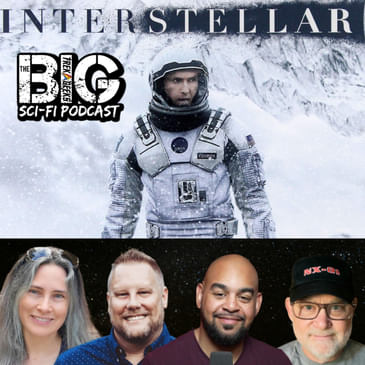
The 2014 film, Interstellar, directed by Christopher Nolan boasts an all-star cast, stunning visual effects, a powerful music score, and a story that is both gripping and mind-bending. Our crew discusses this ground-breaking film with great excitement in this week's fun and mind-bending episode!
This podcast is a proud part of the Trek Geeks Podcast Network and works hard to bring you great content from all over the science fiction universe. We would love to hear your feedback, suggestions, and ideas. Take a moment to send us an email at thebigscifipodcast@gmail.com
Music heard on this podcast opening is from Mikhail Smusev of SignmaMusicArt and provided by Pixabay. Listen to more of his music at: https://pixabay.com/users/sigmamusicart-36860929/
Music heard at the end of this podcast is from Ivan Ohanezov of PumpUpTheMind and provided by Pixabay. Listen to more of his music at: https://pixabay.com/users/pumpupthemind-19969411/
Check our podcast out and learn more about the other great podcasts on the network by visiting trekgeeks.com.
We've got the merch! If you want BIG Sci-Fi swag, check out this link and support us by wearing us everywhere you go! www.teepublic.com/thebigscifipodcast
Check out all of our social links in one place:
https://linktr.ee/thebigscifipodcast
Check out Cris' amazing YouTube channel for Trek content galore:
https://www.youtube.com/@yellingaboutstartrek1532
Check out Brian's new book available at Amazon for Kindle and in paperback:
https://www.amazon.com/stores/Brian-Donahue/author/B0C3BQ93VD
Subscribe for free to Brian's Substack page where he writes original science fiction and fantasy: https://bdonahue.substack.com/
Find Adeena's books here: https://crazyrobot.myshopify.com/
Follow her on Substack here: https://beyondthedroid.substack.com
[00:00:00] This is the Big Sci-Fi Podcast, the biggest sci-fi podcast in the galaxy, a proud part of the Trek Geeks Podcast Network.
[00:00:08] Season 6 was a blast, but Season 7 is going to be even more fun as we continue to go where no podcast has gone before, deep into the sci-fi universe.
[00:00:19] Join Idina, Brian, Chris, and Steve as they explore television, film, and literature for the best sci-fi has to offer.
[00:00:26] Even if you're not a sci-fi fan, you'll love the banter and the epic tangents as these four friends talk about what they love.
[00:00:34] We invite you to sit back and relax, because the journey is just beginning on this season of The BIG Sci-Fi Podcast.
[00:00:44] Hello and welcome back to The BIG Sci-Fi Podcast, where we talk all things sci-fi.
[00:00:49] On this show, we get nerdy, we get spicy, and sometimes we get emotionally moved by a film like Godzilla Minus One.
[00:00:56] And quite possibly today, because we will be talking about Christopher Nolan's sci-fi epic Interstellar,
[00:01:03] which I refuse to believe came out 10 years ago because there is no way that 2014 was 10 years ago.
[00:01:09] It's wild.
[00:01:11] And to help me analyze this film are my usual co-hosts, Brian Donahue.
[00:01:16] Hey everybody, it's Brian from freezing cold and snowy Ohio.
[00:01:20] Steve Merkin.
[00:01:28] And Idina Monyona.
[00:01:31] Hey everybody, it's Idina in Maryland.
[00:01:34] And yeah, 2014 was 10 years ago.
[00:01:36] I did the math.
[00:01:38] Yeah.
[00:01:39] That's why she's the engineer, ladies and gentlemen.
[00:01:42] Yep.
[00:01:42] That's why she's the engineer.
[00:01:44] But first off, how is everybody doing on this somewhat cold, maybe sunny Wednesday, depending on where you are?
[00:01:53] I'm doing wonderful.
[00:01:54] I really am.
[00:01:54] Even though it's cold.
[00:01:55] I got my family with me, played football in the basement with my son, throwing the football back and forth, running around, playing our jams.
[00:02:03] Our tunes were loud, had a wonderful dinner, like can't really complain.
[00:02:08] So, and I'm super psyched to be with my good friends here and talk about this fantastic movie.
[00:02:15] Awesome.
[00:02:15] Cool.
[00:02:16] Cool.
[00:02:17] So anybody else want to go or do we want to just get into Interstellar?
[00:02:21] I'm dying.
[00:02:21] I'm sitting here bursting.
[00:02:22] Okay, let's do it.
[00:02:23] Dying to talk about this film.
[00:02:24] Awesome.
[00:02:25] All right.
[00:02:27] First, overall thoughts.
[00:02:28] How did we all feel about this movie?
[00:02:33] Loved.
[00:02:34] I mean, are we rating it ahead of time?
[00:02:37] We'll save the rating for after, but I got to get a sense of where you're going to rate it.
[00:02:42] Well, I know for me it would be very obvious.
[00:02:43] I loved, I loved this film.
[00:02:45] I loved it when it came out.
[00:02:46] I loved it rewatching it.
[00:02:47] And I'm so glad you had us rewatch this because reminding me how much I love this film.
[00:02:54] I have been, I watched most of it yesterday in about the last 30 minutes today.
[00:03:01] And, oh my word, I saw this when it first came out on DVD.
[00:03:05] I went to the Redbox.
[00:03:07] You guys still have those around your houses?
[00:03:09] Redboxes.
[00:03:10] I saw one at Superstore.
[00:03:11] They're still in a few spots here in Ohio.
[00:03:14] The last one that I was aware of recently was taken away.
[00:03:17] I noticed it was at our CVS and recently it's gone.
[00:03:20] Oh, wow.
[00:03:21] I wonder if we're close.
[00:03:22] But here in Northeast Ohio, they're still around on like pharmacy type stores and a few grocery stores.
[00:03:29] But I remember going to the Redbox to get this, watching this with my wife and going, well, this is a really powerful film.
[00:03:37] It's highly emotional and charged that way.
[00:03:41] But not, we were kind of doing, we weren't like into it, into it.
[00:03:46] And I don't understand why because watching it this time, wow.
[00:03:52] Absolutely blown away at how good this thing is and how deep it is and emotionally charged it is.
[00:03:58] Weeping my face off several faces.
[00:04:00] Several faces.
[00:04:01] I have several faces that I weep from.
[00:04:05] But, you know, just it was incredible.
[00:04:08] I love this film.
[00:04:10] I don't know if it's a film that I'll watch like over and over and over again.
[00:04:14] But man alive, this is a true.
[00:04:16] I'm just blown away today.
[00:04:19] I have a theory as to why it's better the second time around.
[00:04:24] Oh, really?
[00:04:25] Well, yeah, because I think on the first time around,
[00:04:28] I don't think anyone had any idea what to expect from the movie.
[00:04:32] Right.
[00:04:32] And sometimes when you don't have what to expect, the reaction isn't always great,
[00:04:36] especially when this is, this was a very unusual film.
[00:04:38] They did a lot because they were sticking so well to known physics.
[00:04:43] It was very unexpected.
[00:04:44] I remember as much as I liked it the first time,
[00:04:47] I remember I had this different expectation that it was a little bit more action-y.
[00:04:53] It was going to be a little bit more fictional, fictional.
[00:04:55] And I can imagine, though, that once you know, now you know what to expect,
[00:04:59] and then you can just focus on it and just pay attention.
[00:05:02] Then you see how brilliant and amazing it is.
[00:05:05] That's my theory.
[00:05:06] It's a theory.
[00:05:07] Yeah, I think so too.
[00:05:09] Because I liked it.
[00:05:10] I loved it when I saw it, but I haven't watched it again.
[00:05:12] And then watching it, I was like, okay, let me get started on this.
[00:05:16] Let me see how long it takes to get into it.
[00:05:18] But then within like a few minutes, I was hooked.
[00:05:20] And it was really toxic.
[00:05:22] I had to watch it over several days.
[00:05:24] But it was hard not to put down.
[00:05:26] And like, yeah, watching it the second time, it's like I knew what to expect.
[00:05:29] And then I was just blown away by it.
[00:05:32] Because I think then you can pay attention to some more of the details that you might have missed the first time around and all of that.
[00:05:37] Because as much as I loved it the first time, I loved it even more this time.
[00:05:42] The first thing that shocked me about this film was early on where you realize a young Timothee Chalamet is in it.
[00:05:51] And I had not remembered that at all.
[00:05:54] He plays McConaughey's son in it as a younger son.
[00:05:59] And so I just was like, oh my gosh.
[00:06:04] And then more people kept showing up throughout the movie too.
[00:06:07] Like, oh my goodness, this is fun.
[00:06:10] But yeah, right away, they did such a good job, guys, of making you care about this family, this core family around this right away.
[00:06:21] Just with that drone chase at the beginning.
[00:06:23] Like, you wanted to know more.
[00:06:25] You cared about them right then and there.
[00:06:27] And then the school stuff and all that, just brilliant.
[00:06:30] Like, it really helps.
[00:06:31] It was just very well done right away.
[00:06:34] I'm with you, Chris.
[00:06:35] I was hooked again immediately.
[00:06:37] So what about Steve?
[00:06:38] Steve, what do you think, Steve?
[00:06:42] Well, when I saw it in the theater in 2014, when it came out, I had some very high expectations about what I thought the film was going to be.
[00:06:55] Those expectations were not fulfilled because it didn't end up being the film I thought it was going to be from watching the previews.
[00:07:03] So I think I've expressed before a long time ago that I wasn't a fan of this movie.
[00:07:09] Now, watching it a second time, I've enjoyed it more because now I'm looking more in the details that I didn't quite see before.
[00:07:20] Do I still do I do I love this movie?
[00:07:25] I'm going to be honest.
[00:07:27] I'm going to be honest and say no, it's not really in my top five or 20.
[00:07:32] Right, right.
[00:07:32] It's an interesting film.
[00:07:35] And it does have there's a lot going on in it.
[00:07:39] And some of the storyline I do have issues with and I still do.
[00:07:45] But overall, you look at it, you go, this is really you know, this is a Christopher Nolan film, which is big and detailed and amazing.
[00:07:57] And I'll go with that.
[00:08:00] I like it.
[00:08:02] Yeah.
[00:08:03] OK, we need to have a little bit.
[00:08:05] It's true with Steve.
[00:08:07] We need to have a little spice.
[00:08:08] Like if we all agreed all the time that a film is particular is like outstanding or horrible, even like we wouldn't have as much fun talking about it.
[00:08:18] I don't know.
[00:08:18] That's true.
[00:08:19] Absolutely.
[00:08:19] Yeah.
[00:08:20] And again, I think what you were saying, Adina, is about how the film was received when it first came out in the theater.
[00:08:27] And people were because a lot of people may have come and going and try to follow it.
[00:08:33] Because, as you said, this movie is based on real physics.
[00:08:37] And Kip Thorne, is that correct?
[00:08:40] The last name.
[00:08:41] Yep.
[00:08:42] Was involved in this from the very beginning when they got the Inception idea of making the movie.
[00:08:49] Oh, I said Inception.
[00:08:50] That's another one.
[00:08:51] By him.
[00:08:53] And so he's wanted to make it as accurate as possible.
[00:09:01] And maybe the average Joe, I hate to use the expression, Joe Sixpack might have been confused by it.
[00:09:12] But still, film-wise, it's a beautiful movie.
[00:09:16] And we'll get into the soundtrack, which is unbelievable, later on.
[00:09:21] I think you're right, Steven.
[00:09:23] And I think also, maybe, you know, when they make these trailers and previews for these movies, they're trying to hook you to get you there.
[00:09:33] And unfortunately, Hollywood can tend to make movies like this seem more action-packed than they end up being sometimes.
[00:09:42] And it's because they're trying to get you to the theater.
[00:09:45] They're trying to draw you in that way.
[00:09:47] I get it.
[00:09:48] But I wonder if that didn't hurt this film a little bit.
[00:09:53] Is that some people were expecting more action.
[00:09:55] And then when they didn't get it, and it was way deep and all the, you know, just all this stuff.
[00:10:03] And long, too.
[00:10:04] It's an over-two-hour movie, too.
[00:10:06] Yes, it is.
[00:10:07] So I think that kind of hurt it, unfortunately.
[00:10:12] But, again, though, watching it a second time, like, I'm just, again, absolutely blown away by this film.
[00:10:19] Yeah.
[00:10:20] And so at the time that it came out, I didn't know about Kip Thorne's connection to the movie.
[00:10:25] But after, several years after, I did buy the book.
[00:10:28] I have here with me The Science of Interstellar by Kip Thorne.
[00:10:32] And I have a sort of a semi-personal connection to Dr. Thorne because he went to school.
[00:10:40] One of his classmates was a guy named Charlie Misner.
[00:10:44] The two of them studied under John Wheeler.
[00:10:47] John Wheeler was the dude who was, like, the father of gravitational physics as we know it.
[00:10:53] So he's got these students that go off.
[00:10:55] And Charlie Misner was at the University of Maryland where I was.
[00:11:00] And we went through this weird phase where, as undergraduates, this is not common, but as undergraduates, we had faculty advisors.
[00:11:07] And Charles Misner was my advisor.
[00:11:10] Oh, wow.
[00:11:11] And he helped me see that his field of theoretical gravitation was not going to be my field.
[00:11:18] We discovered the point where I was always very good at math.
[00:11:22] We discovered my limit to that.
[00:11:25] But I feel a connection.
[00:11:27] And even back when I was in college 30 years ago, so Kip Thorne, he's written for the public.
[00:11:31] He's had multiple books out.
[00:11:33] And I was reading his Black Holes and Time Warps 30 years ago.
[00:11:37] And so this has been his thing.
[00:11:39] He's a Nobel Prize-winning physicist at this point.
[00:11:42] People might have seen it.
[00:11:43] He did a cameo on The Big Bang Theory.
[00:11:45] And this book, if you actually, for people who want to understand the physics of this movie, this is an amazing book.
[00:11:53] And how he writes it, where he explains very clearly what is true.
[00:11:58] And he explains how we know it's true.
[00:12:02] Versus what is an educated guess.
[00:12:04] Versus what is the speculation.
[00:12:07] Versus what is the speculation.
[00:12:07] And he, but the thing is, even the speculation is very thoughtful speculation.
[00:12:12] So he really goes and covers, and not just the physics, but like the blight itself.
[00:12:17] He goes into some of that part as well.
[00:12:20] And he talks about where, you know, he's not an expert in some of that stuff.
[00:12:23] He explains the experts that did come in to, you know, to deal with that.
[00:12:27] But amazing stuff if you have any interest in this.
[00:12:33] Which I do.
[00:12:34] That sounds, I love all of that.
[00:12:35] Now actually that leads me to my second question is, I wanted to talk about the dystopian future, the blight future.
[00:12:42] How did we feel about that?
[00:12:44] Did that grab you?
[00:12:45] Did you like it?
[00:12:45] Did you not like it?
[00:12:47] What are your thoughts?
[00:12:48] It was terrifying.
[00:12:51] That, that the possibility that we could, yeah, that we could get to that point.
[00:12:59] Um, and have just corn.
[00:13:04] Yes.
[00:13:05] Like, I mean, I know you can do a lot with corn.
[00:13:09] Apparently they're using it for fuel because they're driving around everywhere.
[00:13:13] Apparently gasoline is in full supply still.
[00:13:17] It might all be corn based, right?
[00:13:19] Yeah.
[00:13:19] So it's like terrible.
[00:13:21] That would be E85, E85 fuel, which is 85% corn and 15% gasoline.
[00:13:29] So yeah, that's what it is.
[00:13:31] Yeah.
[00:13:31] Or is it the other way around?
[00:13:32] I forget.
[00:13:32] Anyway, but yes, you're using it.
[00:13:34] And Brazil has been using corn based fuel for many years now.
[00:13:39] So you're right about that, Brian.
[00:13:41] Yeah.
[00:13:42] So, so it was, it's a little terrifying and I think it sets the stage well.
[00:13:47] I think it's a good, um, narrative to show why they need to get off planet.
[00:13:54] I think it's effective.
[00:13:56] I think they pull it off really well too in the story.
[00:13:58] Like, like I'm my willing suspension of disbelief is out is high because I was all in on the story in that part of it in particular.
[00:14:09] I think they played it off very well.
[00:14:39] Yeah.
[00:14:41] Like, it was a very quiet, like, we're not going to be like, oh my gosh, it's like all dark skies and there's no green grass anywhere, but it's just kind of like, oh, there's dust everywhere.
[00:14:50] And this idea that people have gotten used to things like, oh yeah, there's no MRI anywhere because we just stopped investing in that because that's not relevant.
[00:14:59] And we just want people to become farmers.
[00:15:01] So I thought that was a unique, unique future compared to like other dystopian features that we've seen.
[00:15:07] And, and not only that, you know, so the loss of people who can deal with modern technology, but then rewriting history, the scene that like, I want to punch the TV is when the teacher is there with a straight face, you know, talking about how Apollo missions didn't happen.
[00:15:25] And it's not like she's saying it, wink, wink, I'm just saying it to toe with the party line.
[00:15:30] It's like, you can tell she believes it, what she's saying too.
[00:15:35] And so it's, it's, that was the part that for me, I mean, it all hurt to see this, right?
[00:15:41] Cause you don't want to think about, you know, your kids growing up into like any kind of dystopian future, but to, to see that part happen and just those little details and those little threads that they pulled on.
[00:15:52] And that made it very compelling.
[00:15:55] And then talking about, you know, there's no more real professional sports teams.
[00:15:59] Like what's, you know, what's become of it is not what it once was.
[00:16:02] And that several of the people, the older people lived through the transition time too.
[00:16:09] You know, you know, Jonathan Lithgow's character, he obviously, it seems like he was probably our contemporaries or maybe a little younger than, than us.
[00:16:18] Maybe like your age, Chris, or a little younger than you is the feeling that I get that they're trying to convey.
[00:16:27] Well, the story takes place as I could find out in the year 2067.
[00:16:34] That's right.
[00:16:35] That would be about right.
[00:16:36] So something has happened between now and 2067 that create the most dramatic dust bowl of Oklahoma that ever was.
[00:16:48] And also create the same thing that occurred in Ireland, which caused so many Irish people to come to the United States, the great potato famine where the potato crops died off.
[00:16:58] So, but they don't explain what happened.
[00:17:03] Was it, you know, was it global warming?
[00:17:09] Was it a plague?
[00:17:11] Was it the, you know, the earth tilted on its axis and has changed weather?
[00:17:16] They don't explain it.
[00:17:17] We just have to accept the fact that this is where they are right now.
[00:17:21] And that society has gotten down to the point where, yeah, you know, agriculture is all we want to do is feed ourselves.
[00:17:30] But we also miss out what the rest of the world is going through.
[00:17:35] Yeah.
[00:17:35] We don't know.
[00:17:37] Is this happening in Asia and in Europe and in South America and Africa?
[00:17:42] And, you know, is all the rest of the world or is this just a USA problem?
[00:17:47] No, they imply that this is a world, they imply several places that this is a worldwide problem because when they reference that, you know, this is the last crop of okra, like anywhere, you know, how they're talking about the crops dying out.
[00:18:00] I think when they say anywhere, they mean worldwide anywhere.
[00:18:04] Yeah.
[00:18:04] That opening scene with the drone and they're talking about how the drone's just been flying around there for like two decades.
[00:18:11] They're implying that India like isn't really there to take care of their equipment.
[00:18:19] You know, they made these equipment.
[00:18:21] They're there and they're possibly not existing.
[00:18:24] You know, like.
[00:18:24] Right.
[00:18:25] Like it really they do several things that imply this is a worldwide collapse.
[00:18:29] Yeah.
[00:18:30] It's it is interesting, though.
[00:18:31] They do imply it.
[00:18:32] Um, but we never I don't recall ever seeing like them doing any scenes or flashbacks or news stories of that happening around the world, too.
[00:18:46] They really chose to focus in on this one family in particular.
[00:18:52] Mm hmm.
[00:18:53] And then the NASA engineers that were working to get, you know, to go to this black hole.
[00:19:02] So it's an interesting take like like it also kind of added to the effect of how maybe many people would feel kind of on their own.
[00:19:13] You kind of got the sense that McConaughey's family is on their own and fighting their own battles.
[00:19:19] And so in that there's there's an assumption, maybe even if.
[00:19:26] Very lightly or nuanced that other people are experiencing the same things.
[00:19:32] We really don't see much of even other people in their town except for the short school stuff at the beginning and then people driving off.
[00:19:40] We don't see a lot of other human beings other than this family and the people at NASA in this film, which is interesting.
[00:19:48] Yeah.
[00:19:48] And that's that again to me, that's one of the shortcomings, because in other apocalyptic films and of the world films, they do show worldwide reaction to what's going on.
[00:20:06] And that's one of the shortcomings.
[00:20:09] It's a great thing.
[00:20:16] It's a great thing.
[00:20:20] It's a great thing.
[00:20:28] It's a great thing.
[00:20:34] I think that's one of the things that I think that people are saying, no, you're wrong.
[00:20:38] You're wrong.
[00:20:39] You're wrong.
[00:20:39] Some some discord that might have occurred.
[00:20:42] And I think the implication, I think the implication is that those people don't exist.
[00:20:48] That I thought that there was a line in there where they talk about how many less people there are.
[00:20:55] You know, the total population of the planet.
[00:20:58] They mentioned it.
[00:21:00] So like, again, I think this was really it's a world it's intended to be a worldwide calamity.
[00:21:05] And the reason I don't think you see an international effort is there really isn't much international to speak of anymore.
[00:21:12] Yeah.
[00:21:13] And that's what I found interesting is like talking about it, like from because, yes, it is like post apocalyptic end of the world.
[00:21:20] But it's like that's almost secondary to the movie because the movie is about their adventures in space trying to find a new planet.
[00:21:29] Whereas like something like a 2012 or Independence Day to a degree, that's more about, OK, like that's the sole focus focus is on the disaster.
[00:21:39] Whereas we're already past that disaster.
[00:21:41] So I kind of see why they didn't want to focus too much on, OK, what happened previously to a disaster is in this case, it's not the movie.
[00:21:49] It's the inciting incident.
[00:21:51] Right.
[00:21:51] Exactly.
[00:21:52] Into interstellar space.
[00:21:55] And then another disaster.
[00:22:06] And then the second admission was made by man when he also states that he knew from the very beginning.
[00:22:18] Yeah.
[00:22:18] It was not going to work at all.
[00:22:20] Oh, my goodness.
[00:22:21] I had completely forgotten that Anne Hathaway, Michael Keaton, no, not Michael Keaton, Michael Caine and Matt Damon were in this film.
[00:22:30] I totally spaced that.
[00:22:32] And so when they all showed up, I'm like, what?
[00:22:35] OK, here we go.
[00:22:36] Or as my kids would say, let's go, you know.
[00:22:39] Yeah.
[00:22:40] And I feel like it's kind of funny because I think this was around the time also that Matt Damon was in The Martian.
[00:22:46] Yeah, this was like the year before, I think.
[00:22:48] Yeah.
[00:22:50] Was it right after?
[00:22:51] Was it before or after?
[00:22:52] Because like Martian came out in 2015.
[00:22:55] I'm pretty sure it came out in 2015.
[00:22:57] I might look that up.
[00:22:58] But the thing is, I feel like we're used to, or at least I was used to feeling like Matt Damon is a hero character, not a bad guy.
[00:23:05] Yeah, he's a bad guy in this one.
[00:23:08] Oh, I hated him so much.
[00:23:10] I've never hated Matt Damon so much in my whole life.
[00:23:12] I know.
[00:23:13] He did a great job.
[00:23:14] Oh, yeah.
[00:23:15] I mean, he did exactly like what he was supposed to do.
[00:23:18] Well, what's funny is he starts off like his Martian character.
[00:23:22] Like he's funny.
[00:23:23] He's emotional.
[00:23:24] He's like, you know, this is like, oh, here's a great place.
[00:23:27] It's super cold.
[00:23:28] And he's like doing a bit.
[00:23:30] And I was like, oh, that's like his character in The Martian.
[00:23:32] But then it turns and it's like, oh, okay.
[00:23:35] This is not a good idea.
[00:23:36] But his world that he had, the world he had was really uninhabitable.
[00:23:43] Right.
[00:23:44] By any standards, either due to the temperature or the fact that was it ammonia or methane gas or something was in the environment.
[00:23:53] So it wasn't breathable.
[00:23:55] Mm hmm.
[00:23:56] So he got stuck on this planet and lied, sending out false data so that he could get a he waited for the cab to show up to pick him up or his Uber ride, which was going to be endurance.
[00:24:12] Yeah.
[00:24:15] Yeah, that was that was a fun like surprise.
[00:24:18] I remember he showed up, but I forgot that he was a bad guy.
[00:24:20] I just remember.
[00:24:21] I don't even remember what I remembered about him like being there, just that they showed up.
[00:24:25] He had a cameo and then that was that.
[00:24:28] But speaking of Matt Damon, like, did were there any characters that you particularly identified with or like really enjoyed in the movie?
[00:24:38] I was going to say I enjoyed it.
[00:24:41] I enjoyed it all.
[00:24:42] I really did.
[00:24:44] Yeah.
[00:24:46] I, I liked all the care.
[00:24:48] Well, all the characters.
[00:24:49] I did not like Matt Damon's character.
[00:24:51] Well, but you just to be clear.
[00:24:52] But right.
[00:24:53] But he still was.
[00:24:54] You did his part well enough.
[00:24:56] It was intriguing.
[00:24:57] Yes.
[00:24:57] I got to say, like, honestly, there were.
[00:25:02] Uh, there were times I'm not kidding and I can be I kind of wear my emotions on my sleeve.
[00:25:09] Like, I'm not afraid to cry in front of people to really express myself.
[00:25:14] Hopefully in appropriate ways most of the time.
[00:25:17] But, um, and at appropriate times too.
[00:25:19] But, um, I found myself bawling.
[00:25:22] And when he's got to say goodbye to Murph.
[00:25:27] Yeah.
[00:25:27] And Murph isn't responding negatively.
[00:25:29] Like the gut wrenching.
[00:25:30] Like I was almost weeping because I could see myself as the father.
[00:25:35] I could see my daughter in that role.
[00:25:37] And then when he's listening to the messages and seeing his son, uh, grow, grow, um, older.
[00:25:47] And Casey Affleck is now the grownup, uh, Tom, uh, in Timothy Chalamet plays a younger Tom.
[00:25:54] Um, and to see that scene gut wrenching and I guys, I'm just going to go out on a limb and say this.
[00:26:03] I think this is McConaughey's finest hour.
[00:26:07] Yeah.
[00:26:08] I haven't seen all of his films, but from the ones I've seen, I just, this, this was so amazing.
[00:26:18] His portrayal.
[00:26:20] And then when he's behind the bookshelves, you know, uh, pushing and yelling for his daughter, like, oh my gosh, guys.
[00:26:28] And then the deathbed scene with his daughter when she's old.
[00:26:32] Just amazing.
[00:26:33] I tell you, this had a very satisfying come around to the end, you know, which makes the dystopia at the beginning, especially now that, you know, you know, the end.
[00:26:43] I mean, I was incredibly satisfied that we got to the end.
[00:26:47] We got to see what happened.
[00:26:48] And we got to see that humanity survived and how they, you know, basically survived.
[00:26:52] And that he's going after, uh, going after brand going after Anne Hathaway's character too, that he was, uh, I love that the guy, the worker in the dock walking through and realizing the ship is gone.
[00:27:06] And like, what the heck, you know, um, I just, uh, it's just, you're right.
[00:27:10] Adina came back around in a very satisfying way.
[00:27:14] I actually, as I finished this, this film up today, um, I was smiling at the end of it for all the weeping I'd done.
[00:27:22] And again, we're going to talk about the music and all that, but just the drama in this, the acting, the special effects, like, uh, all of the emotional stuff.
[00:27:32] I felt there was a real high at the end of this film as well.
[00:27:36] That made it worth going through.
[00:27:39] If it would have just left us heavy.
[00:27:41] Right.
[00:27:41] I get, there's a place for film like that.
[00:27:44] There's a time and place where, you know,
[00:27:46] I feel like a lot of films will do that.
[00:27:48] They will kind of like lift it, that part be to your imagination or something, or they might imply some things.
[00:27:54] I'm really glad that this film chose to close the loop and close it in a very satisfying way.
[00:28:00] I agree.
[00:28:01] And it's also cool because like, I feel like this is around the time, like it was 2013, 2014,
[00:28:08] when Matthew McConaughey started doing these really serious parts and like his evolution started because before I felt like people didn't take him seriously.
[00:28:17] Cause he did a lot of chick flicks.
[00:28:18] He was amazing in Tropic Thunder.
[00:28:20] He did contact like in the late, he did contact in the late 1990s, which is one of my favorite films ever.
[00:28:26] And I've always thought that that was one of his best roles.
[00:28:29] And this, this to me is similar vein that dramatic role.
[00:28:34] Yeah.
[00:28:34] Yeah.
[00:28:34] I feel like this is a different role, but.
[00:28:37] Like coming back where people are like, Oh wow.
[00:28:39] This guy, we can take him seriously.
[00:28:41] So that was, but I liked him.
[00:28:42] Like you're right.
[00:28:43] Like that, the scene with him, like, okay.
[00:28:46] Like I got him a little bit emotional when he's trying to say goodbye and she's not listening.
[00:28:50] But like what gets me more is when he's driving in the truck and he's already long gone.
[00:28:56] And then she comes out.
[00:28:57] She comes out.
[00:28:58] Yeah.
[00:28:58] Oh, that realization.
[00:28:59] Yeah.
[00:29:00] And the grandpa has to like hold her and comfort her.
[00:29:03] And that's just like, that's devastating.
[00:29:05] And she holds onto that anger for so many years.
[00:29:08] Yeah.
[00:29:09] Which he gets to see.
[00:29:10] Cause again, when he comes back and the messages and he, he doesn't have messages from her until, you know, eventually there's one.
[00:29:15] And, you know, yeah.
[00:29:18] That, that's yes.
[00:29:19] But again, so glad that that came back around and got like all resolved.
[00:29:26] Yeah.
[00:29:27] I'd have been so mad at Chris if, if for having us watch this film, if it didn't come back around, that'd have been.
[00:29:32] If I would have, if I knew, if I had, like, if I wasn't aware of the ending or if I knew, okay, the ending is going to be really rough.
[00:29:38] I would have mentioned that.
[00:29:41] Hey, this is a rough ending.
[00:29:43] Yeah.
[00:29:43] Because here's a poor guy that he gets to stay on endurance while they go down to the water planet.
[00:29:50] And he's left there for 23 years.
[00:29:55] Now, I don't know about you, but that would be like going to solitary confinement in prison for the rest of your life.
[00:30:01] And with the thought that he has no idea if they're ever coming back or not.
[00:30:06] 23 years for him was, I think, three hours on the planet.
[00:30:12] Yeah.
[00:30:12] It was three hours.
[00:30:14] Luckily, they had that, that ability to, you know, essentially go in stasis for periods of time, you know, go to sleep for periods of time.
[00:30:20] So that, that helped.
[00:30:21] Did he do that or not?
[00:30:22] Yeah.
[00:30:22] He talked about doing it a few times.
[00:30:24] Yeah.
[00:30:25] Yeah.
[00:30:25] But still, it's like, you're still wondering, is anyone coming home?
[00:30:30] You know, because.
[00:30:30] Yeah.
[00:30:31] 23 years.
[00:30:33] And then on the frozen planet, the poor guy gets blown up.
[00:30:37] Yeah.
[00:30:38] I mean, really?
[00:30:38] Did he deserve that?
[00:30:40] I don't think so.
[00:30:41] No.
[00:30:42] That's why I really, I feel bad for his character more than anybody because he waited forever and then he doesn't make it home.
[00:30:52] So, yeah.
[00:30:53] You're talking about Romilly?
[00:30:56] Yeah, Romilly.
[00:30:57] Is it Romilly?
[00:30:58] Which, which by the way, David Gyasi is, I was, I've been watching a little show called The Diplomat and highly recommend it.
[00:31:10] Really great show.
[00:31:11] It's got two seasons, but he plays a key role in that show.
[00:31:16] So check it out.
[00:31:17] The Diplomat, I believe it's on Netflix.
[00:31:19] But this, I mean, this film has John Lithgow, Michael Caine.
[00:31:23] Oh, we mentioned Matt.
[00:31:25] I mean, it's just an absolute, uh, Topher Grace, Wes Bentley, which many people would know from Wes Bentley from some people from The Hunger Games, others from, uh, uh, Yellowstone.
[00:31:40] No, no, no, no, no, no.
[00:31:41] No, no.
[00:31:41] Wes, Wes Bentley now is from Yellowstone.
[00:31:44] Topher Grace.
[00:31:45] Yeah.
[00:31:45] That 70s show.
[00:31:47] Um, and Spider-Man three is venom, which I know will upset people, but I, I still enjoy that movie.
[00:31:53] Casey Affleck.
[00:31:54] I mean, this is a stellar.
[00:31:55] Like I'm used to seeing, again, this is also a different role for him.
[00:31:59] You know, I'm used to seeing him in a little more, you know, humorous or something.
[00:32:02] And for him to be kind of a crotchety mean, also like a deliberately not quite a hundred percent likable character, not a hundred percent dislikable because he's taking care of his grandkids, but he's, you know, kind of counter to Cooper.
[00:32:16] And yeah, he's crotchety old.
[00:32:21] Yeah.
[00:32:22] He does that well.
[00:32:24] Yeah, he did do it well.
[00:32:26] Yes.
[00:32:27] I tell you, I just, I hated Matt Damon in this film.
[00:32:30] I just.
[00:32:31] Matt Damon.
[00:32:32] Well, and he was responsible for Romilly's death.
[00:32:35] So there's another reason to hate him.
[00:32:37] I mean, he killed, you know, he killed Romilly.
[00:32:40] And he also just derailed everything.
[00:32:42] Like had it not worked out, he could have just been the end of humanity had.
[00:32:46] Yeah.
[00:32:47] Like they've gone there and then, all right, they're stuck and they didn't get to do all that crazy.
[00:32:51] Like, um, sling.
[00:32:54] I don't know.
[00:32:55] Slingshot.
[00:32:55] That's someone to call it when they get out, when they leave.
[00:32:58] Mm-hmm.
[00:32:59] Mm-hmm.
[00:32:59] Oh my goodness.
[00:33:01] Oh, just how they wrapped that up where it was McConaughey or Cooper touching in Hathaway's.
[00:33:06] What was her name?
[00:33:07] Brand.
[00:33:07] And he was the one touching hands with her.
[00:33:10] Yeah.
[00:33:11] Oh, just, just on.
[00:33:13] Yeah.
[00:33:14] With Brand.
[00:33:14] Yeah.
[00:33:14] Like just how they brought that all back around.
[00:33:17] Mm-hmm.
[00:33:19] So good.
[00:33:20] And the fact that he's the ghost.
[00:33:21] This is all explained in this little book.
[00:33:24] Yeah.
[00:33:24] And by little, I mean, it's really actually pretty thick, but it has a lot of pictures and images
[00:33:28] and, and describes a lot of stuff about gravity and these phenomena.
[00:33:34] Yeah.
[00:33:35] I recommend it.
[00:33:35] Can we talk about that?
[00:33:36] Can we get a little science with Adina?
[00:33:38] Okay.
[00:33:39] First, like, okay, actually, no, this is where I want to go.
[00:33:43] Is there a way you can explain like fairly quickly?
[00:33:46] Oh, gosh.
[00:33:47] If you can't, no problem.
[00:33:48] Because where I got confused was like this idea that gravity can transcend time and it's
[00:33:52] the only thing that can transcend all the dimensions.
[00:33:56] And that's kind of what they're saying.
[00:33:56] Yeah.
[00:33:56] Right.
[00:33:57] That, that is kind of what they're trying to make the case for.
[00:33:59] And in this, in this book, again, Kip Thorne explains what we really do know, which is a
[00:34:06] lot about, you know, general relativity and such.
[00:34:09] And he explains why we know this stuff is true to include everyone's GPS works, you know,
[00:34:16] like the fact that your GPS works and is as accurate as it is, is partly due to general
[00:34:21] relativity.
[00:34:22] So all that stuff is real.
[00:34:23] But then, yeah, this goes like beyond and Thorne explains it really how we get from here
[00:34:30] to there.
[00:34:31] But yeah, that's the case that they're trying to make is that, you know, time flows in one
[00:34:36] direction.
[00:34:36] You can't go back.
[00:34:37] But yet gravity transcends all of that.
[00:34:40] And that while Coop is in the Tesseract that was constructed potentially, you know,
[00:34:47] when they say by like these advanced beings, which they're implying are us way in the distant
[00:34:51] future, you know, so he's in this Tesseract.
[00:34:55] He learns how to manipulate gravity in a way that sends information back and forth between,
[00:35:04] you know, between where he is and where his daughter is.
[00:35:08] Right.
[00:35:09] And I don't know.
[00:35:10] I get it.
[00:35:10] Like, I feel like you really do have to go through half of this book to understand.
[00:35:14] I think I'm going to have to pick it up.
[00:35:16] But I think it's worth looking at.
[00:35:19] And one of the things that I love about this, because a lot of people talk about like, oh,
[00:35:24] we're never gonna do really advanced things like we see in the movies, like we're never
[00:35:29] going to go faster, speed of light, all this stuff.
[00:35:31] But then if you, I love just reminding people that a couple hundred years ago, if you were
[00:35:38] to tell people, oh, someday we're going to be able to have a conversation with someone,
[00:35:43] a real time conversation with someone on the other side of the planet, you would have been
[00:35:46] burned at the stake as a witch.
[00:35:48] You know, because at that time, we didn't know about electricity and magnetism, or we're
[00:35:53] just starting to realize these exist.
[00:35:55] And so just starting to realize these exist.
[00:35:58] And now here, in, you know, the 19th century, 20th century, we've learned how to manipulate
[00:36:04] those forces of nature.
[00:36:06] Well, here's a force of nature, gravity, that we're at the still the early stages of truly
[00:36:11] understanding.
[00:36:12] And so yes, maybe a couple hundred years from now, we will have enough knowledge to then
[00:36:17] manipulate it and use it in who knows what ways.
[00:36:20] Just like we didn't know, people did not know about electricity and magnetism several
[00:36:25] hundred years ago.
[00:36:26] So that's what I love about this kind of science, you know, stuff.
[00:36:31] And like I said, my math wasn't good enough to go into this because it really needs to be.
[00:36:36] This is why I'm an engineer.
[00:36:38] Yeah.
[00:36:39] Well, think about it, though.
[00:36:40] Even something, let's break it down a little simpler.
[00:36:45] Watching Star Trek as a kid and even sci-fi older than that, they were talking at each
[00:36:50] other on screens, seeing real time video of the person they're talking to.
[00:36:54] I remember as a kid going, that'll never happen in my lifetime.
[00:36:58] Right.
[00:36:58] Now, a lot of people probably didn't think it would happen in their lifetimes.
[00:37:01] And here we are.
[00:37:02] So this is what we're doing right now.
[00:37:04] Incredible.
[00:37:05] Like, yeah, it's unbelievable.
[00:37:06] It's unbelievable.
[00:37:07] And this is why I, you know, very much say never say never, because we don't know.
[00:37:11] And this is why, you know, a lot of people criticize, well, why are we studying all
[00:37:15] this?
[00:37:15] Some of this fundamental physics?
[00:37:16] What's the practical applications?
[00:37:19] And honest answer for some of it is we don't know yet.
[00:37:23] You know, maybe a hundred years we'll know, but we still have to do the root science to get
[00:37:29] like to get anywhere.
[00:37:30] You don't go from like the technology that has been developed in the last, you know, 10,
[00:37:35] 15, 50 years.
[00:37:36] It feels like it happened overnight, but this is all built on the backbone of a couple hundred
[00:37:42] years of science and just learning how things work.
[00:37:47] So we still have to do that to move forward or we don't move forward, you know, but I
[00:37:52] think moving forward is good.
[00:37:54] Yeah.
[00:37:55] It's good to move forward.
[00:37:57] Exactly.
[00:37:58] For me, that's not an engineer.
[00:38:00] I don't have the math.
[00:38:01] I, I always love science and movies like this or science or TV shows.
[00:38:06] And of course they did my favorite things.
[00:38:08] They did the whiteboard, which I always love a good life.
[00:38:11] Okay.
[00:38:11] Here's the whiteboard.
[00:38:12] Here's the diagram.
[00:38:13] Let me break it down for the audience.
[00:38:15] And then of course they did the classic, uh, which I think was from the movie event horizon.
[00:38:21] I think that maybe first introduced the whole, like you get a piece of paper, you do two
[00:38:25] lines, you do two, you draw two dots and you do a line, then you fold it, poke a pencil
[00:38:30] through.
[00:38:31] I was glad they brought that back.
[00:38:33] Um, but I just loved, I love watching people explain science to other people in movies.
[00:38:38] So I like the reason why, Oh, I was going to say, I was going to say, go ahead.
[00:38:43] The reason Chris, that you said you're on the fence about, or you might want to get this
[00:38:47] book you're then you really need to, because he's got a whole bunch of explaining the equations
[00:38:52] that are written on the board.
[00:38:54] I want it.
[00:38:55] I want it.
[00:38:55] I need to get that.
[00:38:56] Yeah.
[00:38:56] But what I liked was how, again, they explained the concept of the paper folding bending,
[00:39:03] but then also that the wormhole was a ball, a sphere that you would enter into.
[00:39:12] Whereas in your favorite TV series, of course, Brian deep space nine, the wormhole opens up
[00:39:19] and it's more like a funnel on those, on that series.
[00:39:23] So from that point of how they portrayed it on a star Trek series as a funnel that you
[00:39:31] enter that opens and closes swirling and so on, they show it in more of the theoretical
[00:39:37] way, which is what it should be described at as a sphere.
[00:39:41] And I just, I like, I like that.
[00:39:43] I thought that was really well, well intended, well, well done by the, by the writers.
[00:39:49] What I, you know, what's also in this book and I've, and I've seen this story before.
[00:39:53] I think, um, Kip Thorne had, had wrote about it in one of his older books that I had read
[00:39:56] is the origin of the term wormhole.
[00:40:01] Oh yeah.
[00:40:02] Came from that dude, John Wheeler.
[00:40:04] I mentioned who's, you know, the father of all the gravitational stuff.
[00:40:06] And the term came from how he described this phenomenon was if you take an apple and you
[00:40:14] have an ant walking on the surface of the apple, the ant only knows about the surface of the
[00:40:21] apple, the apple, he doesn't know about anything else, but a worm might tunnel through making
[00:40:26] a hole from one end of the apple to the other.
[00:40:30] And once that like exists, the ant can like travel through.
[00:40:35] Right.
[00:40:35] And so literally wormhole thinking of like an apple with a worm in it.
[00:40:40] That's where the term came from.
[00:40:42] My mind is exploding.
[00:40:44] There's fireworks going off all over.
[00:40:46] Books.
[00:40:46] People need to read books.
[00:40:47] So much stuff you can learn from books.
[00:40:50] Now do the books, the book speech from, uh, the original series when Perk's on trial.
[00:40:56] Just kidding.
[00:40:56] Don't do that.
[00:40:57] Yeah.
[00:40:58] I'll just stick to watching TV shows to learn my physics.
[00:41:04] And that's the amazing thing about science is that if you don't understand it or you get
[00:41:12] a working knowledge of how it works, it is magic.
[00:41:18] If you think of it, you know, in that, it is, you know, and that's how I guess, you know,
[00:41:25] early people perceive these things as it's magic as opposed to understanding why it's there.
[00:41:31] What's the quote?
[00:41:32] There's like the famous, like any alien, like not any alien technology, but like any substantially
[00:41:38] advanced technology will appear to be magic.
[00:41:40] Magic.
[00:41:40] Yep.
[00:41:41] That's something like that.
[00:41:42] That's always, that fits.
[00:41:43] Imagine what we would look like today driving in our cars to the Engel family on Little House
[00:41:52] on the Prairie that had to travel in a wagon across the country.
[00:41:56] I don't think they could process it.
[00:41:57] And that's the thing is I think there's like a gap where you couldn't process what you're
[00:42:01] seeing at all.
[00:42:03] Like, I don't think the human brain is capable of processing, which also lends to some
[00:42:07] interesting like thoughts as to when people, you know, have experiences.
[00:42:11] And again, I'm a very grounded in science person, but I'm willing to accept, like I was
[00:42:16] saying a few minutes ago, yeah, a couple hundred years ago, what we're doing today would have
[00:42:19] been ridiculously crazy magic and we would have been burned at the stake for suggesting
[00:42:23] that such a thing is possible.
[00:42:25] But when people describe experiences that can't be explained, you know, I start to wonder,
[00:42:31] you know, the pieces that we don't know yet.
[00:42:33] And that whole concept that, because I think, and I want to find out a little bit more about
[00:42:38] this because I am actually going to use this in one of my upcoming science fiction novels,
[00:42:42] that concept that humans can't process things that are so far advanced from the art.
[00:42:47] Right.
[00:42:47] One of my books, I might have some robots going back in time.
[00:42:52] Ooh.
[00:42:52] And, and that might be how they're not detected is just that very simply the humans can't
[00:42:58] process them.
[00:42:58] So they don't really see them.
[00:43:00] So they're there in plain sight.
[00:43:01] Oh, that's interesting.
[00:43:02] Interesting.
[00:43:03] That's interesting.
[00:43:04] Spoiler alert on my own books.
[00:43:05] That's like Roger from American Death.
[00:43:07] Nobody can figure out that he's an alien because they just can't.
[00:43:09] Yeah.
[00:43:10] I guess it's because they can't fathom it.
[00:43:12] Right.
[00:43:12] But yeah, I love that.
[00:43:14] That's a cool idea because that's interesting.
[00:43:15] We don't really talk about that idea.
[00:43:19] Like whenever, even when we talk about Trek, it's like, that's far in the future to
[00:43:22] us.
[00:43:23] But we, because we're in the present, we make it perceivable.
[00:43:28] But then it's like, we never really, like, I don't think we've ever really stopped to
[00:43:31] think about, okay, is the, will the future, if we were to jump a few hundred years in
[00:43:35] time, would we be able to understand it?
[00:43:38] Like, would I be able to say, oh, okay, this technology is better.
[00:43:41] But yeah, it's an interesting concept.
[00:43:43] It is an interesting concept, but it was in Next Generation, in the episode First Contact,
[00:43:48] remember Deanna Troy, she makes the comment that, you know, scientists and people have,
[00:43:52] those kinds of people have an easier time accepting their arrival.
[00:43:56] And it's partly because they can, you know, they're creative, they can imagine other things.
[00:44:01] And so they're kind of sensitive to, in a similar way that those of us who are into science and
[00:44:06] even science fiction, we've been exposed to more possibilities.
[00:44:10] So we're possibly more prepared for when aliens come and visit us.
[00:44:16] Right.
[00:44:17] Now there's one thing, another, I keep thinking of things that I didn't mention in, like,
[00:44:21] didn't write in the questions I sent over, but we keep talking about Trek.
[00:44:25] But I want to bring up another sci-fi movie that I think this relates to, and that is
[00:44:29] 2001, because even reading some of the behind the scenes, it was like Christopher Nolan really
[00:44:35] wanted to make a modern, I guess you could call it like a modern take on 2001.
[00:44:40] How did we feel about that?
[00:44:42] But even with all of the physics talked about in science and everything, this film is much
[00:44:47] more understandable, even though there's more actual information in it than 2001.
[00:44:53] So that's what I think.
[00:44:54] I mean, I think, you know, for me, where 2001 fell apart was that end sequence, which never
[00:45:01] really ties to anything.
[00:45:03] Where here, the end sequence, it was analogous as the Tesseract.
[00:45:07] Right.
[00:45:08] But we get kind of explanation and resolution of that, which I think is far superior to what
[00:45:16] they did in 2001.
[00:45:17] And also, too, even from like a cinematic point of view, it's like he was able to capture
[00:45:23] the quietness of space and the beauty of space that 2001 was able to capture.
[00:45:29] But he added dial.
[00:45:31] Like I shouldn't say there was dialogue in 2001.
[00:45:34] But like.
[00:45:36] Christopher Nolan was much more aware of, OK, here's what the audience is going to enjoy.
[00:45:39] So I was like, we can have those moments of quietness, but then we'll also jump back to
[00:45:44] people actually talking.
[00:45:45] Whereas I felt like for me, we're yeah.
[00:45:47] 2001 falls apart because of the end.
[00:45:49] And it's just so wild, which I love.
[00:45:51] But it's also like I want more information.
[00:45:52] But also it's a movie that I tend not to watch start to finish because of how much.
[00:45:59] Like no, like how much how many scenes there are of stuff happening where there's no dialogue
[00:46:04] and there's long stretches of really no communication.
[00:46:08] So I like the fact that the pacing was much even though it was two hours in like, what, 40
[00:46:14] minutes or something.
[00:46:15] So it was still a very long movie.
[00:46:17] But I like that with the modern sensibilities.
[00:46:19] And yes, going back to the end is like we get the weird what the heck is going on that
[00:46:23] you get from 2001.
[00:46:25] But then you get those answered and then you get a nice resolution where we know that
[00:46:30] Coop's going to be OK.
[00:46:32] He's fine.
[00:46:33] As far as we can tell.
[00:46:35] We don't know what's happening to Dave.
[00:46:37] Like we just don't know where he's at.
[00:46:40] Right.
[00:46:41] And not that I don't think we ever really were led to care deeply about Dave to begin
[00:46:47] with.
[00:46:48] I don't think so.
[00:46:48] No, he was just kind of there.
[00:46:50] He was like.
[00:46:50] Yeah.
[00:46:52] Um, I was going to think of some some food analogy where it's like sometimes you just
[00:46:57] want the meat so you can have the sauce where it's like Dave is just there because he's
[00:47:02] just there to keep things going so we can see all the space stuff.
[00:47:06] Whereas Cooper, we care about Coop because we got to meet him at the beginning and we're
[00:47:10] invested in his relationship with Murphy.
[00:47:12] Him and his family and everything.
[00:47:13] Or Murph, I should say.
[00:47:14] So here's your food analogy.
[00:47:16] I want the pasta so I can have all the parm cheese.
[00:47:19] Right.
[00:47:20] Yes.
[00:47:21] There you go.
[00:47:22] Well, you just described French cooking, which is it's all about the sauces.
[00:47:27] Not the meat.
[00:47:28] That's right.
[00:47:30] I'm hungry all of a sudden.
[00:47:31] Me too.
[00:47:32] Yeah.
[00:47:33] Yeah.
[00:47:34] But I do like the fact that you brought up and I when you wrote about how do you feel
[00:47:38] about the ending and I wrote two things very 2001 because yes, it was 2001.
[00:47:47] You don't explain.
[00:47:48] You just know that he goes into this vortex and whatever and all it's just amazing visuals
[00:47:52] and all that.
[00:47:53] And then he ends up being seeing himself and blah, blah, blah.
[00:47:57] And it becomes quite confusing.
[00:47:58] Interesting.
[00:47:59] But the Tesseract.
[00:48:01] Now, for anyone listening, really the first thoughts of the word Tesseract takes you right
[00:48:07] to the Marvel films.
[00:48:09] Me too.
[00:48:10] Oh, see, I always the first Tesseract I ever encountered was Wrinkle in Time.
[00:48:16] Oh, really?
[00:48:17] That's right.
[00:48:18] Yeah.
[00:48:19] So that's what that always takes me back to.
[00:48:21] And I would say a lot of our folks who are readers, I would put money that that's where
[00:48:27] their brain goes.
[00:48:28] Right.
[00:48:28] But for the film viewers, for the film viewers, then you're thinking about something that
[00:48:33] just holds the infinity stone in it and it powers the Nazis and it does all those whatever,
[00:48:41] you know, that's in that.
[00:48:42] So that's the thing that comes about.
[00:48:43] But to understand from what I read is that it's first thought that the wormhole was placed
[00:48:53] outside Saturn and then the Tesseract itself was created by an alien species.
[00:49:01] But then when I read more is that it's actually created by advanced humans.
[00:49:07] Is that right?
[00:49:09] That's what they imply at the end of the movie.
[00:49:11] It's like, so if it's created by advanced humans, that means that humanity was never going
[00:49:20] to perish because there's a humanity in the future or we're in their past.
[00:49:27] Correct?
[00:49:28] I think so.
[00:49:29] That's so.
[00:49:30] If it is humanity, which again, they don't confirm it, but, you know, Coop speculates that
[00:49:36] that might be what it is.
[00:49:37] It's not aliens that it's like, hey, this was us.
[00:49:40] So I don't think there's a guarantee to know that.
[00:49:43] So then.
[00:49:44] Yeah, go ahead.
[00:49:45] I was about to say the other the other thing, too, is that like that I love about this
[00:49:49] compared to 2001 is not only do we explain it, but in 2001, it just happens.
[00:49:53] And OK, we get not only do we get an explanation for this, but it's like it like we.
[00:50:00] It connects back to his relationship with Murph, like we get to see how much he cares about
[00:50:04] her and how he's the one he's her ghost.
[00:50:06] So it's like not only does it give us like a cool like sci fi explanation, but it connects
[00:50:11] back emotionally to scenes that we've already seen into a character that we already know.
[00:50:14] And it's like, man, so he just like hit that hit us on both levels.
[00:50:17] Like we get the oh, my gosh, he's the ghost.
[00:50:19] But oh, my gosh, look at him seeing Murph and all that stuff and him going through that
[00:50:24] emotional like moment of seeing Murph, but also himself leaving.
[00:50:28] And he's like, don't go, don't go.
[00:50:30] And then when she when he's writing stay is, oh, my gosh, that's what she said at the
[00:50:35] beginning.
[00:50:35] So it's just such a great moment.
[00:50:38] So all I know.
[00:50:39] Yeah, go ahead.
[00:50:40] All I know is that as long as Kirk lets Edith Keillor get hit by that car, everything works
[00:50:46] out OK.
[00:50:47] Because it has to happen.
[00:50:49] That's all I know.
[00:50:49] That's my contribution to this.
[00:50:51] Yes, but you're absolutely right.
[00:50:52] That's all.
[00:50:53] But see, I look at going, you know, this is on either if it is advanced humans, then
[00:50:58] what we have here is another Terminator loop where someone from the future sends his dad
[00:51:05] into the past so he can create his son.
[00:51:07] So the son can send his dad back to the past to create him.
[00:51:13] So you're in this loop.
[00:51:14] So if humanity does survive and the only way that humanity in the past can survive is by
[00:51:19] interaction of the humanity from the future.
[00:51:23] I'd rather let me more happy if it was just aliens.
[00:51:26] You refer to that.
[00:51:27] I would have been just as simple that aliens parked it there and they saw how humanity,
[00:51:33] but they couldn't allow us to solve the problem ourselves.
[00:51:37] Hence, we're talking about the prime directive here, kids.
[00:51:42] I like this better.
[00:51:43] I mean, in keeping with the theme of trying to be as scientifically accurate as possible.
[00:51:48] So now while I really liked in contact in the book and in the movie how they talk about,
[00:51:55] hey, you know, if we're the only ones out here, it's a giant waste of space.
[00:51:58] And so kind of like by that logic that there may be someone else out there.
[00:52:02] I think in keeping with trying to be as scientifically accurate as possible,
[00:52:06] where they're looking at what we know for certain,
[00:52:09] what's a good educated guess versus what's purely speculation.
[00:52:13] I think aliens goes even beyond the speculation and then just becomes a convenient trope to use.
[00:52:19] So I like what they did because I think it's consistent.
[00:52:22] I think it's self-consistent with the science that they were trying to do,
[00:52:26] that it's easier to speculate that it was us in the future than,
[00:52:30] oh gosh, there's some alien out there because that has absolutely zero basis for anything.
[00:52:34] Also, it's different.
[00:52:35] Like this film felt so different from all of the other sci-fi films
[00:52:42] and whatever label you want to put on this film.
[00:52:46] It just was different.
[00:52:48] And I loved that.
[00:52:49] So I loved how they wrapped it up with him coming back
[00:52:54] and seeing him see other events that happened earlier in the movie.
[00:52:59] And he was the one manipulating the space.
[00:53:02] And, you know, just brilliant.
[00:53:05] It's different.
[00:53:06] That's why I like it.
[00:53:07] In the book, Adina, since that's really where the answers come from.
[00:53:12] Yes.
[00:53:13] The concept.
[00:53:14] She's holding the book again.
[00:53:15] I love this book.
[00:53:16] She's hugging the book, ladies and gentlemen.
[00:53:18] I am hugging the book.
[00:53:19] She's hugging the book.
[00:53:20] Thank you for having it because the question is these planets, you know, the three planets,
[00:53:27] Murphy, Miller, and Edmund.
[00:53:29] And Edmund turns out to be the Goldilocks of the three.
[00:53:32] And they should have gone there in the first place.
[00:53:36] They're situated near the black hole.
[00:53:41] But doesn't the black hole through its gravitational power would literally suck everything into it?
[00:53:49] I mean, we're not going back to the Disney black hole film, but that was the same concept,
[00:53:54] was that anything got within a certain range of its gravitational pull was going to go right into it.
[00:54:00] Yeah, well, they're obviously not that close.
[00:54:03] They're close enough to be affected by the gravitational pull, but they're not past the event horizon.
[00:54:09] They're not past the point of no return.
[00:54:11] So that they could actually use the concept of using the slingshot going around the black hole without actually being drawn into it,
[00:54:20] because that's part of the story.
[00:54:22] Yeah, you have to, you can't get right, you can't get too close or at some point you're not coming out.
[00:54:27] Exactly.
[00:54:27] I mean, but that's true, you know, that's true for any falling into any gravity well.
[00:54:33] But doesn't Murphy fall into the black hole and that's where he gets into the tesseract?
[00:54:38] But, yeah, yes.
[00:54:40] And so then this is where the, obviously there is some other intelligence at work.
[00:54:46] And this is why I think that they put the black hole there.
[00:54:49] It's the Murphy comment, because it was Cooper.
[00:54:51] Oh, Cooper, yeah.
[00:54:52] Not Murphy.
[00:54:53] Yeah, right, right, Cooper.
[00:54:54] That's right, Cooper, my mistake.
[00:54:56] But yeah, that there was some intelligence, you know, at work there.
[00:54:59] And I think that was kind of, I think that was, you know, we're made to think at the beginning of the movie
[00:55:04] that this, you know, black hole wormhole situation was placed there to draw attention to the other planets.
[00:55:11] I think, no, it was placed there to draw someone into the tesseract, which is related to the black hole,
[00:55:18] which future humans have figured out how to manipulate gravity.
[00:55:24] Right, right.
[00:55:24] And that's really what they needed.
[00:55:26] So, unfortunately, like, that was a, you know, a wild goose chase, the other planets,
[00:55:30] but they got where they needed to be, you know, they eventually got where they needed to be.
[00:55:33] Well, yeah, by going to the other planets, they heightened the story's events,
[00:55:38] rather than just being a straight line going to the Goldilocks planet and, you know,
[00:55:43] and then not having this adventure of ending up on the water planet with the giant wave.
[00:55:51] Oh, my gosh!
[00:55:52] The giant wave, that would have been created due to the gravitational pull of the black hole.
[00:55:59] Yes, because of the tidal effects, which, again, these things are, you think about, you know, Earth and Moon.
[00:56:04] Our tides exist because of our Moon.
[00:56:06] Right.
[00:56:06] And, yeah, so there's a whole, you know, in this book, there is whole chapters on Gargantua, the black hole.
[00:56:13] Right.
[00:56:14] And they talk about, you know, the slingshots, which, again, it's, this is something real.
[00:56:19] We do this for interstellar flight, you know, to get our interplanetary flight, to get, you know, some of our probes out to far planets.
[00:56:26] And we use these gravitational slingshots.
[00:56:28] You hear sometimes every now in the news, you'll hear about a mission.
[00:56:31] Okay, it's going to come back to Earth before it heads out, you know, far.
[00:56:35] So all this, what I found most interesting about this stuff in the book was how they talk about how they visualize it in the movie.
[00:56:44] And that, to me, is some of the most fascinating aspects of it because, you know, yeah, I just, how things move, how things are rotating, that kind of, like, ring of fire that was around Gargantua.
[00:56:59] Like, visualizing all of that, I thought that, that, to me, is amazing and how they worked on that.
[00:57:04] Maybe it would be nice.
[00:57:05] So when the movie came out, they said, here, it's a free copy of the book to go with you.
[00:57:09] So when you're done with the movie and you have questions, please refer to page number this or page number that to get a little background reference as to what you're seeing.
[00:57:18] Other than that, it's, you know, again, for someone who isn't a theoretical physicist or quantum physicist or so on, you look at the movie, is it entertaining?
[00:57:31] Did you like the characters?
[00:57:33] Were you affected by their loss or their troubles or things like that?
[00:57:38] And that's where the movie is really, was supposed to work on, you know, because everyone...
[00:57:44] I think, and I think you do become attached to the characters.
[00:57:49] And I would say all of them in different ways.
[00:57:52] Mm-hmm.
[00:57:54] Um, and so I think the film did a glorious job.
[00:57:57] I don't think this film...
[00:58:00] It wasn't a huge blockbuster, not because of the physics and the science-y stuff, because it wasn't an action film like it was portrayed.
[00:58:08] Mm-hmm.
[00:58:09] And so I think it may be, perhaps it was a little bit ahead of its time, too, in that.
[00:58:14] Mm-hmm.
[00:58:14] Um, I wonder if this film coming out today would maybe fare a little bit better.
[00:58:19] I don't know.
[00:58:20] Maybe not.
[00:58:20] I don't know.
[00:58:21] I don't know.
[00:58:21] I think it was just like so...
[00:58:23] Yeah, it was so different than what people were expecting.
[00:58:26] And I feel like there's a lot of Christopher...
[00:58:28] I'm just trying to think.
[00:58:29] Like, he had...
[00:58:30] Oh.
[00:58:31] The two big ones would have been The Dark Knight and...
[00:58:35] Oh, actually, the other two Batman movies and then Inception, which were also very action-oriented.
[00:58:40] Mm-hmm.
[00:58:40] So maybe this was like a surprise and it was more...
[00:58:44] Yeah, maybe it was just because it wasn't super action-y that people didn't quite like it.
[00:58:48] Whereas I wonder now if people understand it, and I feel like it's had a bit of a resurgence and I feel like people like it more now than they did when it came out.
[00:58:57] But yeah, it's definitely...
[00:58:57] I think also the length of it.
[00:58:59] I mean, you know, length is tough.
[00:59:01] The length is...
[00:59:01] Not everybody wants to be in a theater for two and a half some hours because you're talking previews before the film for half an hour, however long they run those these days, you know?
[00:59:13] And so, yeah.
[00:59:14] And then you find out when you're sitting down that it's only going to be part one.
[00:59:19] Wicked, I'm looking at you.
[00:59:21] Oh, it's only part one?
[00:59:22] I didn't know that.
[00:59:23] Right, see?
[00:59:24] I learned it was only part one like a second before.
[00:59:28] I was sitting there with my friend a second before the movie started.
[00:59:30] She said that.
[00:59:31] And I was like, what?
[00:59:32] They just...
[00:59:33] Yeah, they can't help but do that these days.
[00:59:35] They have to make two films.
[00:59:36] Well, Dune came out of its way to be like, this is Dune part one.
[00:59:39] Right.
[00:59:39] Yeah, they let you know there's going to be three Dune movies.
[00:59:42] Or even worse, they already told us there are going to be multiple Avatar films except it's 20 years in between each release.
[00:59:52] Right.
[00:59:52] Or whatever it is.
[00:59:53] How long it takes to film those things?
[00:59:54] Yeah.
[00:59:55] I will say this.
[00:59:56] The movie did well at the box office because it's grossed so far, $730 million on a $165 million budget.
[01:00:04] So I think that's a pretty good return on the investment.
[01:00:07] Oh, yeah, for sure.
[01:00:08] It performed really well.
[01:00:09] Yeah.
[01:00:10] We're talking Wicked?
[01:00:11] No, no, we're talking about Interstellar.
[01:00:13] We're talking Interstellar.
[01:00:14] Yeah, okay.
[01:00:14] Wicked did way better.
[01:00:16] Wicked did wickedly better than that.
[01:00:18] Wow.
[01:00:18] It's wicked good.
[01:00:19] Such a time.
[01:00:20] But I remember I saw this in the theater at the time.
[01:00:23] He was my boyfriend.
[01:00:24] And he was okay up until around the Tesseract scene is when he lost it.
[01:00:30] Yeah.
[01:00:31] That's when my wife was like, what?
[01:00:33] Yeah.
[01:00:34] Okay.
[01:00:35] I think you have to either know it's coming and know that that's the kind of movie it is.
[01:00:40] Or be just awake.
[01:00:42] Yeah.
[01:00:43] Not tired.
[01:00:44] I also got to be awake for it.
[01:00:46] Like, it's definitely...
[01:00:46] Yeah.
[01:00:47] I find it's just like, this is a symptom.
[01:00:48] And this is maybe the old man version of me yelling about this.
[01:00:51] But it's just like...
[01:00:52] Okay.
[01:00:52] You go ahead and do that there, Christopher.
[01:00:54] Oh, my day when I was a boy, you know?
[01:00:58] Movies would be an hour and a half, maybe two hours.
[01:01:01] Two hours and 40 minutes is too long for movies.
[01:01:05] We got to stop making movies so long.
[01:01:07] Unless it's the Gladiator or Ben-Hur or Spartacus.
[01:01:10] That is why they used to have intermissions in the films that were long, like Gone with the Wind or Spartacus or films of that nature.
[01:01:19] There was a time for you to get up and go use the restroom and come back while the orchestra's playing their intermission.
[01:01:26] I'll say this.
[01:01:27] This is going beyond.
[01:01:28] But just one last thing.
[01:01:31] When Endgame came out, okay?
[01:01:33] When Avengers Endgame came out, there were articles about when you could take breaks.
[01:01:38] Like, when you could go to the washroom.
[01:01:40] Right.
[01:01:40] When you could go get, like, to stretch your legs.
[01:01:42] Like, that's a problem.
[01:01:43] If you have to write guides about when you should...
[01:01:45] Oh, this is when you can go take a bathroom break.
[01:01:48] Then we got to shorten it.
[01:01:50] Although there was a lot to tell in this movie.
[01:01:52] Chris.
[01:01:53] Chris.
[01:01:53] Chris.
[01:01:54] Chris.
[01:01:58] Chris.
[01:01:58] How dare you?
[01:02:00] It's okay.
[01:02:00] It was just during one...
[01:02:01] No, it was just during that one dumb scene where Thanos is fighting Captain America and Thor and nothing happened.
[01:02:07] So, you know, I didn't miss anything.
[01:02:10] There were too many battle sequences.
[01:02:12] Can we please talk about the music in this film?
[01:02:15] Let's go to the music.
[01:02:16] Okay.
[01:02:17] Let's shift gears, please.
[01:02:19] I got to tell you guys, it was fantastic.
[01:02:24] It was freaking fantastic.
[01:02:25] Yeah.
[01:02:26] And part of the reason it was fantastic, besides perfectly capturing the emotion and the epic nature of what was happening,
[01:02:35] the score has a wonderful mix of orchestral and electronic sounds, but also the heavy use of organs.
[01:02:44] Yeah.
[01:02:45] Yeah.
[01:02:45] Just unbelievable.
[01:02:46] Oh, yeah.
[01:02:48] I'm going to listen to that again.
[01:02:48] Bone-chilling, beautiful, exciting, dramatic organ music, especially tail ends of notes that, to me, just makes this soundtrack stand out.
[01:03:02] I downloaded it on Spotify.
[01:03:04] I'm going to be listening to it, perhaps while writing.
[01:03:09] It's two hours of music, kid.
[01:03:11] It's just...
[01:03:12] It's absolutely...
[01:03:12] It's unique.
[01:03:13] It's different.
[01:03:14] Hans Zimmer is the man.
[01:03:15] Even for Hans Zimmer film, this is, I think, just one of his best.
[01:03:21] And it captures...
[01:03:23] I'm telling you, the music had me hooked, too, in this film.
[01:03:26] It was just as good.
[01:03:27] For me, it was a character just like any of the humans in this film.
[01:03:32] I love theater organ music.
[01:03:35] I just absolutely...
[01:03:36] You get a 1920s Wurlitzer multi-pipe organ playing, I am as happy as can be.
[01:03:43] And this one just...
[01:03:45] Yeah, you're right, Brian.
[01:03:47] And the music gets loud, and it's powerful, and then it goes quiet, and soft and subtle when it's supposed to be.
[01:03:55] He just does a remarkable job.
[01:03:58] Yeah.
[01:03:58] This is Star Wars New Hope level of...
[01:04:01] Yeah, I can't imagine any other music with this film.
[01:04:05] Yeah.
[01:04:05] It's just that good.
[01:04:06] It's just that good.
[01:04:07] It's just that good.
[01:04:08] Thank you for letting me do that.
[01:04:10] Should we go on to score?
[01:04:12] Oh, yes.
[01:04:14] What?
[01:04:15] Not music score.
[01:04:16] A rating.
[01:04:17] Score, score.
[01:04:17] Oh, score, score.
[01:04:18] Oh, score, score.
[01:04:19] Sorry.
[01:04:20] Sorry.
[01:04:20] Sorry.
[01:04:20] Keep up, Steve.
[01:04:21] Keep up.
[01:04:22] Sorry.
[01:04:22] I wasn't scoring this correctly.
[01:04:24] I had you at third base, Brian.
[01:04:26] Sorry.
[01:04:28] I'm so first.
[01:04:31] All right.
[01:04:31] Who wants to go first?
[01:04:33] Oh, we don't get to do our final thoughts?
[01:04:34] Me, me, me, me, me, me, me.
[01:04:35] Okay.
[01:04:35] Go ahead.
[01:04:36] Yeah.
[01:04:36] Yeah.
[01:04:36] We'll include final thoughts with it.
[01:04:38] Go ahead.
[01:04:38] Sure.
[01:04:39] Well, I'll go because I'm really quick.
[01:04:42] Okay.
[01:04:42] A thousand thumbs up.
[01:04:43] This is a great movie.
[01:04:45] That simple.
[01:04:46] And then the book makes it even better.
[01:04:47] So you're giving this a five, Adina?
[01:04:50] Yes.
[01:04:50] Yes.
[01:04:50] A clear five.
[01:04:51] You have not done a five yet, I don't think.
[01:04:54] This might be your first five.
[01:04:56] It might be.
[01:04:57] Yeah.
[01:04:57] Yeah.
[01:04:58] Research.
[01:04:58] Somebody do the research.
[01:04:59] Yeah.
[01:05:00] I haven't been keeping track.
[01:05:01] Listen to all of our, absolutely every episode.
[01:05:04] Yes.
[01:05:05] And we'll send you something from the big sci-fi.
[01:05:08] If you listen to every episode and tell us if Adina has ever ranked anything five.
[01:05:12] Okay.
[01:05:13] We'll send you a sticker or something.
[01:05:14] I have.
[01:05:15] That has our logo on it.
[01:05:16] Sure I have.
[01:05:16] I think maybe you have, but I can't think of what you would have rated five.
[01:05:20] Maybe just recently.
[01:05:21] But either way, that's really.
[01:05:23] Neither here nor there.
[01:05:24] It's jolly good of you.
[01:05:25] This is a clear, there's no, like, maybe five.
[01:05:28] This is absolutely 100% five.
[01:05:30] Done.
[01:05:31] Boom.
[01:05:31] Okay.
[01:05:32] Mic drop.
[01:05:33] How about you, Steve?
[01:05:34] Don't do that.
[01:05:35] For me?
[01:05:36] Well, I'm going to say, this is one of the, again, I said, this is one of the movies I
[01:05:42] watched because I had to watch it.
[01:05:44] It's not one that I would choose to watch.
[01:05:46] And he's made some great movies.
[01:05:49] But again, Christopher Nolan has a tendency of making films that are over the top.
[01:05:52] Films like Inception, Tenet, Memento, even Oppenheimer.
[01:05:57] He loves to play with time.
[01:05:59] Going back and forth and back.
[01:06:01] And started off with Memento, even though it wasn't a time one, but still trying to remember
[01:06:06] the past.
[01:06:07] You know, the character did that.
[01:06:09] So sometimes, you know, it gets a little blurry with his, but he still makes a beautiful,
[01:06:15] beautiful film.
[01:06:16] I'm going to give this a three and a half.
[01:06:18] Okay.
[01:06:19] I think that's fair.
[01:06:21] And I think that this is one of those films.
[01:06:24] It's easy to understand why Adina would love this film, but it's also done really, really
[01:06:31] well.
[01:06:32] Right.
[01:06:33] It's not just the content.
[01:06:35] Yes.
[01:06:35] And the information.
[01:06:36] It is done really, really well across the board.
[01:06:40] Yes.
[01:06:40] So I am with Adina.
[01:06:43] More for, I give this a clear 5,000 thumbs up or whatever.
[01:06:48] And I also like the emotional hook of this film is tremendous.
[01:06:56] Like I could see myself in McConaughey, not so much as the hero part of that, making this
[01:07:03] ultimate sacrifice, but just that father daughter relationship really grabbed me so tight.
[01:07:08] And that, that love in that connection lasted all those years and brought them back together
[01:07:16] as I think he believed it would ultimately as he left Murph in that room.
[01:07:25] Even though it was gut wrenching in, you know, he yells at himself, go back.
[01:07:30] You idiot.
[01:07:31] Stay, you idiot.
[01:07:32] You know, because he realizes the, the amount of sacrifice he made was more than I think
[01:07:38] he realized.
[01:07:39] So, um, uh, five, this is Chris.
[01:07:41] Chris, I want to say thank you for having us watch this film again, because it is now,
[01:07:50] I almost want to say in my top 10 films, but for sure in my top 20 films of all time,
[01:07:55] if we ever do a list like that, make sure you guys remind me that it needs to be, we need
[01:08:01] to be reminded of this film for me.
[01:08:03] So remember we did that list a couple of years ago and I don't think I had this in my top
[01:08:07] 10, but I think because, you know, and we said at the time our list can change as we
[01:08:12] watch and rewatch and things and you know, what's in your head and yeah.
[01:08:17] Redoing that list.
[01:08:18] This is clearly my top 10 if it wasn't before.
[01:08:21] Chris.
[01:08:22] I have to say this is a five out of five for me.
[01:08:25] It like hit every, all the elements hit.
[01:08:27] It was like, it did the great combination of it.
[01:08:29] We're telling this really big story.
[01:08:30] We're talking about space and of mankind, but then we're using the vehicle of the family
[01:08:36] to like bring it back emotionally.
[01:08:38] So there's like, yeah, you're emotionally invested in what's going on.
[01:08:42] And it really is just a really great father daughter relationship at the end of the day.
[01:08:48] Yeah.
[01:08:49] I guess my only credit that's not even a criticism.
[01:08:51] It's just like, I liked it so much that I want more, but at the same time, I don't know
[01:08:55] that more would be better.
[01:08:57] Even though I want to know what ends up happening, it's like probably better that we don't
[01:09:00] know, but we got enough that it felt satisfying.
[01:09:03] It wasn't like, wait, what?
[01:09:05] So yeah, just really well.
[01:09:07] And just like, again, the acting was on point.
[01:09:11] Like there was like none of the actors I felt, I felt like all the actors are really good.
[01:09:15] I've been, you know, that wasn't a good choice.
[01:09:17] The score was phenomenal.
[01:09:19] Cinematography.
[01:09:20] I loved special effects.
[01:09:22] It was just like, it was the whole package.
[01:09:24] It's definitely one of those ones where I'm like, yeah, I really wish it would have done
[01:09:29] better when it came out.
[01:09:30] But that's how it is.
[01:09:32] All right.
[01:09:33] I just want to finish with another thought, if you don't mind.
[01:09:36] Yeah.
[01:09:36] Do it.
[01:09:37] Ultimately, we must assume that the Earth becomes completely inhabitable and that they
[01:09:42] use the space arcs to go to Saturn because then it's a space station that Murphy's in as 137
[01:09:50] year old woman and dad catches up with her there.
[01:09:53] And that's the future of humanity.
[01:09:56] Two films that also deal with the end of humanity, the end of Earth and space arcs.
[01:10:02] One was When Worlds Collide.
[01:10:05] They came out in the early 50s.
[01:10:07] If you haven't seen that movie, you should watch When Worlds Collide.
[01:10:10] It is a beautifully made George Powell film.
[01:10:13] And another film on the same context was Don't Look Up.
[01:10:17] Remember that one, Adina?
[01:10:19] Again, they're building a space arc to get a portion of humanity off the Earth.
[01:10:23] The Earth is destroyed.
[01:10:25] But as far as solving a Earth ending situation, I got to wait till 2026.
[01:10:32] When Project Hail Mary comes out.
[01:10:34] Because there is a film that I'm looking forward to seeing and how they transport the book about
[01:10:40] dealing with an end of the world situation and how a suicide mission, which is what Murphy
[01:10:47] was sent on, is done.
[01:10:49] Sorry, Murphy.
[01:10:51] Yeah, excuse me.
[01:10:52] Cooper.
[01:10:52] Oh, yeah.
[01:10:53] I love the name Murphy.
[01:10:54] So that's the reason why it's a nice name.
[01:10:56] But Cooper is sent on a it's essentially a one way mission.
[01:11:00] He knows he's going to go.
[01:11:01] He's supposed to die.
[01:11:02] He's not supposed to get home.
[01:11:04] Hopefully, you know, he does.
[01:11:05] And in Project Hail Mary, kids, the main character is sent on a suicide mission.
[01:11:11] And how he saves humanity is really it's going to be a great movie.
[01:11:16] I'm looking forward to that.
[01:11:17] I got to wait till 2026.
[01:11:19] Written by a friend of the podcast, also appeared on the podcast, Andy Weir.
[01:11:23] Yes, he did.
[01:11:24] Yes.
[01:11:25] So anyway, that was my final thoughts on on this film.
[01:11:28] But one final thought before I close.
[01:11:30] Please.
[01:11:31] That space station, like such a cool design of like all the feel like it's like core like
[01:11:36] where where Cooper ends up and where he spent a lot of his time.
[01:11:39] It's like you have he's in cornfields.
[01:11:41] But it's like it's wrapping all the way around because it's a station.
[01:11:44] So it's like the one in the third Trek movie.
[01:11:50] That's the Kelvin universe.
[01:11:51] Really just.
[01:11:52] You're talking about.
[01:11:55] Why can't I?
[01:11:56] Yeah, I know.
[01:11:57] Yeah.
[01:11:58] Yeah.
[01:11:59] But even in 2001, again, it's a circular station.
[01:12:03] They they're they're able to walk the walls or the ceiling is the floor.
[01:12:08] Yeah.
[01:12:08] It's like it's different because it's like, yeah, 2001, you get them walking around like
[01:12:12] that.
[01:12:12] But this one, it's like they've made it.
[01:12:14] So it's like you feel like they're growing crops.
[01:12:16] Yeah.
[01:12:16] Yeah.
[01:12:17] So love it.
[01:12:18] That's that's the gravitation.
[01:12:20] Like a ring world feel.
[01:12:22] Yeah.
[01:12:22] Yeah.
[01:12:23] And there's also some art that NASA had commissioned in the 70s for some space settlements that also
[01:12:30] have that that that look in that feel.
[01:12:32] There's this one particular picture that gets shown in like any discussion of space settlements.
[01:12:37] I'll I'll I'll find it and show it to you guys.
[01:12:39] You've probably seen it before.
[01:12:41] But yes.
[01:12:42] All right.
[01:12:43] You're just full of book recommendations tonight, Adina.
[01:12:46] I am.
[01:12:47] Well, she loves her books.
[01:12:48] This is this is this is stuff that NASA had commissioned in the 70s, like papers and
[01:12:52] things like and work to think about space settlements.
[01:12:55] So not quite a book, but it's in a bunch of books.
[01:12:57] Hey, everybody.
[01:12:59] We should let Chris sign us off for this.
[01:13:02] There you go.
[01:13:03] Go for it, Chris.
[01:13:04] I was going to do that.
[01:13:05] But yeah.
[01:13:06] Thank you, everyone, for a very fun discussion.
[01:13:09] It's always exciting to talk about this.
[01:13:11] And I'm glad you for the most part all enjoyed Interstellar.
[01:13:15] I wasn't sure what the reception would be, but I'm glad we talked about that.
[01:13:18] And thank you all for listening to us.
[01:13:21] If you have any comments or suggestions or just have things you want to talk about, hit
[01:13:25] us up on Facebook.
[01:13:26] Hit us up on X and check out the other Trekeek show like the Big Sci-Fi Sisters.
[01:13:33] But until you check out the next one, take care, stay safe, be nice and live long and prosper.
[01:13:42] Thanks for listening to this week's episode of the Big Sci-Fi Podcast.
[01:13:46] If you're having fun and enjoying the podcast, we ask that you would share the love by liking,
[01:13:52] following, subscribing, rating and writing a review for us.
[01:13:55] That helps get our podcast in front of more potential listeners.
[01:13:59] Follow us on Facebook, Instagram, YouTube and Twitter.
[01:14:02] Once again, we're a part of the Trek Geeks Podcast Network.
[01:14:06] And you can find our podcast along with other fantastic podcasts by visiting trekgeeks.com.
Become a Patron

Our Presenting Sponsor

The Best Star Trek Band Ever
All the News on All the Star Treks