
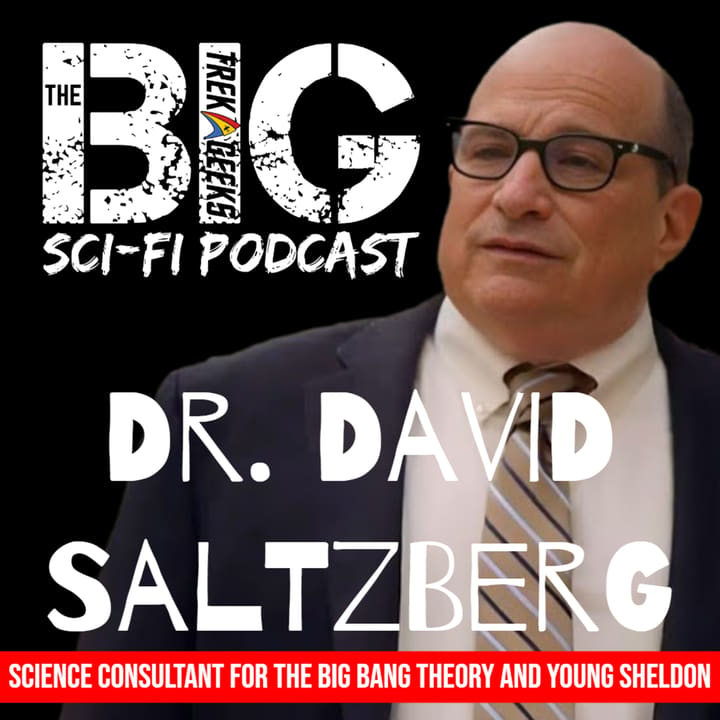
Dr. David Saltzberg
The BIG Sci-Fi PodcastAugust 09, 2024x
13
01:07:16

Dr. David Saltzberg

Science Consultant for The Big Bang Theory

This week's episode is the Big Bang episode many have been waiting for! We welcome David Saltzberg to the show to talk about his time as a science consultant on The Big Bang Theory and Young Sheldon. The astroparticle physicist gives us a fascinating and fun look into the show that had a ton of science fiction references throughout its run on television. This show is still capturing the imaginations of future scientists and this episode will capture your imagination as we discuss one of the funniest shows in television history!

This podcast is a proud part of the Trek Geeks Podcast Network and works hard to bring you great content from all over the science fiction universe. We would love to hear your feedback, suggestions, and ideas. Take a moment to send us an email at thebigscifipodcast@gmail.com.

Check our podcast out and learn more about the other great podcasts on the network by visiting trekgeeks.com.

We've got the merch! If you want BIG Sci-Fi swag, check out this link and support us by wearing us everywhere you go! www.teepublic.com/thebigscifipodcast

Check out all of our social links in one place:
https://linktr.ee/thebigscifipodcast

Check out Cris' amazing YouTube channel for Trek content galore:
https://www.youtube.com/@yellingaboutstartrek1532

Check out Brian's new book available at Amazon for Kindle and in paperback:
https://www.amazon.com/stores/Brian-Donahue/author/B0C3BQ93VD?ref=ap_rdr&store_ref=ap_rdr&isDramIntegrated=true&shoppingPortalEnabled=true
Follow Brian on Substack: https://bdonahue.substack.com/

Subscribe for free to Brian's Substack page where he writes original science fiction and fantasy: https://bdonahue.substack.com/

Find Adeena's books here: https://crazyrobot.myshopify.com/

Follow her on Substack here: https://beyondthedroid.substack.com/?utm_source=homepage_recommendations&utm_campaign=1493637

[00:00:01] Do not change the station. What you're hearing is coming from The BIG Sci-Fi Podcast in the Trek Geeks Podcast Network Stay tuned for the next exciting episode of...

[00:00:11] Wait a minute, receiving a new transmission. What is that? What am I seeing? It's big! It's really big! Oh my god it's so... Welcome to season 6 of The BIG Sci-Fi Podcast, the biggest sci-fi podcast in the galaxy.

[00:00:25] Join our crew, Adina, Brian, Chris and Steve as we travel the Milky Way looking for the best science fiction that science fiction has to offer. Make sure you're strapped in tight because we're going to have a lot of fun talking all things sci-fi.

[00:00:38] Stay tuned to this channel for the next audio transmission. Welcome back listeners of The BIG Sci-Fi Podcast. While we usually delve very deep into science fiction, today we're exploring a unique blend of science and what I like to call

[00:00:56] sci-fi adjacent entertainment with a very special guest from one of our favorite shows, The BIG BANG Theory and its spinoff Young Sheldon.

[00:01:05] So this is all my co-host Chris's fault. A few weeks ago he was like, we should talk to the guy who does science for Big Bang Theory.

[00:01:12] So I reached out to Professor David Salzberg and here we are. We did have to wait until after the finale of Young Sheldon aired.

[00:01:20] And we are going to be spoiling that in the show today. So if you don't want spoilers and you haven't watched it yet, just pause.

[00:01:30] We'll wait while you go binge the rest of Young Sheldon, binge the rest of that final season. My little pro tip, have a large box of tissues handy. There are some massive tear-jerker moments in those last episodes or two.

[00:01:45] Today's episode here though is going to be a real treat and hopefully no crying. Dr. David Salzberg, he's a renowned physicist out at UCLA where he teaches and conducts research in particle physics.

[00:01:57] He's going to deep dive into how he's helped make some of these complex concepts from the Doppler effect to subatomic particles to relativity and supersymmetry. Well, how he's made them accessible and fun. And we'll also talk about his experiences behind the scenes of these beloved shows.

[00:02:15] David, welcome to the big sci-fi. Hi, thanks for having me. We're so happy to have you and I think we should just start. Tell us how you originally just got attracted to having a career in science and in physics.

[00:02:30] Well, as far as I can remember, I always was oriented this way and liked it. I probably a big aspect of it was that my father was an engineer. He worked for Bell Labs back during its heyday.

[00:02:43] And we did lots of things, you know, a little electricity with the model train sets, other things like that. I used to remember I used to get this monthly monthly things of science would come in the mail.

[00:02:58] Got a little older and maybe junior high level, a friend and I used to blow things up with some chemicals and stuff that we found. Definitely not something that would pass any of the science safety trainings that we get, but we managed to make it back.

[00:03:17] My mother said if I didn't have all my fingers, I wasn't allowed to come home. And then I in terms of why physics, I always just liked it and put one foot in front of the other.

[00:03:31] You know, when I hit it in in high school, which was a typical thing where we do biology first, then chemistry, then physics, which is very common. Was physics was this revelation of how everything under those was working.

[00:03:46] There is a move afoot to have physics first so people can know, for example, what energy is, which is useful in talking about bio, you know, how living things. But then that's rare. And so I just liked it.

[00:03:59] And I also like the puzzle, puzzle solving aspect of physics. And I always just wanted to learn. And also, I read a lot of nonfiction about science for that was intended for the public or teenagers.

[00:04:16] Things like Isaac Asimov, in addition to all of his science fiction, he wrote science fact about everything, other things and everything that I wanted to understand. You know, about particles and what they're made of.

[00:04:32] And I didn't. And so but I just enjoyed it each step along the way. And so just kept going. It wasn't a grand plan. Yeah, no, that's excellent.

[00:04:41] And so our listeners might not know we talk all the time that I work in the aerospace industry, but I don't think I talk about all the time that my undergraduate was also in in physics.

[00:04:51] A lot of people just assume that because I work in engineering by degrees in engineering. But no, I started out in physics too, although probably for slightly different reasons.

[00:05:00] But one thing you just said, which I like to emphasize when anyone is ever thinking about these kinds of careers, is you also said you liked it. And that was my experience as well. I loved physics.

[00:05:12] And in order to get through a major like that, I think you have to you have to love it. If you hate it, you're you're not going to make it through. No matter how smart you are or anything else, you really do need to love it.

[00:05:26] And although it also can be that you might take one course in college or university and not like it. And that could just be the way that course was set up. And the second course, you might love it. Yep. And that's true.

[00:05:37] I know people who didn't clash with a particular professor, which meant they had a bad experience, which set them on a different path, which is a shame because yeah, which just goes to show how important the professors that we have are.

[00:05:52] So did you grow up as a science fiction fan as well? That's interesting. I thought you might ask me that based on your on your podcast. And I didn't want to disappoint anyone. I grew up reading a lot of the science fiction, you know, The Martian Chronicles.

[00:06:08] I think I tried to get through Dune and as a teenager and didn't finish. Everybody mad at me. I watched and we can talk about this. So various things that were on television, you know, Battlestar Galactica, things like that. But I wouldn't call myself a sci fi aficionado.

[00:06:26] I've kind of let that drop. And and certainly don't ask me questions about the things that I had read. I remember them. And now that there's not that I don't enjoy it and it's just somehow I haven't I should go back and pick that up.

[00:06:44] What sounds sounds like you're very busy fellow in life as well. So that that is something that I love about science fiction, though, is that it does attract people from all different walks of life.

[00:07:00] And I think also that was something that we loved about the Big Bang Theory and Young Sheldon is that those are just shows that people from various different walks of life can tune into week in and week out or stream now and binge watch them, whatever.

[00:07:18] And could relate to it and find stuff to hold on to that entertain them. That made them laugh. That made them cry. That taught them stuff about life and science, too, you know, and all that stuff. So that's it's a great crossover thing there.

[00:07:32] We would be surprised by how many people come up to us and say, oh, they're such miss. They grew up as such misfits. They really identify with the characters and sometimes would be like, you don't seem like too much of a misfit.

[00:07:43] OK, do you associate yourself with any of the four characters from the show that you saw? Then you went, you know, that's OK. That's relatable. That's relatable.

[00:07:55] It's so funny. You know, we get asked this a lot and I don't want to pick out any one of the characters because then, you know, the other my friends or the actors might wonder, well, why didn't you pick me?

[00:08:06] But I have, for example, found myself explaining why I wanted to sit in a particular part of the room and a particular chair.

[00:08:12] OK, I certainly I think Raj gets under not picked often enough so I could pick Raj because I think he's got a great, great presence and challenges in life. Yeah, but they're all great. My youngest daughter, when she was in school, I would say, let's watch the show.

[00:08:33] She is not. I can't. And I said, well, just because I live with those people. That was why I love the show. We noticed a lot of people would say, I know someone just like Sheldon and a lot of people told us that.

[00:08:46] And no one ever said I'm just like Sheldon. So you can do math. Really? Right. Interesting. True. But the concept of you have these like this group of friends and what they you know, they have this mixture of talking about science and then playing games and science fiction.

[00:09:03] That was the group of people I hung out with in college. So I don't know if, you know, one of us was one or like the other. But just the fact that that was kind of their I'll say culture to me.

[00:09:15] That was what made this show is like, oh, my God, I've lived this. Right. And that I think did bring a lot of people in in the beginning and then more and more people found it after that. Yeah, I didn't start watching the show until the third season.

[00:09:32] I had really not much knowledge. And then when I started watching, I'm going, oh, this is really funny stuff. This is and it's interesting and and relatable because, you know, everyone has a bit of a nerd in them, no matter how macho they want to be.

[00:09:48] And then they get excited about watching an old science fiction film or relating, seeing something and relating back to it or whatever. So, yeah, there's that there there's a lot of them in all of us, I would say.

[00:10:02] And people that haven't seen too much of the show make, oh, this is nerd humor or something like that. But it's there's a lot more to it. First of all, the writers are always careful to say that these were exceptional people.

[00:10:14] And I think they weren't writing them specifically as this concept of what you would call a nerd. And I think the humor came out of these are people that are very talented and bright in one aspect of life and not at all in another aspect of life.

[00:10:28] And that was the tension that brought it together. And I was going to say the yeah, so they're just really exceptional people. So how did you originally get involved in the show? It was really funny because I've lived in Los Angeles since 1997.

[00:10:48] I came here for my job at UCLA and no connection to Southern California, which is in Los Angeles, which is the heart of what they call the industry in quotes.

[00:10:58] And sometimes I would venture out of my little bubble physicists and with say if I was invited to a neighbor's party or something and something about Los Angeles. If you go to a random gathering of people, lots of them are involved with the industry.

[00:11:13] So I was just kind of this weirdo that I was just this physics professor. And I figured, OK, that's the way it's going to be. I'm obviously never going to have any reason to cross with this entertainment industry.

[00:11:25] And then through really a chance of a friend of a friend of a friend of one of the co-creators put me in touch with them. They were looking for someone to ask a few physics questions to.

[00:11:37] And that turned into just being a constant presence as the physics consultant. It's a little bit lost to me. That's actually I should say they started with a friend of mine who put me in touch and he had since moved far away, couldn't continue being a physical presence.

[00:11:57] And so my friend Peter Gorham in Hawaii. So I stepped in at that point during the during the first pilot. But that's how I got connected. It was just it wasn't something I sought out. That's amazing. So I am dying to ask about the white boards.

[00:12:20] How are the different equations? I think they're all equations. Like, how is that decided on for each episode? So it's interesting. Well, first we should distinguish between sets and props. Oh, OK, great.

[00:12:33] I didn't know before I was in television the sets and set dressing are things around the wall like you're talking about. But props or properties are things that the actors touch. Right. Yes.

[00:12:45] So there are those roughly three white boards and some seasons there was a chalkboard that will be on the wall. And really no interaction with the cast other than like you would they might walk by it. And that was set dressing.

[00:13:01] And I would write those up and send those in. I started by Xeroxing handwritten stuff and then later on iPad.

[00:13:13] And there was one member of the set dressing team had great handwriting just like mine and made it because you know, you have to have to look like math. Right. The way it would be drawn. There's many ways to do it.

[00:13:24] But he did a beautiful job of that. What I would do is if there is something that they had been that we've been in the news that they might be talking about that would want in the physics news, it would be up there.

[00:13:40] For example, when the great John Wheeler died and in fact, I think Adina may know may know him. I never met him. But he yeah, yes. Famous physicist.

[00:13:55] And so they had his famous greatest hits, let's say on the white boards because it's conceivable that would have been talking about because we're only visiting them one day a week. But they have lives that were going on. We just weren't there.

[00:14:09] And so a lot of the time my concept was what would they have been talking about? Sometimes they might have been talking about something in the Cheesecake Factory before we see them in their living room.

[00:14:20] And then it's conceivable that they would have come in and written something on the boards about it.

[00:14:26] One thing I tried to do, which I gave up on was if they were talking about something in one episode, I'd be like, OK, well, maybe they continue to talk about it. And I put it on the next episode. But sometimes they aired out of order.

[00:14:37] So not that I even noticed that. Other times it was just something I found interesting that was in the, you know, that I put up there. And there were other times that it was just some scribbles. I never made anything distracting.

[00:14:55] It was never like weird puns using Greek letters that the people in the audience who knew science would get. I've seen that in movies and so forth. I find it jarring.

[00:15:08] And so I tried to make it just really what would be on there and then just finish that.

[00:15:14] Then props would be something where if you saw one of the characters like Sheldon writing an equation, if you look carefully, often he's just writing the last X in the equation or a dot to something that the actor doesn't have a lot to memorize.

[00:15:29] But the way they cut it, it makes it look like he just wrote all of that. And often that would be connected to whatever the dialogue was that they had at the moment. So that was kind of easy.

[00:15:40] But with 279 episodes and three chalkboards, I did sometimes run out of ideas. But there were also diagrams. If there was a plot that was in the news that somebody might, the mass of a new particle. I tried not just to have only equations.

[00:15:58] I tried to have some diagrams. I tried to have color. Yeah, the color was really good.

[00:16:03] I just find when I watch the show, like obviously I'm paying attention to everything going on, but it's just I'm drawn to the whiteboard and how colorful it is and just how neat.

[00:16:12] And I'm always like I had this fantasy of being able to do math just for the purpose of putting it on a whiteboard because I just love how visually interesting it looks. So that was perfect. Anyway, this is great.

[00:16:27] Some of them I'm kind of proud of that they did connect to some interesting things that were going on. Other ones were kind of just some doodling. But it was accurate though. Yeah, but accurate doodle.

[00:16:40] The whiteboard is often you might use it one at one moment to show someone something in which case it'll be kind of organized. Another time you might use a whiteboard basically like scratch paper to yourself. And so it'll look different at different times.

[00:16:54] So in later seasons there definitely seemed to be some continuity between episodes, especially with like Sheldon's career as he was kind of trying to figure out what to do after string theory. And then in the final season when they got into like that super asymmetry.

[00:17:10] So were you involved, you know, needing I guess some of that continuity? Did you get, I guess, involved in the scripts even earlier to make that happen? How did that? Right. So in general, with my involvement with this course, all the writers know so much about everything.

[00:17:25] If you're going to be a TV writer, I think there's just you know enough about everything that you can create a world and actors are really good at playing make believe.

[00:17:36] So in the end if they didn't have me, they would be OK because that's their skill set is to be able to create a world. That said, what I did was I started coming to the Big Bang Theory was taped in front of a live audience.

[00:17:49] And that's why you see sort of three walls and not four. That's why it feels somewhat theatrical, I think, if you watch it. So I used to come to the episodes originally just well they might need me there might be some science question.

[00:18:03] But the truth is almost never would they touch the science part of the script or anything at that point. They would rewrite jokes if the audience didn't laugh. I say comedy appeared to me to be an empirical.

[00:18:15] You know, you can argue that some theoretically that something's funny, but if people don't laugh, you need to figure out why and they would rewrite that. But they didn't tend to almost never did they rewrite the science.

[00:18:28] So I used to come to every episode for that reason was clearly not the reason they needed to be there.

[00:18:32] But then at the same time, I realized a good reason for me to actually be there was I would chat with the writers about some future episode or what might happen.

[00:18:41] And it's the kind of thing where, like, yeah, they could call you on the phone or they could email you. But you know how people are probably won't happen.

[00:18:48] And just by being there and sharing a little dinner in between scenes, it was very low barrier to have that kind of discussion. So in general, I was there to answer your question about the continuity. Until the last season, there wasn't huge story arcs.

[00:19:05] Right. You know, there was some slow development of characters, but it wasn't one episode building on the previous episode very much. And that's two different styles. What I've heard of talking to TV writers is different styles.

[00:19:18] One is to write to a conclusion and the other is to which I think was more of Big Bang. They put their characters in a situation and they knew their characters and they asked themselves, how would this character react? And it would go wherever it went.

[00:19:35] So most of the most of it was, I think. The latter with some very slow development, you know, girlfriends become fiancees, become spouses very slowly.

[00:19:49] But we did have when they when they we did actually had this idea that the ending would be sheltered and Amy winning a Nobel Prize. I hope that's not a spoiler at this point, and we needed to have.

[00:20:00] And then it was fun because we would talk about things and can't they get a Nobel Prize? Well, you know, you can't really get a Nobel Prize for just something theoretical. It has to be proven.

[00:20:13] And so that started this idea of, oh, well, maybe there's this lab we can Fermilab in that case. Observe it. And then I mentioned so and then they're like, well, I'll forget the Nobel Prize. And I'm like, well, actually only three people can win it.

[00:20:26] So that, of course, the writers realize there's a point of tension, a point of conflict. So they pick up on that. I could never really quite predict what the writers would pick up on and find interesting or not. So I would kind of just talk.

[00:20:40] And when I did think like, oh, this is really great. I got to tell them this and they will go, meh, and really pick up on something that I was just almost even didn't even say. And then they would run with it.

[00:20:52] What was it like working with Chuck Lurie and Steve Malaro? I mean, did you interact with them directly or was it only with the writers and the show? Showrunners. Chuck Lurie and Steve Malaro are part of the writing team.

[00:21:09] You know, they're you know, and so the wonderful, wonderful gentlemen. Absolutely wonderful. And I and others too. I should there's also Steve Holland had the realm for a while. Bill Prady originally. So and I could go on.

[00:21:23] I don't want to list all the names really dedicated to their craft, really struggling with what's the reality here? What's the truth here? And incredible talent to just make it funny.

[00:21:33] I would read the draft scripts all alone in my bedroom and just laugh out loud, just reading it. And I would be there sometimes during rehearsals. And it was wonderful how these people you mentioned would would would find a way to make the joke a little funnier,

[00:21:53] you know, just in the way that things people were moving around or by adding one line or taking away one line and just fine tuning the emotional part of the scene. It's a little hard for me to get examples, but you know, in my own world in science,

[00:22:10] I can see someone getting one of my students getting a preparing a scientific talk and I can give feedback on how to make it better. It's immediately obvious to me, let's say, how to make it better.

[00:22:20] And we take people like Chuck and the Steve's and Bill and the others. They have decades of experience with this. And so they can it's remarkable how they can improve it and explain what needs to happen.

[00:22:35] And big supporters of science, they love the fact that people come by and say, I got involved in science because of this. You may know that the writers as well as the cast and the crew put together a scholarship for UCLA STEM major science technology engineering.

[00:22:54] Oh, wow. That's amazing. So all these people, let's say so you just talk about the writers as wonderful people, wonderful human beings and wonderful other craft. And then in general, you know, there are like something I hadn't realized until, you know, when I watch television,

[00:23:09] I see two people talking how complicated can that be? But then you realize there's like 20 departments that make that happen. I'm going to forget to me a wardrobe. We talked about props and sets, cameras and so on.

[00:23:27] And all what was amazing about this on Big Bang was that these people you talk to all had decades of experience. And they would ask me questions like, is this the right color goggles? Is this the right use brass bolts or aluminum bolts here?

[00:23:43] The right, you know, even the actors sometimes would ask me, you know, what should I be doing at this table? And people really, really wanted to do a good job. And they really wanted to make it. And they had the experience to do it as well.

[00:23:54] And I think about that sometimes like sometimes you watch something, maybe it's an amateur production. You're like, this doesn't seem right. Right. You're not quite sure what it is. Like, what is it about something when you see that it's an amateur?

[00:24:05] It feels amateurist versus something that really works wonderfully. And I think the answer I thought of, and it's just me, but the answer I thought of was, well, everything, everything matters.

[00:24:16] And so it's just these 20 departments working every one of them working together doing A plus work is what makes it work.

[00:24:25] When they propose coming up with young Sheldon as a follow up show to Big Bang and they wanted to come up with this junior version of Sheldon in your. Ramblings through science and so on. There are young true young Sheldon's out there.

[00:24:45] There are truly young, young geniuses out there. Have you have you encountered them? Are they so fixated on science or are they you know, they're still kids. You haven't ever come in contact with those young prodigies. There are a few around.

[00:25:05] Occasionally I come across someone who's young, a lot younger than the other students here. And it's always going to be a challenge if they're under 18 and a lot of the activities are over 18. You have to be there. There's some challenges.

[00:25:16] But in general, the one student in particular that I wound up working with in a lab course pretty well who I knew I didn't really notice after a moment that it just was another student who who was working hard and beginning to be a good student.

[00:25:31] But they're just you just seemed like another student in the class. I remember asking someone once who did that he was older gentleman who had done it. I think back in the 40s is he had gone through very quickly and gone to college and gotten out.

[00:25:49] And I asked him, well, you know, why did you do that? And he said his parents had pushed him. And I was like, well, and the reason was the sooner he graduated, the sooner he get a job and get out of their house.

[00:26:05] And it was just that one less mouth to feed attitude. So I don't know that's the current I don't know if that's the current I don't think that's the current driving force among a lot of them.

[00:26:16] But there could be I think the point is that every case is different.

[00:26:22] The one thing I do love about young Sheldon is that he lived in a family that were supportive of him, even though they didn't understand him and his uniqueness and the way that they presented him. But his family still cares so much.

[00:26:37] And that's why, as Adina says, the the ending is so we Chuck knew where it was going to end because they established that in the series. You know, he'd already established that. But still, even watching the last couple of episodes, you didn't want this character to disappear.

[00:26:57] Yeah, he was remarkable. Right. So here's that we have some of the spoilers again, people. This has been out for a few months. Pause here. But it's also say, you know, if you watch Big Bang Theory, it's not quite a spoiler.

[00:27:09] We know that his, you know, Sheldon's dad dies. So the second to last episode of Young Sheldon is the funeral. And I'm not a very emotional person. I'm the last person to get choked up at anything on screen. I was I don't believe it. Balling.

[00:27:28] I was watching it before Trek Long Island. We were at Trek when we were waiting for Trek Long Island to start. That's when I was catching up and watching it. And I was each morning I was watching two or three episodes that last season and that episode falling.

[00:27:42] Yeah, which is short. The final season seven is only 14 episodes. I think it was short rather than the usual 22 because of the writer strike. Not right. Because of the writer strike before that last season, because so much.

[00:27:59] I mean, I love every episode, but that last season really holds together really nicely. It really puts, you know, goes up, goes far because of all we've invested.

[00:28:09] And I was not I was glad to see, you know, when we started this, I wasn't sure if we'd lose George halfway through the series or something. OK, we get to keep them all the way to the end, except maybe the one last episode. Really great.

[00:28:23] What a way to go. And then the fact, I guess it's not surprising that's the second last episode. So you can end on a more positive note. Right. But this the scene where Sheldon is at the breakfast table and he's dealing with his dad's passing. Oh, that's rough.

[00:28:40] They show right away the clip from Wrath of Khan. And then he he says goodbye, Dad. And they share each other the Vulcan salute as he walks out the door. And Missy says, what do you think about a Star Trek? She goes, how could you?

[00:28:56] But that was his that was his go to place for reality and an understanding. And I always thought that that was so very special that the trek was so important for the writers, I guess. And to make it part of Sheldon's life growing up.

[00:29:14] But they did it in a perfect way where we could see and understand what is happening in Sheldon's head. We completely get it. His sister's family, they have no they have no idea what's going through his head. Like they can't they cannot comprehend. They don't see it.

[00:29:28] They don't get the viewpoint that we get to have there. Yeah, aren't these you know, these writers are really amazing. They did a great job. Fantastic job. So for you how was it different working on Young Sheldon versus Big Bang Theory?

[00:29:46] So it was a totally different experience for me to work on Young Sheldon than Big Bang. Big Bang was 80 percent of it or 90 percent of it was filmed in front of a live studio audience.

[00:29:57] And so it's like you got together on Tuesday afternoon, afternoon through the evening and you put on a play for your friends. And you had friends in the audience.

[00:30:08] Speaking of which, I'll tie it back to the one some members of the audience that would come regularly were writers from the original series Star Trek. Oh my goodness. And of course, the writers and the cast and the crew loved them back.

[00:30:23] And that was that was a wonderful connection there. There's a very genuine love for Star Trek in among the show. So that was all.

[00:30:36] And so I would come every week and I would come sometimes twice if I had to come to rehearsal or help with a chalk with a chalkboard that they might be using or with some equipment on the table.

[00:30:47] I'll say go back to say a word about some my guy, something I learned about giving advice where Young Sheldon is film more like a movie. There's only one camera instead of multiple cameras at Big Bang. There's four cameras so that you can catch every angle at once.

[00:31:05] It's very efficient. The single camera is slower. It gives them I think more cinematic control over the lighting and other sort of tone. There's no audience, which I think was an advantage when the cast was really young. But watching that being produced is really like watching paint dry.

[00:31:29] You know, you hear this main line 50 times. There's no way the writers can be there all the time because they also have to write the future episodes. And so I didn't and then COVID hit as well. So I really didn't go to the set much at all.

[00:31:44] I knew some of the writers, but I was much a little more distant from the show. The production of the show. You know, I didn't know all the grips and everything like I did in Big Bang. Still love both both shows.

[00:31:59] But I really just knew the people I worked with like in sets and props, but not so many from the other departments. And so it was pretty different and partly it was good. But just also that's that style.

[00:32:10] So people haven't noticed if you're watching a comedy, there's two major types of comedy. There is the sort of stagey multi-camera often where you hear laughter and then like Big Bang and then Sheldon, which is less theatrical, a little more dramatic. I'm not using the right word maybe.

[00:32:31] But there's no audience laughter. There's no sense of that. You're part of an audience when you're watching it. And that's called single cam. And they're just different. They just have their their different styles. You must be enjoying this, Chris, because you're interested in cinematography.

[00:32:46] Yeah, I've always been fascinated by because I remember like I shouldn't say starting out because I'm like just in film school. So I'm not starting out like I'm just beginning. But like first learning about it, I always thought that it was odd that bigger shows had single cam.

[00:33:02] And I thought, well, wouldn't you want to have multi-cam and then but hearing within learning about it where it's like, OK, right. So you can get you have a multi-cam show. You can get all the angles at once, but you can't fine tune them as much.

[00:33:14] So just seeing. Yeah, I just find it fascinating just to see how different shows can be and how like especially when you would something like Young Shades.

[00:33:24] And when you would something like Young Sheldon comes out and you assume that if there's going to be a spin off, at least that's what I would like. What I assumed before we started hearing about Young Sheldon that, oh, they ever do a spin off.

[00:33:34] It's going to be in the same format, but it's very unique to have a sitcom that spins off into still the sitcom, but not the same style of not in front of a live audience sitcom. So I found that very interesting.

[00:33:50] I think there are technical reasons to do it. You know, partly the kids being younger, but I think it was a really wise decision because it distanced the show to two shows. So Young Sheldon was its own show.

[00:34:02] Most of the cast and crew were new to the show. And so was their show. And in fact, one thing I've learned, which is kind of fascinating, is there's a lot of people who've come to this universe first through Young Sheldon, younger people.

[00:34:14] And it's news to them that there's another show where Sheldon's an adult. And they're like, really? And oh, really? In reverse order, which is going to be a completely different experience.

[00:34:23] Yeah, I wonder what that'd be like watching Young Sheldon because I feel like a lot of this is most of this is true for I think a lot of prequels where it's always like I'm a big believer watching things in release order.

[00:34:35] So if you're going to start with a prequel, like I guess you could technically because it's a prequel. But I feel like you'll get a lot more out of the show if you had seen Big Bang Theory.

[00:34:43] Then you get to see how they deal with, like even with the George situation, because the way they made George sound in the Big Bang Theory was like he's a jerk. He cheated on his wife, all this stuff. But then he's super loving and caring.

[00:34:57] And so they did that cool thing where, oh, he wasn't cheating on his wife. They were just in costume. Right. They were just doing their own thing. And so I feel like you would get more appreciation of that by watching.

[00:35:10] There's something really deep going on, I think, so that his memory was imperfect, I think, when he first did. And then we realized because it's even an even older Sheldon who's kind of narrating this.

[00:35:26] That his original interpretation and perception was not as much later as his own kids. And his perception on his own past changes, which is right.

[00:35:40] That's actually probably partly the reason it was different was just because it was a better show to make it to not make follow exactly what Big Bang said. And that's the writer. You have to ask the writer about that.

[00:35:52] But I think it was a I like the way they went with George. It's absolutely it wouldn't have worked if he was a jerk.

[00:35:58] No, yeah, because that would have been a very different show sort of concept on memory and how we remember our childhoods and all of that. And so in the end, to my mind, it made the whole thing even deeper.

[00:36:12] Yeah, because he gets called out by Amy, I think, at the very end where she's like, wait, did you are you misremembering that? So that was interesting. Now, I'm curious because you talked a lot about watching the actors work. What was it like to see?

[00:36:26] I don't know if you were on set that day, but able to see Amy and Sheldon in those characters, but working on a very different set than Big Bang Theory. Oh, I didn't see them for the one when they came back to the young Sheldon.

[00:36:39] Unfortunately, I didn't see them that day or days that they were there. I did come back towards the end. The head producer, Tim Marks said, you know, he'd been around for a long time. But remember, you want to come back?

[00:36:53] And I thought he was glad that I was glad I did it. That was right. I was glad he did it. And then I had to pick which day and it was one of the days was going to be when we hear what happens to George.

[00:37:05] I was like, I don't know. Or it was the funeral. I don't think I want to be there that day. Oh, wow. I picked some other day where it was a little lighter. Yeah. I missed them on their return. Whatever days those were. Yeah.

[00:37:19] Well, in true Pasadena form, they lived in a craftsman home, which was very nice question for you, David, in that in the Big Bang Theory, the great character of Professor Proton played by Bob Newhart. And I'm a big Bob Newhart fan. I've loved him since the early 60s.

[00:37:40] And here's a guy that never won an Emmy until he appeared on that show playing Professor Proton. I didn't know that. The question to you is, was there ever a Professor Proton that you watched that got you into science as well? Right.

[00:37:59] Because this is before the days of Bill Nye, the science guy when I was young. And if I tell you before I get to your question, I'll tell you a little bit. I often brought some guests with me to the tapings, which were live tapings.

[00:38:12] It was a bit of cross cultural pollination. And sometimes it was a student and sometimes it was a Nobel laureate. It was just a range and the writers would enjoy talking to them.

[00:38:20] And the student knew that was the same episode where Bill Nye was there as Professor Proton. Right. Yeah. The student knew Bill Nye, but not Bob Newhart. And I was like, OK, we've got to go look up Bob Newhart.

[00:38:37] And then came back later and said, yeah, that guy is really funny. But just shows about the generations. For me, what did I watch back then in terms of nonfiction? I loved this thing.

[00:38:53] It was on PBS, but it probably came from BBC because he had a British accent. Was the show called Connections. I think his name was James Burke. He was our and he just tell you the story. Well, this led to this.

[00:39:05] And if it hadn't been for that, then this would have happened. And it was just as well. Any of you remember that that would have been sounds really familiar. The name sounds familiar.

[00:39:15] It was called Connections and it literally was just he would walk through, you know, why we have light bulbs starting back in the 16th century or something. If it hadn't been for this very tightly. I remember watching the this is long before the Oppenheimer movie.

[00:39:34] There was an Oppenheimer miniseries with James with Sam Waterston. I always say that, you know, when we see things that are like quote unquote wrong in movies and film, you know, if it sparks the interest, if it sparks someone to ask the question, like it doesn't bother me.

[00:39:53] So I. You are watching any kind of media and you're like, oh my God, they got, you know, this wrong in this movie here, the show there. How what is your level of bother bothered? Well, there's wrong and there's wrong.

[00:40:09] You know, so you know, you could you could be a real pill and say, well, in back to the future, they really couldn't have had a time machine.

[00:40:16] And if you went backwards in time, you'd be you'd be in a space where the earth wasn't present and you would die. You know, so I'm not going to go that far. You have to let people tell their story.

[00:40:27] And I always thought that was my role as a science consultant was just to help the writers and the actors and. Find their way through and not to be the science police, right? If you want to have Ghostbusters, I mean, scientifically accurate, it wouldn't be Ghostbusters.

[00:40:47] So those kinds of things don't bother me at all. What does Jarmy is something like, well, the other spaceship is so many hectares off our bow, which doesn't make.

[00:40:59] Just watching the episodes of the reruns of Big Bang Theory that were on TV happened to be one where they were discussing the whole time travel thing in between. Has not has been has not. Yeah, I was watching that clip too and I was like, I love it.

[00:41:15] So perfect. I like the one where they find the time machine from the original 1960s movie and different. Yeah, yeah. And just how they like what if it really worked? You know, they were so excited about finding this movie problem.

[00:41:32] Let's come back to this moment and visit ourselves. And then there's nothing happens and they go, well, that was disappointing. So I have a question about some of the characters because you talked a little bit about the endgame.

[00:41:46] Was there any do you know if there's any discussion about like, say, all right, we know we're going to give we're going to have Sheldon and Amy win the Nobel Prize.

[00:41:56] But was there any talk about maybe having Leonard or Raj having or even Howard like having some big breakthrough that would like elevate them? Well, I don't remember too much.

[00:42:11] I don't want to even if I knew I kind of wouldn't want to expose these kind of alter universes and kind of like ruin it in people's heads because there is. That's fair.

[00:42:21] I don't think they would give the same story to two characters because that wouldn't be as interesting. I don't know, but I'm not a writer. So everybody kind of did follow a different had their story kind of resolved in some right differently.

[00:42:41] But. Yeah, and of course, I'm not even there in the writers room to know all the cases, but I think also people shouldn't want to know because I think it'll just kind of spoil your view of what choices were made.

[00:42:55] Right. Even so, in the last episode of Big Bang, when Sheldon is doing a speech, he takes time to thank his friends. And I think that was very significant in that even though he's an egotistical, narcissistic, self-centered individual, he still had a in his heart.

[00:43:19] He had to thank his friends and there was a fitting way to end the series. It was actually showing a moment of growth. Yeah, final growth. What was interesting was coming back.

[00:43:28] I remember the opposite in young Sheldon when he says goodbye to Tam and he just does it really bad. His friend Tam comes back and he says goodbye and it's really kind of unsatisfying in some ways because Sheldon was just kind of being a bad friend.

[00:43:45] And I remember discussing it with some people and I was like, yeah, this is so sad and unsatisfying in a way. And they're like, yeah, but he has this moment in Big Bang where he grows, for example, the scene you're talking about, twice.

[00:44:04] So in that sense, in young Sheldon, they can't have him grow too much. He does grow. Right. Because he hasn't grown yet. And this is why it's important to watch things in the order in which they've appeared on television, not in universe timeline necessarily.

[00:44:22] So, Dina, shall we go for the final spoiler about Young Sheldon? To the final person who gets to talk to Sheldon at the very end. We're talking to him right now.

[00:44:41] So for our listeners, if you actually want to see Professor Salzberg here, watch that final episode and he's in it. So how did that? Not just the final episode, it's the final scene. Yes, it is. Can we say what happens? Yeah, go ahead.

[00:45:00] We're spoiling it all the time. So yeah, so Sheldon arrives at Caltech right after having visited MIT and it was too cold. Yes, that was funny. That was great. It's a new beginning for him. And he's looking at a sign that says California Institute of Technology.

[00:45:17] It's a very short scene. And someone walks up to him, somebody looks like he's dressed like a professor, it's me, wearing some very 1994 brown and tan clothing. And some glasses from back then. And just says, you lost? And he says, no, I'm exactly where I need to be.

[00:45:41] And I kind of get a little nod and he walks off into the beautiful sky, not sunset, but walks under the beautiful California sky towards some of the famous buildings at Caltech. And that's it. That's how you, that's the end.

[00:45:55] So it was a huge honor to be asked in that scene. I mean, my gosh, that's the very last of seven series, seven seasons of Young Sheldon plus 12 seasons of Big Bang. It's a huge number of years.

[00:46:10] And to be asked to be in that final scene was amazing and scary. They asked Steve Holland who called me and asked if I wanted to do it. And I had to say yes, but I was personally frightened.

[00:46:23] It was great. So I went a few days early and got fitted for clothing and I felt a little bit like my father given the clothing. And I remember did those very geometrical and wide ties and all of that.

[00:46:36] And the other thing is you go, well, how hard could this be? Right. You go, well, I'm just going to walk up and say my two lines. I'll act natural in my mind. I'm a professor and then I'll walk off.

[00:46:45] But what you don't see is that there's all these cameras that are like zoomed into one little spot. And you're walking and you have to hit that spot. They call it a mark. And there's a piece of tape on the floor.

[00:46:55] But you can't look be looking down at the floor because in real life, this professor would not be looking for a piece of tape. You can't even look like you walked up and planted yourself at the right spot.

[00:47:07] If you miss by six inches, they have to retake it, you know, and it has to all look natural. And this is what these actors do every day. And I was a little nervous. But I was happy with the way it came out.

[00:47:23] And the other thing is, I knew my job was to be small because this was about Sheldon, about young Sheldon and the end of his story. And I was there to facilitate to say something to facilitate that story.

[00:47:36] That said, after the scene, I went to the writers and I said, well, I'm going to do this. You know, who is this professor? You know, where is he? You got the acting bug. OK. Did they laugh just like we did? No. Or did they remember?

[00:47:58] I think people pitching stories at them. I bet. I have a model of gravity. Well, speaking of other physicists, one of the things that I was very impressed by and again, I don't know how folks who I guess aren't deep into physics, how they took this.

[00:48:18] But in that last season or two, there is like Kip Thorne and George Smoot. Like, whose idea was that? Because these are not people. These are again, if you are studying physics, chances are, you know who these people are.

[00:48:34] If you're not studying physics, there's a good chance you don't. Kip Thorne has written some books for anyone. And actually, George Smoot did too. He wrote one of the most famous books in the world. That's not good. Arnold was another Nobel laureate. She was there and some others.

[00:48:55] This idea of also whose idea something is, I also, if I even knew, I don't like to get into because I think it's a very collaborative exercise. And people are going to pitch ideas and so forth. And sometimes they're not good.

[00:49:10] And I kind of feel like you should sort of forget who came up with what idea because it'll compromise your future. Like, oh, well, five years from now we're going to say this was so-and-so's idea.

[00:49:22] I think if you're a collaborative, you're going to be able to do that. And I think that's the thing about physics. I think it's productive to try to remember who came up with what idea. No, that's fair. I guess I'm going to say this was so-and-so's idea.

[00:49:35] I think if you're a cloud reading, you should just let that go and just your group thought of it. That said, I take no credit for this because I think I just read about it.

[00:49:44] In this case, I didn't tell you I just read about it in the script. But I just don't think it's productive to try to remember who came up with what idea. No, that's fair. I guess I'm just impressed. So they had a lot of guest stars.

[00:50:00] They had a lot of actor guest stars that I think would be generally known for that audience. But then having the science guest stars, like I was just saying, I'm impressed that that was included. And it made my day.

[00:50:14] A lot of the guest stars were kind of, I think, just the writers wanted to meet so-and-so. And so they found a way to write them in. Sure. Why not? But it gives credibility to it.

[00:50:27] It gives some reality to it, having real scientists or real physicists on the show. I mean, all of the comic book stuff and the sci-fi and everything, there was a genuine love.

[00:50:38] To some extent, it's a love story to all of that kind of fandom from the writers themselves. I say that somehow this is like anti-nerd humor. No, no. Yeah, for people to say that and it's like, no.

[00:50:56] I mean, for me being a nerd and being a Trekkie, I watched it from the beginning. I remember liking it and enjoying it. And then when I think Sheldon mentioned the star date for the episode, the Enterprise incident,

[00:51:10] when they steal the cloaking device and they found out they got the star date right, I looked it up and I'm like, that's brilliant. Like that's just like to have someone on TV say that was like the coolest thing.

[00:51:21] And it just made it feel like, OK, this is legit. Even if the characters, even if the actors themselves aren't nerds, the writers clearly are. And if I remember correctly, he had some framed comic books in his bedroom, if I remember correctly.

[00:51:36] And they belonged to, there were some special episodes issues and they belonged to one of the writers. Ah, OK. Yeah. As part of I think the core demographic of that show, I mean, like I never felt made fun of.

[00:51:49] That's what you like when people say they're making fun of nerd. No, no. Again, those people I know myself and who again in physics and in STEM and even as a woman,

[00:52:00] I don't feel like at any point in time I was being made fun of or used in a in a negative way. I think they did a great job. It's interesting to see how people react to it.

[00:52:13] But I think people maybe are missing, not missing the point, but yeah, I always just felt like it was a very like respectful show. And if you were a nerd, you would appreciate it for that. But if you weren't, you would appreciate Penny and being like, OK,

[00:52:30] how is she interacting with the boys and then sort of understanding where they're coming from now. That a super fan would get. I think I've read about some things on Reddit or something. You know, there is no way you're going to satisfy this world.

[00:52:44] You are going to make something wrong. Oh, yeah, for sure. One or two science things wrong that I felt bad about. Maybe I won't even say what they are. But I think I can think of two things we got wrong and I just felt bad about, you know,

[00:52:58] because it's going to happen. Yeah, you know, I'm talking that much and don't forget these episodes come together in six days. And so mistakes are going to happen. We kept them to a minimum. Are there any scientific concepts you wished had gotten in that never got got in?

[00:53:16] No, that's really interesting because, you know, sometimes I would ask. So what happened was they would ask me for sometimes it was just science to come in the script and it was just some words.

[00:53:25] And so telling you go think of some science is a little bit like telling a comedian. They'll be funny, right? You need a little something to bounce off. So sometimes it would be very what the setup would spark something in my mind because it's so constrained.

[00:53:40] Like, hey, they, you know, they go to the roof and they're doing something scientific at night when Penny and her boyfriend comes up. And I and that immediately.

[00:53:51] Left itself to something I've heard of, which was bouncing lasers off the moon to test some general activity and things like that. And so they give them such a constrained idea that like the one or one possibility popped into my mind and maybe a second one.

[00:54:08] But it was so constrained, I found that easier than when they just have an open is to come. That's what I would do is sometimes some science would interest me and I would say, oh, that might be useful sometime.

[00:54:21] And so I had a little word document that I would just write things into. And then if I was just really stuck, I would go back to that document and just kind of see if any of those things would would would spark.

[00:54:35] And here and one thing I really wanted to do, and I'm sorry we didn't do it, was I have you know, they wanted something for Raj that would be like a pretty big discovery in astronomy. I think it was for Raj. What would it be?

[00:54:54] And one of the ideas I pitched or it was something they got involved in something I can't remember, which didn't just this one up on the cutting-wing floor.

[00:55:03] They went to something was like, oh, let's say they find an asteroid, but it's from or a meteorite on the ground or an asteroid in space. And for some reason, they determined it didn't come from our own solar system.

[00:55:16] Like that would be kind of cool. Maybe there'd be signs of life on it. I don't know. And at the time, I wasn't even sure how you would know.

[00:55:23] Right. And about a year or two after that, there was a discovery of this object which is called Omua Mua, which has certain and it turns out because it has what's called a hyperbolic trajectory.

[00:55:36] We knew it. That turns out to be a signature for something that came from beyond our solar system. And so we missed the chance to predict, predict that discovery. So that's one that sort of got away.

[00:55:50] And so I have a list of things. So we come back for seasons 13, 14, 15. I've got some list of things that were on my mind. But you know, theory too. But that was yeah.

[00:56:07] So and in the whole it is a small yeah, it is a small like physics industry. You were just mentioning bouncing lasers off the moon. So the professors that designed the retro reflectors that were left on the moon were they were my professors when I was at school.

[00:56:24] And Maryland, Dr. Curry and Dr. Ali. I want to say it's Dr. Ali. We started out in the late 50s, early 60s to get into the program. So mostly we had left retro reflectors.

[00:56:38] Those are mirrors that are set up in just the right way so it always reflects light back at you from the direction it came.

[00:56:44] If you ever throw a ball into the corner of a room, it comes right back at you and can bounce any number of ways among the walls. But it comes straight back at you. And the same thing is true for mirrors at three mirrors at 90 degree angles.

[00:56:56] And that's like I think bicycle reflectors use that principle as well. Yes. So those are left on the moon. And yeah, a lot of people didn't know. Yeah, the way I found out because I didn't I was in my final year of school and my space club.

[00:57:12] We had brought Buzz Aldrin to come speak at school and Dr. Ali who was using I think Emeritus at the time, you know, Professor Emeritus at the time. He just came up to Buzz Aldrin and shook his hand. He's like, hey, it's good to see you.

[00:57:26] It's been a while. And that's when he told us a story like that. I'm like, I had no idea that my school was part of that history. And of course, that that happened before I was born. But just that these professors were involved in that was pretty amazing.

[00:57:42] That was before you saw the episode. Oh, yeah. No, this was this would have been like in 1996 or 1996, 97. That's my final year college. I just have a new definition of cool to when you just walk up to Buzz Aldrin and shake his hand.

[00:57:59] Well, I've shook his hand twice. I've met him three times. I've seen him three times, but twice I was able to shake his hand about 20 years apart. So a funny follow up is I remember Zach says something like, well, you're shooting lasers at the moon.

[00:58:14] Don't blow it up. Right. Yeah. And so I then happened to meet up again with Professor Tom Murphy, which is at San Diego, which is the reason. And he's using them now. And he's the one who gave me that idea. He said, oh, yeah.

[00:58:29] People say that to me all the time. I couldn't believe it. So I went back to the writers and said, guess what? That thing that Zach said, people say all the time. And the writers said, oh, yeah, we can write stupid.

[00:58:41] It's just smart that we need help with. That's going to be a T-shirt. I love it. That's good. That's good.

[00:58:49] You know, so it's so funny how like all that develops just from that was a cool thing about like I could have an idea in my head and then it becomes like, oh, yeah, I'm going to write a book. And then it becomes real.

[00:59:01] Like in young Sheldon, they're like, what's an experiment he's going to work on with Sturgis and Linkletter? Right. And I was in that case, I'll confess, I was trying to think of something that would look visually interesting for them to work on. Right.

[00:59:15] If they're just soldering something or doing a calculation, it wouldn't be as interesting. So at that time, so that was helpful to have a constraint. What was happening in the early 90s? People were building these giant spheres of liquid, either water or mineral oil to detect neutrinos.

[00:59:31] And so I thought, well, maybe they're building a prototype. And then the prop master comes up with like this beautiful, huge liquid, you know, beautiful, huge spherical glass container and fills it with liquid. It looks amazing the way it refracts the light and everything.

[00:59:50] And then for some reason, and it might have been Emmy season or some reason, the show was in the news that week. And so the pictures are the actor holding this beautiful giant spherical refractive object.

[01:00:04] And it's just kind of interesting to think like, wow, I could have easily suggested 10 different things. And somehow you say one thing and this whole apparatus of writers and prop masters and other people turn it into a reality. That's amazing. That's awesome. Yeah.

[01:00:23] So do you think there's other collaborations in your future with the television industry or you back? Imagine, I mean, what television has been around for about 100 years. This was about a once in 100 year kind of chance. So it's going to have to be another 100.

[01:00:40] You know, so first of all, the chance that someone brings physics back in to a show. Right.

[01:00:47] And then the happens to be this was kind of broad in physics, so I could do it or some of it if you know what the stuff I did with Oppenheimer was close to my field. So I knew that.

[01:00:58] So it could be physics that I don't even know. Like, let's suppose somebody says, hey, we have a physics story and it's about quantum computing. Well, I'm not going to be able to be the person that helps them with that.

[01:01:09] So even if we had another physics drama or comedy show come along, which seems to be out once in 100 years, the chance that the specific subfield or whatever that it relates to is something I could help with.

[01:01:19] And, you know, I want to give them help beyond what people can look up in Wikipedia. Right. Yes. So it would have to be someone else. So I would have to suggest someone else. So I think that's it. It was a wonderful 18 years experience.

[01:01:33] There was some overlap between the seven and the 12 seasons. But, yeah, pretty satisfied with how that went. But it's I believe a chapter that's ended. It's not likely in some of your audience maybe. How do I get involved in this? I have such a good to ask that.

[01:01:53] That's perfect. And my experience is, well, you just can't expect you can't plan for it. That said, someone does have an expertise subsequent to my being involved. There is a organization called the National Academy of Sciences, which has been around since Abraham Lincoln.

[01:02:13] It's an advisory arm to the government. They formed a group called the Science and Entertainment Exchange. So you can just Google National Academy of Sciences Science Entertainment Exchange. And they have a giant Rolodex of scientists and experts.

[01:02:27] So if your expertise is underwater volcanoes and somebody happens in 10 years to be making a movie that involves underwater volcanoes, they will look in the Rolodex. And maybe it's a certain kind of spider that lives in an underground volcano. However, you know, you're the expert.

[01:02:46] You get your name into the Rolodex. And then when it comes up, maybe I'll give you a call. That's the closest I could say for how to get involved. But other than that, like I said in the beginning, this just kind of fell on my lap.

[01:03:01] It's been a wonderful experience. But you must feel very proud to have been part of both of those two series. I'm proud of the work that we I can't take. Begin. I don't want to be sound.

[01:03:13] You talk about one how you love the show and everything, and I can't even begin to take even a small part of that. My little contribution.

[01:03:21] I'm proud of what I did, and I'm very proud to be part of this group that did something I think was really great. Yeah, that's amazing. Anyone have any final questions? Well, that was my big question.

[01:03:36] I guess this is such a this is a very like not science related, but we've it is something that I do because when I watch TV, I like to eat food. You know, this is my thing. Everybody knows this.

[01:03:47] Do you do you have like a food that you like to eat when you watch TV or like a routine? You're like, you know what? It's Friday night. I'm going to kick back.

[01:03:55] I'm going to put on my show and just just hang out and not spaghetti with hot dogs. OK, it can be spaghetti with hot dogs. Oh, do I have any sort of special food that I mean, you're killing me because I'm trying not to put on weight.

[01:04:12] And I think even just thinking about this, you've stumped businesses. I'm trying not to put on weight. It's a question you can't answer. Anything. But, you know, obviously the usual thing is I'm trying to think of there's something we know my research.

[01:04:29] I can tell you it's not one thing that I ate once interested the writers. I don't know. OK, I got to hear this. It almost made it. It almost made it into one of the shows.

[01:04:42] A lot of my research takes place in cold environments like Antarctica or Greenland. And one of the things you can do before you go to sleep to stay warm is, of course, to have hot chocolate because it's warm and there's sugar. But that burns off quite quickly.

[01:04:55] So what people often do is put half a stick of butter into the hot chocolate with butter in it is really good. And so if you ever want to. So I'll go with hot chocolate with butter in it.

[01:05:11] OK, I've got to try to butter not half a stick. No, just maybe just a pat, just a pat. Maybe just one ounce just to give it to see that. Maybe make some more creamy longer to burn. And so you stay warmer. Right. Interesting. That's cool.

[01:05:30] I did not expect this is not what I expected, but I love it. Well, that's cool. We're going to I think that's a perfect way to segue into saying, David, thank you so much for joining us for this episode today. My pleasure. Yes. Great. It's really cool. Yeah.

[01:05:48] This has been very interesting and I want to talk to you more about just physics, but possibly in a way that would bore everyone else. So we can do that off another time.

[01:05:59] So to our listeners, I want to thank you because this again is going to bring us to another end of an exciting episode of the Big Sci-Fi podcast.

[01:06:08] We hope everyone else has enjoyed diving into this fascinating world and understanding some behind the scenes from the Big Bang Theory and Young Sheldon.

[01:06:19] And don't forget to share this episode with your fellow science and sci-fi enthusiasts and join us in our Facebook group to keep the conversation going.

[01:06:28] We love to hear what you think about this episode, which physics concepts are your favorite and what just sparks your curiosity and love for these shows. Thank you for tuning in.

[01:06:40] Remember to subscribe for more episodes where we will unravel the mysteries of the universe one sci-fi show at a time. Until next time, keep your curiosity charged and your mind open to the wonders of science.

[01:06:52] Live long and prosper everyone and join us next time here at the Big Sci-Fi podcast.


Copyright 2025, Coconut MediaWorx LLC. All rights reserved. Our podcasts are not endorsed, sponsored or affiliated with CBS Studios Inc. or the Star Trek franchise. All STAR TREK trademarks and logos are owned by CBS Studios Inc.