
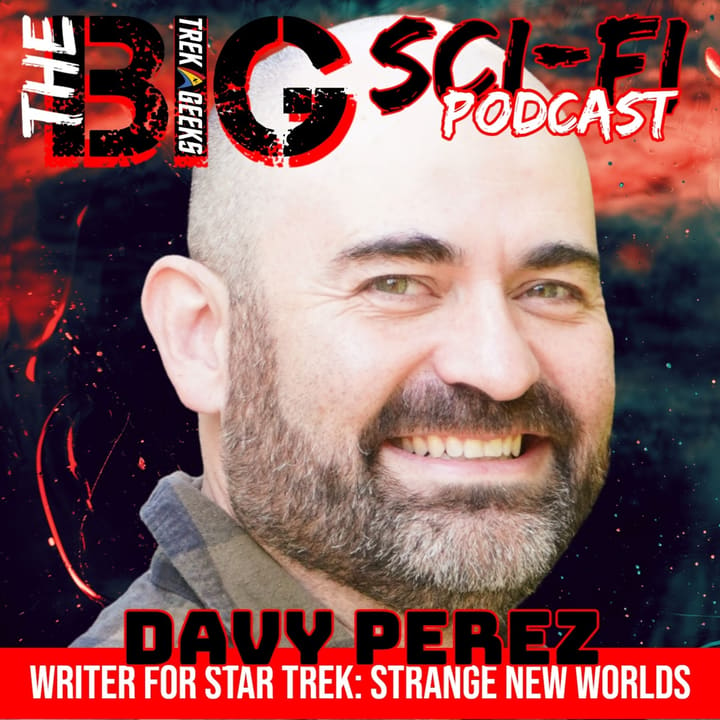
Writer for Star Trek: Strange New Worlds
Davy Perez joined us for a fun conversation about writing for Star Trek: Strange New Worlds (seasons 1 and 2). He shares fascinating insights into the process for writing for this much beloved new series. He couldn't share anything concerning season 3, but we promise that there is a lot of interesting insight into the episodes he worked on and behind the scenes fun. He's an accomplished writer and producer and it was a great pleasure to learn about his life outside of Trek as well!
This podcast is a proud part of the Trek Geeks Podcast Network and works hard to bring you great content from all over the science fiction universe. We would love to hear your feedback, suggestions, and ideas. Take a moment to send us an email at thebigscifipodcast@gmail.com.
Check our podcast out and learn more about the other great podcasts on the network by visiting trekgeeks.com.
We've got the merch! If you want BIG Sci-Fi swag, check out this link and support us by wearing us everywhere you go! www.teepublic.com/thebigscifipodcast
Check out all of our social links in one place:
https://linktr.ee/thebigscifipodcast
Check out Cris' amazing YouTube channel for Trek content galore:
https://www.youtube.com/@yellingaboutstartrek1532
Check out Brian's new book available at Amazon for Kindle and in paperback:
https://www.amazon.com/stores/Brian-Donahue/author/B0C3BQ93VD?ref=ap_rdr&store_ref=ap_rdr&isDramIntegrated=true&shoppingPortalEnabled=true
Follow Brian on Substack: https://bdonahue.substack.com/
Subscribe for free to Brian's Substack page where he writes original science fiction and fantasy: https://bdonahue.substack.com/
Find Adeena's books here: https://crazyrobot.myshopify.com/
Follow her on Substack here: https://beyondthedroid.substack.com/?utm_source=homepage_recommendations&utm_campaign=1493637

[00:00:00] Welcome to season 5 of the Big Sci-Fi Podcast with Adina Brian, Chris and Steve, the biggest
[00:00:14] sci-fi podcast in the galaxy. The adventure is just beginning here at the Big Sci-Fi
[00:00:20] Podcast, and we invite you to come aboard the Starship tangent. We know you'll enjoy
[00:00:24] the conversation, the laughter, the banner back and forth, and most of all friends who love
[00:00:29] hanging out to talk about all things science fiction sets your phasers to fun. Here we go.
[00:00:35] Podcasts The final frontier These are the recordings of the Big Sci-Fi
[00:00:41] Podcast. It's ongoing mission to explore films, TV shows and literature to seek out new
[00:00:48] and interesting people to interview. To boldly go and talk about what we love to discuss
[00:00:54] science fiction, tonight's episode, Davey Perez. However before we begin let's introduce
[00:01:02] the crew of the Big Sci-Fi Podcast, our captain Brian Donahue. Hey I was waiting for your voice
[00:01:08] to change. Hey hi. Hi. I'm sorry you were supposed to chase like that. I'm sorry. Our
[00:01:15] engineer and science officer Adina Mignonna. Hello hello. Ships counselor Chris Fox. Hey everybody.
[00:01:24] And me I'm Steve Merck and the guy in the red shirt that seems to be always around in the
[00:01:30] background. First let me say thank you to our Starfleet command better known as Trekheeks for
[00:01:39] making us a part of their podcast team. We've done so much to promote ours and other podcasts
[00:01:45] like the Sci-Fi sisters and we are so thankful to be part of their group. Now to the interview
[00:01:51] we back on September the 8th 2023 I was at the Paramount Studios lot to support the writers
[00:01:58] and actors that make Star Trek and who were on strike. There I saw friends from our podcasts
[00:02:04] like John Billingsley, Larry Neembichek, Mike and Denise Akuda and the wonderful Michelle
[00:02:11] Hurd who gave me a hug. I also got to meet Walter Coney for the very first time as well. Someone
[00:02:19] who was there from the very beginning. In addition I got to meet script writer Phyllis Strong who
[00:02:25] worked on Voyager and my favorite enterprise and who we interviewed earlier this year. And then
[00:02:32] at the end of the day I was introduced to whom we are interviewing today Davey Perez. Davey please
[00:02:40] say hello to our listeners. Hello to your listeners. How are you? That's a pleasure to be here and
[00:02:46] thank you for having me. And that's what happens when you're a literal person. You say things
[00:02:55] we I know we have a multitude of questions to ask you since you are the writer for Strange New World.
[00:03:02] One of the writers that is I guess the first question I'd like to ask you is can you keep a secret
[00:03:10] in? Yes absolutely I'm really good and it's part of my job to keep them. Good because listeners we are
[00:03:19] not and we will not be discussing season three of Strange New Worlds in any way shape or form.
[00:03:27] Think of season three as a Christmas gift. Currently the writers, the actors,
[00:03:32] the production team are all busy making wrapping and putting a pretty bow on season three.
[00:03:39] So we're not sneaking a peek sorry but we will be talking about Davey's work on season one and
[00:03:47] season two which he has written four scripts for those seasons so without any further ado I'd like
[00:03:54] to pose you the very first question. You grew up in East LA. Yes that is correct.
[00:04:03] Did you ever go to El Tapayat for dinner? El Tapayat I must have. I'm pretty sure I have
[00:04:10] on more than one occasion yes. My my my daughter Jenny when I told her who we were interviewing
[00:04:15] where you're on she goes well make sure you ask me if he's been there and if he's ever had a man well.
[00:04:20] I don't know if I've had the man well but I know I for sure have gone to El Tapayat.
[00:04:26] For those who don't know the man well is a five pound burrito. Oh good night. Yeah I know one
[00:04:34] time I went there with my buddy Ross and we attempted to have an eating contest and I got about
[00:04:41] three inches from the end of it and I finally gave up and he pointed laughed at me. It's a great
[00:04:47] place it's a wonderful place to go to the great food and so that was the first question which
[00:04:53] was posed by my daughter Jenny so well the answer is of course who hasn't and it's been a while
[00:05:00] but no I've not ventured to try and finish the burrito. It's it's it's we'll just get a holland
[00:05:06] back it's only happened man well it's really good. So I guess the real first question I'd like
[00:05:13] to ask you and I think it's also in the minds of others is what was your first experience with
[00:05:18] science fiction was it a book it was it a TV show was a movie can you recall what kind of
[00:05:23] sparked your interest in this? Yeah I mean this is gonna sound like I'm pandering but the reality is
[00:05:30] the first movie I saw on the movie theater was Rathap Khan. Yeah I was too young to see it I was
[00:05:39] probably about five or six years old and my older sister who was in her preteens went with
[00:05:46] friends and I had to go and she had to watch me and it was a double feature it was Rathap Khan
[00:05:51] and Friday the 13th part of the year something. So you know I'm sorry is that sci-fi and horror
[00:05:59] front and center which probably makes sense to a lot of people who might follow the things I do
[00:06:05] but I remember everything I loved the movie instantly I knew it was the show that my dad would watch
[00:06:11] like really late at night on syndication and those con worms I just freaked out and was like but
[00:06:19] like fascinated and obsessed you know that's interesting. That explains a lot because you know some
[00:06:28] of the episode is changing in the world are like the darker episodes the you know the more horror
[00:06:33] inspire you. Yeah I did super natural too. Super natural. Yeah I came out of that camp and I do tend to
[00:06:41] you know being born on Halloween and having these films you know I think the next movie I saw
[00:06:47] after that was like extra-sist. And six years old. Probably six or seven yeah so there's these
[00:06:55] like this horror and this sci-fi and this way to advanced type of a tone is being imprinted on my
[00:07:02] young mind but I was both scared and fascinated by it you know and interested in it and I kind of
[00:07:09] wanted to understand it so it wouldn't scare me as much and then now as a writer and a creator I
[00:07:15] definitely go to those wells. Interestingly with your episodes from season one and yeah and
[00:07:25] I have to say I am in the camp where I love the Gorn reimagined at first I at first I was like oh
[00:07:35] but then as I thought about it I'm like how could they possibly make them look as cheesy as they did
[00:07:41] in the original series and for it to for us as an audience to accept it I mean it had to be
[00:07:48] reimagined right and it was terrifying especially the little baby ones oh yeah that's horrifying.
[00:07:54] Well yeah I mean you touch on a lot with that comment you know for our show
[00:07:59] A you know a lot of the things we try and do is like what would they have done if they had the
[00:08:04] money to do it back then right and we're not trying to take away or reinvent or you know we are just
[00:08:10] trying to sort of as fans of the original series and all the other series that came after
[00:08:15] interpret like what was the intent and how can we use that in a new way
[00:08:21] and you know with the Gorn and you know they were a one episode character but they mean so much
[00:08:27] to so many people and the message of the episode was so important and it's their iconic you know
[00:08:33] so it was um you know how do we how do we do that and some people were going I felt uncomfortable
[00:08:39] with it you know a little bit but I also was like I want to see what we could do in our version of it
[00:08:44] and I have to say like a Kiva when I met him for the first time on zoom as I was you know um going
[00:08:50] through the process of uh trying to get on the show he said you know what are some of your favorite
[00:08:56] episodes and I said oh you know balance the terror and arena and he said well you know um I want
[00:09:02] to do the Gorn I want to I want to make them uh the villain of season one and I said I yes can
[00:09:08] I be on the show please now I really want to do that and so it was something he had in mind um and
[00:09:14] and you know our interpretation of them was it was very much guided by sort of his his vision of
[00:09:20] it and then the more we got other writers on board and I came on board we all got to collaborate
[00:09:25] on certain things and you know um I was just very fortunate to be able to write those two episodes
[00:09:31] and sort of um get into the specifics of some of the mythology as to how they grow what stage are
[00:09:39] they and you know um when they're born they're so and I think a conversation we had was we know that
[00:09:46] they can build starships we know that they're intelligent beings right but if we want to tell a
[00:09:53] monster feature story how do we do that and not like totally undo what do we know these creatures are
[00:09:59] so it was like what if they're just when their babies as as part of their development cycle they're
[00:10:05] just that's when they're the monster and then as they get bigger they get smarter and then um
[00:10:11] eventually you know and there's a whole there's there's a probably notes and notes of stuff that
[00:10:16] never ended up on screen as far as like what their breeding cycle is and and why you know
[00:10:23] they're why so many are born but then only one survives and then that's the one that gets to be
[00:10:28] allowed to kind of develop into adulthood and develop you know intelligence and maybe go off and
[00:10:35] captain a ship and get some on a planet with James Kirk someday. It's very interesting about
[00:10:42] the creation of the Gorn for because in the first that is set in the first episode you did
[00:10:48] you didn't really see them you just got to see you just kind of knew about them they were
[00:10:53] it was more of a was more of a submarine adventure in the first one you know the battle and
[00:10:58] trying to find what's going on where they are and all that absolutely but in the second episode
[00:11:03] where you revealed them it took me when I saw it I'm going wait a minute where have I seen these
[00:11:09] creatures before and not in this TOS episode but it was an enterprise the second mirror episode
[00:11:17] and in that one the Gorn was more like how you portray them more vicious more you know blood
[00:11:24] thirsty and and violent and I thought okay did you guys tap into that say okay that's the Gorn
[00:11:32] we want to have in this in our sense. Well you know it's funny because we're fans of everything
[00:11:38] is track and we want all things to make sense you know and ultimately we want all things to be
[00:11:43] true for whichever part of it you like you know and so we don't want to take away
[00:11:48] but we want to add and so you know we did talk about that they're the like as we were talking
[00:11:53] about the Gorn there's like other versions of them have been represented. We even talked about
[00:11:58] the Gorn wedding in lower decks you know like we wanted to you know people are fascinated by these
[00:12:03] characters and we want them to enjoy them in any way that they enjoy for themselves and this is
[00:12:08] just a version of that and yes you know how can we make it make sense that they're intelligent
[00:12:15] and you can do a moral story in arena but also make it make sense that they're vicious and that
[00:12:20] they're you know we didn't want to make them look like a digital Yoshi character that that enterprise
[00:12:25] because of the technology at the time kind of kind of looks. But we wanted to sort of take all
[00:12:32] these little pieces and put them together and say yeah you know and look like people many things
[00:12:38] can be true. You can say someone is nice and someone is mean and they can be both things and you
[00:12:43] could so a Gorn can be what it is for this story because we're encountering a specific Gorn
[00:12:51] and a specific type of phase in its development and you know you could develop or see a Gorn and
[00:13:00] and have it have a different experience with it that's the beauty of stories like it's not
[00:13:04] everything is going to be the same every time and not every speech she uses the monolith you know.
[00:13:15] We've asked this of other people I think it's important to ask Davey this what got you started in
[00:13:22] writing yeah and then let's then let's jump back into the Trek stuff we're past. Sure yeah no
[00:13:27] I mean in a lot of ways I've always been writing. I would journal as a kid just because I had a
[00:13:36] lot of things going on as much many young people do and then I was in bands and I would write song
[00:13:42] lyrics and they'd be a little too they wouldn't be punchy enough they'd just be a lot of like
[00:13:47] basically poetry instead of song lyrics not that song lyrics can't be poetry but it was just
[00:13:53] a thing that I was always doing and then I actually started to take acting classes and
[00:14:00] you know I wanted to be telling stories on screen or be a part of it I didn't know how to break in
[00:14:06] no one showed me the steps to take and I just saw oh if I can be on screen then maybe that's
[00:14:11] the way to do it and so I went to an acting conservatory and after about four years there's like a
[00:14:18] course where you start to write your own scenes and you come in you know and I really like that
[00:14:24] I started to like well I just want to do that part of it and off of that was actually teaching
[00:14:31] young kids inner city kids at an acting school and they all wanted a perform and so I would like
[00:14:37] make these little one act. Oh wow. Play adaptations and that's really when it codified
[00:14:43] okay I love doing this and I could do this like in my spare time and so how do I get paid to
[00:14:49] just do this and and you know that it took a long time to make happen for myself it wasn't overnight
[00:14:57] but the drive and having that passion kind of kept me going so to go after it.
[00:15:04] Awesome thank you for sharing. Oh Dina, go ahead. Yeah okay so in writing oh gosh now how do I
[00:15:11] phrase this question when you're writing the Gorn in season one and you're working on the first
[00:15:19] of those two episodes so episode four and episode eight how much of episode eight do you know
[00:15:27] while you're writing for like how much of it was written kind of simultaneously versus
[00:15:32] we're writing this episode then we're writing this when they were writing this one. It's a good
[00:15:36] question because what we did know was the concept of nine like we talked a lot like what we do
[00:15:43] yeah sorry my bad. Sorry um the we talk about the characters and we talk about the journey that
[00:15:50] we want to take the characters on throughout this season and so for Lawn we knew she had the
[00:15:56] backstory about being a Gorn survivor we knew we wanted her to confront that fear and then we
[00:16:01] wanted her to really have to confront it head on and and sort of deal with these personal demons.
[00:16:08] So that arc we knew which meant that we knew we were going to have the Gorn in two episodes
[00:16:14] in order for her to have that character journey and then we talked about the genres of episodes
[00:16:19] and so we knew that episode four was going to be summary movie and we knew that episode nine was
[00:16:25] going to be our horror movie episode that we had planted those to be the genres and so those
[00:16:31] pieces of the stories were known before we even broke the specifics of the story beats and the
[00:16:40] scenes and just you know all of that um and another thing that was known since we bring up nine
[00:16:46] we knew as a horror episode we talked very specifically what do horror episodes do and
[00:16:51] what do we like about horror episodes and very often they kill off a character that you don't
[00:16:56] expect to die um especially with Hitchcock will do it in the first act oh my gosh yeah and so
[00:17:03] we you know not to bring up these source judge of the camera but I know the question's coming at some
[00:17:08] point it is we knew before we knew it was an andorian before we knew it was Bruce Horak before we knew
[00:17:18] how much we would fall in love with this character and wish we didn't have to do this
[00:17:23] we knew we're gonna kill our engineer in episode nine and I was gonna say because well we had
[00:17:30] Bruce on our show the person I asked him was when did they tell you you know did they tell you
[00:17:37] you're gonna only you're only gonna last nine episodes he said aha he knew from the very
[00:17:41] beginning he was only gonna last nine episodes so now so let me let me kind of follow on that is
[00:17:45] given that he then had a couple cameos in season two was that in response to how much the character
[00:17:53] was light or when did when was that decided well that was in response to how much we liked Bruce
[00:17:59] as an actor as a person uh how much of the just track family he became you know um you can
[00:18:07] like a character all you want but that doesn't translate into you now being a klingon it's the
[00:18:12] performer right and so um we did and I remember we in theory we were like okay if we're gonna kill
[00:18:20] the engineer we really have to fall in love with them for it to mean anything yeah the character
[00:18:25] was designed for you to like but then we did such a great job we did it really well this was
[00:18:33] amazing and his chemistry with salio was so great that it was like I remember like having a
[00:18:38] moment like are we are we gonna do this still is it the right choice and ultimately it was like
[00:18:44] well if we're feeling this then it was successful we designed it successfully you know and so let's
[00:18:50] let's commit to it but because we love Bruce it's it was like where can we fit him and how do we
[00:18:56] bring him back and try to have a wonderful uh history and legacy of you know being able to
[00:19:02] bring characters back in in in makeups and sometimes not in makeups you know just just bringing them
[00:19:08] back because you like them and so we wanted to find a place and that's how we we found the the
[00:19:12] klingon captain for him in season two so because Bruce is so awesome I'm gonna shamelessly
[00:19:17] plug something for a second he's as if we speak he's he's narrating my my book my latest science
[00:19:25] fiction novel he's doing audiobook for logic logic so just have to plug that to treat we brought it up
[00:19:30] but no but that's again it was an amazing character yes you're right we fell in love with him
[00:19:36] and then to so it's interesting to understand how the show comes together and how and when these
[00:19:41] decisions are actually made because I think a lot of us still and I know I did up until recently
[00:19:49] now that we've been learning more and more about what happens behind the scenes but I think for a
[00:19:52] while a lot of us still think the that that episodes are created the way they were back in the
[00:20:00] episodic television days you know twenty-thirty years ago where it's a quicker turnaround so yeah these
[00:20:06] things aren't necessarily known that far in advance and things in a given season get responded to
[00:20:12] closer to real time and and the fact that it's not that way anymore I guess has its pluses and
[00:20:18] minuses you know you get your great story arc but yet you have yeah we're not we are an airing
[00:20:27] at the same time as we're writing necessarily that season right so you know the previous season
[00:20:34] errors and we get reactions from that and that might inform us in some ways and some things could
[00:20:40] adjust lightly off of the reaction to the previous season but you know what you once you're
[00:20:46] committed and you you're in a vacuum you know literally that first season was like we created it
[00:20:52] we liked it it looked great to us but we didn't know what the audience was going to feel on and how
[00:20:59] they would react I mean we were well into production late production of season two when season one
[00:21:09] aired so like you know many of those scripts had already been written and in fact I want to say
[00:21:16] like I was in the middle of production of episode eight maybe when season one aired like that's how
[00:21:22] the timeline is a little like so so creating two seasons of television almost in this semi vacuum
[00:21:29] of experience and just hoping that we're gonna touch people in the way we like to be you know
[00:21:37] moved around emotionally and what is cool for us is going to be cool for the audience we hope you
[00:21:43] know and that's sometimes we get it right and sometimes we upset people and that's just the nature
[00:21:48] of it and you could do that even if you're writing and you're with airing you know and one of the
[00:21:54] strengths of the show in my opinion is how quickly I became attached to the characters
[00:22:03] I just felt like like that is something the writers deserve such high props for is in the actors
[00:22:10] too I mean they absolutely have to play it well too but I just the characters are so interesting
[00:22:19] and the characters we know like a hurrah are different enough but still there's the essence there
[00:22:27] they've done right the writing in the actors doing all that together it's just it that's one of
[00:22:33] the things that really impress me the most about the show it looks fantastic the production value is
[00:22:38] incredible but yeah it's got the it's got the feel that Star Trek fans I mean well
[00:22:48] you've been waiting for it for a little while thank you for that and um you know I come from
[00:22:55] supernatural as you mentioned and that was a show where I learned for me that
[00:23:02] yeah this show is cool and fun it has monsters in it but um people really love the relationship
[00:23:08] between the brothers and the angels and the demons that are in their lives and the car you know
[00:23:14] and so it's really about these personal collections that that that you develop and all the other
[00:23:19] writers the shows they come on they've learned that at same lesson so for us it was like let's
[00:23:25] make sure we're servicing the characters and then make sure our episodic stories are from a
[00:23:31] perspective of one of our characters and so we could be with them on this journey and we sort of feel
[00:23:36] feel their closeness um all of the actors on the cast are amazing and bringing these characters to
[00:23:43] life and in viewing them with them themselves and a lot of our writing you know we're tapping into
[00:23:50] these personal places and um you know each of us is kind of putting a piece of ourselves in them so
[00:23:57] that when they do come to life hopefully like you mentioned the people respond because there's
[00:24:01] something true about what you're what you're being connected to you know well I have to say that
[00:24:06] the the team that shows the actors for this series picked great actors to portray unique and
[00:24:17] you know memorable characters from Star Trek lore and have done it very very well I mean even to
[00:24:24] the point where I remember reading and saying that you chose a Scottish actor to play
[00:24:29] a Scottish and I think that's that shows that but but even so everyone of your characters are so
[00:24:36] likable and here's the really weird one you're reimagining of James T Kirk it's so damn good
[00:24:46] it works it works it works I mean I like him even more than Shatton your I like him even more than
[00:24:53] the first time yes I like him I like that you yes I love the way you wrote it the acolyte come on
[00:25:00] tomorrow tomorrow tomorrow oh great him at his best he made him so human well you know
[00:25:09] he's so likable it's funny that you mentioned that because a lot of times when we try to you
[00:25:16] bring characters to life or a storyline to life that is gonna touch on very established can in and
[00:25:22] very personal feelings for people in the fandom we kind of just go back to the source and we
[00:25:28] try to go back to the original intentions that we think the creators had and we talked a lot about
[00:25:35] young James Kirk and and and he's how people talk about the character and how he was actually
[00:25:41] portrayed when you watch the episodes you know in the 70s and throughout the 80s and 90s he got
[00:25:48] the the reputation of oh well Kirk's always kissing the alien or he's the guy with the swagger and
[00:25:53] we we make jokes light jokes about that but the reality is in the series he was always talked
[00:25:58] about oh he was bookish oh he was the overachiever oh and then you watch those some of those
[00:26:05] episodes and he's always trying to find a path to empathy and he's very likable and he is charming
[00:26:12] that's why he gets to kiss the alien because he's just naturally charming so we focused it more
[00:26:17] on the who is this character not who you think the character is but who is the character really how
[00:26:23] was he created design how was he written and what is our our reason for bringing them on and how are
[00:26:31] we gonna do that you know what I mean because you could just very easily have we could just write
[00:26:37] the jokie oh he's always trying to hit on the people and he's that's what he is but that's such a
[00:26:42] a one note take on the character that we were like no let's flesh him out let's and he's younger
[00:26:47] he's not a cat yeah yeah how would this character be influenced by our captain pike of the
[00:26:55] enterprise and our yeah you know the crew people that are being populated the enterprise right now
[00:27:03] yeah so in tomorrow and tomorrow and tomorrow in that one to me he was most like the original
[00:27:11] 1960s Kirk more than any other time we see him in the series I think that's that's true
[00:27:17] and I think there was a lot of conversation about trying to channel even you know you know
[00:27:24] in season two and in that episode and then the one with her at the space station we were like
[00:27:31] we made some light humor about his reputation but it was like he was the one who believed her
[00:27:37] he was the one that was willing to think out of the box he was the one who actually sort of
[00:27:40] empowered her to go through that journey that she was on um all simply because he saw someone
[00:27:47] and he needed help and he wanted to be helpful you know what I mean but even so your actress who plays
[00:27:53] the word is so wonderful she's so sweet and she is playing a really well established and iconic
[00:28:03] character and who was played by a remarkable actress so to step into those shoes it's almost like
[00:28:09] you know Zachary Kinto going oh yeah I got to play the famous character of all Star Trek
[00:28:17] and I got to play opposite him in the same move right right yeah I'm sure that was not daunting at all
[00:28:24] no yeah so I mean you you to do that and to come across and to make her so likable well she's
[00:28:31] she really is it's very talented and and a total pro and I think um we had conversations and
[00:28:37] season one about where her character is at and I think she embodied that so greatly because
[00:28:45] it was yes everybody knows and appreciates and um you know or uh how we say it wrong uh Huda um
[00:28:55] like whoever's I think all of us would say differently right
[00:28:59] and I think we should have seen the same sentence I could say your hurra uh uh and I get
[00:29:05] crap for it all the time because I shouldn't I should be one of the people who can say it
[00:29:09] and pronounce it accurately every time and I don't know why I can't but anyway circle back to the
[00:29:16] actual thing I was trying to say which was the character was seen as um a young person with
[00:29:22] greatness in them that needs to um find the path to allowing that greatness to come out you know
[00:29:30] and so and it wasn't about the like the insecurity of that because you could play that
[00:29:35] that's the sort of the one note but it was the like and also the other spectrum of the I'm so
[00:29:40] great at everything right away and that's also not an interesting thing it's more like
[00:29:46] you're you are a character with greatness in them but you haven't realized it yet but you know
[00:29:52] it's there and so and and other people realize it and it's how do you foster that greatness
[00:29:58] without letting it sort of like pressure you and feel a certain way you know
[00:30:03] Chris you've been the quietest of the bunch will you have any questions go ahead my friend
[00:30:08] so I'm trying to jump in a couple of times yes please do
[00:30:11] I've got a lot you gotta cut me off from supergareless yeah so I you sort of touched on this
[00:30:16] with the various characters but I'm just wondering just because I think like
[00:30:21] this feels like it's it's such an amazing show in that it feels like the original series
[00:30:26] but it also feels very modern and it feels like this is what they would have done as you said
[00:30:31] earlier like this is how they would have made your original series if Star Trek only came out
[00:30:36] you know in 2022 instead of the 60s how did you so how have you been able to manage making it feel
[00:30:45] like original series but also making it feel like a modern show that doesn't go too lean too
[00:30:53] differently from the original series sure I mean it's a hard balance you know I have to really
[00:30:58] give a lot of credit to a cubic Oldsmann and Henry Lanzel Myers for setting that
[00:31:05] as a North Star kind of thing in season one and also Jonathan our production designer and
[00:31:12] costumes hair everybody is sort of a full court press about the look of the show the props
[00:31:21] and you know everyone's a fan and we'll pull a screen grab from an old episode and be like hey
[00:31:28] this is what it look like in the 60s let's make our version of this and you know so balancing
[00:31:36] the look and the feel I think is a lot of the world itself you know right down to the costumes
[00:31:43] and how can we make them have that classic feel but still feel modern and not silly
[00:31:51] and then the stories themselves you know I could say for me I like to watch a lot of all the series
[00:32:00] you know TNG and TOS in particular and kind of tap into that episodic story and how they maybe
[00:32:08] approached a topic of their day and and how can we approach a topic of our day and not to totally
[00:32:16] reimagine and think that I'm going to create something holy new that's never been told before
[00:32:21] but how would we tell it our way you know what I mean and how do we some tales are unfortunately
[00:32:29] classic and some morals are not learned so you have to keep reminding people about tolerance
[00:32:37] about peace about the things that scare us can sometimes make us stronger you know those
[00:32:44] things are people in humanity have been telling their stories just the cave dwelling days and I'm
[00:32:50] not going to come up with a new story but I can come up with a new way of telling it that is
[00:32:55] going to interest you because it's this world that you love and these characters that you love
[00:33:00] and I kind of went a little esoteric there but that's kind of that is my personal process
[00:33:04] and I actually think a lot of the Twilight Zone I love the Twilight Zone and I'm like what would
[00:33:10] the Twilight Zone episode be well with the what would the interesting take on this be that makes
[00:33:16] you go oh I didn't think of it that way or oh that's I'm a slightly uncomfortable about this
[00:33:22] but I'm interested you know is there I'm sorry Steve no good is there has there been anything
[00:33:31] in the course of seasons one and two that has surprised you that either the writing team went
[00:33:38] there or the show went that direction or maybe it's a character arc or something is there anything
[00:33:44] or maybe maybe a better way to ask it surprise or just that you particularly really loved maybe
[00:33:50] well I mean I think there's it's both and it's interesting because it's an episode I wrote I think the
[00:33:59] I mean all of season two had surprising things you know the animated crossover obviously not
[00:34:04] when I wrote but I was just surprised we were able to go there and that's always fun the musical
[00:34:09] was such a great you know that we really crossed into a genre that hadn't gone before but the one
[00:34:14] that really like because I was so inside of it was the Joseph and Benga backstory and how this
[00:34:23] character who's a beloved doctor and is it kind of up to that episode feels like a moral center
[00:34:30] of the ship and then you learn that he's a combat veteran with with a bunch of confirmed kills
[00:34:36] that might not have left the war behind you know and so I really when we were like we're going to
[00:34:45] tell this story I wanted to do it as much justice as possible and I did a lot of reading I did a lot
[00:34:52] of documentary watching and I talked to combat veterans and at every step of the way I was like
[00:35:01] I didn't really get to let up this to this are they really gonna let us tell this are they're
[00:35:06] gonna say we can't make the doctor be this will air as because you know I come from network and
[00:35:11] you often get at the note kind of early or sometimes late in the game we don't want to dislike
[00:35:16] our character we can't tell the story with this character so it was a hard thing to have your
[00:35:24] character do something made people uncomfortable but still kind of on their side at the end or at
[00:35:30] least understand why they were on that side that they were on it even if you weren't on that side
[00:35:36] with I could tell you when I watched it all I could think back was a TV show mash and every time
[00:35:44] the transport was a incoming transport and all I could think about radar righty lia incoming yeah
[00:35:51] oh I know oh my god you have you've got the mobile army surgical team right there it was just
[00:36:00] it was remarkable I have no shame I have no shame saying I watched a lot of mash when I was
[00:36:05] writing that because you know like I like I just alluded to like stories have been told before
[00:36:11] people have figured out certain things that are effective and as a creative person you know I
[00:36:18] I know the limitations of my own experiences so I have to research I have to watch I have to
[00:36:24] be inspired I have to pull from things and when I was watching mash I was eight it was two reasons
[00:36:29] it was like how do I keep it interesting and engaging but also like really have a little gut punch
[00:36:35] in there for you yeah and you know I had I had about 20 minutes to tell that war storyline and
[00:36:41] guess what mash episodes were about 22 minutes yes so like what would a mash episode structure be
[00:36:47] it's funny and light but it's also got these dark things and obviously mine wasn't as funny
[00:36:51] and light but I got to create a character that you kind of was quirky with when Howard
[00:36:57] and so as I was watching it I just became like very conscious of that repetitive thing and then
[00:37:03] it really hit home when I was watching I think there's a show called combat rescue
[00:37:07] that's on lifetime or one of those reality things and what they had it was in an
[00:37:14] Afghanistan I believe and it was about these combat medics in Afghanistan and anytime they had
[00:37:20] to go out into the choppers and go pick up people they had a bull horn and it would say Leroy Jenkins
[00:37:28] all right Leroy Jenkins yeah and so yeah and it was this and at first it's funny the first time
[00:37:34] you hear it it's like oh right they're using Leroy Jenkins but after watching that show for a while
[00:37:39] and seeing the things like that Leroy Jenkins it was like oh god and it weighed on me it became
[00:37:45] a horror to hear that and I was like how do I channel that emotional like just that sound is
[00:37:51] evoking this dread and just please stop because I know that that means young people are dying you know
[00:37:57] yeah so one of the things I think you completely nailed it with this because I've dealt with
[00:38:03] several friends and other relatives who have struggled with PTSD from combat and non-combat
[00:38:10] situations in the military is you completely nailed the sense of they are unable to talk to those
[00:38:20] of us who have not experienced it like hit that that that got as because I'm one of those people who
[00:38:27] they can't talk to you know when the fear should be able to so you completely nailed that
[00:38:35] that was amazing thank you and it's funny I take great pride in that and I feel
[00:38:43] honored to get that compliment and I got a lot of messages actually from people asking me
[00:38:48] were you in combat how did you know were you there or did you know someone who's there
[00:38:53] and it's the irony as not even irony it's not that I were but the truth of the matter is
[00:39:01] like I said we often tap into our personal lives I have PTSD from childhood trauma
[00:39:07] and so I could tell a story about PTSD about what I know to be my experience with PTSD
[00:39:15] and just ordered over to it but at the same time I do not know what combat is like I say
[00:39:20] that front and center it is a different experience but I will research and I will talk to people
[00:39:25] I will be informed I will try to get as close as possible but when you're talking about the human
[00:39:30] experience of dealing with trauma I know some things about that and that's where it got personal
[00:39:37] and I have been that person who cannot share and I have burned that person who looks to
[00:39:43] alcohol for relief or as a sudden burst of anger and then having to not be able to explain
[00:39:51] what that came from so that was a very personal story that I was channeling into the writer and
[00:39:58] then just put the layer of combat of veteran on that you know what I mean yeah there's something
[00:40:05] therapeutic that art like a show like this can do for people there's there's a type of it's not
[00:40:15] that it's the answer and healing is completed when you watch a TV show that talks about this
[00:40:22] but I know some people too that are Star Trek fans that have seen combat that saw that episode
[00:40:28] or just like they nailed it it was on but and it's in but it was done tastefully it was done very
[00:40:34] respectfully as well and so I think hopefully that's what any person that's been in combat could
[00:40:44] say that hey that that honored yeah and then went through you know and that's where I take
[00:40:51] I find that to be the best compliment you know right right I don't really I don't know what the
[00:40:56] critics might say about it I don't know what you know if you're if you're busting on me because the
[00:41:01] Klingons don't look like the way you like Klingons but if the people that have that real experience
[00:41:07] could say well that was actually you know and for being a war in space in an imaginary sector of a
[00:41:13] galaxy for them to say that's what it was out like for me that's a huge compliment and I you know
[00:41:20] I read the things they carried which was about Vietnam I read the the Coit the Coat of Myer
[00:41:26] biography that was about Afghanistan I was watching he said I was feeling and like for months and
[00:41:32] like to the point where like after the production of that episode and through the rhymes I needed
[00:41:40] to break I was like yeah I completely took my family to San Diego on a little in a resort week
[00:41:48] and unplugged and I you know in the middle of production of I think the musical which came
[00:41:57] after I was like you guys are going to go singing in space I just came out of Jigal
[00:42:02] I'm going to go to Legoland and see world and hang out in Carl's Bad with my family because it
[00:42:12] was living in me in such a way you know you know we did a review of second season on this show
[00:42:20] we talked about it and I said that this second season truly was strange new worlds because
[00:42:29] you ex you delved into doing Star Trek in a different way and either was a beautiful crossover
[00:42:37] episode with lower decks which was just just absolutely fantastic and they had so much fun
[00:42:44] doing that and then doing something like subspace rhapsody you know not I kept thinking going back to
[00:42:52] the Buffy episode where there's a musical which is acclaimed and I can listen to the music
[00:43:00] any day and the same smile comes to my face when I hear it because it's just who came up with
[00:43:09] the idea to do that I mean when I'm asking maybe that was look I mean it's hard to nail it
[00:43:17] to like an individual because at the beginning of this season like like I said we all the writers
[00:43:24] getting a room we talk about genres we talk about things you've done and I would honestly say that
[00:43:31] that might have even got thrown around season one is kind of like you know a half joke right
[00:43:37] a joke but not really in a second all joke pitches this is something Dana Horge and I always says
[00:43:41] all joke pitches become real pitches and then you know at the beginning of season two we talked
[00:43:48] about what genres haven't we done and you know what genres we want to do again and you know
[00:43:54] we we did talk you know Henry and Lonzo Myers has done musicals on the magicians and supernatural
[00:44:00] has done a musical so we knew that the musical was a format that television does what the Buffy
[00:44:05] episode and so on to the two yeah the flash and the the thing that you mentioned though about how
[00:44:13] beloved the Buffy episode was is like that was the bar right if you're gonna do it you gotta have
[00:44:20] the story matter and not just be singing through the story and the song who got to be actually
[00:44:27] you know and this is where Dana who co-wrote that episode were built was very much kind of
[00:44:32] guiding that through the process and she was like the songs can't just be catchy for catchy
[00:44:38] sake in a real musical the song actually pushes the story forward and the scene is the song right
[00:44:46] the song actually has an arc and it you like you start it and you're in one place and by the end
[00:44:51] you're like you're in another place and and and she was the perfect person to be quarterbacking
[00:44:57] that experience and you know I was like great you guys you guys got the musical I've got
[00:45:04] clinging on you know killing people and you know uh and the other one that co-wrote co-wrote with
[00:45:11] Kirsten Byer I really really do like the the Lotus Eaters one quite a bit because you're
[00:45:20] going back to Rydall 7 which is a part of Pike's Canon you're sort of
[00:45:23] modern that was cool yeah it was like a piece of the cage you're kind of modernizing for our
[00:45:29] our audiences and then your like in that was this opportunity to do this the twilight zone
[00:45:37] for me like what is the like little moral story that's underneath everything it's not like hitting
[00:45:42] you in the face but it's there it's it's a it's a a cast society of the haves and have nots it
[00:45:50] just have memories and have nots memories instead of you know money and so there was this cool world
[00:45:56] building thing I'm like you could watch it and enjoy it and never get that from it and just be
[00:46:00] this oh this cool sci-fi world had this weird planet experience or you could watch it and be like oh
[00:46:05] they're commenting on disparity and what does that mean you know the right yeah do you have a
[00:46:12] okay Chris go Chris do you have a specific process when you sit down to write an episode so not
[00:46:18] when you're necessarily breaking with other writers but when you're by yourself and you have your
[00:46:23] computer open um I feel like I used to have a conscious process and now I have a shit it's due
[00:46:31] and I gotta sit here and get it done
[00:46:41] but to be fair to your question I think I can probably do that because of a process that I
[00:46:47] engaged with that has now become like repetitious for me it's like going to the basketball court
[00:46:53] have it and shooting and shooting free throws right and then now I don't got to think about the
[00:46:57] free throw and so um if I can sort of recall the process for me you know the outline is there
[00:47:07] right the outline has been done and the outline is the road map I know that this is the order of
[00:47:12] events and so I just go in and I say okay this was the promise we promised them this scene
[00:47:22] but I know from experience that you don't just make your character say these words and that makes
[00:47:27] a scene that just makes an outline that people are talking about out loud so you still have to go
[00:47:35] and and say where is the activities and points of view that these characters have that make it a
[00:47:43] scene and sometimes it's not even there sometimes it's um and this was a lesson I learned
[00:47:49] at Supernatural was like you know at the beginning of every episode they catch a case
[00:47:55] they they're oh this monster killed somebody in in Iowa right how do you make that interesting for
[00:48:03] 350 episodes well you find something for them to do Dean's cooking eggs uh
[00:48:11] Sam's um trying to paint something or the cars broken so you're like the scene is actually now
[00:48:18] this activity so I think about who's doing something and who wants something which is an old
[00:48:23] acting exercise and it's not even like the words of the like this has to be the moment that
[00:48:30] pike confronts lawn about something and that's just a scene I pulled out of my butt whatever
[00:48:35] but how can I make that like if the story has already evolved to a point that we know
[00:48:43] with their up to oh this person's investigating and this person want answers that's one thing
[00:48:48] but if you're just flat and coming in you're like well I got to make this something I got to make
[00:48:53] this uh you know lawns on the way of the gym and pike needs to get this answer because
[00:49:00] Starfleet command asked him to you know and that's not in the outline the outline was Pike is asking
[00:49:06] lawn some questions and and so you kind of you you it's for me it's like bringing the characters
[00:49:12] to life what is the character gonna where are they coming from and that that's all my acting
[00:49:18] background where are they coming from what do they want how do they feel and then I kind of left
[00:49:23] them talk to each other and then they start saying things and that sounds cool and oh they're talking
[00:49:28] too much like take some of that away you know um are there characters that you find easier to write
[00:49:34] their dialogue versus harder like ones that the voices come that more naturally to you or ones
[00:49:39] apart I mean by this current season that shall not be named um season three uh it's sort of a habit
[00:49:47] it's sort of like a you know at the beginning I knew what Spock sounded like and I had a feeling
[00:49:54] of what Pike might sound like and Chapel and and the Hurrah maybe kind of um Ginga it was just
[00:50:03] sort of finding the archetype of you know oddly enough I knew Hammer because that you know we were
[00:50:08] talking before the podcast role um he's an engineer and a mentor and my older brothers and engineer
[00:50:15] and was a mentor to me so I knew what I wanted that character to sound like at least for me when
[00:50:22] I wrote him you know he might be written a little differently in other episodes but for me I was
[00:50:26] like this is my brother uh and so even the line about you know an engineer's tools are his mind
[00:50:35] in his hands um I think uh I had co-written that with Bo and I think the line he had in there
[00:50:40] was engineers tools are his his hands and I was like no I know my brother his best tool is his mind
[00:50:47] and so it was just like little things like that that I was like just wanting to make sure I I brought
[00:50:53] some point of view to it you know yeah in speaking of Hammer uh I just again watching that episode
[00:51:04] originally episode nine of season one um when I realized what was happening I was like
[00:51:13] you know devastated as I could be watching uh show but at the same time it was so beautiful it was just
[00:51:21] it was so well done and set up and we just cared deeply I mean even in that episode I think there
[00:51:30] was in my opinion a lot watching it just recently again uh there was a lot done even in that
[00:51:36] episode that made me like him or even more so that the impact of him dying was even more effective
[00:51:47] yeah yeah it was a rough day I couldn't see that I fell asleep just fine but I kept waking up I
[00:51:54] get to invent said I kept waking up he like oh no hemmers dead but it's made for a good podcast afterwards
[00:52:00] I was I'm cracking it uh I'm sorry I'm delighted at paint time yeah right yeah well like you know
[00:52:06] again it's like how do you how do you make people fall in love with the character with the
[00:52:12] limited amount of time you know and and Bruce was a big part of that yeah or I can body this
[00:52:17] character and we showed him playful and then um the pilot I believe or or maybe it was a second
[00:52:24] episode the the scene where her has to do the captains dinner yeah you got to see got a little bit
[00:52:29] playful side and then in four years good um you know we we kind of wanted to do the um
[00:52:37] the grumpy person that you have to earn their respect right and so he was kind of like down
[00:52:41] hundred percent bit but then they kind of like you know and that was like total submarine movie 101
[00:52:48] it was like the sergeant and the private and the sergeants you know hard on you but then the end
[00:52:54] of you know giving you the best recommendation that you could imagine and so there was a little
[00:52:59] bit of that leaning into that and then it was at nine in particular because we were like well we are
[00:53:05] we are going to kill him this episode and it was the end of the season and it was like we're
[00:53:11] it just so happened that it weed so great greatly great it weed so greatly with her
[00:53:19] own arc of having to find her place here and to have the person who you kind of like well I'm
[00:53:26] flipping with you and you're the fun wippy person to be like I'm gonna I'm gonna talk to you in a
[00:53:31] real way like I see this need in you I'm gonna call you out on it and and then in tapping into
[00:53:38] your vulnerability then I'm gonna die you know yeah and then that scene like there was a lot of
[00:53:46] permeations of that scene and it was just getting it right and how much is too little how much is too
[00:53:51] yeah late and and um a couple things we're working for us there like uh again wrath of con the
[00:54:00] the scene of spock giving himself sacrifice total call back to that and then the words that he spoke
[00:54:08] was advice my brother gave me in reality wow when I was a young man and feeling uh alone
[00:54:16] in the in the world and he he he's got a very successful marriage and he has kids before me much
[00:54:24] much younger than than mean when he started his family and and that that idea of you know hey just
[00:54:33] find find a home find a person you can fall if he was telling me about relationship advice but I
[00:54:39] took that and I how do I take that nugget and make it a little bit more broader and make it
[00:54:42] more specific for her but the the idea of making a home for yourself and you'll be happier than you are
[00:54:49] um sad was it was totally generally made by the role wow that's great that's right engineers give
[00:54:56] the grade the best advice they do and they're always the ones party then hang out with he's he's
[00:55:01] much more fun than I am well you know because again that all came as an engineer the mentor relationship
[00:55:09] also came true because that is a very big part of engineering and it is something that we we discuss
[00:55:14] discuss all the time to try to especially the the team that I've been working with for the last few
[00:55:20] years a lot of you know I've been watching my mentors there they've been retiring the last few years
[00:55:26] in fact one of them you know when I when I lamented his retirement he was like well you know because
[00:55:31] I'm like well who's you know going to be the adults around now and he's like well adina you're the
[00:55:36] adult now yeah what I still need adults your adults around like the reality is you know I've been kind
[00:55:43] of a mentor in in that role as you know other people at my level that's just what we do that is
[00:55:48] part of the process you don't you don't you only learn so much in school most of it is on the job
[00:55:54] and what you what you learned from your mentor elders in the workplace so yeah a lot of that
[00:56:00] you know rang true well I'm glad and so now you see where I got it from and yeah that makes sense
[00:56:07] and I think a lot of people can probably at least in some certain fields it's true creative
[00:56:13] fields too like you you you can only learn what which you can by making some mistakes
[00:56:21] and then there's hopefully people that are above you in a little bit more season that have made
[00:56:25] those mistakes already and can say wait you might want to look at it this way or let me say
[00:56:30] if you said the time or you're not going to learn it unless you make the mistakes so go ahead
[00:56:34] you know and all of that is is that mentorship journey you know yeah then can I ask a question
[00:56:40] with regard to season the episode nine which is I'm I want to watch it again in again
[00:56:46] in been a while since I've seen it and I assume that as you say other things influence your writing
[00:56:53] and bring those forward and things like that and when I'm watching it episode I am seeing so much
[00:57:00] of aliens in it the movie the the child that's the only the survivor the young girls only
[00:57:07] survivor you have the creatures being born out of someone who's a host um you see Sam Kirk acting so
[00:57:17] much like Bill Paxton's character of overreacting and getting so yeah you know no we're going to
[00:57:24] die are all going to die you know and I just did that and I again no one steals because
[00:57:32] better than James Cameron he's the greatest stealer right but do I have aomes and things like that
[00:57:38] does that get into your mind going you know these are really good I couldn't I couldn't sit here with
[00:57:44] the straight face and say no you know okay because like clearly you know alien and aliens were
[00:57:51] movies of my childhood that I absolutely love and I'm a big Ridley Scott fan and it you know
[00:57:57] it's kind of hard to you're gonna do horror in space so it's kind of hard not to evoke those things
[00:58:05] we had talked about you know how do lizards procreate and how do we want to make these things
[00:58:11] you know the body horror was a big and so there was a Kayla Cooper had this clip that she showed us
[00:58:17] of these these frogs leaping out of the back of another frog like the eggs around so that's where
[00:58:23] that idea kind of came from okay but then it was like well this does feel like alien and how much
[00:58:28] do we like swerve into this kid and how much do we not but there was other films that I definitely
[00:58:34] would only from um you know people don't don't always mention this one but Gremlins you know
[00:58:41] oh my god yeah yeah any monsters wreaking havoc around you and freaking you out and you know
[00:58:48] they're you know the the whole sequence of chapel in the lab and they're all over her is Gremlins right
[00:58:55] yeah and then um also the thing you know the John Carpenter froze in landscape and and the horror
[00:59:04] of um you know just this this intense you know survival and where it's around the corner and so
[00:59:11] there was a couple absolute influences that were just seeping and yeah look we have
[00:59:19] 50 minutes to tell a story that people have told in two hours so what are some what are some
[00:59:25] shorthands and I'm sorry what are some shortcuts that are just going to get people to understand
[00:59:30] right away what what's happening and what's going on and um and we did we knew we're like we're
[00:59:36] putting this little girl here this is this is you know newt like should are we being stupid for doing
[00:59:42] this but ultimately the story was about lawn and lawn was a little girl when she was on a
[00:59:48] long bean planet and so it was like look sure yes echoes and shades and it's very parallel
[00:59:55] but this very specifically calls back to lawn and that's why we decided yes we need to do it
[01:00:03] this way you know now it worked perfectly and and just I mean it was the right level of terror that
[01:00:09] was needed and then we get into episode 10 of season two and you go holy moly you really pushed
[01:00:17] going to like oh these things are evil yeah right and at this phase in our canon they
[01:00:24] they can be that for us right because we not until Kirk has to be stranded on you know
[01:00:30] zest on it's not zestis but the planet just beyond zestis with a gorn do we learn to maybe
[01:00:37] empathize with them right now they are the unknown and the thing is more scarier than the unknown
[01:00:43] and and it keep it had a real strong vision for this in particular because he said and he's
[01:00:50] he's correct trek always teaches you to identify with your enemy trek always teaches you that
[01:00:55] everything can be worked out that we just need to find our common ground and he's like how do you
[01:01:01] do that when you are faced with something so unknown and so foreign that you just cannot find
[01:01:07] the common ground right now and so that was like in its concept of how to write that that's why
[01:01:13] we didn't see them at all in that first episode because they we would identify with them too much
[01:01:18] if we got to see them just they're just the things in that ship that one is dead you know
[01:01:24] and we hear them and we know they're out there but it's just you know the unknown enemy the
[01:01:29] unseen enemy it's terrifying because you don't know what you're dealing with it and accept
[01:01:35] one person and she's the she did it as a child and she had those nightmares those monsters
[01:01:40] and she's telling you you can't reason with them yeah and so you're only you're reliable
[01:01:47] quote unquote maybe unreliable because of experience person is telling you don't bother talking to them
[01:01:53] and so okay well so what do we do we run you know yeah yeah I have a general comment I'm a music
[01:02:01] I love talking about music compositions especially with track I think Star Trek has a rich
[01:02:07] in vast history of fantastic music associated with it and to put that into kind of the realm of
[01:02:17] writing I really feel like strange new worlds on season one and two is just is this beautiful symphony
[01:02:26] of different movements and pieces and adventures we get to go on like we would some of the great symphonies
[01:02:35] or a great musical score of a film we love that we really I just want to say kudos to you and
[01:02:43] the rest of the team like it's just we went on such a journey and it was thank you it was fun
[01:02:48] and it in episodes were different from each other well I mean that's that was our composer right
[01:02:54] it's not me that's Jeff it's it's like there is conversation of evoking themes that we are
[01:03:02] familiar with and using those and then also the genre helps right this is a genre what is the
[01:03:09] music that is best in that genre when is it a sweeping adventure when is it a a slightly more
[01:03:16] melodic moral tale you know right yeah well I'm very happy that they decided to
[01:03:23] at the end of season one of discovery decided to bring back the Enterprise captain pike
[01:03:30] number one these characters and the fact that they decided you know what this came out so well
[01:03:37] we ought to make our own TV series about it and how we get we're lucky to have gotten strange new
[01:03:45] worlds to watch well well thank you thank you and I think probably the in addition to that one of
[01:03:53] the best decisions that was made in the inception phase before I even got on board was to make it an
[01:04:00] episodic show and let you have a one week adventure let you fall in love with characters who will
[01:04:07] evolve over the course of these 10 adventures but like to give you the self contained I think that
[01:04:14] actually has a lot of good will for all these comments we get about you evoke it so well the classic
[01:04:19] tricks so well because classic trick was this little hour that you got and you were told a premise
[01:04:26] that then kind of resolved itself however that happens by the end and that I think was a huge
[01:04:35] value as and part of the reason I think for the success that we enjoy is to be able it makes things
[01:04:43] easier and it makes something harder you know it's a different type of storytelling you know
[01:04:49] you can't lean on four episodes of you know building to a thing that then you're so invested too
[01:04:56] like you have to really get people invested in that you know I'm beef amount of time that you
[01:05:02] have for your setup but the payoff is great because at the end you feel like I understood what that
[01:05:08] episode was and why they did it and whether you liked it or not another story you know yeah because to
[01:05:13] me you if you seem to have captured the best of both worlds where you have every episode is
[01:05:19] essentially self contained there's a story it results itself and then you go into the next one
[01:05:24] but you still have a through line you still have like dealing with his future trauma you still have
[01:05:30] all the other characters and their story lines but like balance in such a way that it's
[01:05:36] not favoring what like it's obviously favoring favoring
[01:05:42] standalone but it's not to the detriment of while I wish these characters would change
[01:05:48] right i think that's just what a perfect balance well thank you yeah but that was also part of
[01:05:53] the design it was like you know episodic stories and serialized character arcs you know and that
[01:06:00] that was very much intentional and you don't want your characters to have an Asia and not have had
[01:06:07] the experience of two weeks ago but at the same time like much like in life we're not always talking
[01:06:13] about the thing that's on our mind and so you don't have to be like re-create constantly having
[01:06:19] scenes about a thing it wasn't like lawn in season one every episode was like oh that Gorn
[01:06:25] breeding planet or oh my god the Gorn are gonna come get me someday it was established there was
[01:06:30] an adventure about that it was kind of in the background and then an adventure really brought
[01:06:36] it to the fore and and you know same with Pike it was the oh I know my destiny is it's gonna make
[01:06:43] me a good captain or not none of that matters i'm just gonna have the time that I have it's on
[01:06:49] in some line it's on his mind and then in the finale it's like oh you haven't really fully resolve
[01:06:54] this and here's a whole story about that and so you you couldn't have had that finale if you didn't
[01:06:59] understand the character maybe but you could have still had that finale because you could just set up
[01:07:06] your future self is coming and you're about to make a mistake and here's a lesson about making
[01:07:09] that mistake you know when you're in the writing room with your fellow writers and you're working
[01:07:16] on a script or you have written a script does it go around the room like when you wrote
[01:07:22] your the fourth episode of season one did the script go around the room and do they all go
[01:07:28] yeah Davie this is just beautiful let's just put on the refrigerator because it's perfect it's
[01:07:33] there's nothing wrong with it at all or do they go do they each import a little advice to you
[01:07:41] and then you go you know you're right and i'm gonna change that because this is what the character
[01:07:45] should have done or would do or yeah um well i you know it's interesting because i'm
[01:07:52] at the upper levels a little bit so and even with the lower level i i shouldn't quantify that
[01:07:58] with you know all writers are talented and they're all in a journey but it doesn't really go around
[01:08:03] robin what kind of happens is that the script comes out and everybody reads it
[01:08:08] and then like a few people will come and say really liked it but there's this one moment that
[01:08:15] you know i thought this could be a funny joke there or hey i was reading it and you kind of got me
[01:08:19] confused here and so these these sort of ad hoc things happen but like with me i would get
[01:08:28] specifically notes from handry and kiva right because they were the the writers okay right
[01:08:34] yeah so they would say we read it here's some of the changes that we think would make it better
[01:08:39] some of the things that we were expecting that didn't happen or hey you gave us exactly what
[01:08:43] we expected but it doesn't work and so that process kind of you know the notes from above that
[01:08:49] that that still happens you know and then we handed to our you know production partners that
[01:08:55] secret hideout and they won't give their round of thoughts and then we handed to the studio in the
[01:08:59] network and so it all kind of spirals upwards um you certainly and then there's a table read
[01:09:06] and then after the table read actors will have questions hey i this line can i kind of felt plenty
[01:09:11] in my mouth and um and then you know the writers will have been on the table read and watched it or
[01:09:17] been in the room and said you know i didn't catch this before but now i'm gonna so it's constantly
[01:09:22] getting refined like you're not wholesale like pulling all these threads you know uh the bulk of the
[01:09:29] work is kind of done in the in the front half of it um and then it just goes through the pipeline
[01:09:36] of collaboration to just kind of be at the place the directors who come on will say look i have to
[01:09:42] shoot this um but you know what this location doesn't exist and we don't have it on a stage and
[01:09:48] could it move could it be this way it's easier for me to put the camera here or i had this great idea
[01:09:53] to emotionally make you feel something if i can do this but that means this line might not work
[01:09:58] so you're you're just working in that collaboration of everybody just trying to make it better
[01:10:05] so how does that dovetail with your role as a producer i mean is it a similar hat
[01:10:11] does it really a different hat that you wear it's it's a it's a similar so that yeah i mean look
[01:10:16] there's the writing phase where you put a bunch of things down on the fit page and then there's
[01:10:21] the producing phase where you're trying to bring those things to life and i i i i think i've
[01:10:27] done this enough to be able to decouple those two a little bit when you when you're kind of just
[01:10:35] getting to see some of the first things that you've written come to life there's a tendency to hold
[01:10:40] on to everything because you work so hard for it or because you know yeah or because you know like
[01:10:46] oh my god the studio really liked that moment or oh my god the the but then as you've done this
[01:10:51] enough and you've seen enough of these episodes go through the editing process and you've seen them
[01:10:56] goes from what they look like you realize that some fights are are not vanity in a i don't say but
[01:11:04] but they're just a it doesn't change the needle one way or the other and is this really the moment
[01:11:11] that i need to adjust um and then there's moments that that it is and you have to know the difference
[01:11:17] you know you have this is this important enough and sometimes it could be as simple as a word like
[01:11:22] uh they're using the wrong word does it have the same intention you know and it's a small thing but like
[01:11:29] saying uh someone was can do something versus someone is able to do something
[01:11:37] might have a different meaning in a scene and one might sound condescending and to so you'd
[01:11:42] see like a tiny little thing or it might not and you're just fine being the wrong fight you know and
[01:11:48] so that that muscle is very much the producer muscle also the like uh oh my god i'm watching this
[01:11:56] and this is too long and it read really great but like it's too long now do I tell the director to
[01:12:02] paste it up and make the actors rock faster or do I cut a few lines um you know
[01:12:08] so you are actually so you are there when they're filming the the episode you are there as executive
[01:12:13] producer and personally for the episodes i've written absolutely and then at times for
[01:12:21] helping out on other episodes um that that i'm sort of in that mentoring process or the writer
[01:12:27] couldn't be there for other reasons um and so you know who who's gonna pitch in so yes and and um
[01:12:35] you know the the the producing on set part of this you know it's interesting because it's a big
[01:12:41] when we met on the strike line right and that's a big part of what the guild was trying to bring back
[01:12:47] you know i have been fortunate in my experience in the broadcast circles and in the you know
[01:12:54] 22 episode full-order procedural circles to have had that experience to have had that sort of factory
[01:13:02] floor to have had the scene something go from idea to the edit bay to air um and there are lessons
[01:13:12] and skills that you just cannot learn unless you go through that process and so that's the guild
[01:13:19] was sort of trying to remind the industry that this is how television has been made for
[01:13:24] stekki it's literally and it's changed and guess what it's making things harder and more difficult
[01:13:31] and actually the your you're feeling it now too because there's this whole bunch of talented people
[01:13:37] that are missing out on part of their job you know what i mean yeah well that was a good question
[01:13:43] i i had written down that i was wanting to ask you was you know when i met you it was right in the
[01:13:48] heat of the the strike for both the writers and the actors and you were forbidden to talk or
[01:13:55] promote we couldn't ask you to be on the show at that time because you couldn't discuss
[01:14:00] blah blah as it was called at that time right start right how did what did you do during that
[01:14:07] period of time while the strike was going on how did you keep yourself in tuned i mean
[01:14:13] you know it's the offseason and i'm gonna go to the batting cage and keep you know working on my
[01:14:17] batting swing or i'm gonna keep throwing fastballs to keep myself tight i mean what did you do during
[01:14:24] the time that you were on strike i went camping a lot with my kids i went on some road trips
[01:14:32] i read some books and i kind of unplugged actually because i did i didn't eat a little bit
[01:14:38] of a break and but like the thing that i really impressed upon me that i really wanted to come back with
[01:14:47] is you know we are telling stories and we're hoping to tap into a human experience
[01:14:55] and if i'm living in a fictional head scape and i'm making stories just sort of
[01:15:02] i know this works paint by numbers i know i have to do this beat here i know that the act out
[01:15:06] has to be here and so i get to i might actually sort of start being circular and insular and being
[01:15:13] too formulaic so that time i really you know i really just said what is my experience of
[01:15:22] life with my kids and and how am i kind of being a family man where am i in the world i did
[01:15:29] i did a little bit of that artist introspectiveness to kind of reset myself creatively so that i don't
[01:15:35] come in going this is all gonna be this i know this is this move on and i really was like no no no
[01:15:42] what is the human experience what is the audience experience what is the thing that
[01:15:47] is gonna elevate this to be sane something um because you could forget those things and
[01:15:52] and because it is like we touched on earlier so much a repetition of form
[01:15:59] i don't want to lose why i'm doing the form why i'm what am i using the repetition for not just
[01:16:05] for its own sake you know i mean but you were excited to get back to back to writing when it was
[01:16:10] over with absolutely i mean to engage creatively and almost immediately once the strike ended
[01:16:19] you know it was thinking about star trek but also thinking about other stories that i might want
[01:16:23] to tell outside you know of of trek you know to be blasphemous for a second but you know uh just
[01:16:32] okay we like other things too yeah well you know yeah it's is it's ancillary not in not in
[01:16:40] not in replacement of um is there places where i can uh you know as i wait between the seasons
[01:16:49] do something and what would that be and and and and it kind of really fun interesting way
[01:16:56] i think what i found is you know i am a genre guy and i love that you know because there was a moment
[01:17:03] of like oh i got to tell i got to get back to straight ahead drama or real world uh what would
[01:17:09] my real world stories look like but then i sort of just really had the moment to be like you know
[01:17:14] what i found the wheelhouse sci-fi fantasy or it's a fun wheelhouse yeah there are different
[01:17:25] there are different types of those genres now it is not a bad word it is not a thing that only
[01:17:32] hacks do you know there's there's there's elevated there's pulp there's comedy within it and so
[01:17:38] i kind of found this niche of embracing the label of the you know if you look at the body of work
[01:17:47] like i deserve that label i that is that is kind of what i do does i mean i can't do the other things
[01:17:53] if something came along then i was really like ooh that's a detective story or oh i want to do that
[01:17:58] but you know i have a comfort zone i have a go-to place i clearly it's there and so don't fight that
[01:18:05] you know i mean is there a novel in you because we have a couple of novelists right here um i think
[01:18:13] there used to be one but i think there's like probably there's a tv show and a film in front of
[01:18:20] the novel you know what i mean there's there's other things that are like i think the novel is for
[01:18:25] like when i'm like i'm tired of being on set and being away from my family like i'm just gonna
[01:18:30] go away world and let me have six months you know maybe but but i think there's um
[01:18:36] you know i have directing aspirations and that's cool i think that's good now because
[01:18:42] because we've talked about that is that some people are just they're novelists and they're not
[01:18:47] script writers and some people are script writers and they're not novelists yeah i think i live in
[01:18:53] this cinematic world i think i live on the on the um i can be quick with a script i can be
[01:19:01] i can shorten i like if someone points out a story problem in a script i can fix that very quickly
[01:19:07] and turn that around i think a novel is is a unique great you know piece of literature and i would
[01:19:16] be so lost and i would be just me you know i'd write the 400 page or that makes no sense you know
[01:19:23] i think it's just that the having no sense of the process guidelines or boundaries i think
[01:19:29] with a script i know the limitations and then i also know like when to ignore those and just go for
[01:19:35] it because it that's the point of the story where you have to do that you know what i mean right now
[01:19:39] that's kind of funny that you say that um so i'm assuming you're familiar with the save the cat beat stuff
[01:19:44] yes i am yeah because that's actually what i use to write my novels is that that structure well
[01:19:50] and there's actually what so save the cat is a method or structure for structuring writing it came
[01:19:56] out of the film and TV industry but there's then an application of that and specifically someone wrote
[01:20:02] a book save the cat writes a novel oh yeah and that is after reading like a thousand different
[01:20:09] structure books and things like that the save the cat was the one that resonated the most i
[01:20:14] didn't i didn't really buy into save the cat i did the Sid field books i read when i was kind of
[01:20:21] really early in my process but then i i um i went to junior college and sent some some film courses
[01:20:27] and and was actually the thing that really worked well with me and actually worked great for television
[01:20:33] is what they call a real theory which is um and it goes back to the original films where eight
[01:20:40] minute reels and those eight minute reels had to because of the film stock literally it was a practical
[01:20:46] reason why shorts were eight minutes long and the first sort of features and we're talking silent
[01:20:53] black and white movies were basically eight minute reels that were played back to back to back and
[01:21:00] so you could have a half hour but it was really like four eight minute reels and because of the
[01:21:05] practical reason of having to take a reel off and put it back on every eight minutes was a mini
[01:21:11] little cliffhanger every eight minutes was like so every little eight minutes had to have a
[01:21:15] satisfying story and make you want to come back for more they're actually so that the eight minute
[01:21:22] real theory is basically as you're telling any cinematic story where are you in this story that
[01:21:28] like you're you're keeping them hooked but you got to where are you bringing them in and you know i
[01:21:33] i'm not so rigid i'm not going like oh shit it's page eight it's page sixteen but in television
[01:21:38] you have caked in act breaks you have those moments that you're what are you reeling people in
[01:21:43] and it goes back to you know we don't really have commercials and streaming we have ads
[01:21:49] but it in back in the day it was like and now we're gonna cut to the car commercials and you better
[01:21:54] come back and how are you not gonna change the channel and so yeah yeah yeah that theory of keeping
[01:21:59] them engaged keeping them interested and then oh keeping them what's the question they're asking
[01:22:05] that's gonna make them want to come back for the answer you know the the way again the three act
[01:22:10] story is you've got the first you know ten minutes of tv and then the next ten minutes and you know
[01:22:16] you and your break because and you've got a car commercial in between each one of those things
[01:22:19] to carry you in yeah it's like i know where i want to take you how do i keep you interested
[01:22:24] enough to take you to that one place well you're definitely doing it very well
[01:22:30] oh yes definitely so i have to ask a very go helpress please i have to ask a very selfish question
[01:22:37] because i'm going through film school right now and so i'm just curious for myself in anyone who's
[01:22:42] listening who's also maybe aspiring to direct or write what advice would you have for someone who's
[01:22:49] not in the industry but would like to get into the industry um do it just don't wait for someone
[01:22:57] to tell you to do it go and get if you could only if you could afford a cheap camera get a cheap
[01:23:05] camera used get an old uh and and just shoot stuff that you don't plan to show anybody you know shoot
[01:23:13] shoot shoot and and and i say this because it's the process i've done it's the process that i've seen
[01:23:18] very many successful people have done um and um you know i took college courses at a junior college
[01:23:26] because if you took the film classes you got access to their mini dvcams and so i got access
[01:23:32] to the mini dvcams and i did the course but i also made another short with their cameras you know
[01:23:37] and um i learned so much doing that and you could only learn by doing it and no one's
[01:23:44] ever going to tell you or give you permission and say oh you're ready now or oh yeah now's the
[01:23:49] time to do it um and um i wish i had kind of known that sooner i kind of felt it and i was doing
[01:23:55] intuitively like i was uh taking my parents camcorders and using my gijos to tell little cinematic stop
[01:24:04] action short films just because i wanted to to do that and i was um doing that just for fun
[01:24:10] and then as an adult like i was a struggling actor and the thing about being a struggling actor is
[01:24:17] you need people to hire you right same with the director you need someone to maybe give you money
[01:24:22] to make your short um as a writer you just need time and motivation and then
[01:24:27] i kind of realized as a director i i don't need money i could make low budget
[01:24:34] just for me just to put a camera in my hand just to know that if i look this way and then i try
[01:24:41] to edit it i cross the line and i did a mistake but that mistake cost me what like eight dollars of
[01:24:47] a vHS tape you know and so um i practice it's like practicing like if you want to you you
[01:24:53] you can't be a painter and not paint on canvas you know it doesn't mean you're going to get an
[01:24:58] expensive oil and go and get this big it just no but you're going to get a sketchbook and
[01:25:04] you're gonna practice and you're gonna practice so if you want to be a filmmaker and you want
[01:25:07] to do a cinematic story you've got to practice putting stories on screen you know
[01:25:12] and and and as hard as that might be to share with people or as hard as they might be to watch
[01:25:17] because you're like fuck i suck
[01:25:21] they're not for you know those first pieces aren't meant to be shared you know
[01:25:26] they're just like you know if you have an idea for a scene and you want to see what it looks
[01:25:30] like on screen and and here's the here's the other great part right actors want to act
[01:25:37] and there's acting school out there of all of these people who want experience and so if you find
[01:25:42] a group of people that's the other piece of advice find yourself a group of people that are
[01:25:47] want to have learning experiences and want to have fun doing this with you and that you're all
[01:25:53] kind of at the same level if someone's above you or someone below you it's going to be a little
[01:25:57] difficult but if everyone is kind of at your same level ground of trying to break in about to
[01:26:03] break in and just like hey you know i'll i want to do with a short on Saturday and it's going
[01:26:11] to be like four hours of work i'll buy a pizza we'll we'll we'll do a scene from your class
[01:26:17] or a scene that i wrote and you'll get to practice being on camera i'll get to be practicing where
[01:26:22] i put the camera i'll get to see how bad i am with the lights i rented or the lights i own
[01:26:27] yeah and and then shoot it and then while and try to edit it and then go god there's a lot i need
[01:26:34] to learn but i learned something the last time i want to try the next one to be a little better you know
[01:26:38] me that's fantastic yeah definitely yeah yeah thank you so much any other questions i mean we
[01:26:47] could go on for another couple hours i know i know you've been so wonderful i have a one but go
[01:26:54] ahead Chris one last question if we have time that's very hard of course i have to talk about this
[01:26:59] and ask this is on behalf of every Canadian what listing to this tomorrow and tomorrow what went
[01:27:07] into the process of deciding that it's going to be in Toronto because to me like nothing's ever everything
[01:27:14] that's filmed in Toronto is either New York or it's a Canadian show right to have an American show
[01:27:19] like Star Trek it be filmed in Toronto and have it be Toronto was like a huge moment it's i'm glad
[01:27:25] and i'm glad and it's funny because it was and this is maybe telling a little bit of the where
[01:27:31] the bodies are buried it was in its inception also good movie um very good going to be in New York
[01:27:40] and we were like hey we could shoot Toronto as New York and maybe the Brooklyn Bridge is blown up
[01:27:46] or you know what are the things that are very New York and then we were like we are going in circles
[01:27:52] to try and cheat a city that's actually an iconic city with its space needle and its own elements
[01:28:01] and why don't we just embrace the Torontoness of it and that was kind of a fun moment of like
[01:28:07] oh yeah like there are no rules or in a city we're in a city and not only it's like it's
[01:28:13] it's you know earth in an alternative future and you know not everything has to be so uh
[01:28:21] Americana centric it's Star Trek we are in Toronto it's easy for production it's kind of fun for
[01:28:28] the story now what is it about this that is going to kind of inform the script now and we just
[01:28:33] leaned into it and it really kind of actually it was that moment of like aha this is going to
[01:28:37] bring certain things to life for that particular and it was refreshing too to see
[01:28:45] not New York being used right I mean it was really nice yeah I was quite ready for us to get
[01:28:51] destroyed at least one alien you know you see that I mean you see that right LA got blown up in
[01:28:59] war of the worlds an independent stay it's time for somebody others let's go wreck another
[01:29:07] I still want the independence day what was happening to Toronto and Toronto uh story but I have
[01:29:13] to say they're like watching that first the the season two trailer and be like oh my gosh is that
[01:29:18] the root store is that a Toronto maple and star Trek I'm like that's incredible yeah I love
[01:29:25] that turquoise not to lunch and he goes gravy on french fries and it's a crazy I know my god
[01:29:33] I should say in condison to the Canadian it's one of them from Toronto would you like to say
[01:29:38] something we should be proud of but absolutely yeah that was a really really nice treat
[01:29:43] oh well thank you what am I when I old boss she originally was from Canada and when she went to
[01:29:49] a restaurant here in LA and they put gravy on french fries she was she almost broke into tears
[01:29:55] she was like oh my god this is just like home you know oh yeah nice before I sign off I just want
[01:30:03] to thank you for having me I love being here and hopefully you'll have me back sometime thank you
[01:30:09] for your time I just say the word just let us know when after season three is been aired we will
[01:30:14] love to have you wanted to chat about that when it's legal I'd love to be back there you have it folks
[01:30:21] a little insight into the working to the writing a writer for strange new worlds we the big sci-fi
[01:30:27] podcast team are so appreciative had on our show someone of the caliber of Davie it allows us to
[01:30:33] get to know how a TV show like strange new worlds is produced as I've stated before without a
[01:30:39] script writers there wouldn't be any characters any story nothing it all begins with the written
[01:30:46] word and we are so happy that the writers and actors strike ended and then we can look forward
[01:30:52] to season three of strange new worlds yes folks when it's legal we'll chat about it then
[01:31:00] if you have any comments on this episode or any other episodes please share them on
[01:31:05] Facebook or Instagram pages or send us an email to the big sci-fi podcast at gmail.com your positive
[01:31:14] comments help to support us and move us up the pecking order of podcasts both nationally and
[01:31:20] internationally I'm talking about you Norway you hear me thanks again to Trek Geeks for supporting
[01:31:27] us and and and we look forward to meeting you at Trek Long Island on May 31 through June 2nd
[01:31:35] get those entry tickets airline tickets room accommodation so we can meet you there as well as the
[01:31:43] folks of as well as other folks and our fellow podcasters from Trek Geeks we plan to have fun and
[01:31:51] games at the event but above all to meet new old friends like I did on September the 8th when I met
[01:31:57] our interviewee David Perez as they sang on the Simpsons a stranger is a friend you haven't met
[01:32:05] and as always let me close by saying keep watching the skies live long and prosper
[01:32:21] you
[01:32:31] cook it up


