
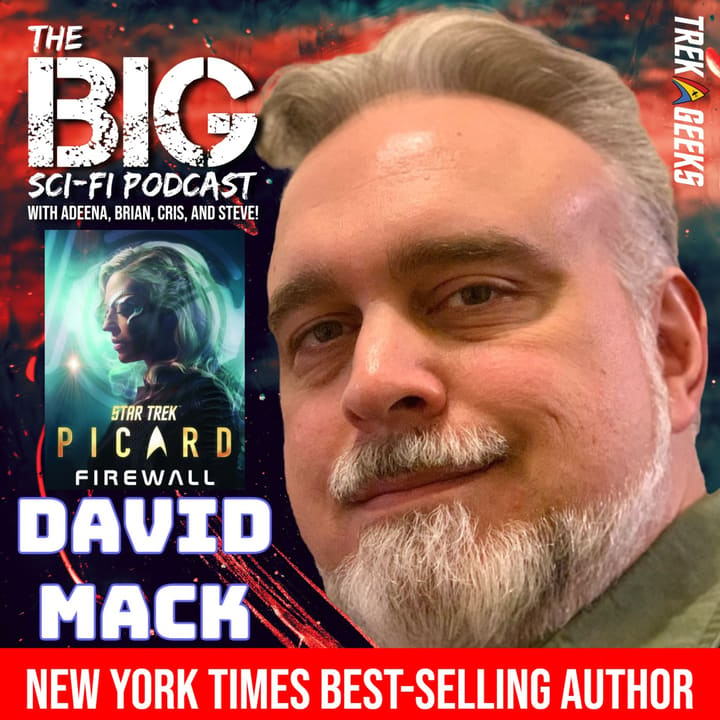
David Mack
The BIG Sci-Fi PodcastMarch 08, 2024x
17
01:09:11

David Mack

New York Times Best Selling Author

Dive deep in this episode with New York Times bestselling author David Mack, whose prolific writing career includes the newly released 'Firewall.' This novel takes us on Seven of Nine's journey from Voyager to Fenris Ranger. Join us as we explore not only the adventures within 'Firewall' but also David's own journey from a film and TV production major to a celebrated author and consultant for our beloved franchise.

This podcast is a proud part of the Trek Geeks Podcast Network and works hard to bring you great content from all over the science fiction universe. We would love to hear your feedback, suggestions, and ideas. Take a moment to send us an email at thebigscifipodcast@gmail.com.

Check our podcast out and learn more about the other great podcasts on the network by visiting trekgeeks.com.

We've got the merch! If you want BIG Sci-Fi swag, check out this link and support us by wearing us everywhere you go! www.teepublic.com/thebigscifipodcast

Check out all of our social links in one place:
https://linktr.ee/thebigscifipodcast

Check out Cris' amazing YouTube channel for Trek content galore:
https://www.youtube.com/@yellingaboutstartrek1532

Check out Brian's new book available at Amazon for Kindle and in paperback:
https://www.amazon.com/stores/Brian-Donahue/author/B0C3BQ93VD?ref=ap_rdr&store_ref=ap_rdr&isDramIntegrated=true&shoppingPortalEnabled=true
Follow Brian on Substack: https://bdonahue.substack.com/

Subscribe for free to Brian's Substack page where he writes original science fiction and fantasy: https://bdonahue.substack.com/

Find Adeena's books here: https://crazyrobot.myshopify.com/

Follow her on Substack here: https://beyondthedroid.substack.com/?utm_source=homepage_recommendations&utm_campaign=1493637

[00:00:00] Welcome to season 5 of the Big Sci-Fi Podcast with Adina Bryan-Chris and Steve, the biggest

[00:00:14] sci-fi podcast in the galaxy.

[00:00:17] The adventure is just beginning here at the Big Sci-Fi Podcast, and we invite you to come

[00:00:21] aboard the Starship Tangernt.

[00:00:23] We know you'll enjoy the conversation, the laughter, the banner back and forth, and most

[00:00:28] of all, friends who love hanging out to talk about all things science fiction.

[00:00:32] Set your phasers to fun.

[00:00:34] Here we go.

[00:00:36] Welcome listeners to an extraordinary episode of our podcast where we're thrilled to have

[00:00:40] the chance to chat with award-winning and New York Times best-selling author, David Mack. David's illustrious career includes more than 36 novels, the most recent of which

[00:00:51] is one coming out as of February 27, 2024, called Firewall, which tells a tale of 7 of 9 and how

[00:01:00] she became a Fenris Ranger, so after Voyager, but before Picard.

[00:01:05] But before we dive into the cosmic depths of our conversation, a quick reminder to all

[00:01:10] of our incredible listeners, please don't forget to like, review, and share our podcast

[00:01:15] on your preferred platform.

[00:01:17] Your support helps us to continue to bring you these stellar discussions.

[00:01:21] And now back to David, whose work not only includes pivotal episodes of Star Trek

[00:01:26] Deep Space Nine, but also contributions as a consultant to the animated series Star Trek Lower

[00:01:32] Decks and Star Trek Prodigy. His writing has garnered a critical acclaim and a dedicated fan base,

[00:01:39] thanks to his ability to weave complex narratives that explore the very fabric of the Star Trek ethos. His

[00:01:46] passion for storytelling and deep understanding of the Star Trek universe have made significant

[00:01:51] impacts on both the series and its audience. So join us as we explore the universe through

[00:01:56] David's eyes discussing everything from his early rejections to his most recent achievements.

[00:02:02] David, welcome to our show.

[00:02:04] I'm glad to be here and that's a heck of an introduction.

[00:02:07] Thank you.

[00:02:07] And she was being so modest with you.

[00:02:10] That was one heck of an introduction.

[00:02:11] I'm honest.

[00:02:13] Thank you.

[00:02:13] My goal is to embarrass our guests.

[00:02:16] I'm very hard to embarrass.

[00:02:19] 36 years in New York, hard to embarrass.

[00:02:21] Easy to flatter, hard to embarrass.

[00:02:24] Awesome. Well, how did you

[00:02:27] just, you know, I want to start at the beginning of how did you get into writing in general and

[00:02:32] then how did you get into writing Star Trek? You know, where did it begin? I mean, I have pretty

[00:02:37] much was always a writer, a storyteller at heart going all the way back to childhood. My folks used

[00:02:43] to like to tell stories of, you know,

[00:02:45] as a kid, I would say I played at night, you know, in my room with the little black and white TV,

[00:02:50] and I would watch things like the Pink Panther movies that were in reruns at the time. And I could

[00:02:55] come out to breakfast the next morning, having seen one of these movies once, and I could recount

[00:03:02] the plot, start to finish. And I could tell you everything that happened in the movie.

[00:03:07] Apparently my brain was wired for story

[00:03:10] right from the beginning.

[00:03:12] So I always loved stories.

[00:03:14] I loved storytelling, particularly visual media,

[00:03:16] like TV and film.

[00:03:19] I got the bug to start trying to put words on paper

[00:03:22] probably around maybe the age of eight or nine. I started

[00:03:25] having these daydreams of you know I would draw book covers and I come up with imaginary titles

[00:03:31] and put my name on a byline because there was nothing I love more than books as a kid.

[00:03:37] Love to collect them love to read them. When I was really small I love to have my mom read them to me

[00:03:43] but some of the best times I had like on on weekends, you know, she would go to run errands,

[00:03:48] buying groceries and whatnot. And rather than have to tote me around all day,

[00:03:52] she figured out she could trust the librarians with me. And she would just drop me off at the

[00:03:56] town library, put me down in the kids section, and the librarians would make sure I didn't wander off

[00:04:02] or, you know, go staggering into traffic.

[00:04:05] But there was a little chance of that, because once I'm in a quiet, comfy place with a whole bunch of books,

[00:04:11] I wasn't going anywhere. She had to drag me out of there.

[00:04:16] I found all the great Sunday editions of all the color Peanuts comics.

[00:04:22] I could read 50 years of Charlie Brown comics. Then I found the science

[00:04:26] fiction book section and I started reading like the kids YA science fiction books. I still remember

[00:04:32] I think one of the first sci-fi books I ever read was called The Space Eagle. You know maybe

[00:04:37] about a great work of literature but it caught my imagination. I must have read it three four times.

[00:04:43] I found Planet of the Apes eventually as I

[00:04:46] got older and the movie novelizations of those, the Star Trek Logs by Alan Dean Foster,

[00:04:54] all kinds of stuff. And then eventually he found original works like Wrinkle in Time

[00:04:59] by Madeline Langol and then my brother started learning the his Andre Norton novels, but so always always in love with words and love with books

[00:05:10] right from the very beginning and dreaming of seeing my name on a book around you know somewhere around the age of like

[00:05:16] 9, 10, 11 was when I started having that daydream

[00:05:20] with only a sort of a detour

[00:05:23] starting around age 15 where I suddenly got the

[00:05:26] bug for screenwriting and that was what led me into film school and writing for

[00:05:31] TV. So I wrote for TV first. Oh, my first professional credit writing fiction for

[00:05:39] money was TV. So what series was that? If you don't mind.

[00:05:45] Oh, wow, very good.

[00:05:46] That was my breakthrough when I was 26.

[00:05:50] That's a big breakthrough to be able to walk into something like,

[00:05:54] it wasn't like you started writing, you know, for something small.

[00:05:58] I broke through from out of the slush file into a pitch meeting.

[00:06:03] You know, I basically got that one in 10,000 shot.

[00:06:08] They tell you as impossible that you're never gonna get,

[00:06:10] it's never gonna happen.

[00:06:12] They discourage everybody,

[00:06:13] they tell you don't dream the impossible dream.

[00:06:15] Yeah, I did it three times.

[00:06:18] That's amazing.

[00:06:20] Then that was what launched me.

[00:06:21] It was a sale to Voyager and then sales to DS9

[00:06:24] with my then writing partner, John Ord over.

[00:06:28] That breakthrough in the TV eventually opened the doors

[00:06:31] to writing for Star Trek in book form.

[00:06:34] And after we'd spent a number of years pitching to TV,

[00:06:39] unable to replicate some of those early successes,

[00:06:42] I'd been making money in the electric books office

[00:06:45] doing editorial work,

[00:06:47] helping with things like rejecting slash manuscripts,

[00:06:51] writing reference materials for the Star Trek authors,

[00:06:54] people like Peter David, Michael Jan Friedman,

[00:06:57] helping to flesh out books that came up short.

[00:06:59] Like I wrote a chapter for John Vornholt,

[00:07:02] Genesis Wave Book One. And then after that, you know, when I pulled that off

[00:07:07] on short turnaround time, they offered me a book

[00:07:10] around, say, the year 2000 after I'd been working for them

[00:07:14] as sort of an office dog's body for about five years.

[00:07:17] I got offered the Starfleet Survival Guide.

[00:07:19] That was my first book.

[00:07:21] Got the contract, wrote the book.

[00:07:23] They said, okay, you can finish your book.

[00:07:25] Would you like to start pitching fiction?

[00:07:27] I said, sure.

[00:07:28] They said, well, we'll start out on the eBooks, which

[00:07:30] was at that time something that they were doing that not a lot

[00:07:34] of people were doing was a monthly eBooks start track

[00:07:36] novella, the Star Trek Corps of Engineers series.

[00:07:40] So they were doing monthly original eBooks.

[00:07:44] And I sort of jumped in on that.

[00:07:46] Started my first couple that I sold. It was a two-parter I wrote with my buddy Keith Ari Decandido.

[00:07:52] With that point, I was already establishing himself pretty well as a novelist.

[00:07:56] And he helped me sort of get my feet wet and helped me understand the transition from writing scripts to writing prose.

[00:08:06] You know, help me get the hang of the change of format, the difference in approach, the

[00:08:11] difference in perspective and point of view, whereas in film you're writing pretty much

[00:08:16] in this external point of view, the camera, it's very character neutral.

[00:08:22] When you write prose, you have to be in the head of a particular character in each sort of scene

[00:08:28] because it is through the perceptions of the character

[00:08:30] that we really experience story.

[00:08:33] So novel writing is a very different animal

[00:08:35] and he kind of helped me get the hang of that.

[00:08:39] Eventually I wrote my own two-parter called Wildfire.

[00:08:44] That one took off, got great critical acclaim,

[00:08:46] sold really well. And based on that, I got invited up to the Major Leads. You know, I got

[00:08:52] basically, I was like a minor league pitcher getting recruited up to the Major. Somebody just

[00:08:57] dropped out on our big nine book project for the fall next year. We have two book slots open,

[00:09:03] back to back, book seven and eight of the

[00:09:05] A Time Two series. Do you want to step in at the last minute and pick these up? I was like,

[00:09:10] I'll take it. Sure. I'll come in. Of course, at the time I had just gotten engaged. I was moving

[00:09:16] out of my apartment, you know, moving out with my wife coming out here to Queens. So my whole

[00:09:21] life was in it and I just started a new job within my last few years. So I'm like, my whole life is a state of upheaval.

[00:09:26] And this is when I'm agreeing to write my first two full length novels

[00:09:30] back to back. And I'm trying to finish them both before I get married.

[00:09:34] But I did it. And one of them hit the USA Today list.

[00:09:39] And I've been writing for Star Trek and other franchises and my own original stuff

[00:09:44] ever since,

[00:09:46] 20 years now. Wow. That's amazing. So when you first got that first break into Deep Space Nine,

[00:09:52] like at that point, what would your level of fandom in Star Trek be? Because you were describing

[00:09:59] that you were very into books where you also really watching the show growing up and

[00:10:05] Are you kidding? I grew up with Wachek. I mean, I was born just too late to see it in first run

[00:10:13] because it would have been an infant. I was born like maybe about a month before the series ended

[00:10:19] on TV, but it went in dis-educated reruns. And so, you know, I got planted in front of the TV

[00:10:26] and in addition to Sesame Street, Electric Company,

[00:10:29] via legway, you know, Mr. Rogers' neighborhood,

[00:10:33] there was also Star Trek.

[00:10:36] And, you know, as I like to say, I was like a duckling

[00:10:40] that imprints on the first moving thing it sees.

[00:10:42] And for me, that was Star Trek.

[00:10:44] Star Trek was the first major sci-fi franchise

[00:10:48] that found its way into my imagination and into my heart

[00:10:51] and did imprinted, and I imprinted on it.

[00:10:54] And so the ethos of Star Trek,

[00:10:56] of humanity bounded together in friendship,

[00:11:00] the ideals of peace being better than war,

[00:11:03] better to create than to destroy

[00:11:06] better to you know build bonds of friendship than

[00:11:10] You know try to oppress or colonize

[00:11:12] These are the ideals that I grew up with and which you know sort of formed my worldview

[00:11:18] Right from the beginning so I watched every episode of the original series of track

[00:11:24] Multiple times I've probably seen them all like 20 times by the time start track the motion picture came out in I watched every episode of the original series of track multiple times.

[00:11:25] I've probably seen them all like 20 times

[00:11:26] by the time Star Trek The Motion Picture came out in 79.

[00:11:31] Went to see that, devoured that.

[00:11:34] Sure, they say now it was slow

[00:11:37] and had these problems and other problems.

[00:11:39] I don't care.

[00:11:40] I was, I loved it.

[00:11:41] I'm sitting around watching Veeger.

[00:11:43] I don't even care that it's basically the episode,

[00:11:45] the changeling just revised and written much.

[00:11:49] I don't care.

[00:11:50] It's just awesome.

[00:11:52] I mean, there's Vulcan with that huge thing

[00:11:54] and there's the Spock with the colon,

[00:11:56] our thing and Veeger and then, you know,

[00:11:59] I leah and the light, I don't care, I loved it.

[00:12:02] So, you know, I saw all the Star Trek movies

[00:12:06] and then Star Trek the next generation began

[00:12:09] just as I was starting film school.

[00:12:11] So here I am, you know, I'm learning to write scripts.

[00:12:14] I love Trek, here's next gen.

[00:12:16] And starting in season two,

[00:12:18] next gen creates the open door script submission policy

[00:12:23] where they invite young writers and of all kinds

[00:12:26] they say if you got an idea and you can execute it as a script.

[00:12:30] Not just story ideas, not a page, but a finished script.

[00:12:33] You can send it in on spec if you sign the waiver.

[00:12:37] So I started submitting scripts.

[00:12:39] I would work on them.

[00:12:40] I'd have my friends read them.

[00:12:42] I figure I'm in film school.

[00:12:43] I'm being taught screenwriting.

[00:12:44] Why not put it to use?

[00:12:46] I've ever broke through,

[00:12:47] never got out of the slush pile at NextGen.

[00:12:49] That was many years of throwing

[00:12:52] things at the wall, collecting rejections.

[00:12:54] You can never have more than one script on submission at a time.

[00:12:57] But I just kept collecting the rejections.

[00:13:00] Then this continued DS9 had the same policy when it started.

[00:13:04] So I continued sending scripts. Now I'm sending scripts continued DS9 had the same policy when it started. So I continued sending scripts.

[00:13:06] Now I'm sending scripts to DS9.

[00:13:08] And originally I sent some on my own.

[00:13:11] I sent some with a different writing partner who I worked with briefly.

[00:13:15] And we kind of hit a lot of brick walls.

[00:13:18] And I just realized I wasn't quite getting the traction.

[00:13:22] I knew that I couldn't figure out why none of these things

[00:13:25] were getting traction.

[00:13:27] The one thing that I was not big into

[00:13:29] in terms of fandom, I was never big into conventions.

[00:13:32] Didn't go to a lot of conventions.

[00:13:33] I went to a few as a kid,

[00:13:35] but that was more about my interest in role playing games.

[00:13:38] I went to find like the cool 30-sided dice.

[00:13:41] I went to find the cool figures, you know, for me.

[00:13:44] It wasn't there. I was there more for RPGs and

[00:13:47] gaming than I was for fandom itself. But then, you know, here I

[00:13:52] am, I'm trying to break into track. I'm living in New York

[00:13:54] City. It's 1992, I think, maybe then, or in there. And I see

[00:14:01] that there is going to be a science fiction convention,

[00:14:05] a short walk from where I live.

[00:14:07] At the time I lived in Hell's Kitchen,

[00:14:08] which is like the West 40s in Manhattan

[00:14:11] over by the Hudson River.

[00:14:13] And at one of the hotels around like maybe I think

[00:14:17] it's seven.

[00:14:18] We got across from Penn Station.

[00:14:20] Yeah, that one.

[00:14:20] Got a big creation con, sort of the thing.

[00:14:23] And I see like a couple of guests who are going to be there

[00:14:27] doing like a discussion thing.

[00:14:29] They say they're going to have Ron Moore, Brandon Bragan,

[00:14:33] and script coordinator Lolita Fajo there to talk to you

[00:14:35] to tell people about how to write for Star Trek on TV.

[00:14:38] And I'm like, oh, that sounds like useful information

[00:14:41] that I could really dig into.

[00:14:43] Except I've never been to a convention.

[00:14:45] I don't know if you're supposed to buy tickets in advance.

[00:14:47] Yeah.

[00:14:48] Nobody tells me these things.

[00:14:50] It's nice.

[00:14:51] I figured, last time I went to a con for RPG, I was a kid.

[00:14:54] It was at UMass.

[00:14:55] I just walked in.

[00:14:56] You walked around.

[00:14:57] You bought dice.

[00:14:58] You walked out.

[00:14:59] I didn't know.

[00:15:00] Nobody tells me these things.

[00:15:01] So at the time I had a job, I'd gotten out of college.

[00:15:05] I was working in publishing,

[00:15:07] working for magazine publishing.

[00:15:09] So I went down there thinking,

[00:15:10] well, this is a professional situation for me.

[00:15:13] I treated it like any other.

[00:15:15] At the time, I was young,

[00:15:16] I was a lot thinner than I am now.

[00:15:18] I had nice dark arrows, clean shaven.

[00:15:21] And I walked in, I was wearing my suit,

[00:15:23] nice dark suit, white shirt, crisp tie,

[00:15:25] polished shoes, long trench coat.

[00:15:27] I'm carrying my briefcase with some of my scripts in it.

[00:15:30] I walk in and I zero in on a guy wearing a shirt that says convention security.

[00:15:37] And I walk right up to the guy and I go, excuse me, I'm looking for

[00:15:41] Lolita Fajo, Brandon Braga, and run more.

[00:15:44] You know where they are, please.

[00:15:45] He goes, oh, yes sir, they're right in there.

[00:15:47] They're in the ballroom, you can go right in.

[00:15:50] Thank you.

[00:15:51] And I walk right by him, I go in the ballroom.

[00:15:53] The ballroom is empty, the event hasn't started yet.

[00:15:56] Oh my goodness.

[00:15:57] Brandon and Ron Moore are at the end by the big table,

[00:16:01] just kind of hanging out, shooting the breeze

[00:16:02] between the three of them.

[00:16:04] I walk right up.

[00:16:06] I'm standing there like I'm just waiting for a chance to jump into the conversation.

[00:16:10] I'm picking up things by osmosis.

[00:16:12] We say hi, I say hi, we shake hands.

[00:16:14] We start talking, we start talking about script writing and track and, you know, what are they

[00:16:18] working on?

[00:16:19] How are things going?

[00:16:20] And, you know, I start asking them questions.

[00:16:22] And I mentioned you, I've got these scripts.

[00:16:24] I've been collecting these rejections.

[00:16:25] And they all kind of stop and they look at each other.

[00:16:30] And they look at me and they go,

[00:16:32] you're not the lawyer from Paramount, are you?

[00:16:34] I said, I never claimed that I was.

[00:16:41] You just look back.

[00:16:42] I hear someone look at the part right.

[00:16:44] And they were like, oh, I'm trying that wild.

[00:16:46] At this point, Brandon is just fed up.

[00:16:50] He walks away mumbling curses under his brain.

[00:16:52] Oh man.

[00:16:53] He's got no time to talk to me.

[00:16:55] But Lolita and Ron were very nice.

[00:16:57] And they said, okay, they said, you know,

[00:16:59] what kind of stories have you been submitting

[00:17:01] that got rejected?

[00:17:02] No, tell them.

[00:17:03] And I described one and Ron sort of took it apart. He says, all right, here's what I'm hearing. He says would tell them, and I'd describe one, and Ron sort

[00:17:05] of took it apart. He says, all right, here's what I'm hearing. He says, you know, you're working on

[00:17:08] this, you're thinking in very first level idea, you're thinking about the concept, but you're not

[00:17:13] thinking about what it says about a character's life. So you got to ground the story in how it's

[00:17:19] affecting the character. The character must be undergoing a personal story that is reflected in the

[00:17:25] concept story. The two have to work together. One should illuminate the other.

[00:17:30] Oh, interesting.

[00:17:31] Ah, I got now that's useful. He goes, good luck. Take this information, go forth and rewrite.

[00:17:39] And so I did. And I left, I left the con and went home and had this new knowledge.

[00:17:45] Eventually got a new writing partner, took this new approach and applied it.

[00:17:49] And about two years later, we'd made our sales to Voyager and DS9.

[00:17:54] And we came out in August of 95 to do the break session, which is when you go into the writer's

[00:18:00] room and you take the story, which at this point is just a few pages of narrative

[00:18:06] in simple prose, and you turn it into a scene by scene

[00:18:10] breakdown of how you're gonna write the script.

[00:18:14] This is the teaser, the cold open.

[00:18:16] This is how many scenes, this is what each scene is.

[00:18:18] This is the stinger, this is how we're gonna end the act

[00:18:21] and go to commercial on cliffhanger here.

[00:18:23] Here's how we pick up at the top of act one.

[00:18:26] And you go through and you basically work with the room

[00:18:29] and you break down the whole script

[00:18:31] and you find the structure of the whole thing.

[00:18:34] When it's done and everybody agrees on it,

[00:18:37] the assistant writes it up,

[00:18:39] you go home and you write your script

[00:18:40] and you got two weeks to turn it in.

[00:18:43] So my buddy John and I, we go out for the break session.

[00:18:46] And we walk into the Paramount offices,

[00:18:49] which at that time we're in the Star Trek offices,

[00:18:51] which were on the Paramount lot in the heart building.

[00:18:55] As we're walking into the writer's room,

[00:18:57] as you walk in at that time,

[00:18:59] you'd pass by the desk of the script coordinator,

[00:19:02] Lillie Defajo.

[00:19:03] And as I'm walking by to go into the meeting,

[00:19:05] she looks up and she goes, you're familiar.

[00:19:08] She goes, I know you.

[00:19:10] We've met, I go, yeah, yeah, we've met.

[00:19:12] She thinks and she goes, don't tell me, New York,

[00:19:16] two years ago, you're the one who came to the con.

[00:19:19] I'm like, yeah.

[00:19:20] Yeah, that was me.

[00:19:21] Yeah.

[00:19:22] And she goes, you made it.

[00:19:24] I go, I made it. That's fantastic. goes, you made it. I go, I made it.

[00:19:25] That's fantastic.

[00:19:25] For you.

[00:19:27] Nice.

[00:19:27] That's great.

[00:19:28] That's great.

[00:19:31] That's a very different experience than I had at those

[00:19:33] creation conventions in New York City.

[00:19:35] I went to a lot of them in the from 1998 to early 92 when I left New York to to from

[00:19:42] Maryland, but I was usually there to see the actors because I wasn't yet thinking about, you know, writing and I never thought about, you know, I never thought about script writing so that would not have been like, you know, in that star struck, you know, mode and especially when I got to see people, you know, and again, similar to

[00:20:09] you, I was born a couple of, I think I'm a couple years younger than you, but I was born after

[00:20:13] the original star trek, but grew up watching it, you know, very religiously, in syndication. So

[00:20:18] like, you know, these people, you know, like, de Fars Kelly is a presence in my house and I still

[00:20:23] remember going to see him at a creation convention, just like, again, awestruck that this person who I have seen as Dr. McCoy,

[00:20:30] my entire life, you know, I know him just as well as I know my parents is like standing

[00:20:35] there in front of me, you know, like, what do I do? I don't know.

[00:20:38] Well, I understand that when we were on the Paramount lot doing the break session, we would

[00:20:43] break for lunch. And John and I went over to the commissary to, you know, get a bite to eat places bustling.

[00:20:50] There's nowhere to sit. We're trying to find any place to sit down. And the only available

[00:20:54] seats are at a table with George Takei. Oh, wow. And we didn't want to impose, but he

[00:20:59] saw that we were at a loss. And he's like, do you need a place to sit?

[00:21:06] That'd be okay, Mr. TK. He's like, please join me.

[00:21:09] Okay.

[00:21:10] We had lunch with George D K.

[00:21:12] That's very nice.

[00:21:13] Lovely.

[00:21:14] On the way back to the commissary, we run into Jonathan Frank's and we talk to Jonathan Frank's.

[00:21:19] I'm like, oh, this is incredible.

[00:21:21] I want to live like this all the time.

[00:21:23] I didn't get to all the time about

[00:21:25] keeping them. Just cool for a couple of days. Right. Right.

[00:21:29] Well, can I'd like to know if if you're willing to answer. I don't know if you have a

[00:21:34] favor, but is there a favor Trek series in particular that you just

[00:21:38] fell in love with TV? It's hard to rank them. I mean, I love all of them in their own way. Obviously, I

[00:21:46] think if I've got a favorite, it's got to be DS9. And not just because I wrote for DS9,

[00:21:52] but because I loved its approach to the Star Trek universe. I would say it's probably

[00:21:56] number one. Second place right now is like a close tie, TOS and TNG, TOS, because it's the template. It's where all what I grew up with.

[00:22:09] I know that some younger viewers maybe don't cotton to it because it doesn't feel like something

[00:22:14] they can relate to as a product of the 1960s. But it's what I grew up with. It's what I understand.

[00:22:20] And I can see how Star Trek evolved from that. And then of course, TNG, because that

[00:22:26] was what really, you know, escalated Star Trek and brought it to a much broader fandom and made

[00:22:33] possible everything that is followed. And TNG, although it had a shaky start, some of those early

[00:22:40] seasons were a little, you know, weak at times. Eventually when it found its footing, when it got going,

[00:22:48] it was brilliant.

[00:22:50] There was some great work done there.

[00:22:53] So it's iconic.

[00:22:54] So those two definitely tied in second place

[00:22:58] in my sort of personal estimation.

[00:23:01] Strange new worlds bumping right up right now at number three. It's like right there in third place. Yes,

[00:23:07] sir. You know, and the only reason it's not escalating into

[00:23:10] second is that it's only had two seasons. Right. Look at a

[00:23:14] couple more seasons and hey, you know, it might bump its way

[00:23:18] up and either TOS or TNG may have to come down a peg right

[00:23:23] behind that. Prodigy, prodigy's great. And again,

[00:23:28] I say that not just because I worked on it and made all kinds of behind the scenes contributions,

[00:23:34] but because the Hageman Brothers and their writing team truly created something wonderful.

[00:23:41] And then after that, everything else kind of tied after that in a big jumble, but

[00:23:47] card would probably be slightly ahead of discovery for me, both of which I'd put ahead of lower decks.

[00:23:56] And then there's I love lower decks so much. Then there's Voyager and then there's Enterprise.

[00:24:08] numbers enterprise. See, see, I am TNG is my sentimental favorite. It's what I started Trek in and then went back then started watching the original because

[00:24:13] the original was first on Saturday night and then TNG in the Cleveland area here

[00:24:18] but Deep Space Nine is by far and my other co-host Chris, who's not here, we're kind of on the same page.

[00:24:26] DS9 was just so different. And they lost occasionally, which was so intriguing to me

[00:24:32] watching that. And so I agree with you. Steve, on the other hand,

[00:24:38] enterprises at the top of his list. And you have to understand, David, I watch

[00:24:42] Star Trek live. I started watching September the 8th, 1966.

[00:24:48] And the reason why I love Enterprise is because,

[00:24:52] and this is my strange way of saying,

[00:24:55] it seems to be the most realistic in that

[00:24:59] there is the transition from NASA to enterprise.

[00:25:05] And they made enterprise look like it was actually built.

[00:25:10] You had manufacturer labels on everything.

[00:25:14] The people didn't know what their, they were explorers,

[00:25:17] they're learning.

[00:25:18] And a lot of the actions that took place in the series

[00:25:22] harken back to my love of growing up

[00:25:24] during the NASA program of the 1960s harking back to my love of growing up during the NASA program

[00:25:25] of the 1960s.

[00:25:27] It just seemed to follow that.

[00:25:29] Again, it is probably, you know, when you came out, it broke all the rules of what Star

[00:25:35] Trek was supposed to be.

[00:25:36] Didn't have Star Trek in the name, had an opening song, a lot of things that were not

[00:25:42] what it's supposed to be.

[00:25:44] But I really love it.

[00:25:45] I wrote, as soon as, and I've said this-

[00:25:48] Something wrong with that?

[00:25:49] Too many times I said, I was burned out after Voyager,

[00:25:54] after so much Star Trek,

[00:25:55] and that show rekindled my love of the show.

[00:25:57] But that's not to say they're all good.

[00:26:01] And like you said,

[00:26:02] They all have something to offer.

[00:26:04] Strange new worlds, it's like a joy.

[00:26:08] And this last season was full of just wonderful episodes.

[00:26:14] The cast has amazing chemistry. Oh, they show really the writers are just on fire.

[00:26:22] With only like maybe the occasional slight

[00:26:24] fire. I mean, with only like maybe the occasional slight

[00:26:29] pecancy misstep here and there like the one episode that was clearly just a riff on the ones who walk away from Olmala's very

[00:26:33] heavy-handed and not particularly well done. But I

[00:26:37] forgive it because the rest of the show is just so damn.

[00:26:41] Yeah, I mean, I'm sure to be in that room.

[00:26:44] Yeah, you can't be. I mean told to be in that room. Yeah, you kidding me.

[00:26:46] I mean, right now I'm just advocating

[00:26:48] to try and get a strange new world's novel,

[00:26:50] you know, as my next assignment.

[00:26:51] So.

[00:26:52] Yeah, you had said something a minute ago

[00:26:54] about, you know, younger viewers

[00:26:55] not necessarily getting into original series.

[00:26:58] Now, I don't know what your involvement

[00:27:00] has been in Lower Decks.

[00:27:01] And you wanna ask about that.

[00:27:03] I was a classical president one.

[00:27:04] Okay, cool. Okay. So one of the best things about Lower Decks. And you wanna ask about that. I was a 12-person student one. Okay, cool.

[00:27:05] Okay, so one of the best things about Lower Decks

[00:27:08] is I watched that with my 13-year-old.

[00:27:11] And that has given me a lot of openings to be like,

[00:27:14] oh, you wanna understand that bit?

[00:27:16] We gotta go watch this original series or TNG episode.

[00:27:20] And then he will actually sit there

[00:27:22] and watch the episode with me.

[00:27:23] Okay.

[00:27:24] So it's a excuse to sort of introduce them to the more classic.

[00:27:27] Yeah.

[00:27:28] So they can find that they have no grasp of continuity or cannon at lower decks.

[00:27:34] They're just having fun.

[00:27:36] They're just having so much fun.

[00:27:39] I mean, I would have jacked with it.

[00:27:40] It is so much fun.

[00:27:41] And also insist on calling themselves cannon.

[00:27:43] If they just wanted to be satirical,

[00:27:45] then I would say do whatever the hell you want

[00:27:47] and go for the joke at all expense.

[00:27:49] But don't call yourself canon

[00:27:51] if you don't realize that the M116 features

[00:27:54] been extinct for 114 fucking years.

[00:27:56] Well, here's the thing, David.

[00:27:59] When, when, when Lower Decks came on

[00:28:01] and I watched the first episode, I went,

[00:28:04] this is horrible. This is not I went. This is horrible.

[00:28:06] This is not Star Trek.

[00:28:07] This is horrible.

[00:28:08] Oh my god.

[00:28:09] I loved it so much.

[00:28:10] And then from the first moment, I went back and watched it again.

[00:28:14] And I went, wait a minute.

[00:28:16] This is satire.

[00:28:17] This is funny.

[00:28:19] Oh, wow.

[00:28:20] Now I get the job.

[00:28:21] It's a fine distinction.

[00:28:23] But I'm so indifferent to lower decks. I just I don't I don't fine distinction. I'm so indifferent to lower decks.

[00:28:27] I don't watch it.

[00:28:29] I'm fine without it, but I know others love it.

[00:28:32] I watch it because it's my job to watch it.

[00:28:34] All right.

[00:28:35] Okay.

[00:28:36] I have to know all the continuity of all the shows.

[00:28:39] Wow.

[00:28:40] Because I have to see how they all weave and fit together.

[00:28:43] Because when I'm working in tie-in material,

[00:28:45] I have to know the whole universe.

[00:28:47] I can't afford to be ignorant of a particular corner

[00:28:50] of the universe.

[00:28:51] So I may not have loved Enterprise, but I had to watch it.

[00:28:54] I mean, I loved every minute of Voyager, but I had to watch it.

[00:28:58] And I sometimes could go back and rewatch it.

[00:29:01] Yeah.

[00:29:01] Let's keep counting.

[00:29:02] I think that's a good segue to talk about the recent book.

[00:29:06] Oh, firewall.

[00:29:07] Absolutely.

[00:29:07] So how did that come about?

[00:29:10] You know, again, as tie in fiction and we recently just saw the most amazing

[00:29:15] season of Picard, we are all beyond in love with seven way more than, you know,

[00:29:19] people were before.

[00:29:21] And yeah, so she has this backstory of she was a Fenris Ranger, but there's not a lot of detail about that in

[00:29:28] Picard. And now you have this book. So how did that what was a

[00:29:31] Genesis for the book?

[00:29:32] Well, it started basically when I think probably back in 2020,

[00:29:36] when the episode Stardust City rag first aired. And I remember,

[00:29:41] you know, they were dropping episode week by week. And so

[00:29:44] they have seven of nine appear at the end of the card season one at four is where she saves their butts and they beam her out.

[00:29:53] They say the word spenders Ranger and you see seven of nine, but you don't really get much more about it till the following episode.

[00:30:00] And they give you a little bit, but not again, not a whole bunch more, but they give enough of it that i'm watching start a city rag and i pause in the middle of watching the episode for the very

[00:30:10] first time so that i can pick up my phone and immediately email my editor i want to write a

[00:30:15] femoris rangers novel and with about three minutes she replies it's middle of the night but she's

[00:30:20] awake so she replies within about three minutes, you and everybody else. Oh really? But you said, you know, there's a current moratorium, the folks at Secret Hideout,

[00:30:31] the people who produce the new run of shows. At that time, we're saying that, you know,

[00:30:36] it had to be hands off for things like Fenris Rangers and the new continuity,

[00:30:41] because they weren't sure yet what they intended to do with it. They wanted to

[00:30:45] leave it open and untouched so that if, say, in season two or season three, in the course of

[00:30:51] working in the writer's room, a storyline that had, you know, springs up involving the Fender's

[00:30:57] Rangers, they didn't want to be beholden to anything that had been done, say, in the books.

[00:31:02] And they didn't want to be in the position of having to overwrite our continuity, which they would gladly do in a heartbeat,

[00:31:09] but they didn't want there to be this apparent disconnect.

[00:31:12] They wanted to make sure that the books that were being produced

[00:31:15] and are still being produced are in harmony with what they are doing,

[00:31:21] but they are in the lead and we are in the follows.

[00:31:23] So until they say, okay, we're done playing with this

[00:31:26] toy, you may now play with this toy. We don't get to play with

[00:31:30] the toy.

[00:31:31] Interesting.

[00:31:32] I was told hands off the fan race Rangers toy and go do

[00:31:35] something else. So I did something else for a couple years.

[00:31:38] And around the end of 2021, I went out to lunch with my

[00:31:43] editors or maybe it was the end of 2022 somewhere in there.

[00:31:47] And went out to lunch, and we were talking about this and that and the other thing. And they said,

[00:31:53] so how would you like to write the story of seven of nine joins the fenders rangers? I said,

[00:31:59] would I? Well, I think so. I got to to that gig by the editors and they said,

[00:32:05] go off, go down and write a proposal, write a pitch.

[00:32:09] And the way that currently works is I came up with a general idea,

[00:32:14] the shape of the story, kept it relatively concise.

[00:32:18] And the editors, I tune it until the editors like it.

[00:32:21] Then the editors run it past my friend Kirsten Byer.

[00:32:25] Kirsten Byer is one of the co-creators of Star Trek Picard.

[00:32:30] She's currently a co-executive producer

[00:32:33] with the Secret Hideout team,

[00:32:34] working her way up through the ranks.

[00:32:36] One role she fills specifically for them

[00:32:40] is she is the liaison between Secret Hideout

[00:32:43] and the tie-in publishing arm at Simon & Schuster

[00:32:47] and at IDW Comics.

[00:32:49] And so she has to vet or approve anything

[00:32:53] that's based on the new Secret Hideout versions of track.

[00:32:57] So if it's classic legacy track,

[00:33:00] if it's like NextGen, DS9, TOS,

[00:33:03] it doesn't have to go through Kirsten,

[00:33:04] but if it's card, gen DS9, TOS, it doesn't have to go through Kirsten, but if it's been card discovery,

[00:33:08] strange new worlds,

[00:33:10] Kirsten has to sign off.

[00:33:12] Interesting.

[00:33:12] That's her job.

[00:33:13] So I got to work with Kirsten,

[00:33:16] which is always a joy,

[00:33:17] because she and I have collaborated on things before

[00:33:20] and she has just the most amazing sense of story,

[00:33:25] how to tighten things up, how to knit things together.

[00:33:29] She's able to see where the problems lie.

[00:33:31] She's able to sort of help refocus things

[00:33:34] so that everything works together thematically.

[00:33:38] And so I got her feedback on the story

[00:33:40] and that shaped it and sort of influenced the direction

[00:33:44] that the final

[00:33:45] narrative took.

[00:33:47] And once I had her approval and her buy-in, we were good to go.

[00:33:52] I got the green light, and then it was just a matter of, you know, getting the manuscript

[00:33:57] written despite all the roadblocks that life threw in front of me.

[00:34:01] How about, how long did it take you to write this book and on average, how long does it

[00:34:06] take?

[00:34:07] Well, I mean, if you look at actual days I spent writing, it didn't take me that much

[00:34:11] longer than it usually does.

[00:34:12] I usually write a tie a novel like this in about 10 to 12 weeks.

[00:34:17] What caused the delays were just things like life getting in the way.

[00:34:20] I can't start working on the manuscript until the powers that be, in this case

[00:34:26] Kirsten, give you the green light. And until that happens, you're basically on hold, so you go and

[00:34:31] you work on other things. Then you get the green light and I was, you know, I had to clear the

[00:34:37] decks, I had things going on, I had a couple projects I had to finish first. My plan originally

[00:34:42] was going to be that I was going to spend the month of May

[00:34:46] last year. That was when I was really going to dig in and start working on the book in earnest.

[00:34:53] And then on May 4th, my wife's father died. And the month of May just vanished.

[00:35:00] Suddenly, she's got to go to Texas and she's shuttling between Texas and Illinois

[00:35:05] where he's going to be buried.

[00:35:07] There's things to deal with the family.

[00:35:08] I'm coordinating her travel.

[00:35:10] Eventually, I'm going to have to join her.

[00:35:12] I got to find a cat sitter.

[00:35:13] I got to find someone to take care of the house.

[00:35:16] You know, there's just issues of cost and expense and logistics and travel and all these

[00:35:22] other things.

[00:35:23] And it just, it just ate the whole month.

[00:35:26] And so the time I looked up and was able to breathe again,

[00:35:29] you know, it was June.

[00:35:31] And I had a couple of conventions I had to do.

[00:35:34] And so I was trying to get some momentum again.

[00:35:37] And I finally get to work in around mid-June,

[00:35:40] is when I finally am able to like clear the deck.

[00:35:43] So I've gotten all my responsibilities handled.

[00:35:45] I set to work and I started getting a good pace.

[00:35:49] I got my rhythm going and I had planned to finish.

[00:35:52] I think I had a hard deadline.

[00:35:53] The manuscript had to be in, I think by August 21

[00:35:57] was the hard delivery date.

[00:35:59] And I was cruising toward finishing maybe,

[00:36:01] as much as maybe a week early.

[00:36:03] And I was about a week out from finishing the book, feeling good. I've got my momentum. And I got COVID. Oh, my. And when

[00:36:13] I snuck at COVID, I mean, I got the kind of COVID where my first day I ended up in the ER.

[00:36:18] And I'm here to die. So, my gosh, a nice long day in the ER and then I spent about a week recovering.

[00:36:28] And so that just,

[00:36:30] and then even after you've technically recovered,

[00:36:33] you feel wiped out.

[00:36:35] And COVID leaves you just feeling like a drained battery

[00:36:38] for weeks afterward, but I had to get the book done.

[00:36:41] So I somehow just, as soon as I was even remotely able to work again,

[00:36:46] I just got back in there and I finished the final chapters. I believe I turned in the book

[00:36:51] about four hours ahead of my deadline. Oh my goodness. Wow. You made it.

[00:36:56] I didn't trust an event more than 10, four hours to spare.

[00:37:00] Yeah. So, but usually it takes me 10 to 12 weeks. And that was again roughly the same amount of

[00:37:05] writing time. It's just life kept getting to the way. Yeah. It took the same amount of time. It just

[00:37:11] got spread out over a longer period. Now, now can I ask you a selfish question as an aspiring writer

[00:37:18] myself who is got a couple just short stories that I'm really just deadlock. Like I can't, I don't even feel almost the inspiration to work through just to sit down

[00:37:31] and just type something, do something to see if I can't get a good rhythm going.

[00:37:36] Is there anything you do or do you just have to walk away for a time and then come back

[00:37:42] and see it with fresh eyes?

[00:37:43] Or is there any practice you do just to push through that?

[00:37:47] If you can't see the story then maybe there's something wrong with it and walking away can

[00:37:51] help give you a fresh perspective.

[00:37:54] Sometimes if a scene just refuses to happen it could be a sign that you're writing it

[00:37:59] through the eyes of the wrong character.

[00:38:02] Try choosing a different perspective character.

[00:38:05] One of the keys to figure out who should be your point of view in any given scene,

[00:38:10] it should always be the character who has the most lose in that scene.

[00:38:14] Whoever has the most at stake, whoever's going to be the most emotionally involved,

[00:38:20] that's usually the best person to choose as your POV character,

[00:38:24] unless you need to withhold information by using a different character.

[00:38:30] Beyond that, my only other advice, what's worked for me over 20 years, I drink.

[00:38:34] I subscribe to the right drunk at its sober philosophy.

[00:38:41] I drink less.

[00:38:42] I do.

[00:38:43] I used to go through like maybe a couple of levels.

[00:38:45] No, I don't drink at all.

[00:38:47] I don't know.

[00:38:48] I can't drink at all anymore.

[00:38:50] Since I hit that age, you know, that's a big sister woman.

[00:38:55] Alcohol does not agree with me anymore.

[00:38:57] I haven't had to drink in a long time.

[00:38:59] Alcohol can put me to sleep pretty fast now.

[00:39:02] It's basically a switch flip for me about maybe

[00:39:06] in the last two years. Used to be I can put away a couple of doubles of whiskey and ginger

[00:39:11] out or whatever over the course of the night and write two scenes. Now if I try to do that

[00:39:16] I'm asleep in my chair with a computer on and I'll lose three, four hours and then I'll

[00:39:22] wake up and I'll have done not much. I can have maybe a drink if I nurse it.

[00:39:27] If I try to do two drinks, I am down for the night.

[00:39:31] Darn you metabolism.

[00:39:33] Darn metabolism.

[00:39:34] Darn liver function shutting down after the day.

[00:39:38] Yep.

[00:39:39] But so no, I'm the creature of habit, remember.

[00:39:41] I write my habit no matter what.

[00:39:44] But for Brian, if I'm not feeling it, move on. I do, I write by habit, no matter what, but I get to it.

[00:39:45] But for Brian, if I'm not feeling it, right,

[00:39:47] move on to something else, or I like David's suggestion

[00:39:50] of switching around maybe as a different character

[00:39:52] you need to think about, or maybe really it's not the right

[00:39:56] scene or not the right story in the moment and such,

[00:39:59] but no habit, habit gets it done.

[00:40:01] Having gets it done, there's all sorts of other tricks.

[00:40:03] Like, aside from changing the character point of

[00:40:06] view, sometimes, you know, you get jammed up because something doesn't feel emotionally

[00:40:11] honest and that's why you're not engaging with it.

[00:40:14] Sometimes the key is to say, all right, what if we do the opposite?

[00:40:16] You're trying to write a love scene and the characters just don't seem to click.

[00:40:20] All right.

[00:40:21] At the moment where you think they were supposed to kiss, she slaps them across the face.

[00:40:30] That's a good one. It's definitely a juxtaposed position. If it leads to a dead end, at the very least, if it breaks the logs you have and gets you putting

[00:40:34] words on the page again. Right. Right. Yeah. That's great.

[00:40:39] So another technical writing question I have for you that specifically for writing in the Star Trek universe.

[00:40:45] How do you come up with names of individuals that are not human species?

[00:40:51] Great question.

[00:40:52] Well, because we might come across a species like the Zach Dorn in like one episode in Star Trek,

[00:40:58] but now you're writing and so they're showing up in your novels and I notice they show up

[00:41:02] in Keith's novels and Dayton's novels. How do you come up with names that fit given when you have like one or two maybe three examples

[00:41:11] to work from? Well I mean sometimes you extrapolate for instance they establish

[00:41:16] Zachto on them, they know what's his name, something Cole Kohrami or something?

[00:41:21] Kohrami, yeah. I can't remember what his first name is.

[00:41:24] Yeah but they established he had a first name, something korami.

[00:41:28] And so there's a case to the name.

[00:41:31] So I remember naming one of my Xachtoan characters, Gruun Helkara.

[00:41:38] So you know, I think I have one, I have another background character coming up in firewall.

[00:41:47] So I think I just, I try to find like the cadence

[00:41:51] that already exists for the character names,

[00:41:53] but I either find something with a similar cadence

[00:41:56] or a similar structure.

[00:41:59] I noticed for instance, when you're dealing with Vulcans

[00:42:02] that tend to be two syllable names a lot of the time

[00:42:05] with a couple of rare exceptions.

[00:42:07] You see male characters very often tend to have names

[00:42:10] that start with S and have some sort of K or R or V.

[00:42:16] And then they started establishing things

[00:42:18] like the T apostrophe name convention

[00:42:21] for female Vulcan characters.

[00:42:23] So a lot of writers went and ran with that.

[00:42:25] And then eventually in tie in, you know, you start running out of good options that other

[00:42:30] people haven't already used. So you have to start extrapolating and say, well, if you can use T

[00:42:35] apostrophe, why can't you do something else? And I hit upon L apostrophe, which worked a fine I came up with lohan l-h-w-a-n it looks

[00:42:46] perfectly Vulcan to my eye it sounds right and it fits their convention and

[00:42:52] if you can name a character Valeris or Savic then you can use any other

[00:42:58] variety Savic you know it's actually a little bit kind of Norse you know it's

[00:43:04] not that far off names you'd actually find in Norway or Sweden.

[00:43:08] So, sometimes I'm looking to different sources.

[00:43:11] But for instance, you know, when I need to come up with names across the course of the book,

[00:43:18] I have like, you know, my style, like I know the approach I'm going to take to a Baldian name,

[00:43:22] the approach I'll take if I need to name a Vulcan, a Klingon, a Zachdorn, etc. I have a particular style I like to use for trail and other characters.

[00:43:33] But across the whole sort of the book, lately I've been doing more kind of a themed approach,

[00:43:41] whereas if you go through for instance Oblivion's Gate, book three of the Coda Trilogy,

[00:43:46] you begin to find if you look at all the place names and the names of things like the black

[00:43:50] holes that they go to, and you start looking up what are the sources of these names, where do they

[00:43:55] come from, you find that a lot of it is tied into apocalyptic mythology. Whereas, so when we're

[00:44:02] going through Firewall, because I was asked to write a book about the

[00:44:05] Fenris Rangers who are named after the Fenris Wolf, which is part of North Mythology.

[00:44:11] I chose to go with a lot of Norse names and I basically had a map of Norway.

[00:44:16] Whenever I needed a place name, I'd go and scan it until I found something that looked

[00:44:20] good.

[00:44:21] So you've got a planet called Skanovic Prime.

[00:44:23] Skanovic is a town in Norway.

[00:44:25] I've been very interesting. And so on. And I pulled a lot of some of those names made good

[00:44:30] character names. So I pulled them out when I needed them. So there's a very Norse flavor

[00:44:37] to a lot of the place names and many of the character names throughout the Seven of Nine book throughout Firewall.

[00:44:46] And there's even sort of a little cultural touch from the point of view of a character named

[00:44:51] Kian Harper, who's a Fennress Ranger, who I sort of picture as being like Jeff Bridges in the old man.

[00:44:58] And there's a scene where he's made a terrible miscalculation. He's trying to do something on his

[00:45:03] own and he's basically blundered into an ambush, and he's about to get killed, and he's thinking to himself,

[00:45:09] I have just made the fatal last mistake of my life, and I'm gonna die. And he would have,

[00:45:14] except for the fact that that's the moment that Sevan, who was told to observe and not engage,

[00:45:19] chooses to engage anyway, because she thinks, what would Janeway think of me if I just stand here and watch this guy die?

[00:45:26] And so she comes out guns blazing and saves his ass.

[00:45:30] And when he sees her coming, he can't help it.

[00:45:32] He looks at her and what he sees from his point of view,

[00:45:35] it's described as a tall blonde Valkyrie,

[00:45:40] wielding a pair of Stinger pistols comes out blazing.

[00:45:44] And he's seeing her as a Valkyrie, which again, a very Norse reference.

[00:45:50] But if you also know what the symbolism of the Valkyrie is, they're not supposed

[00:45:53] to be warrior women.

[00:45:54] They're the spirits, they're basically angelic figures that escort the spirits

[00:45:58] of the dead into the next life.

[00:46:00] They are what are known as psychopaths.

[00:46:03] Um, and so this is actually a foreshadowing,

[00:46:06] boiler alert, this is a foreshadowing of the fate

[00:46:11] that awaits poor Keon Harper.

[00:46:14] And we see other, you know, inklings of this,

[00:46:16] other foreshadowing moments that tell you he's sort of

[00:46:20] on a path to, you know, a sad end.

[00:46:24] But, you know, it begins with this Norse imagery of the Valkyrie.

[00:46:28] That's fascinating.

[00:46:30] So another, yeah, that's really cool.

[00:46:32] Another related question, maybe step back also.

[00:46:35] When you're writing characters for this book,

[00:46:39] how is there, do you personally have any methodology

[00:46:44] for choosing the species characters gonna be

[00:46:47] or does it just like organically happen?

[00:46:49] Like, you have a trail, you have a zachthorn.

[00:46:51] And I keep hitting on the zachthorn

[00:46:52] because I feel like I don't see that very often.

[00:46:55] So the zachthorn sticks in my brain.

[00:46:59] Yeah, I mean, like I had the zachthorn

[00:47:01] that I used in Firewalker.

[00:47:02] I think his name was Lennaker Zega.

[00:47:05] He, spoiler alert, he dies early.

[00:47:10] Oh man.

[00:47:11] Yeah, but I try to mix it up.

[00:47:14] I try not to use too many of the same character.

[00:47:16] I try not to let the universe get too human heavy

[00:47:19] for one thing.

[00:47:20] That was always one of those things where T.O.F. Sarah

[00:47:23] is very human heavy.

[00:47:24] And so other writers, you know, Dayton Ward and Kevin Delmore and James Swall and I, That was always one of those things where TOS era is very human heavy and so

[00:47:26] other writers you know Dayton Ward and Kevin Delmore and James Swallow and I we leaned into that when we were working on say the

[00:47:31] Vanguard books which are set in that era and so we made those books more human heavy because that was what

[00:47:39] Felt like TOS but even there we were trying to expand the repertoire beyond

[00:47:46] felt like TOS. But even there, we were trying to expand the repertoire beyond them. We try to get a little bit of variety, especially because we don't have to worry about makeup

[00:47:50] budgets, costume budgets, special next budgets. We can have whoever the hell we want. So I

[00:47:57] try to get in. I throw in a mix of bad guys. I've got antikens. I've got baldex. I've got

[00:48:02] cow-noth. The antiken, yes. That is the other one.

[00:48:05] I was kind of a dog.

[00:48:06] I've got the chowm up.

[00:48:07] I've got, I've got everybody I want, you know, I can put in a

[00:48:11] gourin if I want to.

[00:48:12] I just got to be careful about gourin and continuity now that

[00:48:14] Strange New Worlds is reinventing the gourin.

[00:48:17] Yes.

[00:48:19] But you know, with, for instance, my sort of primary cast, again,

[00:48:22] I just wanted to mix it up.

[00:48:24] So I know I've got seven of nine who is nominally human, but she's also export.

[00:48:31] And then so I pair her up with Tian Harper, who I decided is going to be human and I make

[00:48:35] him, you know, white.

[00:48:38] We've got her love interest, Ellery Cade, and rather than have another human in the mix,

[00:48:42] I decided to make her trill and I pattern her

[00:48:45] after Jessica Henwick.

[00:48:47] So I'm thinking, okay, so kind of like her.

[00:48:50] And then they're sort of surrounding troop

[00:48:53] of other Fenris Rangers.

[00:48:55] You know, I've got a Cardassian or half Cardassian woman.

[00:48:59] I've got a bajorin guy named Jalen Parr.

[00:49:02] We've got a guy named Luken Sagasta,

[00:49:05] who is nominally human, but could be our gillion,

[00:49:07] who the hell knows.

[00:49:10] We've got a guy named Spears, who's pretty clearly human.

[00:49:14] We've got Andorians in the mix.

[00:49:16] We've got Sorians.

[00:49:17] We've got, what's Saru's species?

[00:49:21] The Kelpians.

[00:49:22] We've got Kelpians in the mix.

[00:49:27] There's like a half human, half Klingon who happens to be within the Fender's Rangers.

[00:49:30] The Fender's Rangers will basically take anybody

[00:49:31] who wants to sign up.

[00:49:33] They're not particularly, you know, picky.

[00:49:36] So I try to get at least, you know, a sense of diversity,

[00:49:39] a sense of range in the cast.

[00:49:41] If for no other reason, it helps me to come up with names

[00:49:44] that are significantly

[00:49:47] different from one another so that you know, Jalen Parr, that sounds like a good bajorin

[00:49:51] name. Yes it does. And then you've got you know, Luke and Seagasta, you're not going

[00:49:56] to mix up on a page. Like once you've gotten a good intro for Luke and Seagasta, he's basically

[00:50:00] got dark brown skin and a bright white Cheshire cat smile and he basically is the hot spur the young hot shot of the group

[00:50:08] Who's got away with the ladies? You're not gonna mix him up with you know stiff jail and par or you know

[00:50:14] Go go go commando spears over here. You know once you get the name spears you get spears you got sagas that you get par

[00:50:22] You've got cage. You've got harbor. You can you've got Par, you've got Cade, you've got Harbor.

[00:50:25] You can start telling these people apart very quickly.

[00:50:28] And that's part of why it helps to have different species, different sounding names.

[00:50:34] I try to be aware of the reader needs to be able to quickly parse who these people are.

[00:50:41] I'm being able to establish the character traits quickly.

[00:50:45] And it also helps if the names are distinct enough

[00:50:48] from one another that even if you're just scanning the page,

[00:50:51] you're not gonna get lost.

[00:50:56] Yeah, I got a very Han Solo kind of vibe from Harper.

[00:50:59] Like if Han Solo was a good guy, kind of.

[00:51:03] Oh, Han Solo is supposed to be a good guy. But,

[00:51:05] well, no, no, not good guy. But like, if he was a member of a law enforcement agency,

[00:51:11] was the rogue? Yes, it wasn't for a great, the center's frame, you said the beginning or

[00:51:17] before they had generated into the anarchistic, you know, sort of non-hierarchical entity

[00:51:25] that they become, the band of roving Robin Hoods,

[00:51:28] whatever, they'd become 20 years later.

[00:51:31] This is said earlier when they are just beginning

[00:51:33] that evolution away from being a legitimate,

[00:51:37] interstellar law enforcement patrol

[00:51:40] that, you know, defends a sector of space

[00:51:42] into becoming this sort of freewheeling, anybody who wants to show up and bring a ship, you know, defends a sector of space into becoming this sort of free-wheeling anybody

[00:51:45] wants to show up and bring a ship, you know, hey, you're in. We don't even bother to have uniforms.

[00:51:51] They're not there yet. They are still a little more structured and regimented than that.

[00:51:56] But I wasn't really picturing, I mean, I guess it could be Hanzo, but I, again, like I said,

[00:52:02] not perfectly.

[00:52:05] I'm picturing Jeff.

[00:52:06] Okay, sure. Sure. Sure.

[00:52:08] He's a little, he's got that sort of a Jeff Bridges draw, especially with lines

[00:52:12] like, you know, kid, you talk too much.

[00:52:16] He's got some amazing Jeff Bridges impersonation.

[00:52:19] It's a good one.

[00:52:21] So like, you know, he's like, you know, and his recurring lines through the,

[00:52:24] through the book, when he'll tell some seven

[00:52:27] something she doesn't want to hear. And she'll call my name, say,

[00:52:30] true, the cover kid. You get. Yeah. I like that. That's a good

[00:52:36] one. David, you see multiple books coming out of these story

[00:52:41] lines that you've been going on about? I mean, do you want to do,

[00:52:44] you know, flesh out other characters, maybe make them the main characters of future books about

[00:52:50] the adventures of the Rangers? I don't particularly see a need for that. I don't think I'm working

[00:52:55] for that. I think part of what is going to make this book marketable, if anything, is it's the

[00:53:01] fact that it's a coming of age story for seven. I don't know that there is

[00:53:06] a particular hunger out there for random stories about random Fenris Rangers. If they want to pay

[00:53:12] me to write them I'll find a way. But what was compelling and interesting to me about telling this

[00:53:18] story is that it's about seven at a time in her life, Voyager has just come back to Earth

[00:53:26] within about the last two years.

[00:53:28] And she's had this sort of emotional safety net

[00:53:32] with the crew of Voyager.

[00:53:34] They've been sort of helping to try and reintegrate her,

[00:53:36] help her reclaim her humanity step by step.

[00:53:39] And they provide a very sheltered environment

[00:53:42] in which she's been doing that.

[00:53:44] And then the moment they get home,

[00:53:46] they scatter because the Voyager is going to get put into museum status and they don't need a

[00:53:52] crew for that chip anymore. So Harry's off doing whatever Harry's going to be doing.

[00:53:56] Chikote gets put in charge of the protostar. The doctor's off on his book tour. Tom and

[00:54:02] Bologna go off to have their kid,

[00:54:05] two vockets sent to Starfleet Command, security, whatever.

[00:54:08] And Janeway's now in the Admiralty.

[00:54:11] Right.

[00:54:11] Everybody scatters.

[00:54:13] Sethan has lost her entire found family in a shot.

[00:54:17] And now she's all alone.

[00:54:19] And so the only person she really has left

[00:54:21] who is in her life on a consistent basis is Jane Laine.

[00:54:25] Because once she comes back, the Federation doesn't know what to make of her. They are still only a

[00:54:30] few years out from the events of first contact where the Borg essentially walked right up to Earth

[00:54:36] and from the point of view of Starfleet, who doesn't know that they briefly were wiped out of the

[00:54:40] timeline. But from their point of view, the board walked right up and nearly annihilated us. They are not

[00:54:46] on a good footing with the Borg and they don't trust them. So

[00:54:49] when Janeway shows up and says, here's my friend seven and nine,

[00:54:52] can you give her a Starfleet Commission, please? It's not a

[00:54:55] big surprise when they go, no, no, he was held three times on

[00:55:02] your ship. She seems to control, she assaulted your officers.

[00:55:06] She tried to return to the collective three times.

[00:55:09] And J. Wade tries to explain,

[00:55:11] well, that's post traumatic stress syndrome.

[00:55:13] She didn't know what she was doing.

[00:55:15] She said, I like that anymore.

[00:55:16] Really?

[00:55:17] You want us to bet the safety of a capital ship on that?

[00:55:20] Are you sure?

[00:55:22] If I were an Admiral, I'd have my doubts

[00:55:24] if I didn't know that I'm personally.

[00:55:27] The problem is, of course, they've got this going on, and then the Federation of itself

[00:55:31] has to be told, well, yes, we know that your records say Anika Hanson died, you know, 20

[00:55:37] years ago at the age of six, whatever, but, you know, here she is in the flesh, and can

[00:55:41] you reissue ID cards and bring her back to life?

[00:55:44] And they say, sure, yeah, we can arrange that. that and then she says and my name is seven of nine now

[00:55:50] What?

[00:55:51] Seven of nine that's a Borg designation. Isn't it?

[00:55:55] My name is seven of nine and she's not backing off of this

[00:55:59] So they reissue her documents would say Anna Kahanson

[00:56:02] Which she looks at and she doesn't recognize the name but this is what she's got as her permanent resident card. So they've dead named

[00:56:09] her and there's nothing she can do to get the ID fixed. It's sort of similar to a few years ago,

[00:56:14] maybe it actually might be a while now, maybe it was back there in the Obama years.

[00:56:18] There was some guy, American citizen, he went off, he allied himself with ISIS, and he changed his name to some sort of Arabic

[00:56:26] war name, whatever, to sort of show his shift in allegiance.

[00:56:31] He gave up his sort of American identity and adopted this different identity to show that

[00:56:35] he had allied himself with ISIS.

[00:56:38] They stripped his citizenship.

[00:56:40] They took away his American citizenship and declared him a vowed enemy target.

[00:56:45] Well, that's similar to what the, I mean, it's not as severe, but that's sort of what the Federation is doing here.

[00:56:50] They're like, let me get this straight. You want to keep your board designation, but you want to apply for Federation citizenship.

[00:56:57] You are taking a name which shows your allegiance to and connection with our most dangerous, avowed enemy who, who Janeway just blew up their transwar

[00:57:06] pub and if they do come looking for trouble they're going to be mighty pissed. And you

[00:57:10] want to be seven of nine but you also want to start late commission. So she's getting

[00:57:15] a lot of pushback. She's facing a lot of fear. She's facing a lot of racism. She's not getting

[00:57:22] a warm welcome on earth. And she finally reaches the conclusion,

[00:57:26] Janeway is gonna go to the wall

[00:57:28] and ruin her career fighting for sevens opportunities here.

[00:57:33] And it's never gonna fly.

[00:57:35] And so seven realized is partly she's just feeling embarrassed.

[00:57:39] She's feeling humiliated, she's feeling shut out.

[00:57:42] She's feeling rejected.

[00:57:43] And she's afraid and rightfully so. And so she's feeling shut out, she's feeling rejected, and she's afraid and rightfully so.

[00:57:45] And so she's also angry. That's part of what destroys her relationship with Chicote is the fact that

[00:57:52] he gets to go off to this great new Starfleet assignment, but it's top secret. He's on the

[00:57:56] protostar according to Prodigy. There's no way Starfleet is letting seven anywhere near that ship.

[00:58:03] Right. She can't go aboard that ship. She can't even

[00:58:05] know the name of the ship. She lets all that as she says in the book, she lets the anger, the

[00:58:10] envy, the resentment that comes from that. And she uses that and she sabotages that relationship,

[00:58:17] which is why she's not with him at the start of the book. And she has to go find herself. And what

[00:58:22] we have here is a classic building's

[00:58:26] Roman, which is the German term for a coming of age tale, and it follows all the classic

[00:58:31] beach. She's got to leave home. She's got to cut that figurative metaphorical apron

[00:58:37] string that connects her to Janeway. She's got to leave. She's got to go out on her own

[00:58:42] into the universe. She's got to make her own way, figure out

[00:58:45] how to be an independent adult.

[00:58:47] But now she's also got an additional level of problems,

[00:58:50] which is she's 32 years old.

[00:58:53] She is beginning to figure out that she's queer,

[00:58:56] but she has no idea how to live

[00:58:59] as an adult queer woman on her own.

[00:59:01] And she's going to have to figure it out on the fly

[00:59:04] because all the years when she should have been figuring out who the hell she is, the Borg robbed her

[00:59:08] up not only her childhood, but her adolescence and her young adulthood. All the years that

[00:59:13] we all take for granted when we figured out who we are, who we're attracted to, what we

[00:59:18] want to do in life, where do our talents lie, what do we believe in? We had decades to figure these things out, and all that time was stolen from her.

[00:59:28] So now she's trying to figure all that out at the age of 32, while also separating from the only emotional support network she's ever known.

[00:59:37] And she's dealing with all sorts of other things.

[00:59:40] So the book is essentially, it's about the journey of self-discovery.

[00:59:44] It's about seven, figuring out who she is, who she wants to be.

[00:59:48] At the beginning of the book, she wants the Starfleet Commission.

[00:59:52] She wants her Federation citizenship.

[00:59:54] But what does she really want?

[00:59:56] What does she really need?

[00:59:57] It's not the Starfleet Commission.

[01:00:00] It's not even the Federation's citizenship.

[01:00:02] What she needs is to feel accepted. She needs to feel wanted

[01:00:07] She needs to feel safe

[01:00:09] That's what she needs. She's thinking that what she wants is what Jane Way has told her she should want

[01:00:16] Starfleet

[01:00:17] Federation what she needs is something more primal something more basic and that's what she's gonna find in the fenders rangers

[01:00:26] And much of what's going on in the story

[01:00:27] is that it's an allegory for queer identity,

[01:00:31] where she's actually queer,

[01:00:32] that's not supposed to be a big deal anymore

[01:00:34] at this point in the Star Trek universe,

[01:00:36] but she's facing bigotry of another kind.

[01:00:39] And it's because she's visibly different

[01:00:41] because of her implants.

[01:00:43] She is different visibly so in a way that it makes it

[01:00:47] dangerous for her to live openly. And so that and the fact that she's dealing with

[01:00:52] deadnaming issues are also an allegory for trans identity and trans issues, which are now

[01:00:59] sadly growing in intensity and danger level here in the United States.

[01:01:05] So her story is also in that respect.

[01:01:08] It's a story about being queer.

[01:01:10] It's about being trans.

[01:01:12] It's about daring to be different and then standing up for your identity

[01:01:16] as she does at the end of the book, where she finally realizes

[01:01:19] I can't change the fact that I'm ex-born.

[01:01:22] This is physically part of who I am.

[01:01:24] It can't be removed without killing me. So in that respect, that's the allegory for the queer side of her nature. And then the

[01:01:30] fact that of her name, where she tells someone at the end of the book, the other person who's just

[01:01:34] been to the whole book, and she finally gets him, you know, and has the upper hand, she says,

[01:01:41] and I will never ever again be told that I don't know my own fucking name.

[01:01:47] And it's like, I'm hoping that's the fist pump moment

[01:01:50] where every queer or trans reader

[01:01:53] who gets to read this book will just go fuck yeah.

[01:01:58] Yeah.

[01:01:59] Well, and I do hope a lot of people read the book

[01:02:01] because it really, it is, it's a good book.

[01:02:03] It's a good book.

[01:02:04] Well, thank you. It's very kind. Yes. Well, so what are you working on now if you can tell us or hint at?

[01:02:11] I've got a bunch of short fiction that will be coming out in the Star Trek Explorer magazine

[01:02:16] over the next few months throughout 2024. I have four stories scheduled. The first one will drop

[01:02:22] in issue 11, which I think is coming out on April

[01:02:25] 2nd here in the US. And then there should be stories following either in the print magazine

[01:02:31] or in the digital supplement, issues 12, 13, and 14. I just turned in the last of those.

[01:02:38] I have a couple of original short stories that should be out in anthologies. I think this fall.

[01:02:46] stories that should be out in anthologies. I think this fall. One is in an anthology called Combat Monsters of World War II. That's coming from Blackstone Press edited by Henry Hertz.

[01:02:53] And the concept essentially is real battles or events of World War II, but with some sort of

[01:03:00] supernatural monster creature, mythological being, or, inserted into the story in some way.

[01:03:08] And the story I did for that is called Boxgar, B-O-C-K-S-C-A-R.

[01:03:15] And for those who don't recognize the name, that's the name of the aircraft

[01:03:19] that dropped the second atomic bomb, when we dropped that nygos.

[01:03:24] So I wrote a story about that aircraft and that crew.

[01:03:28] And it's actually based on the real crew who flew the real plane and the real mission.

[01:03:33] Then it adds the monster element and kind of goes off in another direction.

[01:03:36] And then the other one that's coming out as part of a space western anthology by an editor

[01:03:42] named David Boop that will be out through Bain.

[01:03:45] I believe it's called the last train at a Kepler 283C,

[01:03:49] or something to that effect.

[01:03:52] It's the third of the space western anthologies that he's done.

[01:03:56] And I'm happy with the story I did for that,

[01:03:59] which is called Living by the Sword.

[01:04:01] And I'll let people discover that one on their own,

[01:04:04] but I'm very happy with how that

[01:04:06] turned out. In terms of other things that have got going on, I'm in limbo. I'm waiting to hear

[01:04:11] about a project that I was hired for that I'm working on sort of on the QT. I don't know if it's

[01:04:17] going forward. I'm just going to have to wait. I'm working on it with Kirsten Byer and we're

[01:04:23] dealing with a lot of internal politics and other matters at Secret Hideout.

[01:04:28] Hopefully that'll get a green light and I'll work on that later this year.

[01:04:32] I'm working on some pages for an original novel that maybe my agent will find at home for.

[01:04:38] Well, that's what I'm doing.

[01:04:41] That's a lot.

[01:04:42] You're not going to destroy you. Well, the stories are all done.

[01:04:45] The script project is on hold.

[01:04:47] So right now what I'm doing is I'm basically noodling and trying to put together a proposal

[01:04:52] for a new original model.

[01:04:54] Contemporary movies.

[01:04:55] Very good.

[01:04:56] Not Star Trek just an original example.

[01:04:58] I do want to do more Star Trek books.

[01:05:02] I am hoping that if it's at all possible when they do start acquiring

[01:05:07] titles for 2025 and beyond, I don't know yet, but I've told the editors I would really love to

[01:05:13] get my hands on a strange new world's book. Excellent.

[01:05:16] Please, please.

[01:05:19] Hey, I have another.

[01:05:24] That's awesome. Do you have any plans? So I know sometimes you appear I have another.

[01:05:25] That's awesome.

[01:05:26] Do you have any plans?

[01:05:27] So I know sometimes sometimes you appear at conventions on very, very, very, very rarely.

[01:05:34] Yes.

[01:05:35] Because I think it's going to wipe out my, it could have wiped out my con schedule.

[01:05:39] Okay.

[01:05:40] And over the last few years I discovered I really don't miss it.

[01:05:43] Okay. The only con I've been making a point to get back to and I will be back to this

[01:05:47] year is a con in the Maryland area called Shoreleaf.

[01:05:51] Shoreleaf, you know, it's in Pennsylvania this year.

[01:05:54] It moved to Lancaster because the Hunt Valley and sadly after 40 years,

[01:05:59] was sold and is being demolished and got sold for real estate.

[01:06:04] So yes, the con surely is going to be

[01:06:07] this year last weekend in July, which sadly is the same weekend as Comic-Con International in San

[01:06:12] Diego. Because you know we needed that competition and it's moving to any venue Lancaster. But my

[01:06:20] wife is very excited about that because Lancaster is where you go if you want to buy quilting fabric and she loves quilting.

[01:06:27] Okay.

[01:06:27] I'm excited because there's a friendly restaurant, a very short drive from the hotel.

[01:06:32] I want to go and get a gym day and each Sunday.

[01:06:35] Nice.

[01:06:36] Awesome.

[01:06:36] Well, I'm excited too.

[01:06:38] I will see you there.

[01:06:39] We all have our priority.

[01:06:40] So I'll definitely see you there because I'm there too.

[01:06:43] But before I'm usually, even though I'm an author,

[01:06:45] I'm usually at these conventions on the science track.

[01:06:48] I'm usually giving science things

[01:06:50] and then doing my author signings and such too.

[01:06:52] So that's why I was at surely last year,

[01:06:54] but on the science track.

[01:06:56] But so you'll be part of the Friday night signing event, right?

[01:06:59] Mm-hmm.

[01:07:00] Yeah, I will be there.

[01:07:01] See you there.

[01:07:02] And the best thing about that weekend too

[01:07:04] is that's my 50th birthday weekend,

[01:07:07] which I chose to spend at a convention.

[01:07:10] Well, that'll be fun.

[01:07:11] We'll have to solution.

[01:07:12] Yep, it's going to be awesome.

[01:07:14] But cool, so I'm glad we'll get to see you out.

[01:07:16] And folks will get to see your book and get your book signed

[01:07:19] and everything.

[01:07:20] And well, is there any,

[01:07:22] does anyone else have any last questions I wanted to ask?

[01:07:25] Sure.

[01:07:27] What is your favorite science fiction film?

[01:07:30] Doesn't that be Star Trek?

[01:07:33] If it is, that's fine.

[01:07:34] What would you say?

[01:07:35] I do love quite a number of them, but...

[01:07:37] But is there that one that you could say I could sit and watch it every other day?

[01:07:41] Blade Runner.

[01:07:42] Blade Runner.

[01:07:43] The original Blade Runner 1982. Although I do like the final cut version

[01:07:47] more than the original theatrical okay that's hard that's it's not Han Solo

[01:07:54] it's not Han Solo that Harper reminds me of that's yes old decker for Blade Runner

[01:08:01] 2049 that's where it're. Yeah, I got bridges.

[01:08:06] Yeah.

[01:08:06] Yeah.

[01:08:06] Okay.

[01:08:07] Okay.

[01:08:08] Uh, there you go.

[01:08:09] All right.

[01:08:09] There you go.

[01:08:10] Thank you for that answer.

[01:08:12] You're welcome.

[01:08:13] Okay.

[01:08:13] Um, David, thank you so much for joining us today.

[01:08:16] This has been great.

[01:08:17] Great.

[01:08:17] Great.

[01:08:18] And again, thank you so much for sharing your stories and your

[01:08:21] insight with us and our listeners.

[01:08:23] And I just want to say to our listeners, thank you so much for turning into the Big Sci-Fi podcast.

[01:08:29] As always, if you want to interact and chat with us, join our Facebook group or find us on Instagram

[01:08:34] and Twitter, or you can always drop us a note at the Big Sci-Fi podcast at gmail.com.

[01:08:40] We also have to give a shout out to the Trek Geeks podcast network. We are proud to be part of

[01:08:44] the Trek Geeks network. And remember that you will find some of us in our fellow podcasts at Trek Long

[01:08:49] Island at the end of May beginning of June. So if you don't have your tickets, get your tickets

[01:08:53] now. So until we meet again, everybody, remember to send kindness and understanding to everyone

[01:08:59] across the cosmos. Live long and prosper and join us once more for our next Cosmic Journey on the Big

[01:09:05] Sci-Fi Podcast.


Copyright 2025, Coconut MediaWorx LLC. All rights reserved. Our podcasts are not endorsed, sponsored or affiliated with CBS Studios Inc. or the Star Trek franchise. All STAR TREK trademarks and logos are owned by CBS Studios Inc.