
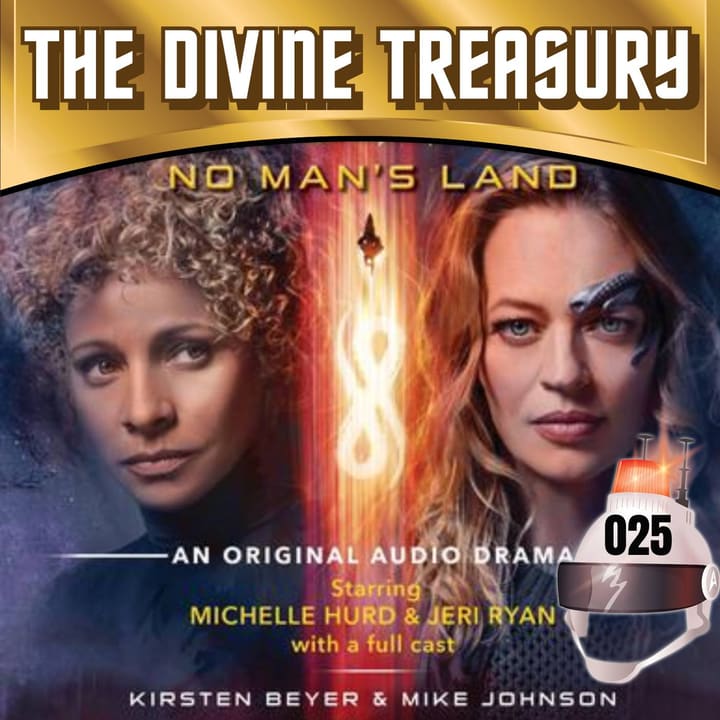
In our 25th episode and our 9th supplemental episode of our series: "The Collector's Corner," we have a special treat. We have the privilege and honor to interview two people who have a large hand in shaping the Live-action and Literary universe of Star Trek. They are Co-Executive Producer of Star Trek: Picard and award-winning Author, Kirsten Beyer and her writing partner and IDW Comics author, Mike Johnson. These two literary heavyweights have teamed up with Simon and Schuster to produce an incredible tie-in audio drama for Star Trek: Picard entitled: "Star Trek: Picard: No Manโs Land."
Join us as we dig into the development of this audio drama including some of the major plot points. We also discuss how these plot points are woven into Season 2 of Star Trek: Picard and the involvement of actresses, Jeri Ryan and Michelle Hurd in this audio project. We also get some insight on other facets of the comic book and audiobook process.
If you would like to be featured on The Divine Treasury, reach out to us on:
- Twitter: @divine_treasury
- Instagram: @divine_treasury
You can also find video of the collections of our guests and reveals of our new items by subscribing to the Trek Geeks Podcast Network on YouTube.
[00:00:00] The Divine Treasure
[00:00:30] is made up your life.
[00:00:33] Hello, and welcome to the Collector's Corner,
[00:00:35] a supplementary edition of The Divine Treasury.
[00:00:38] My name is Mike Bovia.
[00:00:40] And on the Collector's Corner, we get to know the people
[00:00:42] behind the things we like to collect
[00:00:44] or other things in some cases.
[00:00:47] We've talked to licensees, manufacturers,
[00:00:50] we've talked to authors, we've ended
[00:00:52] talked to documentarians.
[00:00:54] As collectors, we love finding out some of the stories
[00:00:57] behind the scenes.
[00:00:59] Like I'm sure you'd all love to know why my co-host has his
[00:01:02] podcast set up by his wall of Star Wars collectibles when
[00:01:06] the rest of the room is Star Trek.
[00:01:08] Inquiring minds, want to know, Jamie Rogers?
[00:01:11] Well, I'm in front of the Star Wars wall because that's
[00:01:14] the smaller wall with the couches.
[00:01:16] If you saw the Star Trek wall,
[00:01:18] you'd know why it's on this wall.
[00:01:20] There's no room for furniture there.
[00:01:23] Well, as mentioned, who we all love behind the scenes
[00:01:27] information.
[00:01:28] And right now, we're in the golden age of Star Trek.
[00:01:31] We have four new series streaming on television.
[00:01:34] We have one that's ready to premiere.
[00:01:36] And we've got a couple more that are in some sort of stages
[00:01:39] of pre-production.
[00:01:41] We're also getting tie-in novels and comic books.
[00:01:44] And now an audio drama.
[00:01:47] So here to discuss that with us are the authors of No Man.
[00:01:52] Land, the audio drama that ties to Star Trek Picard.
[00:01:55] We have Mike Johnson, one of the pre-eminent writers
[00:01:58] of the IDW comic line for Star Trek.
[00:02:01] And Kirsten Byer, the executive producer and co-creator
[00:02:05] of Star Trek Picard.
[00:02:07] Welcome.
[00:02:09] We're so thrilled to have the two of you on.
[00:02:12] Thank you so much.
[00:02:13] It's a pleasure to be here.
[00:02:15] Thank you.
[00:02:16] My only note is you got, you know, Kirsten's name has to come
[00:02:20] first because I'm very much to Robin to her Batman.
[00:02:23] It would be like, I love watching Robin and Batman.
[00:02:28] But that's all I'll say.
[00:02:30] Thank you for having us.
[00:02:32] And I should also note that I'm actually a co-execute producer
[00:02:36] of Star Trek Picard.
[00:02:38] I mean, that's like the promotion, but.
[00:02:40] I was I was trying to keep my words short.
[00:02:43] So I just come to co out of there.
[00:02:46] It matters.
[00:02:47] So, trust me, fellas.
[00:02:48] It matters.
[00:02:49] I'm sure I'm sure it's another zero on the paycheck
[00:02:52] when you go from co to just playing executive.
[00:02:56] But I, you know, Kirsten,
[00:02:58] I want to and Mike obviously I want to say I really enjoyed
[00:03:01] the audio drama obviously.
[00:03:03] And, you know, one of the things I really enjoyed about it
[00:03:06] was the development obviously between Raffi and Seven.
[00:03:09] You know, we see kind of this relationship kind of interwoven
[00:03:14] throughout the entire audio drama.
[00:03:16] And I think that's why I think it's really important
[00:03:19] to see the audience.
[00:03:20] I think it's really important to see the audience
[00:03:22] even saw this relationship kind of hinted
[00:03:25] at the end of season one.
[00:03:27] So who was kind of behind the development of that relationship,
[00:03:30] you know, on the writing staff?
[00:03:32] It was really both the actors and.
[00:03:35] The executive producers and writers Michael Shabon
[00:03:39] and Akivakol's men.
[00:03:41] They were.
[00:03:42] Shepherding those final episodes through production and.
[00:03:45] It sort of happened organically between all of them
[00:03:48] and the actors.
[00:03:50] As, as we were reaching the end of season one that they felt very strongly
[00:03:55] that this was a dynamic they wanted to explore.
[00:04:00] Wow.
[00:04:01] That's awesome.
[00:04:03] So I mean, I know obviously at the end kind of at the end
[00:04:06] of this audio drama,
[00:04:07] we see them kind of splinter apart.
[00:04:10] And then obviously we're going to see what they end up in season two.
[00:04:14] So who's idea was it to kind of have them kind of go their separate ways
[00:04:19] and kind of splinter apart?
[00:04:20] Was that more the two of you when developing this audio drama
[00:04:24] or it is once again, was that kind of developed in the writer's room
[00:04:27] getting ready for season two of a card?
[00:04:29] It was very much the the the tie-ins always follow the lead of the shows themselves.
[00:04:35] So, you know, we're fortunate that when I'm working on one of these projects
[00:04:40] I always am very aware of what directions the shows are going.
[00:04:45] And so we were able to very finely tailor our story to what we knew was going to be coming.
[00:04:52] But I do think it's a little bit more complicated than they're just split apart.
[00:04:57] I think as the story shows,
[00:04:59] they are two people who clearly have an affection for an attachment to one another.
[00:05:03] What they're not sure about is how a relationship between them could possibly work.
[00:05:08] It's thinking of the old friends line we're on a break.
[00:05:11] Maybe that's what applies.
[00:05:13] I cannot believe you just did that Mike because now I'm new thinking about friends.
[00:05:19] It was 12 pages front and back.
[00:05:24] Yeah, yeah.
[00:05:26] So you mentioned, Kirsten, how the tie-ins always are relying on the television product
[00:05:37] that takes center stage and then the tie-ins work off of that.
[00:05:42] So I guess my question is as I look at the tie-ins now with looking at the countdown comics
[00:05:51] that the two of you worked on,
[00:05:53] and this audio drama,
[00:05:55] it almost feels more like these tie-ins are filling in missing pieces for all of us.
[00:06:02] So how,
[00:06:05] I'm trying to figure out how to ask this question the right way.
[00:06:08] How close to the quote unquote cannon are these newer tie-ins?
[00:06:16] Well, like all tie-ins, they're cannon until something, well, they're not cannon,
[00:06:20] but they are as close to cannons they can possibly be until something comes along to contradict them,
[00:06:24] which is always a possibility.
[00:06:26] It's one of those things where we know the job is dangerous when we take it.
[00:06:30] But we do the best we can in the time that we're working to make everything consistent
[00:06:35] and line up with what the shows are going to do.
[00:06:37] But if they happen to go off in another direction subsequently, there's nothing we can do about that.
[00:06:43] Yeah, that's sort of the benefit of having Kirsten on,
[00:06:46] you know, she should plug into the productions.
[00:06:48] Yeah.
[00:06:49] But again, when they start any season of the show,
[00:06:53] everything sort of at the window in terms of what they can, you know,
[00:06:58] they can't suddenly have Vulcan's all have blue skin or something.
[00:07:02] Right. Right.
[00:07:04] When it comes to things that have been established,
[00:07:07] that's why in the Encelerary stuff we really try to not give characters like we don't try to evolve their character,
[00:07:14] the way that we leave that to the show.
[00:07:17] But it's more about diving deeper into where they are, who they are, when we swim less.
[00:07:25] Yeah, I like that because like I look back again going back to countdown.
[00:07:32] I think of how we saw the introduction of Larus and Jiban and that.
[00:07:36] And then they were part of the show.
[00:07:39] And now we've got this where we're seeing how seven and Rafi have kind of taken this relationship to a different level in audio drama.
[00:07:58] And then decide, like you said, Kirsten it's not necessarily a separation in some ways,
[00:08:04] it's more of, you know, if we want to do this, we're going to have to figure out some way to make it work.
[00:08:10] And you see that then in episode, at least in the first three episodes that Jamie and I have seen of Picard,
[00:08:19] how that is worked into the story as well.
[00:08:23] Yes.
[00:08:25] So where did the decision come from to go in the direction of an audio drama for this versus just doing either a comic book or a novel for it?
[00:08:40] That was Simon and Schuster.
[00:08:42] They reached out to me actually like three years ago, and said that they wanted to move into the audio drama format.
[00:08:48] And they really wanted Picard to be their first offering.
[00:08:51] And so we started talking a long time ago about the kind of story that would make sense to bridge seasons one and two.
[00:09:01] And that would serve the Picard characters and Picard universe the best.
[00:09:07] That's neat.
[00:09:09] I mean, that kind of leads me into my next question.
[00:09:11] And so is this is audio drama that medium? Is this going to be something we can expect going forward with some of the newer series that are coming out?
[00:09:20] You know, perhaps even you know season two and three of Picard maybe as is something we can expect.
[00:09:29] I think that's what they might do on the show.
[00:09:32] Yeah, I hope so.
[00:09:33] Yeah, I think so.
[00:09:34] I think hopefully this is like proof of concept that there's an audience that's receptive to these and I think given me a lot of characteristics on TV right now.
[00:09:42] I think it opens the door to all possibility of all kinds of stories being told with not only main characters like seven or happy but even smaller supporting characters.
[00:09:52] So I think we've got really good response to great response to this.
[00:09:56] And I think it's showing that especially things are hungry for a structured stories where and however they can get them.
[00:10:03] Yeah, we're always hungry.
[00:10:06] And I like what you brought out there Mike about, you know, it doesn't necessarily have to be the main characters.
[00:10:12] I mean, that's always something that I've loved about the literary universe of Star Trek is that you know it's always been that there was either a minor character or you know something that someone mentioned in a sentence in one episode.
[00:10:30] And then an author is able to take and develop a whole storyline based off of that one sentence.
[00:10:37] So I mean, that's awesome. That's the kind of thing I love from the literary universe so I'm looking forward to stuff like that.
[00:10:45] Yeah, I just you know, I love once again, I really like the story. I like the development and you know it's cool having it's not just an audio book where all you're hearing is people reading.
[00:10:57] You're actually hearing special effect, you know, you're hearing sound effects and it just it kind of definitely brings the story to life where you can kind of almost picture it in front of you.
[00:11:08] So obviously I'm so interested in the whole process, you know, thinking of was it a situation where you got Michelle heard and Jerry Ryan signed on first and then you developed the story around them or was it kind of like vice versa.
[00:11:24] So I thought we'd develop the story and then he then went to go get them after what which kind of came first in the process.
[00:11:31] We developed the story first and we wrote up an outline laying it out in great detail.
[00:11:40] And once that was approved by Simon issues during CBS, they reached out to Jerry and Michelle to find out if they would be interested in doing it.
[00:11:48] So that was confirmed we were set to start writing script.
[00:11:52] Nice, nice.
[00:11:55] All right, so Jamie's real interested in the audio book process and I think that's it's really cool.
[00:12:03] I mean, the production value on this was top notch.
[00:12:08] Yeah, they did a great job.
[00:12:10] Yeah, I mean, I felt like like Jamie said I was able to visualize the whole thing as we're going forward.
[00:12:20] The last couple of weeks I've been doing a lot of driving and this was just something nice to be able to be different from the audio books because of the feeling that's put into it by the actors.
[00:12:35] I'm interested to know about the comic book process because the two of you again work together on the card countdown series.
[00:12:43] So process on a comic book, especially a series like that.
[00:12:50] I'm assuming that you are writing out your whole story first and then figuring out where the breaks go for the individual issues. Is that right?
[00:13:03] Yeah, that's actually kind of the ideal is that you would have the whole story plotted.
[00:13:08] But sometimes more so on a continuing series, you're kind of you have an overall idea where you're going but the specifics of what happens on each page.
[00:13:17] You figure out if you write each issue, but the actual sort of storytelling process wasn't that different between the audio books and the comics.
[00:13:26] You know, two or nine just stick together and talk out the story. And we just get on phone and hit the story ball back and forth and come up with things that make us excited because I've found that the sheriff's way to energy your fans in this year entertained and can't wait to tell the story.
[00:13:44] And that energy will translate into the work.
[00:13:48] So and then a system matter of, you know, the biggest difference is when you're writing a comic script, you're describing what's happening in each panel for the artist to draw it.
[00:13:58] And in the audio books, you have to forget all of that because you don't have any visual cues.
[00:14:03] So you substitute that with what the sound effects would be.
[00:14:08] So we figured out given seeing what are all the possible sound effects that can be happening.
[00:14:15] And then the ultimate benefit of an audio book that you have music, which I wish comics had like when you open it, like one of those greeting cards just like me.
[00:14:27] They're going to be open up but that technology's way beyond what we have right now.
[00:14:33] So yeah, that was it was just a really cool.
[00:14:38] Well, different, different process coming from the comic.
[00:14:44] Now do you guys almost have to like, you know, I know storyboards are used quite substantially and cartoons and movies is it's almost like you have to storyboard it to kind of like visually see where you're going next sometimes and how the action's going to be or is that not even really part of the process in the connection and audio book.
[00:15:06] Well, I guess I guess both.
[00:15:09] I mean, I would assume in the comics but what about with the audio drama?
[00:15:14] These specific Jamie.
[00:15:16] Yeah, I know.
[00:15:18] I think it's kind of the same.
[00:15:21] I mean, I don't do comics.
[00:15:25] We don't really thumbnail or anything.
[00:15:27] I mean, you do describe the X or like.
[00:15:31] In the comic script, you would say this is a wide shot. This is a medium shot.
[00:15:35] This is our POV over the someone's shoulder is sort of describing the camera right?
[00:15:40] You don't have a camera in the audio drama so it's much more.
[00:15:47] At its dialogue is pairing the story.
[00:15:51] You know, the character walks across the room and sits down in the lazy boy.
[00:15:58] Like that's kind of hard to you don't see it right so you just sort of run and puts that something whatever the ladyboy sound like.
[00:16:06] And so you sort of have to completely switch your toolbox for that but.
[00:16:13] But I did find that when we were working on the script, you know, we got super specific with the soundscapes.
[00:16:18] So we tried to sort of close our eyes and imagine everything that you could hear, you know, in a desert night or a board a specific ship.
[00:16:28] The differences in what the comm signals might sound like depending on who's talking to whom.
[00:16:33] Starfleet communications are probably going to be more clear than fenners ranger communications for example.
[00:16:38] And then we also had in mind not the specific music but that there would be themes that would repeat and evolve musically throughout the piece.
[00:16:48] And so we had in the scripts, you know what kind of sound cues we were looking for.
[00:16:57] And there were a lot of places in this one where it was real, it was I don't know how you.
[00:17:02] How you say this but it was you know music coming from a real source as opposed to scoring so those cues also had to be very specific in terms of the style that we were looking for.
[00:17:14] You know that's interesting because I, you know we're talking about how there's so much that's offered within the audio drama.
[00:17:24] And you don't even always think of the work that goes into it, you kind of take it for granted like I just I sat there and I was like oh yeah that's really nice that you can hear.
[00:17:36] Like you said the desert night as there as they're there having their conversation you don't think about what needs to go into that for that to happen.
[00:17:44] Yeah, it was intense.
[00:17:47] Yeah so and that kind of leads me to the question of like how long does it take you from start to finish to do an audio drama like like from from day one concept.
[00:17:59] How long is that process take.
[00:18:03] Well some of that is determined by other realities that get that come in the middle of like contract negotiations and release schedules and when everybody is available to do a thing.
[00:18:15] So just in terms of our part of it, the writing of it we probably spent a good three months developing the story in the outline and then we had a nice long break and then we probably spent another three months working on the script.
[00:18:29] So both of you come from a writing background both within the comic world in the novel world.
[00:18:38] Is it different in a case like this for the audio drama or even Kirsten for writing a television show, a different process when it comes to scripting it versus just the story itself and the narration behind it.
[00:18:57] Well each form has its own.
[00:19:00] Go ahead, Mike.
[00:19:03] I just can say each form has its own specific set of tools that you have available right so in a novel, you're going to have the ability to go deep inside deep inside character sets and talk about what they're thinking and how they're feeling and not just what they say.
[00:19:24] In a teleplay you're constantly focused on what are we seeing.
[00:19:30] You're not directing but you are creating point of view in a very specific way and, you know trying to lead the audience and the readers through that so that they understand how that story is going to look and feel very specifically.
[00:19:49] The audio drama all you have is what you hear so Mike and I, you know looked for every single possible thing that could come out of that that would help us be clear about where these characters were at and and what was happening between them knowing that there were a lot of times where, you know on screen, a simple look between two people can convey a ton of information but we had no ability to do that.
[00:20:16] So without getting too expository we still had to find ways through dialogue and sound to help the audience ground themselves in the world and where the characters specifically work.
[00:20:31] That cover all of what you had to say Mike.
[00:20:35] And much better than I can express it.
[00:20:40] Is that why you're her Robin.
[00:20:43] Like Robin I just stand there while Batman be put the villains going yeah.
[00:20:50] That could not be further.
[00:20:53] That's funny.
[00:20:56] Well, I know I can I can tell you Kirsten from talking with some of our listeners on the network that you are a hero to a lot of people because you finally you finally put well.
[00:21:10] Wait a minute don't be all happy just yet let me tell you why fabulous.
[00:21:16] I know because because you finally put Jane way and Chacote together in the novel series.
[00:21:25] I did.
[00:21:26] I can't tell you how many people tell me all the time oh, in the novels they're together, you know for me that's that's real life and I thought it was kind of interesting how
[00:21:37] I was like that was hinted a little bit in the beginning of this audio drama when seven and Rafi were talking about past relationships.
[00:21:47] Seven said yeah, there was something before but nothing came of it.
[00:21:52] I mean, you know, you will have to forgive me for if I feel that I can and it's appropriate reinforcing stuff that has been created elsewhere.
[00:22:04] I'm always showing up the shows and you know but in this case and I think Mike and I find places to do this in the comics as well.
[00:22:13] There is a version of this universe that exists outside of that that has its own history and you know it.
[00:22:23] It did not feel inappropriate or that it would contradict anything to to to go ahead and drop that in yeah I guess also.
[00:22:33] Absolutely.
[00:22:35] And I didn't name names or anything I mean for people who didn't read the books they're not going to have any idea we're talking about but that's almost better storytelling because you kind of leave it to the imagination of the people that you know want it to be Janeway and Chacote they think it's seven and Chacote yeah, like a you leave that's like to me the best form it's like
[00:22:56] they leave it open to interpretation and think what they want to think right yeah.
[00:23:01] So you know I'm going to ask this question you know, Kirsten to you specifically do we have any more novels on the horizon out of you or are you kind of now down this path of pretty much.
[00:23:14] You know doing that the television series stuff and kind of getting away from that well my publishers and editors have been very kind to me both in a way.
[00:23:25] And to me both in allowing me to finish the two novels I was contracted you after I started working on the shows.
[00:23:32] And in letting me know that if I ever want to do it again I can and I would never ever say never the challenge right now is the amount of time and energy it takes to write a novel.
[00:23:42] And the number of hours that there are in the day because my regular day job is.
[00:23:48] Kirsten here very busy so you know it's such to have projects announced and then to ask people to wait two two and a half years for them I was very conscious of the fact that
[00:24:00] that was frustrating for folks and I don't want to put people in that position again but I wouldn't say never I just don't know at this moment in time when that might be happening.
[00:24:11] I'm sure I speak for other people when I say I'm glad you are where you are.
[00:24:17] You really add a tremendous amount to the producers that make these shows I mean you guys are putting out wonderful content.
[00:24:29] I'm excited to be able to watch it and view it and listen to it.
[00:24:35] I'm going to be a part of this golden age that you are a huge instrument.
[00:24:41] Well that's very gratifying it's nice to hear when people enjoy what you're doing it's really really great.
[00:24:46] Dayton Ward and David Max speak highly of you you don't have to echo this you don't have to echo the same sediment don't worry about that.
[00:24:54] I would not hesitate to echo the same sentiment they are two of my dearest friends we have been in the trenches together for decades and I could not adore them more.
[00:25:06] I'm very fortunate that I consider them and I think they consider me creative partners.
[00:25:13] Oh yeah oh yeah.
[00:25:15] They've got their fingers in the franchise you know in the shows as well.
[00:25:21] David is advised on strategic strategy and Dayton playing a key role in making sure every part of track is talking to the other and that things are really cohesive when it comes to the canon.
[00:25:36] Yeah I talked to Dave I guess it's like two maybe three years ago now and he was telling me you are not going to believe what comes out of prodigy you're just going to be shocked and most certainly.
[00:25:53] No he was not he was not so really great.
[00:25:58] Yeah I get to and the thing I like about it is I get to do a show with my daughter about it.
[00:26:07] Yeah.
[00:26:09] Which she enjoys so I mean I am she's going to be 13 next month.
[00:26:16] But she's been podcasting now for well only four years so wow.
[00:26:24] She started early she met the two guys that started the network that were on and fell in love with the thought of it.
[00:26:34] So you know her and I just kind of started up with something small and now she covers prodigy for this network.
[00:26:42] That's fantastic.
[00:26:43] Oh I got to check it out that's so cool.
[00:26:46] It's discovering Trek and Jamie and his son were on one of our episodes too.
[00:26:53] And it's always an opportunity.
[00:26:55] Your son my son is 12.
[00:26:58] But I was going to say that I'm watching your kids talking about Trek.
[00:27:02] That's the best.
[00:27:03] Yeah and being you know being enthusiastic about it too you know and you know it's always an opportunity for her to make fun of her father too on.
[00:27:12] Oh God she doesn't always have that for her but any other time.
[00:27:16] Yeah she lays it on thick.
[00:27:18] Oh yeah oh yeah she's she certainly once she gets behind that microphone she's got no problem given it to her old man for that's for sure.
[00:27:32] So we've heard we've heard about the Kiersten's future with television it seems Mike do you have upcoming projects I know you're you're on the team for discovery in the 32nd century now and at IDW right.
[00:27:48] Yeah the first issue is dropped today focuses on grudge the cat told from the point of view so it's in comics now.
[00:27:56] And future issues each one focuses on a different character so the next one will be a beer and then that more and then Linus.
[00:28:04] So that's a lot of fun.
[00:28:07] And then on the actually the most of my days are taking up working on the Star Trek games on the different video games that are out in the production.
[00:28:16] Oh wow really?
[00:28:17] Oh I wish I could talk about that.
[00:28:22] I was going to say it sounds like we're going to have to be in contact with you again.
[00:28:28] It's some point to discuss that happy to come on and nerd out about games.
[00:28:34] Oh yeah oh yeah that's that's that's right in our wheelhouse on this show anyway.
[00:28:41] So it's Star Trek Picard No Man's Land.
[00:28:46] It's available wherever you purchase audio books and it is also available on the physical media as well you can purchase it on CD.
[00:28:56] Kiersten Mike thank you so much for joining us this has been a blast all kinds of fun.
[00:29:04] Thank you for having us.
[00:29:06] That's and I look forward so much to the work that you're going to continue to put out.
[00:29:11] So yeah please keep working.
[00:29:16] Thanks so much from your word from your luck to all the God's ears.
[00:29:22] Exactly.
[00:29:24] Is there a product or collecting service you'd like to hear featured on the collector's corner or maybe even in this case an author or producers of television shows.
[00:29:35] Message us at divine underscore treasury on Twitter and let us know until next time you've been listening to the collector's corner part of the divine treasury on the Trek Geeks podcast network.
[00:29:49] The divine treasury connecting through collecting.
[00:30:02] Music for the divine treasury is provided by five year mission.
[00:30:06] They're writing an original song for each episode of Star Trek.
[00:30:09] Hear more of their music at 5yearmission.net.
[00:30:12] The divine treasury is a production of coconut media works executive producers Bill Smith and Dan Davidson.
[00:30:18] For more great Star Trek discussion, discover the other shows of the Trek Geeks podcast network at trekgeeks.com
[00:30:25] or find us an Apple podcast Spotify or your favorite podcast app.
[00:30:32] Music for the divine treasury on the Trek Geeks podcast network.